

NCERT Class 9 Maths Ganita Manjari Chapter 7 Solutions – Introduction to Probability

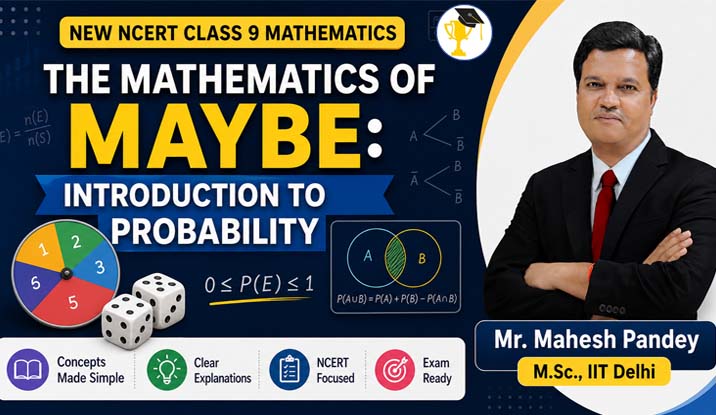
NCERT Class 9 Maths Ganita Manjari Chapter 7 Solutions: The Mathematics of Maybe: Introduction to Probability

Probability is a fascinating branch of mathematics that helps us understand uncertainty and chance in real life. In NCERT Class 9 Maths Ganita Manjari Chapter 7 – “The Mathematics of Maybe”, students learn how to measure and interpret the likelihood of events.

Whether it's predicting rain, winning a match, or being selected in a lucky draw—probability helps us make sense of such uncertain situations.


7.1 What is Probability?

Probability is a type of measurement, just like length, area, or volume. However, instead of measuring physical quantities, it measures the likelihood (chance) of an event occurring.

It helps us answer questions like:

  • Will it rain today?
  • Will our school win the hockey match?
  • Will I be selected in a lucky draw?

These are called random events.

We know the possible outcomes, but we cannot predict the exact result in advance. This uncertainty is what probability deals with.

NCERT Class 9 Maths Ganita Manjari Chapter 7 Solutions: Download Now
Exercise Set 7.1 (Page 1 - 2)
Exercise Set 7.2 (Page 2 - 6)


7.1.1 What is Randomness?

Randomness refers to situations where outcomes cannot be predicted with certainty.

Examples:

  • Tossing a coin
  • Rolling a dice
  • Picking a random name

Even though all possible outcomes are known, the exact result is uncertain.


7.1.2 The Probability Scale

Probability is measured on a scale from 0 to 1.

0≤P(E)≤10 \leq P(E) \leq 10≤P(E)≤1

Interpretation:

  • 0 → Impossible Event
  • 1 → Certain Event
  • Between 0 and 1 → Likely Event

Example:
If probability = 0.75 → There is a 75% chance the event will occur.


Probability Formula

P(E)=Number of favourable outcomesTotal number of outcomesP(E) = \frac{\text{Number of favourable outcomes}}{\text{Total number of outcomes}}P(E)=Total number of outcomesNumber of favourable outcomes?


7.2 Measuring Probability Objectively

Probability can be measured using two main approaches:


7.2.1 Experimental Probability

This is based on actual experiments or observations.

P(E)=Number of times event occursTotal number of trialsP(E) = \frac{\text{Number of times event occurs}}{\text{Total number of trials}}P(E)=Total number of trialsNumber of times event occurs?

Example:
If a coin is tossed 10 times and head appears 6 times:
Probability of head = 6/10 = 0.6


7.2.2 Theoretical Probability

This is based on logical reasoning and all possible outcomes, without performing experiments.

Example:

  • Probability of head in a fair coin = 1/2

7.2.3 Analysing Statistical Data Using Probability

Probability helps in analyzing real-world data, such as:

  • Weather reports
  • Sports statistics
  • Market trends

7.3 Elements of Probability: Sample Space and Events

Sample Space

The set of all possible outcomes is called the sample space.

Example:
Coin toss → {Head, Tail}


7.3.2 Events

An event is a subset of the sample space.

Example:
Getting a head → Event


7.4 Tree Diagrams

Tree diagrams help us visualize all possible outcomes in a step-by-step way.

Example:

Two coin tosses:

  • HH
  • HT
  • TH
  • TT

Total outcomes = 4

Tree diagrams are very useful in solving complex probability problems.


Solved Examples

Example 1: Coin Toss

Probability of getting Head:

  • Total outcomes = 2
  • Favorable outcomes = 1

Answer = 1/2


Example 2: Dice Roll

Probability of even number:

  • Even numbers = {2, 4, 6}
  • Total outcomes = 6

Answer = 3/6 = 1/2


Example 3: Card Selection

Probability of red card:

  • Red cards = 26
  • Total cards = 52

 Answer = 1/2


NCERT Exercise Solutions (Sample)

Q1. Classify events:

Event Type
Sun rises in the East Sure
Getting 8 on dice Impossible
Rain tomorrow Likely

Q2. Probability of Tail

Answer = 1/2


Q3. Number less than 3 on dice

Answer = 2/6 = 1/3


Real-Life Applications

Probability is used in:

  • Weather forecasting
  • Data analysis
  • Games & sports
  • Stock market
  • AI & Machine Learning

Important Tips

? Understand randomness clearly
? Always write sample space
? Practice numerical questions
? Revise formulas regularly


Exam Strategy

  • Focus on NCERT questions
  • Practice examples daily
  • Use tree diagrams for clarity
  • Avoid calculation mistakes

Frequently Asked Questions (FAQs)

It is the measure of chance of an event.
It means unpredictability of outcomes.
All possible outcomes of an experiment.

Recent Posts

Smart Achievers JEE Crash Course 2026

Smartachivers

Mar 02,2026

Why Parents Trust Smart Achievers

Smartachivers

Mar 02,2026

Can I Crack JEE Without Coaching?

Smartachivers

Mar 02,2026

Dropper Study Plan for NEET 2026

Smartachivers

Mar 02,2026

Mental Preparation for NEET

Smartachivers

Feb 27,2026