

Class 9 Science Cell: The Building Block of Life – NCERT Solutions | Complete Guide

Class 9 Science Cell: The Building Block of Life – NCERT Solutions

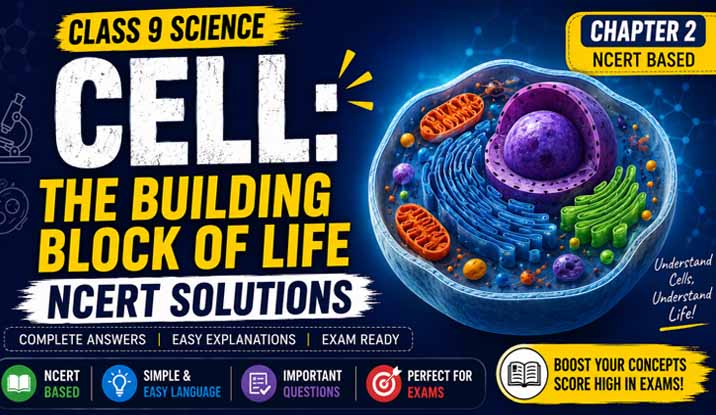
The cell is known as the basic structural and functional unit of life. Every living organism, from tiny bacteria to human beings, is made up of cells. In Class 9 Science Chapter – Cell: The Building Block of Life, students learn about cell structure, functions, organelles, and the differences between plant and animal cells.

This chapter is one of the most important biology chapters because it forms the base for advanced topics in higher classes.


Discovery of the Cell

The discovery of the cell marked a major advancement in biology.

  • Robert Hooke (1665) discovered cells while observing cork under a microscope.
  • Anton van Leeuwenhoek observed living cells.
  • Robert Brown discovered the nucleus.
  • Schleiden and Schwann proposed the cell theory.

NCERT Class 9 Science Chapter 2 Solutions: Download Now


What is a Cell?

A cell is the smallest living unit capable of performing all life activities.

Examples:

  • Amoeba → Single-celled organism
  • Human body → Multi-cellular organism

Cells help organisms:

  • Grow
  • Respire
  • Reproduce
  • Respond to surroundings

Cell Theory

The cell theory states:

  1. All living organisms are made up of cells
  2. Cells are the basic unit of life
  3. New cells arise from pre-existing cells

Types of Cells

Prokaryotic Cells

  • Simple structure
  • No true nucleus
  • Example: Bacteria

Eukaryotic Cells

  • Well-defined nucleus
  • Complex structure
  • Example: Plant and animal cells

Structure of a Cell

The cell consists of three major parts:


1. Cell Membrane

  • Protective outer layer
  • Controls movement of substances
  • Selectively permeable membrane

2. Cytoplasm

  • Jelly-like material inside cell
  • Contains organelles

3. Nucleus

  • Controls cell activities
  • Contains DNA and chromosomes


Important Cell Organelles

Mitochondria

Known as the powerhouse of the cell because it produces energy.


Endoplasmic Reticulum (ER)

Helps in transportation of materials inside the cell.


Golgi Apparatus

Packages and secretes substances.


Ribosomes

Responsible for protein synthesis.


Lysosomes

Contain digestive enzymes and help in waste breakdown.


Diffusion and Osmosis

Diffusion

Movement of particles from higher concentration to lower concentration.


Osmosis

Movement of water molecules through a semi-permeable membrane.


NCERT Solutions (Important Questions)

Q1. Why is the cell called the structural and functional unit of life?

Because all living organisms are made up of cells and all life processes occur inside cells.


Q2. Who discovered the cell?

Robert Hooke discovered the cell in 1665.


Q3. What is the function of the nucleus?

The nucleus controls all activities of the cell and contains genetic material.


Q4. Name the powerhouse of the cell.

Mitochondria


Q5. What is osmosis?

Osmosis is the movement of water through a semi-permeable membrane from higher water concentration to lower water concentration.


Important Diagrams to Practice

Students should practice:

  • Plant cell diagram
  • Animal cell diagram
  • Nucleus structure
  • Osmosis experiment

Diagrams are very important for scoring high marks in exams.


Important Exam Tips

Learn definitions properly
Practice diagrams daily
Revise organelle functions
Understand plant vs animal cell differences
Solve NCERT questions regularly


Real-Life Importance of Cells

Cells are important in:

  • Medicine
  • Biotechnology
  • Genetics
  • Human health research
  • Agriculture

Understanding cells helps scientists study diseases and develop treatments.

NCERT Class 9 Science Chapter 2 Solutions: Download Now

Frequently Asked Questions (FAQs)

A cell is the basic structural and functional unit of life.
Robert Brown
It controls the movement of substances in and out of the cell.
Mitochondria
Plant cells have cell wall and chloroplast, while animal cells do not.

Recent Posts

Smart Achievers JEE Crash Course 2026

Smartachivers

Mar 02,2026

Why Parents Trust Smart Achievers

Smartachivers

Mar 02,2026

Can I Crack JEE Without Coaching?

Smartachivers

Mar 02,2026

Dropper Study Plan for NEET 2026

Smartachivers

Mar 02,2026