
What is the expected cut-off for JEE Advanced 2026?
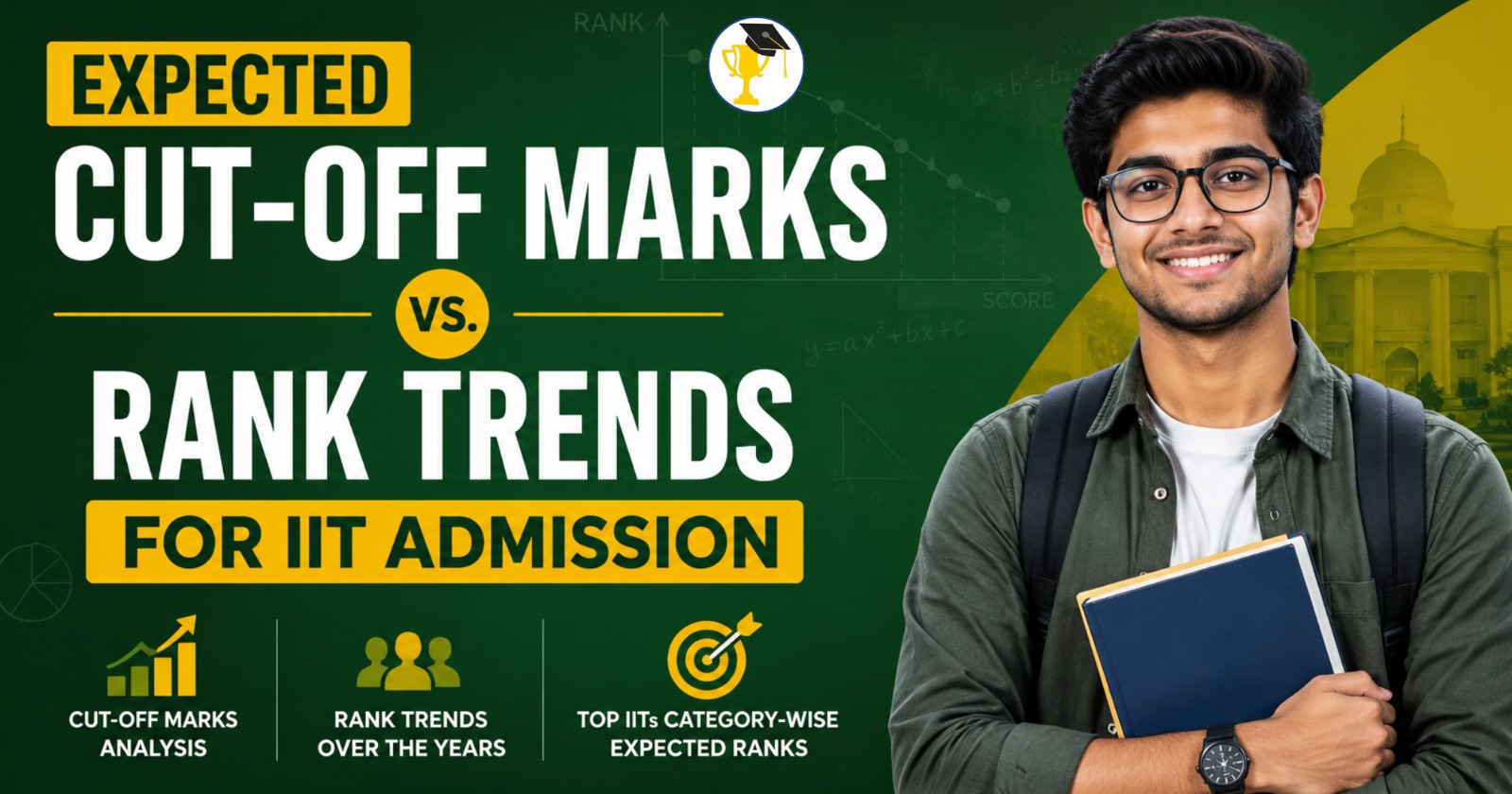
The expected qualifying cut-off for the Common Rank List (CRL) is predicted to hover between 90 and 105 marks out of the total aggregate score. This estimation is based on initial post-exam difficulty feedback across both papers and historical trends from previous evaluation cycles.
To give you a clearer picture of how this impacts different categories, the expected minimum qualifying scores (the absolute baseline required to find a place on the rank list) are structured below:
Expected Minimum Qualifying Marks Matrix:
| Category | Reservation Quota | Minimum Subject Cut-off | Minimum Aggregate Cut-off | Estimated Score Range |
| Common Rank List (CRL) | 40.5% | 10% | 35% | 90 - 105 Marks |
| OBC-NCL | 27.0% | 9% | 31.5% | 80 - 90 Marks |
| SC | 15.0% | 5% | 17.5% | 45 - 55 Marks |
| GEN-EWS | 10.0% | 9% | 31.5% | 80 - 90 Marks |
| ST | 7.5% | 5% | 17.5% | 45 - 55 Marks |
| PwD (Horizontal) | 5.0% (within category) | 5% | 17.5% | Lower Bound Minimums |
How does the 2026 difficulty level compare to previous years?
The 2026 paper layout followed a moderate-to-difficult trajectory, showing a notable jump in complexity compared to the highly scoring papers of some previous years. This shifts the marks vs. rank dynamics, allowing students to land better All India Ranks (AIR) at slightly lower raw scores.
Mathematics: This section emerged as the primary filter. Both papers featured lengthy, calculation-heavy questions rooted in advanced calculus, coordinate geometry, and complex vectors that consumed significant time.
Physics: This paper focused on deep conceptual understanding rather than simple formula application. Questions in electrodynamics, thermodynamics, and fluid mechanics required multiple steps to decode, making it tougher than last year.
Chemistry: This was the most balanced section but featured intricate organic reaction mechanisms and tricky numerical values in physical chemistry.
Because the papers tested endurance and accuracy under time pressure, the overall marks-to-rank ratio is expected to be more forgiving for students who avoided heavy negative marking.
What structural factors determine the final IIT cut-offs?
The opening and closing ranks for IIT admissions do not rely solely on how hard the paper was. The Joint Seat Allocation Authority (JoSAA) manages seat allotment through a highly regulated framework governed by three core variables:
1. The Expanding Candidate Pool
While over 15.3 lakh students took JEE Main this year, IIT Roorkee filters only the top 2,50,000 successful candidates to sit for JEE Advanced. As competition intensifies, the filtering percentile in JEE Main rises, bringing an incredibly sharp pool of students into the final exam and keeping the competition at the top intense.
2. The JoSAA Seat Matrix
The total seat pool across all 23 IITs is expected to stay at approximately 18,160 seats. While older, established IITs (like Bombay, Delhi, and Madras) keep their intakes stable, newer campuses have introduced specialized programs in Artificial Intelligence, Data Science, and Semiconductor Engineering, slightly easing the closing ranks for circuital branches.
3. Strict Category Distributions
Admissions follow the national reservation policy down to individual seats. This distribution creates distinct cut-off ecosystems within the JoSAA framework:
[Total IIT Seats Available: ~18,160]
OPEN (Unreserved): 40.5%
OBC-NCL: 27.0%
Scheduled Caste (SC): 15.0%
GEN-EWS: 10.0%
Scheduled Tribe (ST): 7.5%
(Note: A 5% horizontal reservation for Persons with Disability (PwD) is applied within each of these five parent buckets. Additional Female Supernumerary seats are also added to improve gender diversity across campuses).
How can you track your score before the final ranks drop?
To ensure total accuracy, keep a close eye on the official evaluation dates announced by IIT Roorkee:
May 21, 2026 (17:00 IST): Candidate Response Sheets go live. Log onto the portal to download your marked answers.
May 25, 2026 (10:00 IST): The Provisional Answer Key drops, opening the official challenge window.
June 1, 2026 (10:00 IST): The Final Answer Key and Ranks are released simultaneously.
Once you have your response sheet on May 21, calculate your score by tracking full and partial marks across multiple-correct questions. Be sure to account for negative marking penalties. Keeping your structural documentation ready for JoSAA counselling on June 2 will put you in the best position to secure your desired branch.
Smartachivers
May 21,2026
Smartachivers
May 21,2026
Smartachivers
May 21,2026
Smartachivers
May 20,2026
Smartachivers
May 20,2026
Smartachivers
May 21,2026
Smartachivers
May 17,2026
Smartachivers
May 17,2026
Smartachivers
May 17,2026
Smartachivers
May 17,2026
Smartachivers
May 17,2026
Smartachivers
May 17,2026
Smartachivers
May 17,2026
Smartachivers
May 16,2026
Smartachivers
May 19,2026
Smartachivers
May 19,2026
Smartachivers
May 19,2026
Smartachivers
May 19,2026
Smartachivers
May 19,2026
Smartachivers
May 19,2026