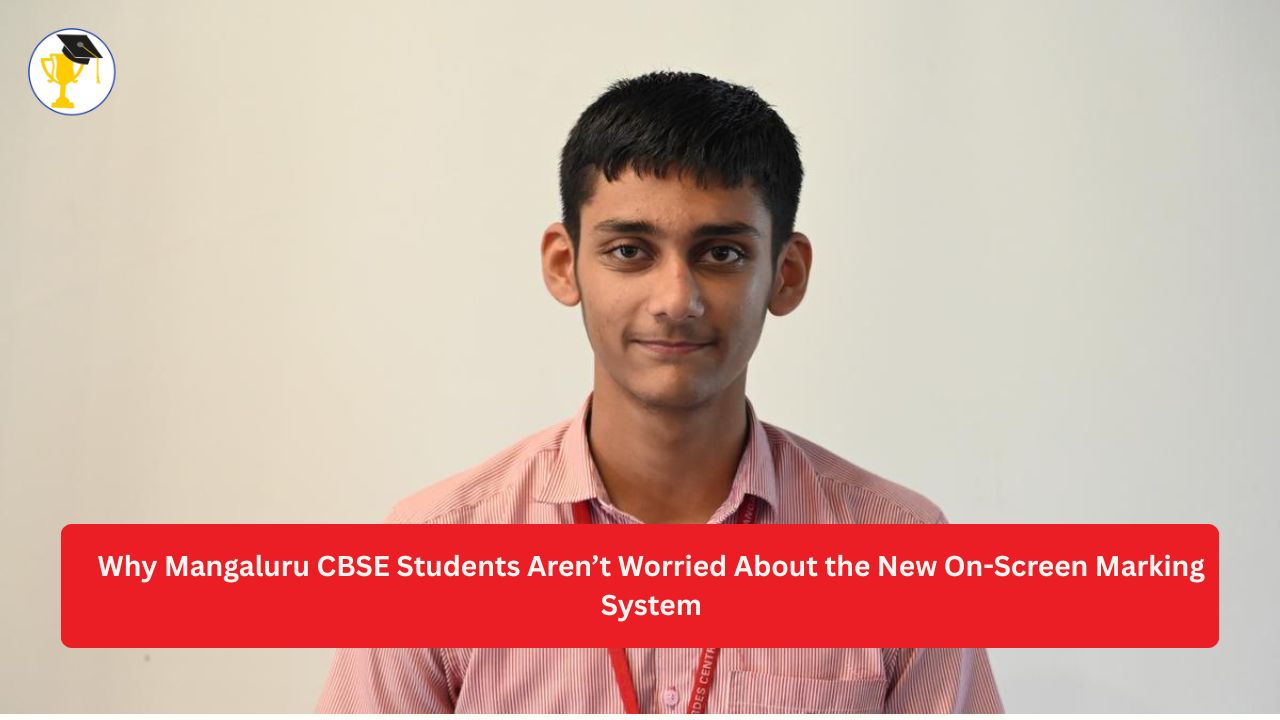
Why Mangaluru CBSE Students Aren’t Worried About the New On-Screen Marking System
As a wave of severe score anxiety sweeps across the nation following the release of the CBSE Class 12 board results, coastal Karnataka is telling a remarkably different story. While student forums and social media networks nationwide are filled with panic over low scores and technical glitches in the newly implemented digital grading system, schools in Mangaluru have anchored themselves as pillars of academic resilience.
Major institutions across the region—including Kendriya Vidyalaya (KV) 1 and 2, PM Shri Jawahar Navodaya Vidyalaya (JNV) at Mudipu, and multiple premier private CBSE schools—have registered an incredible 100% pass percentage. Though the highly demanding Physics and Mathematics papers did suppress the exceptionally high percentages some students anticipated, the region has completely bucked the national trend of hostility toward the board's new digital evaluation system. Not a single Class 12 student from Mangaluru has cited the controversial On-Screen Marking (OSM) platform as a reason for securing fewer marks.
The Local Triumph: Breaking Down Mangaluru’s 100% Success Rate
The uniform excellence displayed by Mangaluru's academic institutions proves that robust preparation can cushion students even against national drops in top-tier board scores.
Institutional Performance at a Glance
| School Name |
Overall Pass Rate |
Performance Highlights |
| Kendriya Vidyalaya-1, Panambur |
100% |
80% of the batch secured above 75% marks; one student crossed the 90% threshold. |
| Kendriya Vidyalaya-2, Yekkur |
100% |
Perfect pass record across the entire Class 12 cohort. |
| PM Shri Jawahar Navodaya Vidyalaya, Mudipu |
100% |
70% of students scored 75% and above, while the remaining 30% secured between 60% and 75%. |
| Lourdes Central School |
100% |
Out of 89 successful students, 46 crossed the 75% mark. Ojas Samaga emerged as the school topper with an elite 97.2%. |
| St. Aloysius Gonzaga School |
100% |
23 students scored between 65% and 85%. Ishaan Pai topped the school with 95.6%. |
| Sharada Vidyanikethana Public School, Talapady |
100% |
T. Shraval Naik topped the institution with a stellar 95.8%. |
| Mount Carmel Central School |
100% |
All 17 candidates cleared the hurdle, led by N. Deeksha with 94.2%. |
Tough STEM Papers, Not Digital Checking, To Blame For Score Dips
Educators across Mangaluru readily acknowledge that a section of students experienced a disconnect between their expected scores and their actual marksheets. However, local faculty are quick to clarify that the responsibility lies entirely with paper difficulty, rather than structural flaws in how the papers were corrected.
According to Ashok Kumar Prasad, a senior Post-Graduate Teacher at KV-1 Panambur, the nationwide drop in Science stream averages was directly influenced by exceptionally rigorous testing. “Physics and mathematics papers were tough, and students have secured less marks in them. But all the 40 students of our school have passed,” Prasad noted.
Reinforcing this view, P. Rajesh, Principal of PM Shri JNV Mudipu, pointed out a regional disparity in question difficulty, stating that the question papers set for local Class 12 students were notably tougher when contrasted with the test sets distributed to candidates in the neighboring Kerala region.
Inside the OSM Digital System: Evaluators Deconstruct the Process
The 2026 academic cycle marked the historic, full-scale implementation of the On-Screen Marking (OSM) system for Class 12 evaluation across India, a process where teachers grade high-resolution scanned copies of physical answer scripts directly on computer screens.
While social media has been flooded with accusations that the digital system led to erratic marking, local education administrators who were directly involved in the central evaluation rooms paint a much more balanced picture.
Addressing Technical Glitches Methodically
C.K. Manjunath, the Director of Academics and Training for the Udupi Shree Adamaru Matha Education Council, actively participated in the evaluation of this year's Class 12 scripts. He identified that the only notable operational friction point was the occasional absence of clean, high-contrast scanned images on the screen, which made a few dense or lightly written answers difficult for evaluators to read initially.
However, rather than rushing the grading or penalizing the candidates, the board followed a strict safety protocol. "In such cases, answer sheets were referred to evaluators in centres that had good answer sheet scanners, and papers were evaluated," Manjunath explained. He further reassured families that the CBSE is actively recording these minor operational flaws to optimize scanning hardware for upcoming cycles.
A System Built for Speed and Fairness
Far from damaging student prospects, regional leaders argue that the digital migration has modernized the educational framework. Principal P. Rajesh stated that the OSM architecture significantly expedited the overall evaluation timeline without introducing bias or negatively affecting student outcomes.
How Mangaluru Students Prepared Differently
Why did Mangaluru students navigate this transition so smoothly compared to the rest of the country? The secret lies in tactical classroom training.
B.G. Vinayak, the Principal of Sharada Vidyanikethana Public School, revealed that their academic strategy explicitly accounted for digital graders. Local faculty specifically trained their students to highlight core definitions, structural formula blocks, and critical keywords within their handwritten answers. Because the OSM screen display can compress subtle handwriting variations, this emphasis on visual formatting ensured that digital evaluators could easily locate and award marks for required keywords instantly.
Next Steps for Borderline Students: The Re-evaluation Route
For students in the coastal belt who still feel that their performance on answer sheets deserved a higher bracket, the path forward is clean and administrative. There is no need to panic over whether you will meet the 75% competitive admission criteria.
Principal P. Rajesh strongly reminds students that the official CBSE re-evaluation window is open precisely to address these residual doubts. If a student holds genuine confidence in their performance, they should systematically apply for a verification of marks and request a copy of their evaluated digital answer script through the central portal.
The Key Takeaway: Mangaluru's phenomenal 100% success rate proves that when rigorous school level training meets an unshakeable student mindset, even the combined challenges of tough national competitive standard papers and a brand-new digital evaluation system cannot derail academic success.


 STUDY MATERIALS
 COURSES
 MORE
MORE
 SUCCESS STORY
 ADMISSION
 STORE
STORE