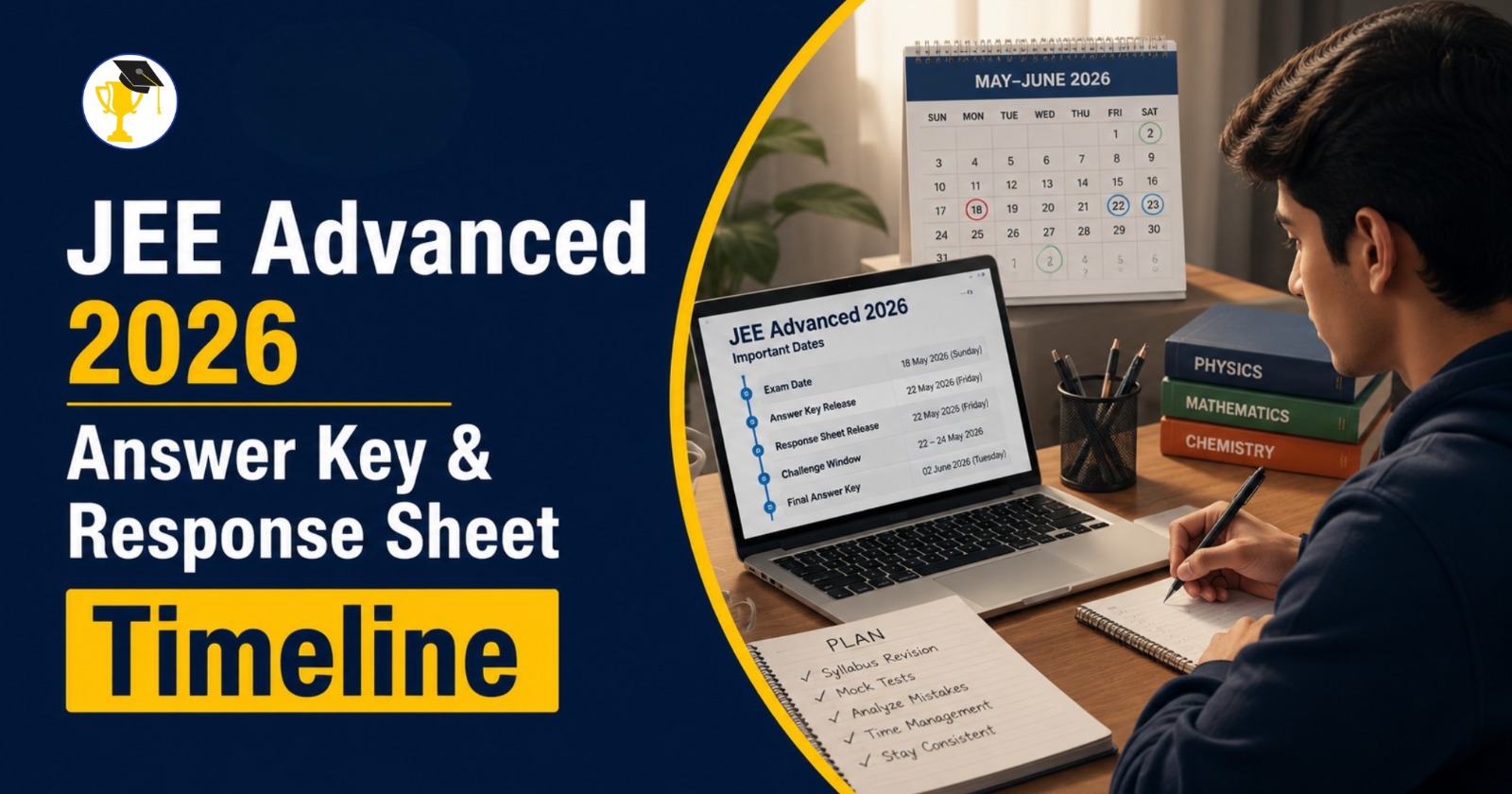
JEE Advanced 2026 Answer Key & Response Sheet Timeline
JEE Advanced 2026 Answer Key & Response Sheet Timeline: Step-by-Step Score Evaluation Guide
Now that the grueling hours of Paper 1 and Paper 2 are officially over, the high-octane pressure of "how to prepare" has completely shifted. For the lakhs of engineering aspirants who sat for the Joint Entrance Examination (JEE) Advanced on May 17, 2026, the primary focus is now tracking down every point of the evaluation process. The burning questions of the hour have changed from complex physics equations to structural timelines: When can I see my marked responses? When will the official answer keys be published? How do I challenge an anomaly? When will the final rank list drop?
To answer these pressing questions, the organizing institute, Indian Institute of Technology (IIT) Roorkee, has established a strict and transparent evaluation timeline. This detailed guide breaks down the exact post-examination schedule, explains how to download your response sheet and provisional answer keys, outlines the methodology for calculating your expected scores, and explores what to anticipate during the JoSAA counseling phase.
1. The Official Post-Exam Timeline
IIT Roorkee operates with high administrative precision. To eliminate ambiguity, the complete cycle from the moment you exit the computer-based test (CBT) center to the announcement of your All India Rank (AIR) is closely tracked via a predefined schedule.
Below is the strict structural data matrix detailing the key post-examination milestones.
JEE Advanced 2026 Post-Exam Schedule
| Milestone Event |
Official Date |
Release Time (IST) |
Strategic Purpose for Candidates |
| Release of Question Papers |
May 17, 2026 |
Immediately Post-Exam |
Provides immediate access to the Paper 1 and Paper 2 master sheets in English and Hindi. |
| Candidate Response Sheets |
May 21, 2026 |
17:00 Hours |
Discloses the exact options marked by individual candidates during the online exam. |
| Provisional Answer Key |
May 25, 2026 |
10:00 Hours |
IIT Roorkee’s initial set of verified answers open for student scrutiny and comparison. |
| Feedback & Objection Window |
May 25 – May 26, 2026 |
10:00 (May 25) to 17:00 (May 26) |
The official period allowed for candidates to submit challenges against potential errors. |
| Final Answer Key Declaration |
June 01, 2026 |
10:00 Hours |
The absolute, unchallengeable answer script used for final score tabulation. |
| JEE Advanced 2026 Results |
June 01, 2026 |
10:00 Hours |
Announcement of individual marks, category-wise qualifying cutoffs, and All India Ranks. |
| AAT 2026 Registration Window |
June 01 – June 02, 2026 |
10:00 (June 01) to 17:00 (June 02) |
Registration portal opens for qualified students targeting B.Arch programs at select IITs. |
| Architecture Aptitude Test (AAT) |
June 04, 2026 |
09:00 – 12:00 Hours |
Conduct of the offline architectural drawing and aptitude assessment. |
| Declaration of AAT Results |
June 07, 2026 |
17:00 Hours |
Final publication of AAT pass status, clearing the path for architectural seat selection. |
2. Understanding Candidate Response Sheets
The Candidate Response Sheet is a digital duplicate of your marked options during the computer-based test on May 17. Because memory can be unreliable under exam stress, this sheet provides an objective record of your answers. It records every choice you logged, every question you left blank, and every item marked for review.
Why the Response Sheet is Critical
Without your response sheet, calculating an accurate estimated score is impossible. It removes the guesswork from self-assessment. Once downloaded, it serves as your primary data source. When matched against the provisional answer key on May 25, it tells you exactly where you earned marks and where negative marking applies.
Step-by-Step Guide to Downloading Your Response Sheet
On May 21 at 17:00 IST, IIT Roorkee activates the response sheet download facility. Follow these steps to retrieve your copy:
-
Visit the Official Portal: Navigate your web browser to the official central node: jeeadv.ac.in.
-
Access the Candidate Portal: Click on the prominent link titled "JEE Advanced 2026 Candidate Response Sheet Retrieval".
-
Input Credentials: Enter your unique identification parameters, including your JEE Advanced 2026 Registration Number, Date of Birth (in DD-MM-YYYY format), and the Mobile Number used during initial registration.
-
Security Verification: Solve the visual CAPTCHA code and click on the 'Login' button.
-
Download and Backup: Once your student dashboard displays, click on "View Response Sheet". Download the document as a PDF and save multiple backups across your devices. Print a physical copy for manual cross-referencing.
3. Demystifying the Provisional Answer Key
The Provisional Answer Key represents the initial solutions verified by IIT Roorkee's faculty panels. Released on May 25 at 10:00 IST, it provides the baseline answers for both Paper 1 and Paper 2 across Physics, Chemistry, and Mathematics.
The keyword here is provisional. While highly accurate, these answers are not set in stone. Ambiguities in question framing, multiple valid interpretations of an advanced physics setup, or calculation discrepancies can occur. The provisional release gives the entire engineering community—including candidates, coaching mentors, and subject matter experts—an opportunity to audit the exam papers before final ranks are locked.
4. Navigating the Objection Window
If you identify a genuine mistake in the provisional key, you are not powerless. IIT Roorkee provides a brief 31-hour challenge window starting May 25 at 10:00 IST and concluding promptly on May 26 at 17:00 IST.
[Provisional Key Released: May 25, 10:00 IST]


        Review & Match Responses

          Identify Discrepancy

       Gather Textbook Proofs


       Submit via Portal Check

[Objection Window Closes: May 26, 17:00 IST]
Protocol for Filing a Valid Challenge
Frivolous challenges without structural academic backup are rejected. To submit an objection that the IIT evaluation committee will consider, you must follow a methodical approach:
-
Log into the Feedback System: Access the online portal via jeeadv.ac.in using your standard credentials during the active window.
-
Specify the Coordinates: Select the exact Paper (Paper 1 or Paper 2), the Subject (Physics, Chemistry, or Mathematics), and the unique Question ID from the master question paper.
-
State the Nature of the Discrepancy: Indicate if the official key contains an incorrect option, if multiple options are correct, if the numerical value range is wrong, or if the question is fundamentally flawed.
-
Upload Scientific Documentation: You must upload a clear, legible PDF file containing your step-by-step solution. Cite authoritative engineering text references (such as NCERT standard concepts, Irodov clarifications, or advanced international publications) to justify your claim.
-
Final Submission: Review your uploaded support materials and lock your objection. Keep a confirmation receipt of your submitted feedback.
5. Calculation of Estimated Score & Marking Schemes
The marking matrix for JEE Advanced changes every year. IIT Roorkee reveals the exact point values on exam day within the instructions panel of the computer-based test interface. To calculate your aggregate marks, you must separate your questions by section and apply the correct score formulas.
The typical JEE Advanced structural architecture includes three main question archetypes, each with its own evaluation rules.
1. Single Correct Option Questions
These require a single choice from four options.
2. Multiple Correct Options Questions (Partial Marking Matrix)
These feature one or more correct choices. They reward precise analysis and carry significant negative marking risks.
-
Full Marks (+4): If you choose all correct options and only correct options.
-
Partial Marks (+3): If four options are correct, but you only choose three correct options.
-
Partial Marks (+2): If three or more options are correct, but you only choose two correct options (and no wrong choices).
-
Partial Marks (+1): If two or more options are correct, but you only choose one correct option.
-
Zero Marks (0): If you leave the question unattempted.
-
Negative Marks (-2): If you choose any incorrect option, even if you also selected some correct ones.
3. Numerical Value / Integer Type Questions
These require entering a numerical value or decimal range using an on-screen keyboard.
-
Correct Entry: +3 or +4 marks (falling within the official tolerance range).
-
Incorrect Entry: 0 marks (usually safe from negative penalties, though check your year's instructions).
-
Unattempted: 0 marks.
The Estimation Formula:
Once you have audited your response sheet against the keys, compute your final scores using this structural formula:
Total Score = {(Correct Marks) Paper 1 + {(Correct Marks) Paper 2- ({Penalties) Paper 1+ {(Penalties) Paper 2 )
Ensure that your aggregate score meets both the minimum subject-wise cutoffs and the overall aggregate cutoffs to qualify for ranking.
6. From Final Answer Key to Rank List
Once the objection window closes on May 26, IIT Roorkee compiles all student feedback and delivers it to a specialized panel of professors. These experts evaluate every challenged question. If an objection proves valid, the answer key is revised. In rare cases where a question is found to be structurally broken or ambiguous, it may be declared "dropped," awarding full marks to all candidates who appeared for that paper.
This review process leads to the final answer key, which is locked and uploaded to the portal on June 1, 2026, at 10:00 IST. This final key is used to generate the official results.
The Tie-Breaking Protocol
When thousands of elite students compete, exact score ties are common. If your total calculated mark matches another candidate's score, IIT Roorkee uses a strict hierarchical sorting mechanism to assign ranks:
-
Higher Positive Marks: The candidate with higher total positive marks across the exam receives the higher rank.
-
Mathematics Dominance: If a tie persists, the candidate with higher marks in Mathematics is ranked higher.
-
Physics Performance: If the tie remains unresolved, the higher rank goes to the student with superior marks in Physics.
-
Joint Ranking: If all criteria match exactly, both candidates are assigned the same rank.
7. Analyzing Expected Cut-offs for 2026
The difficulty of JEE Advanced fluctuates significantly based on paper design, making a raw score of 50% highly competitive in tougher years. Initial feedback from students and educators after the May 17 exam suggests that the 2026 papers leaned toward the moderate-to-difficult range.
Mathematics emerged as the most demanding section across both shifts, featuring long calculations and complex calculus integrations. Physics focused heavily on conceptual depth and mechanics applications, while Chemistry was tricky and time-consuming, particularly within organic pathways.
Based on historical data and initial analysis, the following table presents the estimated category-wise minimum marks required to qualify for inclusion in the Common Rank List (CRL).
Expected Minimum Marks Percentage for Ranks
| Reservation Category |
Expected Minimum Subject Cut-off |
Expected Minimum Aggregate Cut-off |
Estimated Raw Score Range (Out of ~360) |
| Common Rank List (CRL) |
10.0% |
35.0% |
90 - 105 Marks |
| GEN-EWS |
9.0% |
31.5% |
80 - 90 Marks |
| OBC-NCL |
9.0% |
31.5% |
80 - 90 Marks |
| Scheduled Caste (SC) |
5.0% |
17.5% |
45 - 55 Marks |
| Scheduled Tribe (ST) |
5.0% |
17.5% |
45 - 55 Marks |
| PwD (All Categories) |
5.0% |
17.5% |
Lower Bound Minimums |
Note: These ranges are estimates based on early post-exam feedback. The definitive qualifying benchmarks will be published alongside the official results on June 1.
8. Essential Post-Result Steps: JoSAA Counseling
Qualifying in JEE Advanced is only part of the journey. To secure your seat at an Indian Institute of Technology, you must navigate the Joint Seat Allocation Authority (JoSAA) counseling process.
       JEE Advanced Results Declared: June 1

       JoSAA Registration Portal Activates

       Choice Filling & Mock Locking

       Seat Allocation Round 1 to 5

       Document Verification & Fee Payment
Crucial Actions for Candidates
-
Choice Filling Strategy: You must log into the JoSAA portal and list your preferred combinations of institutes and academic programs. Always rank your dream branches higher, regardless of your estimated cutoff limits.
-
Understand the Freeze, Float, and Slide Mechanisms:
-
Freeze: Select this if you are completely satisfied with your allocated seat and want to lock it, opt out of further rounds, and secure your admission.
-
Float: Select this to accept the currently allocated seat while remaining open to a higher-preference choice at any IIT in subsequent rounds.
-
Slide: Select this to retain your allocated seat while remaining open to a preferred branch upgrade within the same institute.
-
Document Readiness Audit: Keep your essential documents scanned and organized to avoid losing an allocated seat during verification:
-
Class X Certificate or Birth Certificate (for age validation).
-
Class XII Marksheet (verifying the 75% aggregate or top 20 percentile requirement).
-
Category Certificates (GEN-EWS or OBC-NCL certificates must be issued on or after April 1, 2026).
-
Medical Certificate (completed using the format specified in the JoSAA bulletin).
-
Passport or OCI documentation if applying under foreign categories.
Summary for Quick Action
As you navigate this high-stakes period, keep these three key action items in mind:
-
May 21 (17:00 IST): Log into jeeadv.ac.in to secure your personalized response sheet.
-
May 25 (10:00 IST): Download the provisional keys and verify your options against the official answers using the partial marking matrix.
-
June 1 (10:00 IST): Access your definitive scorecard, confirm your All India Rank, and prepare your choice list for the upcoming JoSAA registration cycle.
Verified Source Information & Official Resource Registry
To ensure complete accuracy and avoid misleading rumors, cross-reference all information with official platforms:
-
The Central Examination Portal: JEE Advanced Official Node
-
Organizing Authority: Indian Institute of Technology Roorkee Administration Bureau
-
Counselling Management System: Joint Seat Allocation Authority (JoSAA) Advisory Core


 STUDY MATERIALS
 COURSES
 MORE
MORE
 SUCCESS STORY
 ADMISSION
 STORE
STORE