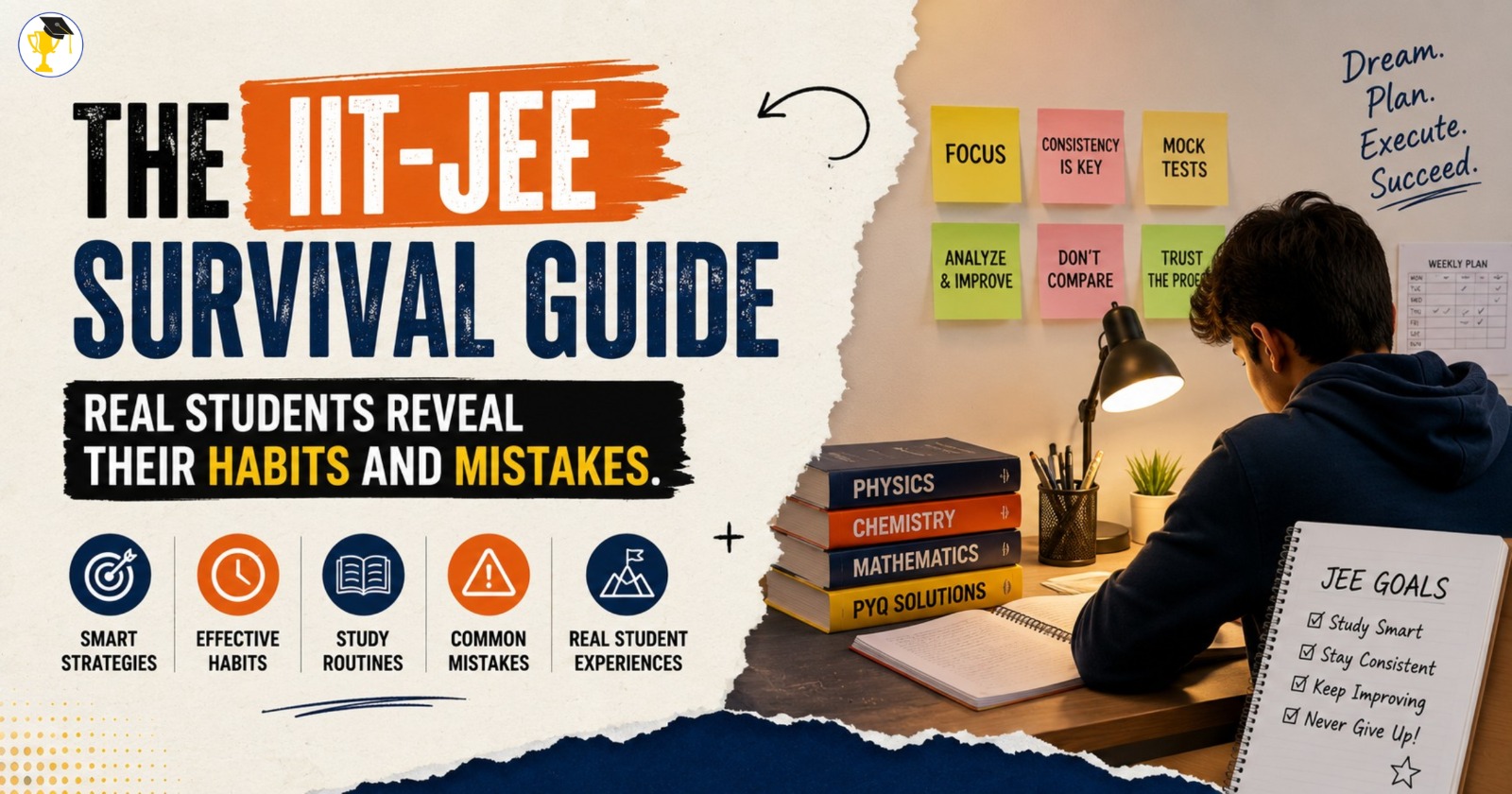
The IIT-JEE Survival Guide: Real Students Reveal Their Habits and Mistakes
Mastering the Grid: Smart Achievers Students Decode the Habits, Pitfalls, and Mental Resilience Needed to Conquer the JEE
Every single year, hundreds of thousands of ambitious minds plunge headfirst into the high-stakes arena of the Joint Entrance Examination (JEE). Armed with pristine notebooks, dense coaching modules, and ambitious timetables, they set out to claim a seat at India’s premier engineering institutions. Yet, as the weeks turn into months, the initial adrenaline frequently gives way to a daunting cycle of unending mock tests, fluctuating ranks, and sleep-deprived nights. It is within this crucible that a vital truth becomes apparent: cracking one of the world's toughest competitive exams is rarely a matter of raw, brute-force studying.
True success lies in a deeper, more strategic domain. It requires an honest understanding of your personal cognitive blind spots, the psychological agility to handle immense academic pressure, and an unwavering commitment to consistency long after initial motivation has dissolved.
To peel back the layers of this intense academic journey, we sat down with top-performing first-year engineering scholars from Smart Achievers. Having recently successfully navigated the JEE storm, these institutional alumni share their raw, unvarnished insights. They reveal what genuinely moved the needle for them, the structural mistakes that almost derailed their efforts, and the specific mindset shifts cultivated at Smart Achievers that helped them turn immense pressure into a catalyst for academic excellence.
Pillar 1: The Strategic Pivot and Calculated Resource Allocation
Insights from Vedanga Gupta B.Tech (IIT Bombay)
"When time is your scarcest resource, raw panic must be replaced by surgical precision. You cannot treat every chapter as an equal priority when the calendar is working against you."
           [ 12-Hour Strategic Daily Split ]

   Conceptual Deep-Dives         Rigorous Numerical Drill
       (4 Hours)                        (5 Hours)

  High-Yield PYQ Analysis & Error Correction (3 Hours)
For many students, the road to the JEE is a multi-year marathon planned out from early high school. However, unexpected shifts in career goals can sometimes force an accelerated timeline. My own transition into serious JEE preparation happened abruptly after a late-stage pivot from alternative career tracks. With a severely compressed timeline to master a vast syllabus, I quickly realized that traditional, slow-paced learning methodologies would not suffice. I had to cover vast quantities of advanced physics, chemistry, and mathematics—including complex topics not thoroughly explored in regular schooling—while simultaneously adapting to the rigorous, multi-layered pattern of the exam.
Instead of succumbing to anxiety, my time spent at Smart Achievers taught me to approach this challenge with calculated focus. Survival meant replacing panic with high-efficiency strategy.
The Power of Peer Mapping and Trend Analysis
The first foundational habit I developed was systematic trend mapping. By interacting closely with top-tier peer groups and faculty mentors within the Smart Achievers ecosystem, I filtered out the noise to identify "high-yield" topics—those specific chapters that statistically carry the highest weightage year after year.
-
Mathematics as a Foundation: Recognizing my natural aptitude for logical reasoning, I used Mathematics to anchor my confidence, diving straight into Past Years’ Questions (PYQs) to understand the exact flavor of application required.
-
Chemistry as the Scoring Engine: I treated Chemistry as an efficiency engine. By systematically breaking down Inorganic and Physical Chemistry trends, I created a reliable source of quick, high-probability marks.
-
Physics as a Conceptual Hurdle: Physics required a complete overhaul of my study mechanics.
Overcoming the Trap of Rote Memorization
I quickly discovered that memorizing formulas without context was completely useless against the JEE's complex problem designs. To overcome this, I shifted my focus toward deep conceptual clarity. Before attempting any complex numerical sets, I spent hours breaking down core theoretical principles to understand their fundamental derivations.
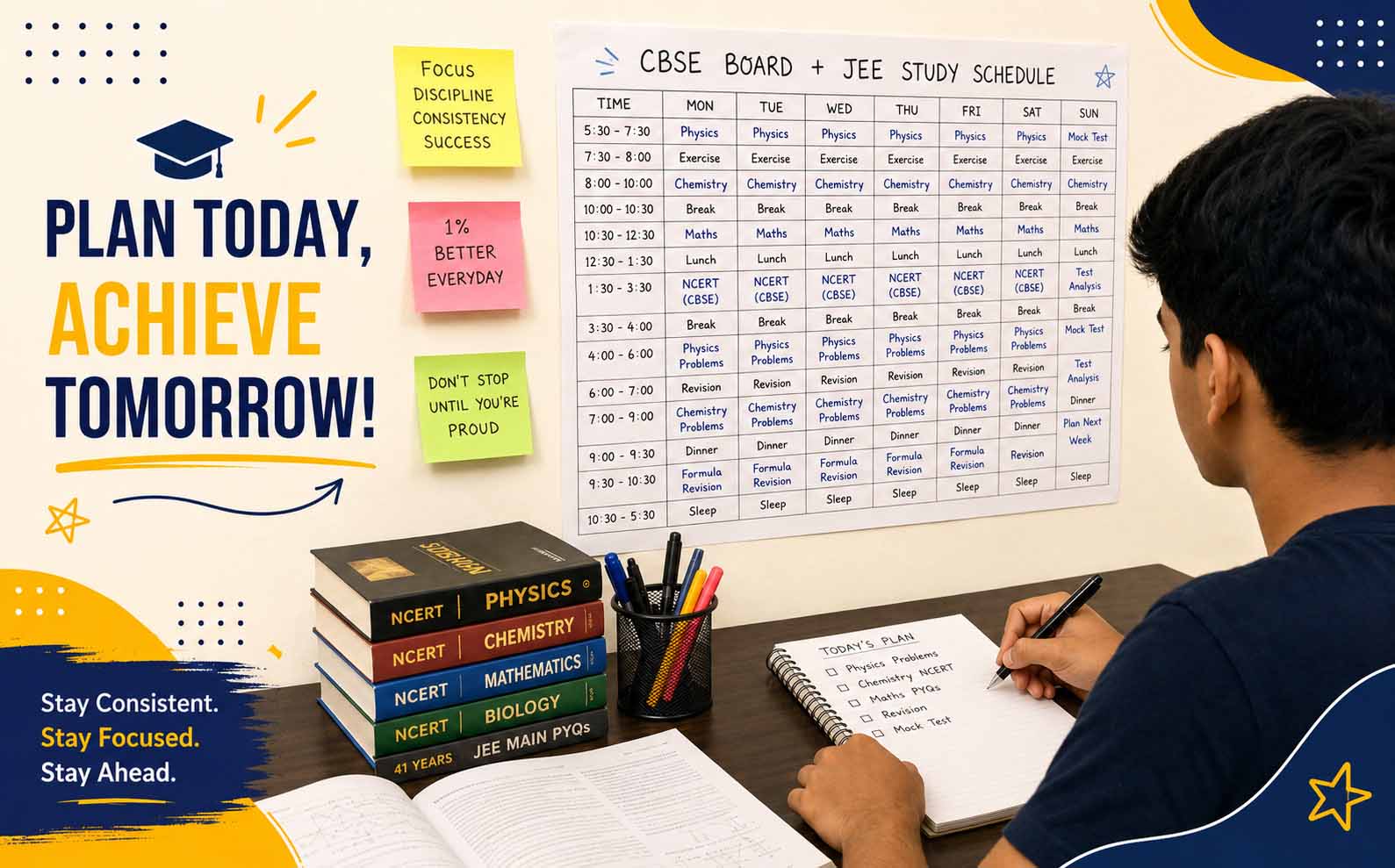
My daily routine expanded into a disciplined 12-hour schedule split cleanly between deep-dive conceptual study and intense problem-solving. In the critical final weeks leading up to the exam, I shifted completely to timed mock tests and synchronized my sleep cycle with the actual exam slots. This ensured my mind was at peak cognitive sharpness during the exact hours I would be sitting in the test center. My journey proved that when time is limited, a calculated strategy and leveraging your core strengths are your most reliable tools.
Pillar 2: Deconstructing the "Resource Trap" and Building Core Foundations
Insights from Shaurya Jain, B.Tech (IIT Roorkee)
"The urge to collect every reference book in existence is a symptom of fear, not a strategy for success. True mastery is built by scaling down your resources and scaling up your depth of understanding."
                  THE CORE KNOWLEDGE PYRAMID

 Level 3: Advanced Problem Applications (Selected Exemplars)

 Level 2: Rigorous Conceptual Probing & "Why" Deconstructions

 Level 1: Foundational NCERT Texts (The Indispensable Base)
For a substantial portion of my early preparation phase, I fell victim to a prevalent myth: the belief that clearing the JEE requires mastering every question bank, reference book, and specialized study guide available on the market. I was driven by a persistent fear of missing out, anxious that ignoring a single textbook might cost me my dream score. This counterproductive mindset led to fragmented attention, where I constantly hopped between different books and teaching styles, creating a surface-level understanding wrapped in immense stress.
Through the guidance and structured pedagogy at Smart Achievers, I underwent a major perspective shift. I realized that the JEE does not test how many thousands of pages you have turned; it tests how deeply you understand the core principles behind those pages.
Embracing the "Holy Grail" of Engineering Prep
Once I embraced this approach, my daily study routine completely changed. I stopped rushing through volume for the sake of completion and began asking the fundamental "why" behind every derivation and theorem. If your core foundation is incredibly solid, even highly complex, multi-concept problems can be systematically broken down.
| Resource Type |
Common Misconception |
Strategic Reality |
| NCERT Textbooks |
Too basic; only useful for board exams. |
The absolute foundation; critical for Inorganic Chemistry and fundamental Physics concepts. |
| Advanced Question Banks |
Solving more questions automatically improves ranks. |
Useful only if every single mistake is deeply analyzed and understood. |
| Multi-Source Mentorship |
Collecting tips from every online platform maximizes edge. |
Causes cognitive overload; sticking to one structured regime yields better results. |
I cannot stress this enough to future aspirants: never underestimate standard foundational texts like the NCERT. While they might not mirror the complex presentation of an advanced JEE problem, they provide the exact vocabulary and conceptual framework upon which those advanced problems are built.
Winning the Battle Against Comparative Anxiety
Beyond the academic hurdles, dealing with self-doubt was a major psychological barrier. Being surrounded by exceptionally brilliant peers can easily make you question your own capabilities.
However, the turning point in my preparation came when I consciously stopped comparing my progress to others and started competing exclusively with my own past performance. I adopted a personal guiding motto: "Aut viam inveniam aut faciam"—I will either find a way, or I will make one. This mental shift from external comparison to internal mastery carried me through the toughest phases of my preparation.
Pillar 3: Systematic Review, Error Tracking, and Holistic Well-Being
Insights from Samridh Girdhar, B.Tech (IIT-Delhi)
"An unanalyzed mock test is a complete waste of time. Your true growth doesn't happen when you get a question right; it happens when you document exactly why you got a question wrong."
                    [ THE FEEDBACK LOOP OF RECOVERY ]

                          Execute Mock Exam


                          Identify Errors &
                          Categorize Outliers


                        Log in Error Notebook:
                        Conceptual vs. Careless


                        Target Targeted Remedial
                        Study & Re-Testing
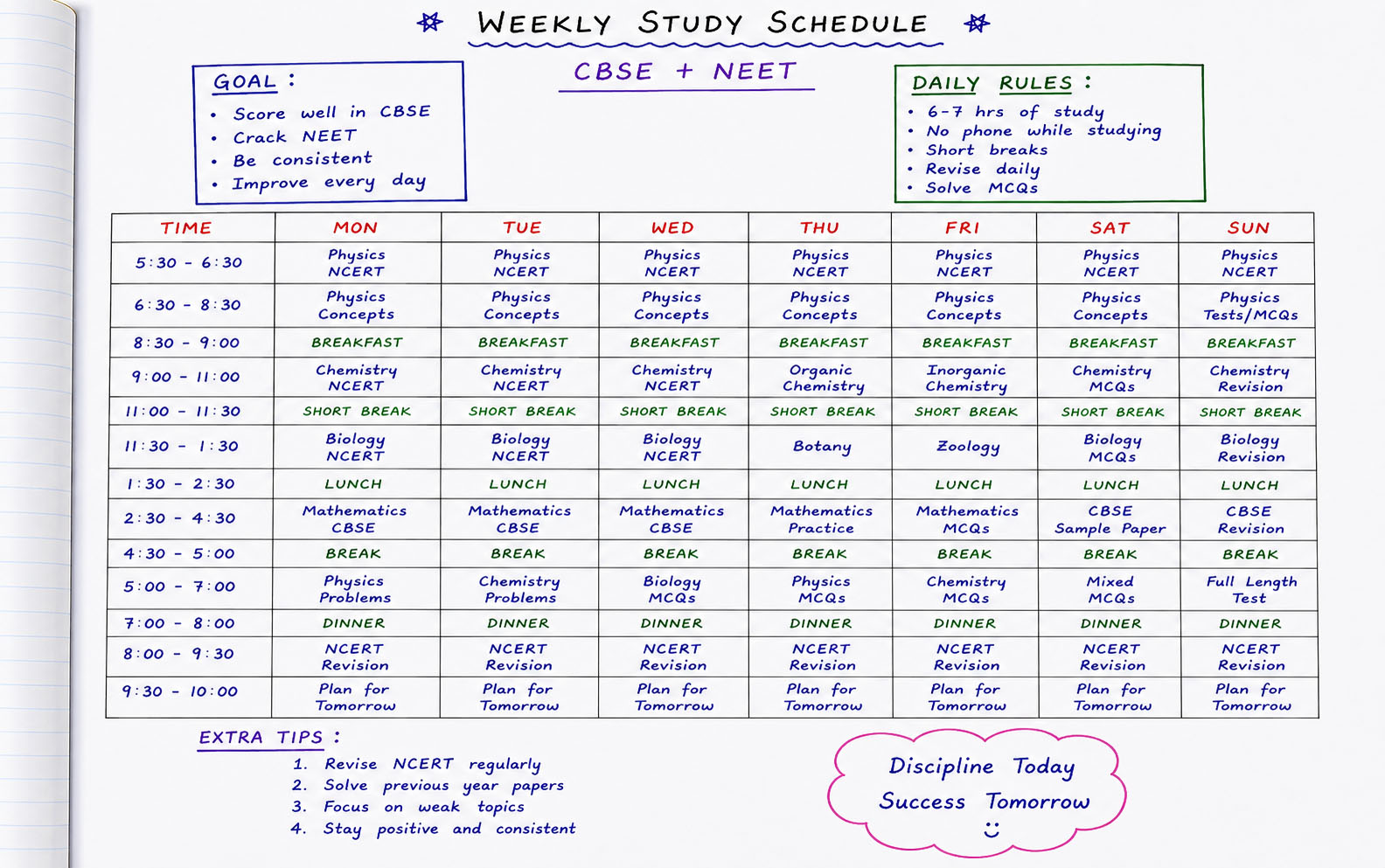
One of the most valuable lessons emphasized during my time at Smart Achievers is that structured planning and targeted study hours are vastly superior to blindly tracking long, exhausting days. It is incredibly easy to confuse being busy with being productive. A truly effective routine requires a disciplined, predictable daily schedule: rising early to utilize peak cognitive hours, dedicating focused windows to formula retrieval, engaging actively in lectures, and breaking problem-solving sessions into uninterrupted, timed intervals.
The Architecture of an Effective Error Notebook
A central tool in my preparation was the strict maintenance of a dedicated "Error Notebook." Many students complete a mock test, check their final score, and immediately move on to the next test. This approach misses the entire point of testing.
Whenever I lost marks, I meticulously documented the question, categorized the mistake (whether it was a conceptual misunderstanding, a misread prompt, or a calculation error), and wrote down the correct solution path. Reviewing this notebook before every subsequent test dramatically minimized unforced errors and consistently improved my accuracy.
Maximizing Cognitive Retention Through Deliberate Practice
To maximize retention, I avoided the trap of continuously consuming new study materials. Instead, I focused on spaced repetition, revisiting a concise, high-quality set of resources multiple times. This approach saved valuable time and prevented old concepts from fading as I took on new chapters.
Equally important was protecting my mental and physical health. True consistency is impossible without proper recovery. I kept my workspace strictly free of smartphones, protected my sleep schedule, stayed close with my family, and carved out brief moments for personal hobbies to keep burnout at bay.
To maintain high motivation, I kept a visual reminder of my target percentile right on my study desk. This daily anchor kept me focused through periods of fatigue, reminding me of a core truth: consistency matters infinitely more than short bursts of panicked effort. Do not stop when you are tired; stop only when your work is complete.
Pillar 4: Shifting the Mindset from Academic Perfection to Regular Consistency
Insights from Anshika Jain (NSUT)
"The journey to IIT-JEE is not a sprint designed for natural prodigies; it is a long distance endurance race won by average students who refuse to quit when they stumble."
[ Pre-Exam Mindset Trap ]  "I need to master 100% of the syllabus perfectly."

                                        (Smart Achievers Intervention)
[ Strategic Reality Shift ]  "I will optimize high-yield domains and build resilience."
I want to dispel a common misconception right away: I have never been a natural academic prodigy or a consistent top-ranker throughout my early school years. I was a thoroughly average student who achieved high performance purely through deliberate practice, resilience, and systematic consistency.
One of the most significant advantages I found at Smart Achievers was the value of trusting a singular, coherent mentorship structure. In an era of infinite online options, it is remarkably easy to break your focus by trying to blend ten different strategies from ten different sources. Once I tuned out the external noise and committed to our structured coaching methodology, learning became far more streamlined.
Navigating the Major Jump from Class 10 to Class 11
A widespread trap for many students is a sense of complacency after doing well in their Class 10 board exams. There is a common assumption that high school and competitive entrance prep will simply be an extension of the same format.
In reality, the sheer volume and conceptual depth of the JEE syllabus represent a massive step up. Recognizing this early and starting with disciplined, focused effort from day one is essential.
       [ SYLLABUS COMPLEXITY COMPARISON: A GRAPHIC VIEW ]

Class 10    (Linear, Direct Applications)

Class 12/
JEE         (Multi-Variable, Non-Linear, Cross-Concept Linking)
The Strategy of Variable Time Allocation
Through this journey, I learned that you cannot allocate your time uniformly across all chapters. A strategic approach requires analyzing weightage and prioritizing key, high-yield topics while maintaining a continuous review cycle for older material.
The preparation process is naturally filled with performance highs and lows. You will encounter mock tests that leave you discouraged, and days where your energy is low. However, the students who ultimately succeed are not those who played a flawless game, but those who consistently chose to reset, adjust, and keep moving forward after every setback.
The Smart Achievers Consensus: A Unified Strategy for Success
When we look closely at these individual reflections, a powerful common thread emerges. There is no singular, hidden secret or magic formula for clearing the Joint Entrance Examination. The path is built on universal, time-tested principles implemented with absolute discipline.
While individual strengths vary—some students excel by maximizing mock tests, while others find their edge through deep conceptual reviews—the core principles for success remain completely identical.
                         THE JEE SUCCESS EQUATION


        Deep Conceptual         Relentless Error
           Clarity                   Dissection


                   Structured Mentorship


                   SUSTAINED CONSISTENCY
The intense pressure surrounding high-stakes national exams often leads students to believe they must adopt extreme, unsustainable habits or constantly chase every new trend online. The real-world experiences of these successful Smart Achievers students prove the exact opposite.
At the end of the day, it is focused planning, rigorous self-honesty through error tracking, a strong foundation in core concepts, and the resilience to keep pushing forward that build a true top-tier engineer. Hard work is essential, but it is structured, intelligent execution that turns that effort into an elite rank.


 STUDY MATERIALS
 COURSES
 MORE
MORE
 SUCCESS STORY
 ADMISSION
 STORE
STORE