What to Do When JEE Mock-Test Scores Stop Improving
A stalled mock-test score is not a sign that your JEE preparation has failed. It usually means your current method has reached its limit and you need sharper analysis, better revision, and more deliberate test-taking strategies. This guide explains how to identify the reason behind a score plateau and turn every mock into a practical improvement plan.
Why do JEE mock-test scores stop improving?
JEE mock-test scores often stop improving when students keep taking tests but do not change what happens between tests. At first, marks rise because basic syllabus coverage improves. Later, progress depends on accuracy, time allocation, question selection, error correction, and revision quality.
A plateau can come from several causes. You may be attempting too many questions without enough control, revising topics passively, repeating the same calculation mistakes, or losing marks in chapters you think you already know. Sometimes the issue is not knowledge at all; it is exam temperament, poor sequencing, or getting stuck on one difficult problem while easier marks are left behind.
The key is to stop asking only, “How much did I score?” and start asking, “Why did I score exactly this much?” That shift is the foundation of effective jee mock-test strategies.
A score plateau is data, not a verdict
When your marks remain in the same range for several tests, the score is giving you a pattern. Treat it like a diagnostic report. A single low score may be caused by fatigue, a tough paper, or weak focus on that day. But repeated stagnation shows that your current routine is not targeting the real bottleneck.
Instead of reacting emotionally after every test, compare your last three to five mocks. Look at subject-wise scores, attempted questions, accuracy, silly mistakes, time spent, and chapters where you repeatedly lose marks. This gives you a clearer picture than one test alone.
A useful mindset is: your mock score is not your identity; it is feedback on a system. If the system changes, the score can change too.
How should you analyse a mock test?
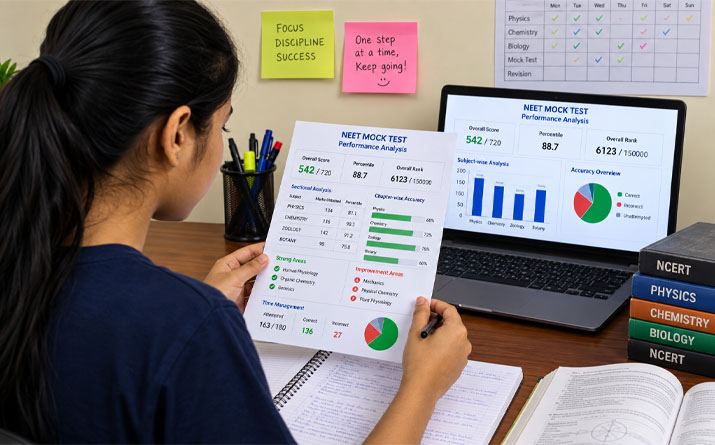
You should analyse a mock test in layers: score, attempts, accuracy, time, error type, and chapter pattern. A complete analysis takes more effort than just checking the answer key, but it is where most score improvement begins. If you only mark questions right or wrong, you miss the reason behind the result.
Use this post-test review structure after every serious mock:
-
Reattempt before checking solutions First, try the questions you left or got wrong without looking at the answer. This separates lack of knowledge from pressure-related mistakes.
-
Classify every error Put each lost mark into a category. Was it a concept gap, formula confusion, calculation error, misreading, poor time choice, or guesswork?
-
Track repeat mistakes One mistake is normal. The same mistake in three tests is a preparation problem. Keep a separate list of recurring traps.
-
Review correct guesses too A correct answer is not always a strong answer. If you guessed or used an uncertain method, mark it for revision.
-
Note time leaks Identify questions where you spent too long for little return. Time leaks reduce your ability to collect easier marks later.
This method turns mock tests into a training tool instead of a weekly judgment session.
Separate knowledge gaps from performance gaps
Many students respond to a plateau by studying more hours. That may help if the problem is syllabus coverage, but not if the issue is execution. Before changing your schedule, identify which gap is hurting you most.
Knowledge gaps
These appear when you do not know the concept, formula, standard approach, or required theory. For example, you may repeatedly struggle with rotational mechanics, organic reaction mechanisms, coordinate geometry, or electrochemistry. In such cases, more tests alone will not solve the problem. You need targeted revision, solved examples, and graded practice.
Performance gaps
These appear when you know the topic but lose marks under test conditions. You may choose the wrong questions, make sign errors, rush calculations, or panic after two difficult problems. Here, the solution is not just more theory. You need better test-taking strategies, timed sectional practice, and stronger decision-making during the paper.
Revision gaps
These appear when you once understood a topic but cannot recall it quickly during the mock. This is common in long JEE preparation because the syllabus is wide. Revision gaps need active recall, formula sheets, mixed practice, and periodic return to older chapters.
Once you know the gap type, your next steps become much more precise.
Build an error log that you will actually use
An error log does not need to be fancy. It needs to be short, clear, and revisited. Many students create detailed notebooks but never open them again. A practical error log should help you revise mistakes quickly before the next mock.
Include these points for each important mistake:
For example, instead of writing “silly mistake in maths,” write “forgot domain restriction in inverse trigonometry; check domain before final answer.” This makes the correction actionable.
Review the error log at fixed times: the day after the mock, two days before the next mock, and before major test series papers. The goal is not to record every mistake forever. The goal is to prevent the same avoidable marks from leaking again.
Improve accuracy before chasing higher attempts
When scores stop rising, many students try to attempt more questions. This can backfire if accuracy drops. In JEE, uncontrolled attempts can turn a manageable score into a disappointing one because negative marking punishes careless guessing.
A better approach is to improve your attempt quality first. Ask yourself:
-
Which questions can I solve with high confidence?
-
Which questions are worth trying after one careful read?
-
Which questions should I skip quickly?
-
Where do I usually overestimate myself?
During analysis, calculate subject-wise accuracy, not just total marks. If your attempts are high but accuracy is weak, work on selection and verification. If accuracy is strong but attempts are too low, work on speed, familiarity, and reducing hesitation.
This is one of the most important jee preparation tips: higher scores come from better decisions, not just more attempts.
Refine your paper-attempt strategy
Your mock-test strategy should not be random. By the time you are taking full-length papers, you should have a tested method for moving through the exam. The exact order may vary by student, but the principle remains the same: collect secure marks first, then invest time in medium-level questions, and leave time-consuming traps for later.
A simple three-round approach can help:
-
Round one: secure questions Solve questions that are direct, familiar, and low-risk. Do not get stuck. Build confidence and collect marks quickly.
-
Round two: moderate questions Return to questions that need more thought but are still within reach. Use careful calculation and avoid rushing.
-
Round three: selective risk Attempt only those remaining questions where you have a clear path. Avoid emotional guessing just because time is left.
This structure reduces panic and protects you from spending ten minutes on a question that may not be worth it. It also trains you to see the paper as a scoring opportunity, not a battle with every problem.
When should you change your preparation plan?
You should change your preparation plan when the same weaknesses appear across multiple mocks despite regular study. Do not overhaul everything after one bad test. But if your chemistry score keeps falling, maths accuracy remains low, or physics time management repeatedly fails, your plan needs adjustment.
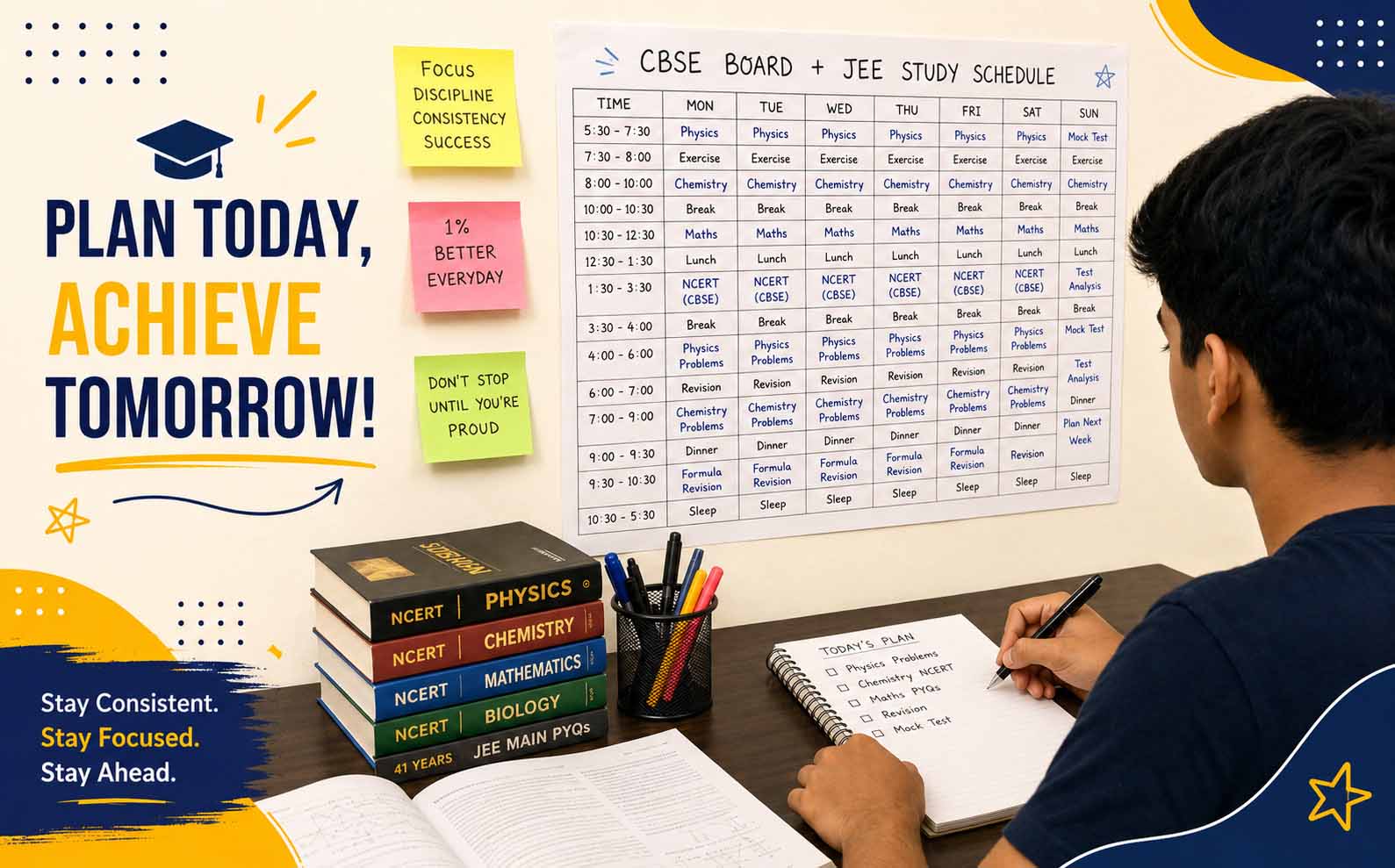
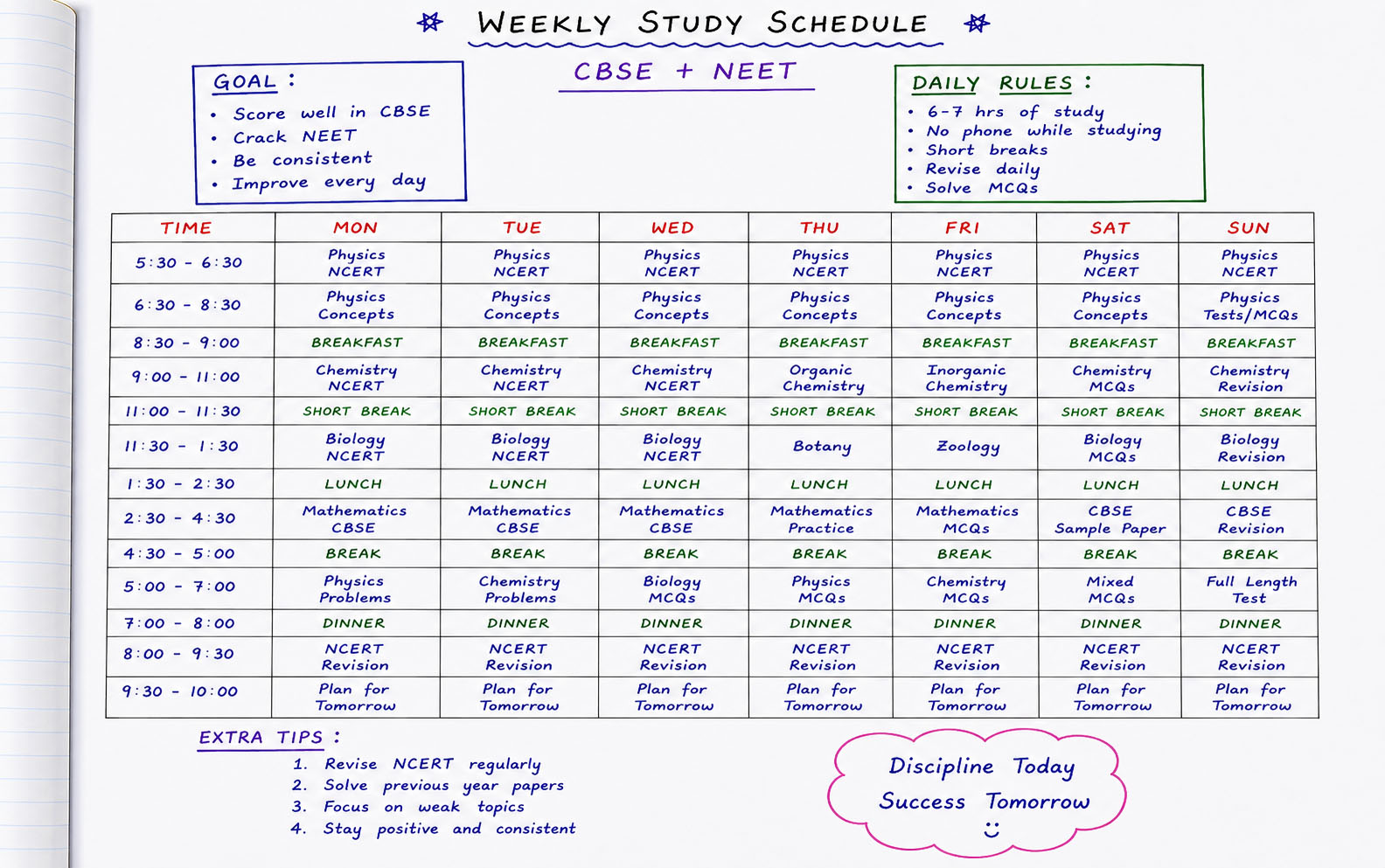
Start with small, measurable changes. Replace vague goals like “revise physics” with specific ones like “revise current electricity formulas, solve 40 mixed questions, and review all errors before Sunday.” A focused plan creates visible progress.
Use this weekly reset checklist:
-
Pick the top three weaknesses from your latest mock analysis.
-
Assign each weakness a revision block and a practice block.
-
Solve a mix of easy, medium, and exam-level questions.
-
Revisit your error log before the next test.
-
Take one timed sectional test for the weakest subject.
-
Keep sleep and breaks stable before full-length mocks.
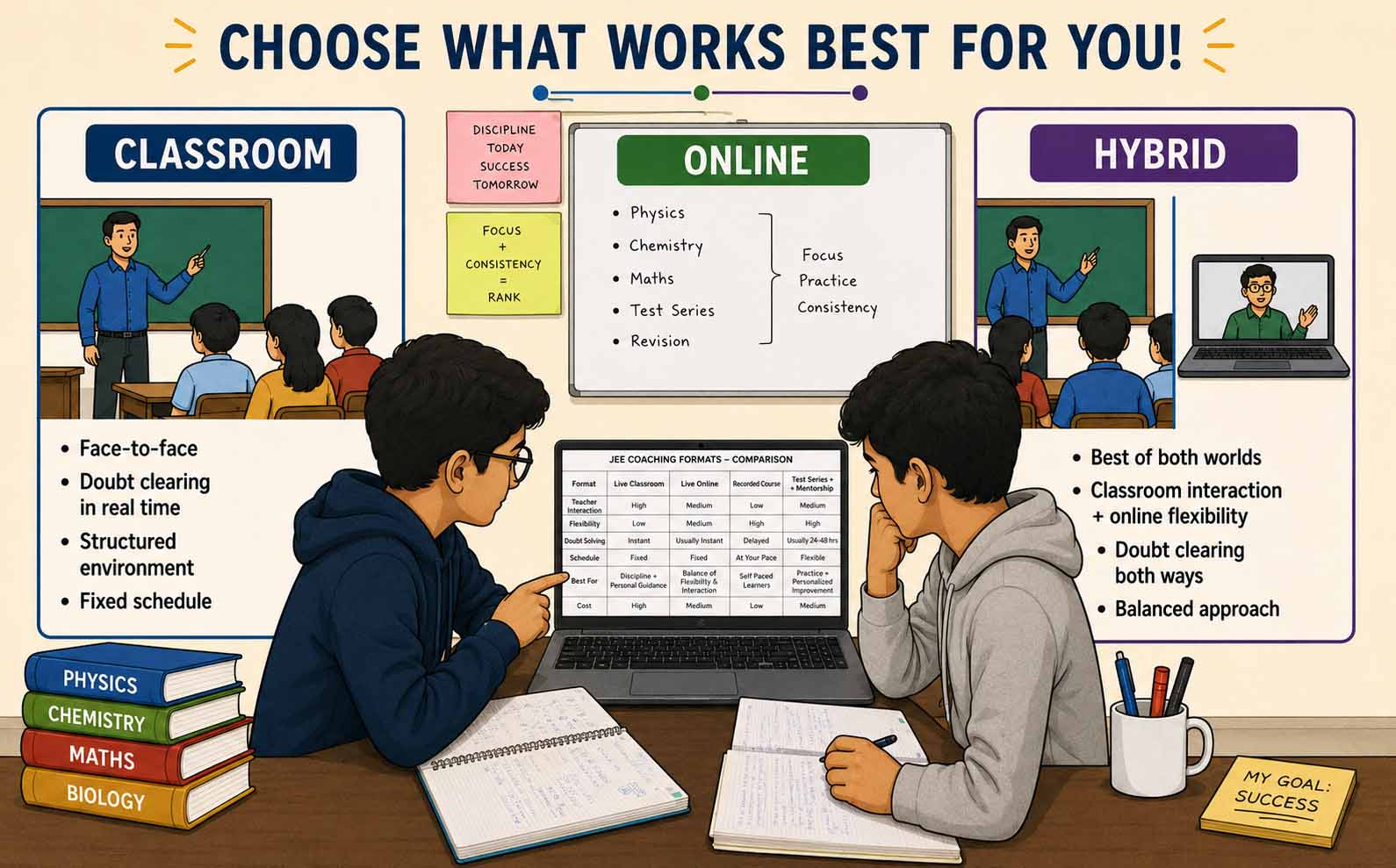
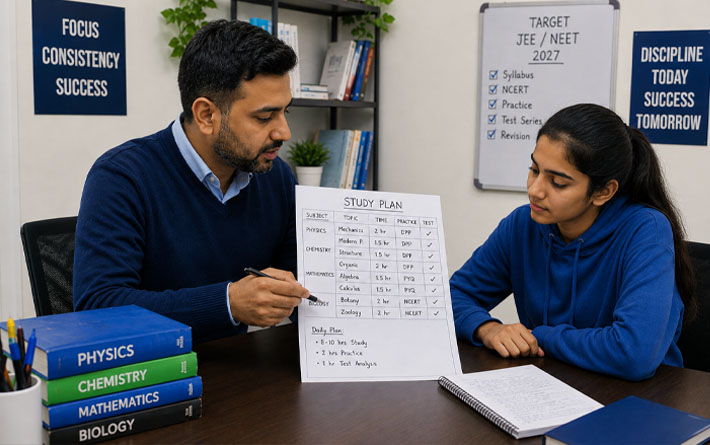
If you attend a structured program, discuss these patterns with your teachers. Students looking for jee coaching in ghaziabad, or already enrolled in coaching, should use faculty support not just for doubt-solving but also for test analysis, strategy correction, and realistic study planning.
Balance full mocks with targeted practice
Taking too many full-length mocks without fixing weaknesses can create fatigue. Taking too few mocks can leave you underprepared for exam pressure. The balance matters.
Use full mocks to test your overall readiness. Use sectional tests to improve speed and accuracy in one subject. Use topic tests to repair weak chapters. Use revision sessions to strengthen recall. Each type of practice has a different job.
A good cycle after a full mock looks like this:
-
Day 1: Take the mock and do a first review.
-
Day 2: Analyse errors deeply and revise weak concepts.
-
Day 3: Practise targeted questions from weak areas.
-
Day 4: Take a sectional or mixed-topic test.
-
Day 5: Review the error log and revise formulas.
This cycle is more useful than taking another full mock immediately without correction.
Protect your mindset during a plateau
A plateau can be mentally exhausting because effort does not seem to convert into marks. This is when students start comparing scores, changing resources too often, or losing trust in their preparation. Avoid making decisions from panic.
Instead, focus on controllable metrics. Did your accuracy improve? Did repeated mistakes reduce? Did you skip traps faster? Did you revise weak chapters properly? These signs may appear before a major score jump.
Also, keep your resources limited. Jumping between too many books, channels, notes, and test series can create confusion. Depth usually beats scattered effort. Choose reliable material, revise it well, and measure progress through analysis.
A practical action plan for the next three mocks
If your scores have stopped improving, do not wait for motivation. Use the next three mocks as an experiment.
For the first mock, focus on detailed diagnosis. Do not change too many things during the paper. Afterward, identify your biggest score leak.
For the second mock, apply one strategy change. It could be a new question order, stricter skipping rule, or improved time division. Measure whether it helped.
For the third mock, combine analysis with targeted revision. Revisit the error log before the paper and check whether repeated mistakes reduce.
By the end of three mocks, you should know whether your main issue is concept clarity, revision, speed, accuracy, or temperament. That clarity is powerful because it tells you exactly where to work next.
Turn every mock into a smarter next step
JEE preparation is not only about studying more; it is about studying with better feedback. When mock-test scores stop improving, the solution is to slow down your analysis, sharpen your test-taking strategies, and repair the exact weaknesses that keep repeating.
A plateau is frustrating, but it can also be the point where your preparation becomes more mature. Use your mocks as training data, keep your corrections specific, and make every test lead to a clearer plan for the next one.


 STUDY MATERIALS
 COURSES
 MORE
MORE
 SUCCESS STORY
 ADMISSION
 STORE
STORE