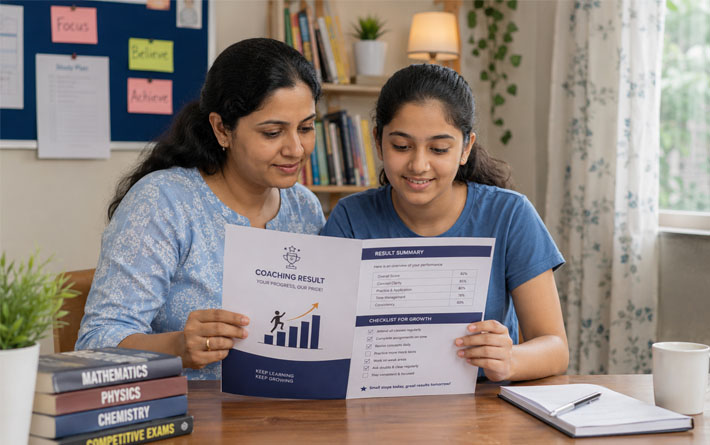


Balancing Board Exams with Competitive Prep: Class 11 & 12 Guide

Balancing Board Exams with Competitive Prep: Class 11 & 12 Guide

When parents sit down for academic counseling in Class 11, the primary concern is almost universal: "Will preparing for competitive entrance exams harm my child’s school board performance?"

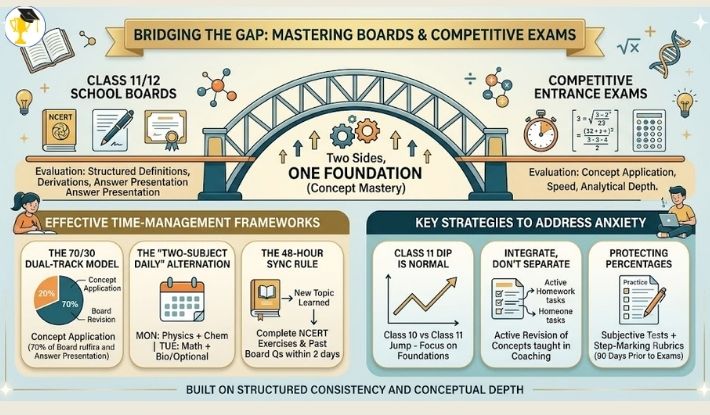
It is a valid worry. The leap from Class 10 to Class 11 is steep, and balancing school deliverables with rigorous entrance preparation can feel overwhelming. However, board examinations and competitive tests are not opposing forces—they are two layers of the exact same syllabus.

Boards evaluate presentation, derivation, and structured definitions, while competitive exams test application, speed, and analytical depth. Mastery of the fundamentals directly strengthens board results rather than weakening them.

Three Practical Time-Management Frameworks

To keep students from burning out, replace unstructured study sessions with clear, proven routines.

  • The 70/30 Dual-Track Model: Allocate 70% of study time to mastering concepts and solving numerical/application problems (covering competitive entrance prep), and reserve the remaining 30% strictly for textbook reading, derivations, and board-style subjective questions.

  • The "Two-Subject Daily" Alternation: Avoid superficial multitasking. Dedicate each weekday evening to just two core subjects (e.g., Physics + Chemistry on Monday; Mathematics/Biology + School Revision on Tuesday) to ensure sustained focus.

  • The 48-Hour Sync Rule: Whenever a new topic is taught in school or coaching, ensure textbook end-of-chapter questions and past-year board questions are completed within 48 hours while the theory is fresh.

Sample Balanced Weekly Schedule

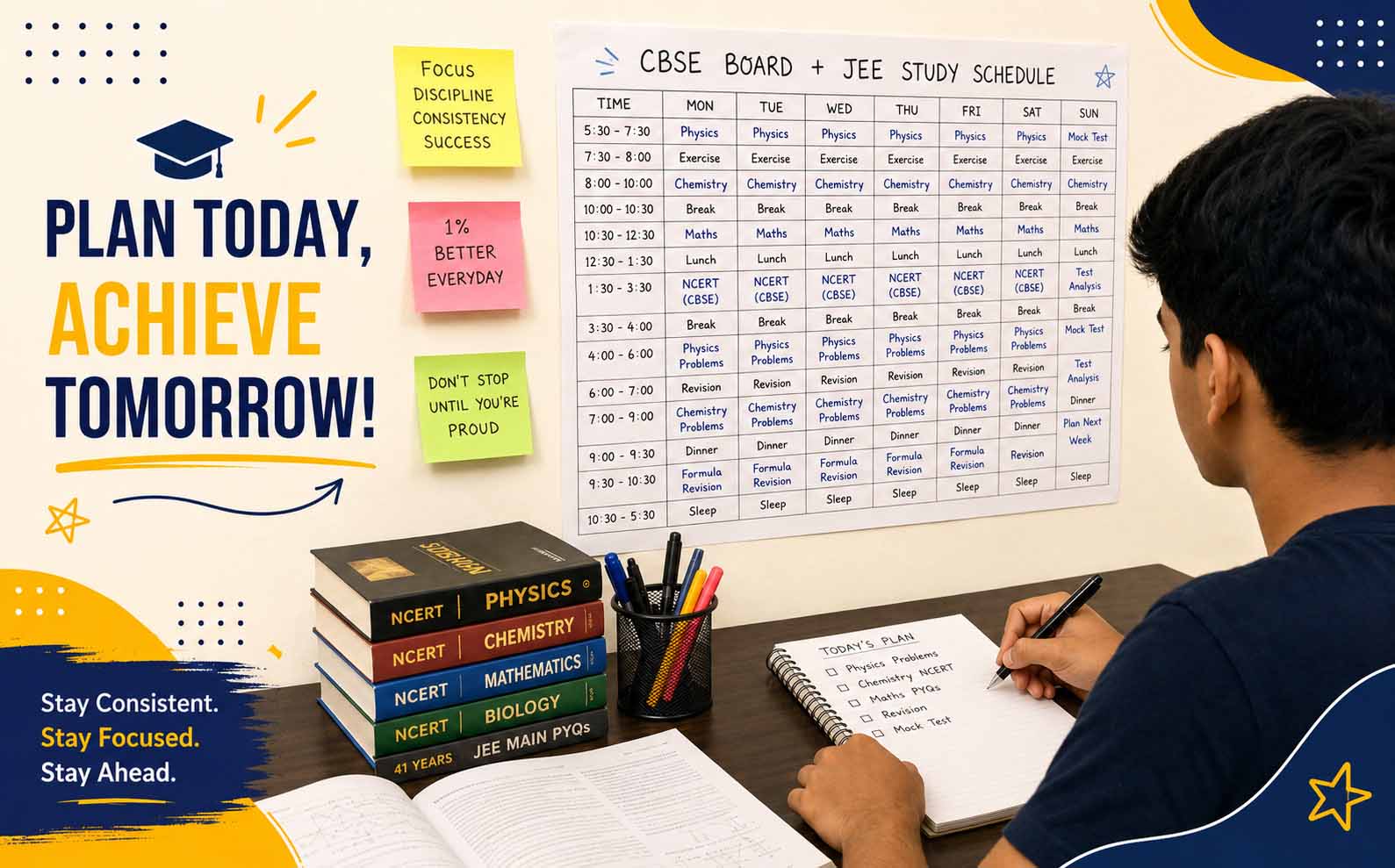
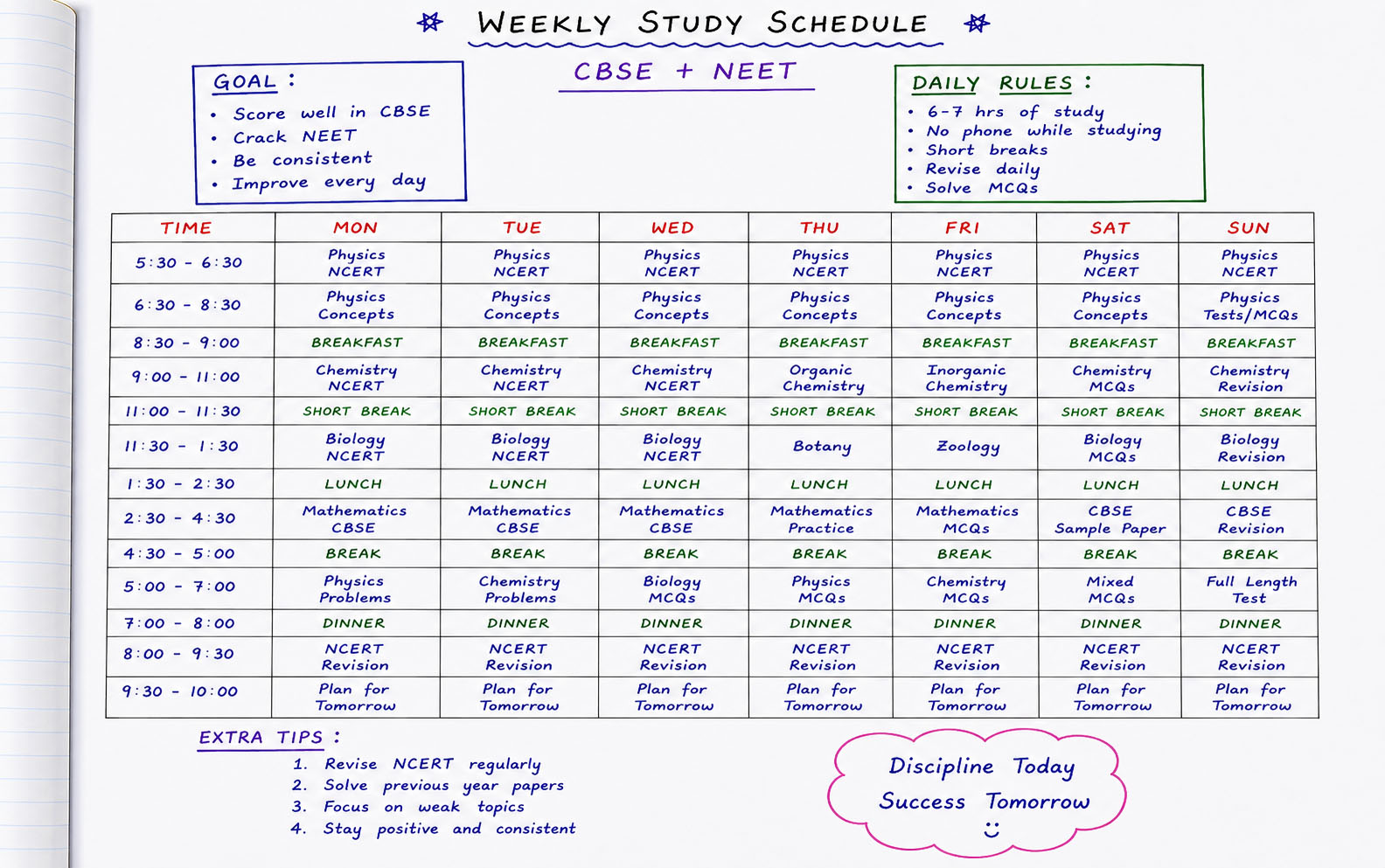
This timetable balances a typical 8:00 AM – 2:00 PM school routine with evening preparation.

Day / Slot Afternoon (4:30 PM – 7:30 PM) Evening (8:30 PM – 10:30 PM) Primary Objective
Mon – Wed Coaching / Deep Concept Application NCERT Exercise & Subjective Derivations Establish core theory and complete board homework.
Thu – Fri Problem Solving & Speed Drills School Project Work & English/Optional Subject Keep secondary school subjects consistently updated.
Saturday Full-Length Entrance Mock / Practice Test Test Analysis & Mistake Log Review Identify conceptual gaps before they compound.
Sunday Weak Topic Revision (Morning) Board-Style Subjective Practice Test (Evening) Master answer presentation, step marking, and diagrams.


Handling Common Parent Objections

1. "Class 11 marks dropped significantly compared to the 90%+ scored in Class 10. Shouldn't we drop entrance coaching?"

"A dip in the first semester of Class 11 is standard. Class 10 relies heavily on straightforward recall, whereas Class 11 introduces a five-fold expansion in syllabus volume and analytical depth. Stopping entrance preparation does not automatically raise board marks, because the real bottleneck is foundational conceptual understanding. Our focus is diagnosing specific weak chapters and teaching structured step-marking techniques."

2. "School homework and practical records leave zero time for self-study."

"School work should not run on a separate track from competitive prep. If a student is writing a laboratory record on projectile motion or organic conversions, that study time counts toward mastering that chapter's core concepts. By using the 48-Hour Sync Rule, school homework becomes active revision rather than an administrative burden."

3. "What if my child ends up scoring poorly in both?"

"Underperformance happens when a student tries to prepare using two disconnected approaches simultaneously. When students master a concept at an entrance level, their comprehension is already far ahead of the board baseline. To protect board percentages, we integrate timed subjective tests with step-by-step marking rubrics 90 days prior to school exams, ensuring students articulate their knowledge clearly on paper."

Coordinating board targets and competitive ambitions comes down to structured consistency, targeted diagnostic testing, and closing the gap between conceptual understanding and written presentation early in the academic session.

Frequently Asked Questions (FAQs)

No. Board and competitive exams share the same core syllabus. Competitive preparation deepens conceptual clarity and analytical thinking, while board success depends on clear written presentation, formulas, and derivations. Balancing both requires practicing subjective step-marking alongside objective problem-solving.
The transition from Class 10 to Class 11 involves a significant increase in syllabus volume and conceptual difficulty. Class 10 often rewards rote memorization, whereas Class 11 tests in-depth application. An early dip is common and reflects the adjustment period, not an inability to handle the curriculum.
A practical benchmark is the 70/30 Dual-Track framework: dedicate 70% of self-study time to understanding core concepts and solving numerical or application problems, and use the remaining 30% for textbook exercises, formal definitions, and derivations.
Synchronize homework with coaching topics using the 48-Hour Sync Rule. When a topic is covered in coaching or school, complete the textbook questions and school assignments within two days. This transforms school deliverables into active revision rather than an isolated task.
Students should begin integrating dedicated board-style subjective tests roughly 60 to 90 days before the board exams. This window allows students to refine time management, master multi-step derivations, and practice precise diagram presentation without losing touch with core concepts.

Recent Posts