Classroom vs Online vs Hybrid JEE Coaching
Choosing between classroom, online, and hybrid JEE coaching is not about finding the “best” format in general. It is about matching the format to the student’s discipline, location, school schedule, doubt-solving needs, and family budget. This jee coaching comparison breaks down how each model works, where it performs well, where it can fail, and how to choose without getting distracted by marketing claims.
Which JEE coaching format is right for you?
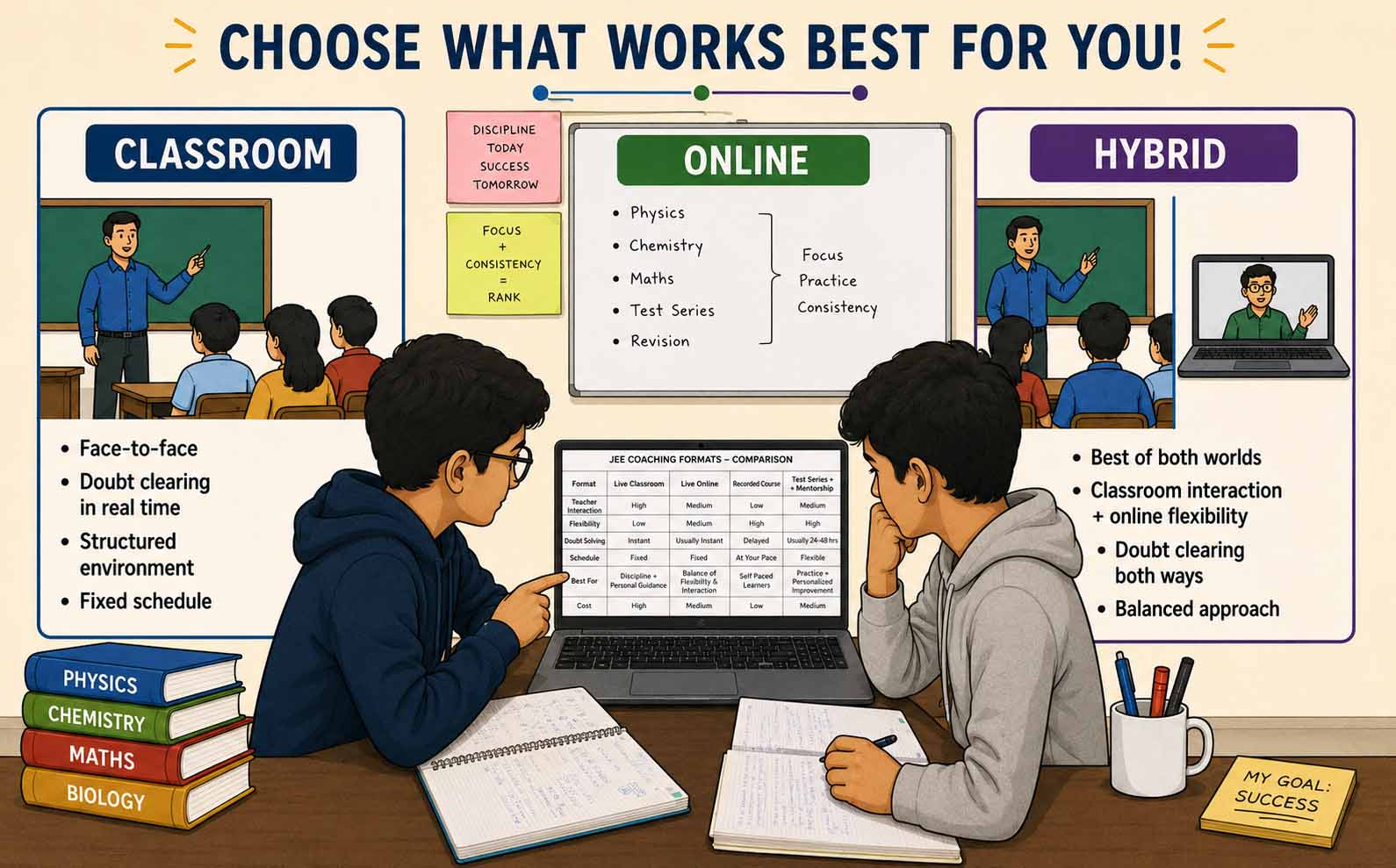
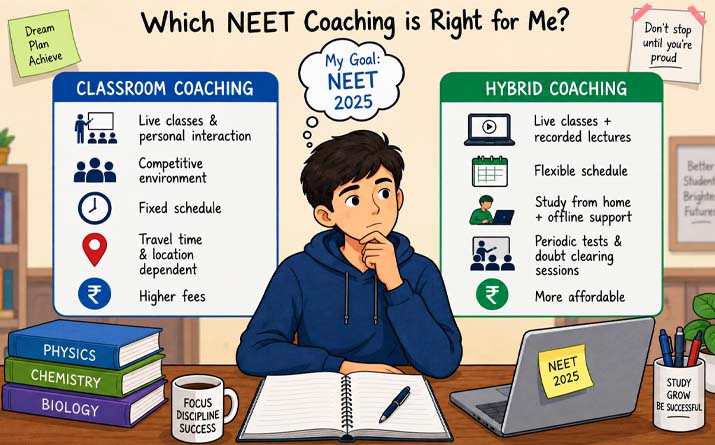
The right JEE coaching format is the one that gives the student consistent learning, regular testing, quick doubt resolution, and enough structure to stay on track for JEE Main and JEE Advanced preparation. Classroom coaching suits students who need fixed schedules and face-to-face accountability. Online coaching suits self-driven students who can learn independently and manage time well. Hybrid coaching suits students who want the flexibility of online learning but still need periodic classroom support, offline tests, or in-person doubt sessions.
A useful comparison of iit jee coaching institutes should not only compare brand names. It should compare the learning environment, teacher access, batch size, test quality, study material, feedback system, and how the institute helps a student recover after weak scores. A format that looks convenient at the start can become stressful later if it does not match the student’s habits.
Use this simple starting point:
-
Choose classroom coaching if the student studies better in a disciplined physical environment and benefits from direct teacher presence.
-
Choose online coaching if the student is consistent, comfortable with screens, and needs flexibility because of location, school, travel, or budget.
-
Choose hybrid coaching if the student wants recorded or live online classes along with offline tests, mentoring, or periodic classroom sessions.
The three coaching models at a glance
Classroom, online, and hybrid coaching often teach the same syllabus, but the learning experience feels very different. The same chapter on rotation, electrostatics, coordinate geometry, or organic chemistry can be easier or harder depending on how doubts are handled and how regularly the student practices after class. That is why the format matters as much as the faculty.
Classroom JEE coaching
Classroom coaching is the traditional model where students attend scheduled lectures at a coaching centre. The biggest advantage is structure. Students travel to a fixed place, sit with peers, follow a timetable, and interact with teachers directly.
This format works well for students who need external discipline. The classroom environment creates a sense of seriousness because everyone around the student is preparing for the same exam. It can also help students learn through peer competition, teacher observation, and immediate classroom doubt clarification.
However, classroom coaching can become difficult if travel time is long, batch size is large, or the student hesitates to ask questions in front of others. Missed classes may also create gaps unless the institute provides backup lectures or revision support.
Online JEE coaching
Online coaching delivers classes through live sessions, recorded videos, digital tests, app-based assignments, and online doubt support. Its main strength is flexibility. Students can learn from home, repeat difficult lectures, save travel time, and access teachers or content that may not be available locally.
This format can be powerful for self-motivated students. Recorded classes allow revision at a personal pace, and online test analytics can help identify weak areas quickly. It also helps students in smaller towns who may not have access to established coaching centres nearby.
The challenge is consistency. Online students must manage distractions, screen fatigue, delayed doubts, and the temptation to postpone classes. If the platform does not provide strong mentoring or regular testing, students may consume lectures without doing enough problem practice.
Hybrid JEE coaching
Hybrid coaching combines online and offline elements. A student may attend live or recorded online classes during the week and appear for offline tests, doubt-clearing sessions, or periodic revision classes at a centre. In some models, core theory is taught online while practice, mentorship, and tests happen offline.
This format works well when it is planned carefully. Students get flexibility without losing all physical accountability. It can be especially useful for students balancing school, board preparation, and JEE coaching.
The risk is confusion. If online and offline parts are not integrated, the student may receive too many schedules, too many resources, and no clear priority. A hybrid program is only valuable when the institute clearly explains what happens online, what happens offline, and how progress is tracked.
Learning environment and discipline
The learning environment is one of the strongest deciding factors in any comparison of coaching institutes for jee main preparation. JEE preparation is long, repetitive, and mentally demanding. The student must not only understand concepts but also solve hundreds of problems, analyze errors, revise regularly, and appear for tests even after disappointing scores.
Classroom coaching creates discipline through routine. The student has to reach the centre, attend the class, follow the batch pace, and complete homework before the next session. This external structure can prevent procrastination, especially in Class 11 when many students are still learning how serious JEE preparation is.
Online coaching depends more heavily on internal discipline. A motivated student may use this freedom very well by pausing lectures, revising difficult topics, and creating a personalized study plan. But a student who struggles with consistency may fall behind silently because no one physically notices absence or low engagement.
Hybrid coaching sits between the two. It can provide enough freedom for independent study and enough offline contact to keep the student accountable. The quality of this model depends on whether the institute actively monitors attendance, test scores, and homework completion across both formats.
Best fit by discipline level:
-
Needs strong supervision: Classroom coaching is usually safer because the routine is fixed.
-
Moderately disciplined: Hybrid coaching can work well if mentoring is consistent.
-
Highly self-driven: Online coaching can be efficient, especially with strong test practice.
-
Easily distracted at home: Classroom or hybrid is usually better than fully online.
-
Lives far from good centres: Online may be more practical, provided the student follows a strict schedule.
Which format gives better doubt-solving support?
Classroom coaching usually gives faster doubt-solving during or immediately after lectures, while online coaching can offer convenience if the platform has active doubt channels. Hybrid coaching can be strongest when it combines digital doubt submission with in-person doubt classes. The best option depends less on the format label and more on how quickly, clearly, and personally doubts are resolved.
Doubt-solving is critical in JEE preparation because one unresolved concept can affect several chapters. A student who does not understand limits may struggle in calculus. A weak base in mole concept can affect physical chemistry. Confusion in vectors can create problems in mechanics and electromagnetism.
Classroom doubt-solving
In classroom coaching, students can ask questions directly. Teachers may notice confusion through facial expressions, class performance, or repeated mistakes. Some students also benefit from listening to doubts raised by others because those questions reveal common traps.
The limitation is batch size. In a very large batch, shy students may not ask questions. After class, teacher availability may be limited, especially in crowded centres. Classroom doubt-solving is excellent when the batch is manageable and the institute has dedicated doubt counters or extra support hours.
Online doubt-solving
Online doubt-solving may happen through chat, live sessions, video calls, discussion forums, or image uploads. This helps students ask doubts at home without waiting for the next physical class. Some students also feel less embarrassed asking questions digitally.
The concern is response quality. A short text answer may not be enough for a complex physics problem or a multi-step calculus question. Online coaching works better when doubt support includes detailed explanations, not just final answers.
Hybrid doubt-solving
Hybrid programs can offer the best of both sides if designed well. Students may submit doubts online during self-study and attend offline doubt sessions for complex problems. This model helps students who need flexibility but still want personal explanation for difficult topics.
Before enrolling, ask how doubts are handled in practice:
-
Are doubts solved by the main faculty, assistant teachers, mentors, or peer forums?
-
Is there a fixed doubt-clearing schedule?
-
Can students ask doubts outside class hours?
-
Are solutions explained step by step or only marked with final answers?
-
Is doubt support available for both theory and test analysis?
-
Does the institute track repeated doubts to identify weak chapters?
Test practice and performance tracking
JEE coaching is incomplete without a serious test system. Lectures build concepts, but tests reveal whether the student can apply those concepts under pressure. A strong jee coaching comparison must therefore examine test frequency, difficulty level, analysis quality, and follow-up support after poor performance.
Classroom coaching often provides scheduled offline tests that feel closer to a formal exam environment. Students sit with peers, face time pressure, and experience competitive ranking. This can build exam temperament because the student gets used to solving under observation and pressure.
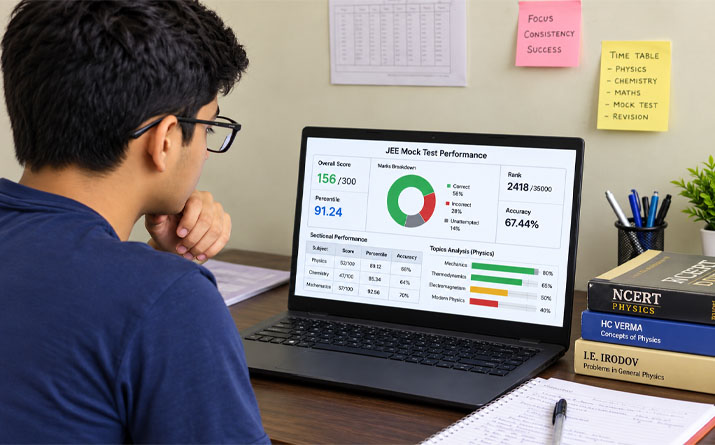
Online coaching usually provides more frequent quizzes, chapter tests, and full-length mock tests. Digital analytics can quickly show accuracy, speed, attempted questions, weak topics, and time spent per section. This is useful only if the student and mentor actually review the data and convert it into a revision plan.
Hybrid coaching can combine offline seriousness with online analytics. A student may take major tests at a centre and use online tests for chapter-level practice. This format is effective when offline and online test results are connected in one progress report.
Strong test systems usually include:
-
Chapter-wise tests after each major topic.
-
Cumulative tests that force revision of older chapters.
-
Full syllabus mock tests closer to the exam period.
-
Error analysis that separates conceptual mistakes, calculation errors, and time-management issues.
-
Rank or percentile-style comparison within a relevant student group.
-
Follow-up tasks after each test, not just marks and solutions.
If an institute only conducts tests but does not help students analyze mistakes, the test program is incomplete. The goal is not just to score marks in coaching tests. The goal is to understand why marks were lost and how to prevent the same error in JEE Main or JEE Advanced.
Flexibility, travel time, and daily routine
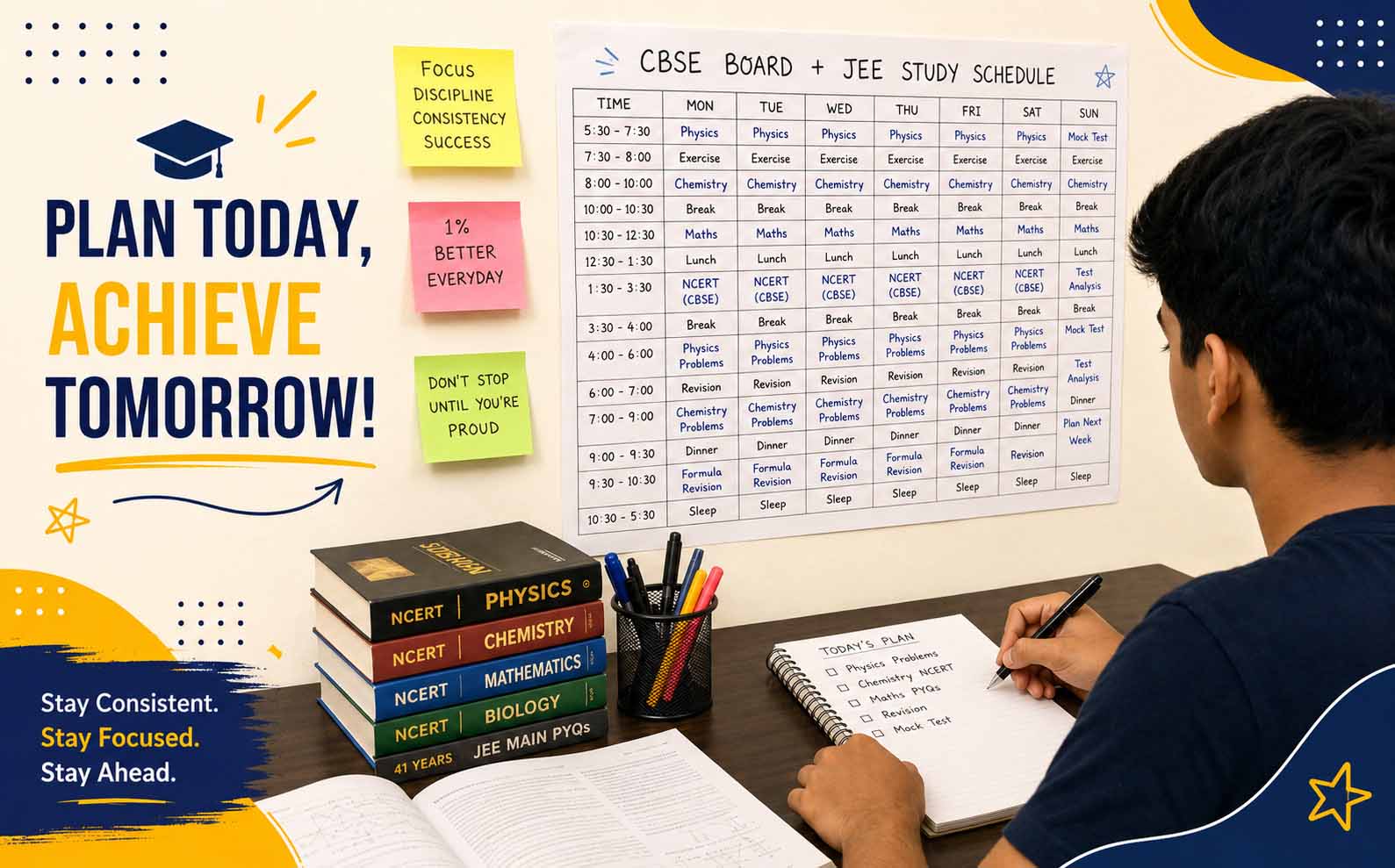
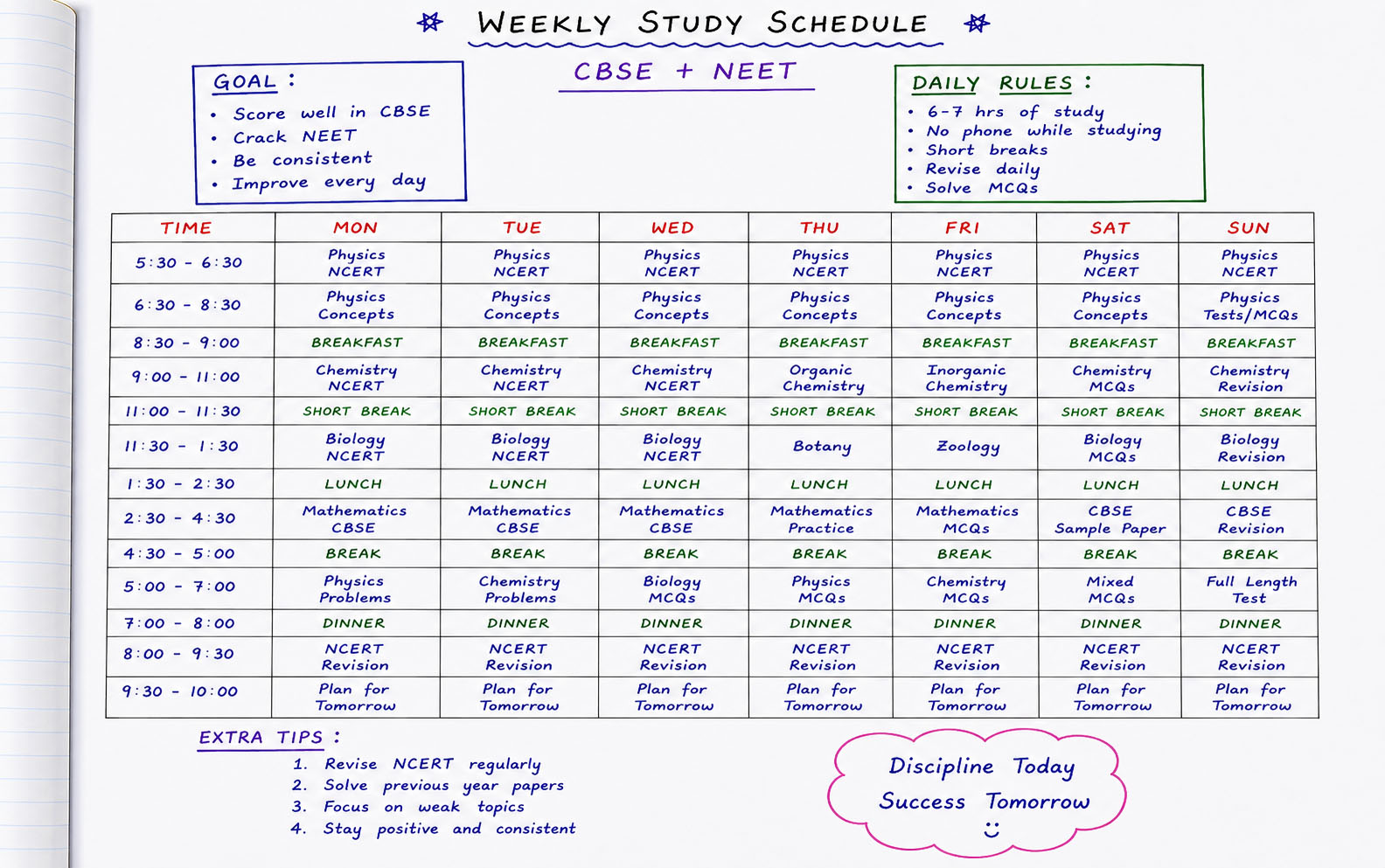
Time management can decide the success of JEE preparation. Students already balance school, homework, board exams, coaching assignments, revision, sleep, and personal stress. A format that saves time may improve consistency, while a format that creates long travel hours may drain energy.
Online coaching is the most flexible. It removes travel time and allows students to revisit recorded lectures. This is helpful for students in locations without strong institutes, students with demanding school schedules, or students who need to revise at unusual hours.
Classroom coaching is less flexible but more structured. The fixed schedule reduces decision fatigue because students know exactly where to be and when. However, long commutes can reduce self-study time, especially if classes are frequent and located far from home.
Hybrid coaching can reduce travel while preserving important offline touchpoints. For example, a student may study theory online and travel only for tests or doubt sessions. This arrangement can be practical for families who want quality guidance but cannot manage daily commuting.
Routine impact by format:
-
Classroom: Strong routine, less flexibility, possible travel fatigue.
-
Online: High flexibility, no travel, higher need for self-control.
-
Hybrid: Balanced routine, selective travel, needs clear schedule coordination.
The best routine is not the busiest routine. A student needs protected self-study time after every class. If the coaching schedule leaves no time for solving problems independently, even the most reputed format may not produce results.
Which option is more cost-effective for JEE preparation?
Online coaching is often perceived as more cost-effective because it can reduce travel and infrastructure-related expenses, but cost-effectiveness depends on the total value received. Classroom coaching may justify higher costs if it provides strong faculty access, disciplined tests, and personal mentoring. Hybrid coaching can be cost-effective when it reduces daily travel while still offering meaningful offline support.
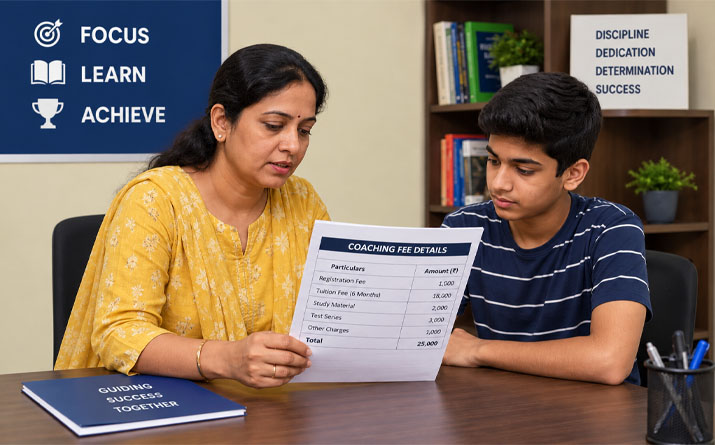
Families should avoid comparing only the fee amount. A lower fee does not help if the student needs extra tuition later because doubts are not solved. A higher fee is not automatically better if the batch is overcrowded or support is generic.
When comparing costs, look at the full picture:
-
Coaching fees for the full course duration.
-
Study material, test series, and revision modules included or excluded.
-
Travel expenses and daily commuting time.
-
Device, internet, and power backup needs for online learning.
-
Availability of recordings for missed classes.
-
Mentoring, doubt support, and test analysis quality.
-
Whether extra courses are pushed later for revision or advanced problem solving.
For many students, the most cost-effective format is the one they will actually follow consistently. If a student wastes online access because of poor discipline, the lower price is not useful. If a student loses hours daily in travel, the classroom advantage may shrink. Cost should be judged against learning continuity, not just the brochure fee.
Faculty quality and teaching consistency
Faculty is one of the biggest reasons students choose a coaching institute, but the format affects how faculty quality is experienced. A brilliant teacher in a classroom can make concepts come alive through interaction, examples, and immediate feedback. A strong online teacher can explain with excellent visuals, structured notes, and replayable lessons.
In classroom coaching, the teacher’s energy, clarity, and ability to read the room matter a lot. Students can ask follow-up questions, and teachers can adjust explanations when the class looks confused. But quality may vary across branches, batches, and substitute teachers.
Online coaching can give access to well-known or specialized teachers regardless of location. Recorded content may also be polished and carefully planned. The drawback is that students may not receive the same personal attention unless the program includes live interaction, mentoring, or small-group support.
Hybrid coaching needs strong coordination among faculty, mentors, and test teams. If online lectures are taught by one team and offline doubts are handled by another, the student should still experience one connected learning path. Otherwise, hybrid becomes fragmented.
Before choosing any institute, check:
-
Who teaches Physics, Chemistry, and Mathematics in the actual batch, not just in promotional sessions.
-
Whether the same faculty continues through the course.
-
How missed classes are covered.
-
Whether teachers explain both JEE Main speed-based questions and JEE Advanced concept-heavy problems.
-
How faculty supports students after low test scores.
-
Whether the institute offers demo classes or trial access before enrollment.
A meaningful comparison of iit jee coaching institutes should examine teaching consistency over time, not only the reputation of a few star teachers.
Study material and practice depth
Good study material turns lectures into preparation. For JEE, students need theory notes, solved examples, graded exercises, previous-year questions, mixed practice sets, and mock tests. The material should not be so shallow that students remain underprepared, or so overloaded that they never complete it.
Classroom coaching usually provides printed modules and assignments aligned with the lecture plan. This helps students follow a clear sequence. The teacher can also tell students which exercises are essential, which are advanced, and which should be revised before tests.
Online coaching may provide digital notes, downloadable PDFs, video solutions, and app-based quizzes. This can make revision convenient. However, students must organize resources carefully because too much digital content can become overwhelming.
Hybrid coaching can provide both printed and digital material. This is useful if the student uses each format for a clear purpose: printed modules for deep practice, digital tools for revision, test analysis, and quick doubt support.
Good JEE material should help students:
-
Build concepts from basic to advanced level.
-
Practice JEE Main-style speed and accuracy.
-
Attempt JEE Advanced-style multi-concept problems.
-
Revise older chapters through cumulative assignments.
-
Identify common traps and wrong approaches.
-
Strengthen weak areas after test analysis.
The issue is not whether material is offline or online. The issue is whether it is sequenced, solvable, relevant, and reviewed regularly.
Peer group, competition, and motivation
The peer group can strongly affect motivation. In classroom coaching, students see others working hard, asking questions, and improving through tests. This can create healthy pressure and remind students that JEE preparation requires daily effort.
However, peer competition can also become stressful if rankings are discussed without proper mentoring. A student in a strong batch may feel motivated, but another may feel discouraged if the gap seems too large. Good coaching should use competition to guide improvement, not create fear.
Online coaching has a different peer experience. Students may interact through live chat, discussion groups, leaderboards, or test rankings, but the feeling is less physical. Some students enjoy this because it reduces pressure. Others feel isolated and lose momentum.
Hybrid coaching can create a moderate peer environment. Offline tests and doubt sessions allow students to meet peers, while online study preserves personal space. This can help students who want competition but not daily comparison.
Parents and students should notice how the peer group affects behavior. If competition leads to better revision, it is useful. If it leads to anxiety, copying schedules blindly, or constant comparison, the student needs better mentoring and a more balanced study plan.
Decision summary by student type
A practical comparison of coaching institutes for jee main and Advanced preparation should end with a decision, not confusion. The best format depends on the student’s learning pattern more than popular opinion. Use the following guide as a realistic starting point.
Classroom coaching is better for:
-
Students who need fixed routines and external discipline.
-
Students who learn best through face-to-face explanation.
-
Students who ask doubts more easily in person.
-
Students who benefit from direct peer competition.
-
Families living near a reliable coaching centre.
Online coaching is better for:
-
Self-disciplined students who can follow a schedule independently.
-
Students who need flexibility because of school, location, or travel limits.
-
Students who like replaying lectures and revising at their own pace.
-
Students with access to a stable device, internet, and quiet study space.
-
Families looking for broader teacher access without daily commuting.
Hybrid coaching is better for:
-
Students who want flexibility but still need periodic accountability.
-
Students who can study theory online but prefer offline tests or doubts.
-
Students with moderate discipline who need mentor check-ins.
-
Families who want to reduce travel without removing physical interaction.
-
Students who need a balanced system for school, boards, and JEE.
If two formats seem equally suitable, choose the one with stronger doubt-solving, better test analysis, and a schedule the student can maintain for the entire preparation cycle. JEE preparation rewards consistency more than initial excitement.
Final recommendation
For most students who need structure, classroom coaching remains a dependable option, especially when the centre has good teachers, manageable batches, and serious test analysis. For disciplined students with strong home support, online coaching can be highly efficient because it saves time and allows flexible revision. For students who fall between these two profiles, hybrid coaching may offer the most balanced path.
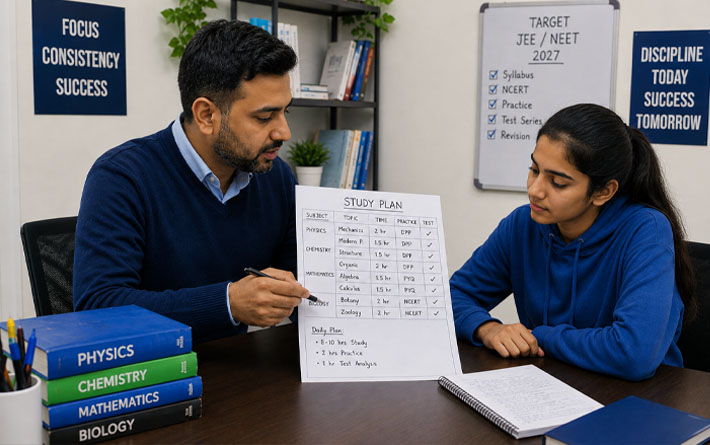
The smartest jee coaching comparison is personal. Visit or review the actual program, attend demo sessions if available, ask about doubt support, check the test system, and understand the weekly schedule before committing. Do not choose only because a format is popular, affordable, or heavily advertised. Choose the model that keeps the student learning, practicing, testing, and improving week after week.


 STUDY MATERIALS
 COURSES
 MORE
MORE
 SUCCESS STORY
 ADMISSION
 STORE
STORE