How to Balance CBSE Boards and JEE Preparation in Classes 11–12
Balancing school, CBSE board exams, and JEE preparation in Classes 11–12 is possible when you stop treating them as three separate battles. The smartest approach is to build one connected study system where NCERT clarity supports board marks, JEE practice deepens problem-solving, and revision keeps both tracks moving. This guide shows you how to plan your time, choose the right jee study materials, revise efficiently, and avoid the common mistake of preparing hard but in the wrong direction.
Why is it hard to manage CBSE boards and JEE preparation together?
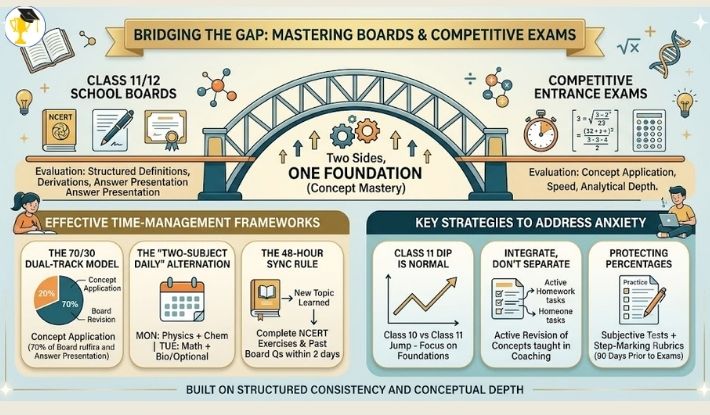
It feels hard because CBSE boards and JEE test the same subjects in different ways. Board exams reward clear theory, step-by-step presentation, definitions, derivations, diagrams, and NCERT-based understanding. JEE rewards speed, accuracy, concept application, mixed-topic thinking, and comfort with unfamiliar problems.
The pressure increases in Classes 11–12 because the syllabus is large and cumulative. If Class 11 concepts remain weak, Class 12 topics in Physics, Chemistry, and Mathematics become harder to handle. A good cbse boards jee preparation plan does not ask you to study twice for everything. It teaches you to study once for understanding, then practise differently for boards and JEE.
What should your study priority be before starting?
Your first priority should be concept clarity from the school syllabus and NCERT, followed by JEE-level practice once the basics are stable. Do not jump directly into advanced questions before you can explain the chapter, solve standard examples, and write board-style answers. Strong fundamentals reduce stress because the same concept can then be revised for both exams with different practice methods.
Before making a timetable, check three things honestly:
-
Your current class level: Are you in Class 11 building foundations, or Class 12 managing boards with JEE revision?
-
Your subject strength: Which subject needs the most time: Physics, Chemistry, or Mathematics?
-
Your exam stage: Are school tests, pre-boards, practicals, mock tests, or JEE sessions approaching?
-
Your backlog: Which chapters are incomplete, weak, or forgotten?
-
Your daily energy: How many focused hours can you actually study after school or coaching?
This self-check prevents unrealistic planning. A timetable that looks perfect on paper but ignores school hours, homework, travel, fatigue, and revision will collapse quickly. Start with what is sustainable, then increase intensity when your routine becomes stable.
1. Build one combined syllabus map
Begin by writing all chapters for Physics, Chemistry, and Mathematics from Classes 11 and 12 in one place. Mark each chapter as strong, average, weak, or not started. Then mark whether it is important for CBSE board exams, JEE, or both. Most chapters overlap, but the style of preparation differs.
For board-focused preparation, note what needs written practice: derivations, reactions, definitions, labelled diagrams, proofs, NCERT exercises, and long-answer explanations. For JEE-focused preparation, note what needs numerical practice, formula application, conceptual traps, multi-step problems, and timed tests.
This map becomes your control sheet. Instead of asking, “What should I study today?” you can see exactly which chapter needs concept study, which needs board writing practice, and which needs JEE problem-solving. Update it weekly so it reflects your real progress, not your hope.
A simple marking system works well:
-
Green: Concepts clear and questions are manageable.
-
Yellow: Theory understood but practice is weak.
-
Red: Chapter needs full revision or first-time study.
-
Blue: Board writing practice still pending.
-
Purple: JEE-level questions still pending.
2. Study NCERT first, then move to JEE practice
NCERT is not only for boards. It gives the base language, definitions, diagrams, examples, and conceptual structure that help in school exams and many objective questions. In Chemistry especially, NCERT reading can be extremely useful because small lines, exceptions, reactions, and trends often matter.
Use this sequence for each chapter:
-
Read the NCERT or school text carefully. Focus on definitions, solved examples, diagrams, laws, reactions, and formulas.
-
Make short notes. Write formulas, key concepts, exceptions, and common mistakes in your own words.
-
Solve NCERT examples and exercises. This supports CBSE board exams and confirms that the basics are clear.
-
Practise board-style answers. Write answers in steps, not just mentally.
-
Move to JEE problems. Start with basic objective questions, then medium-level problems, then mixed or advanced sets.
-
Review mistakes. Add every repeated error to a mistake notebook.
Do not treat JEE study materials as a replacement for NCERT. They are best used after the chapter foundation is clear. If you reverse the order, you may spend hours on tough questions without understanding the reason behind each step.
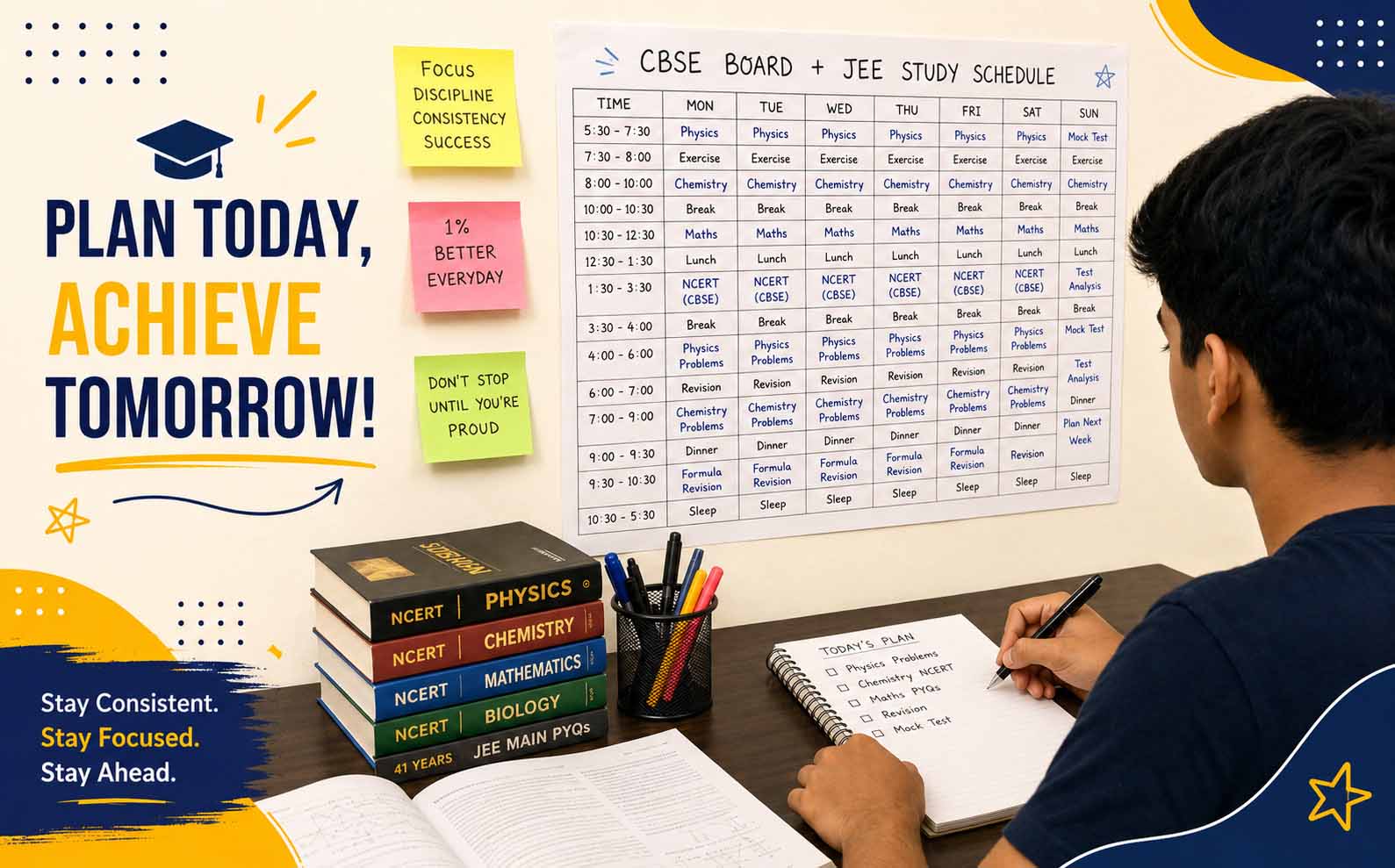
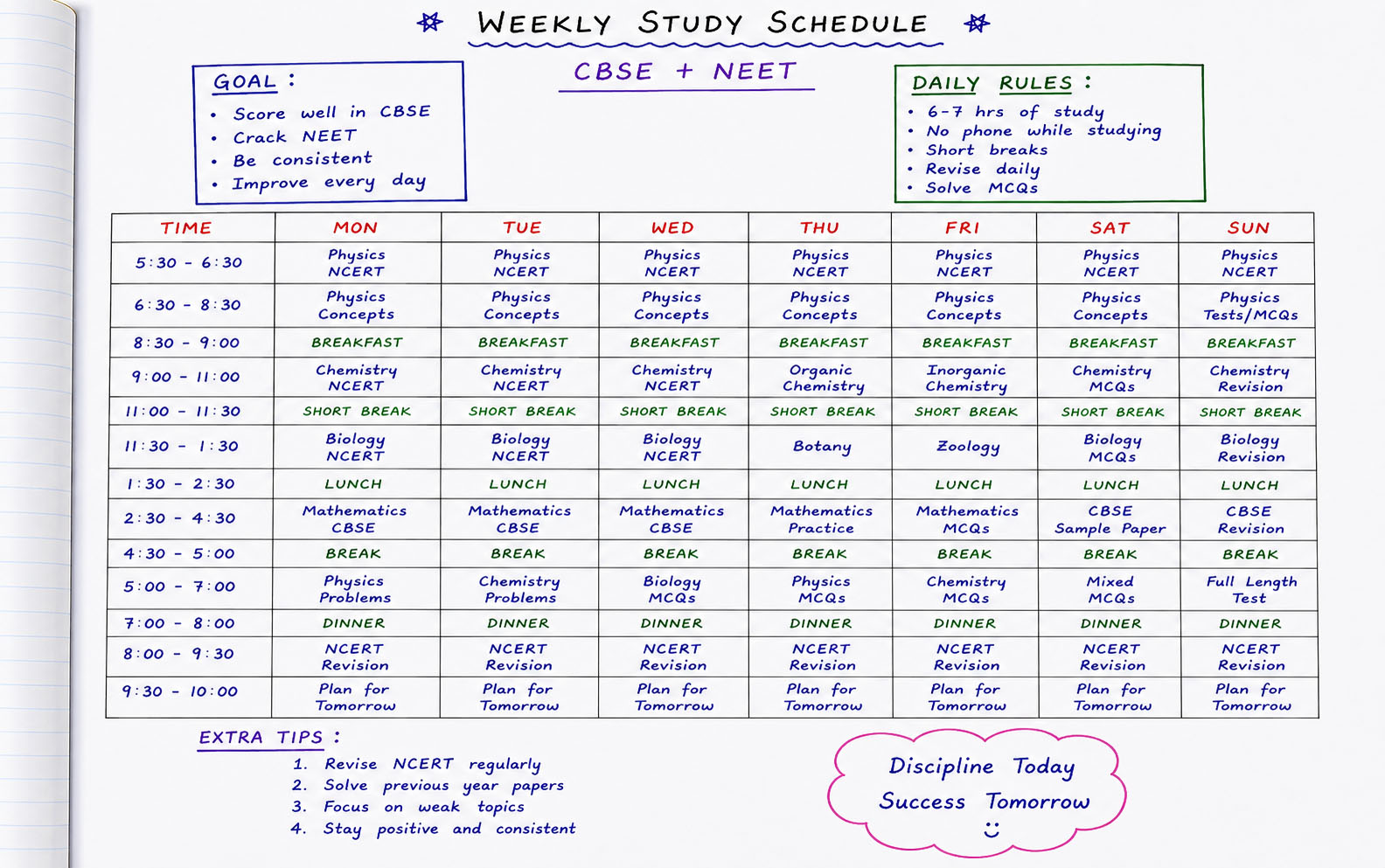
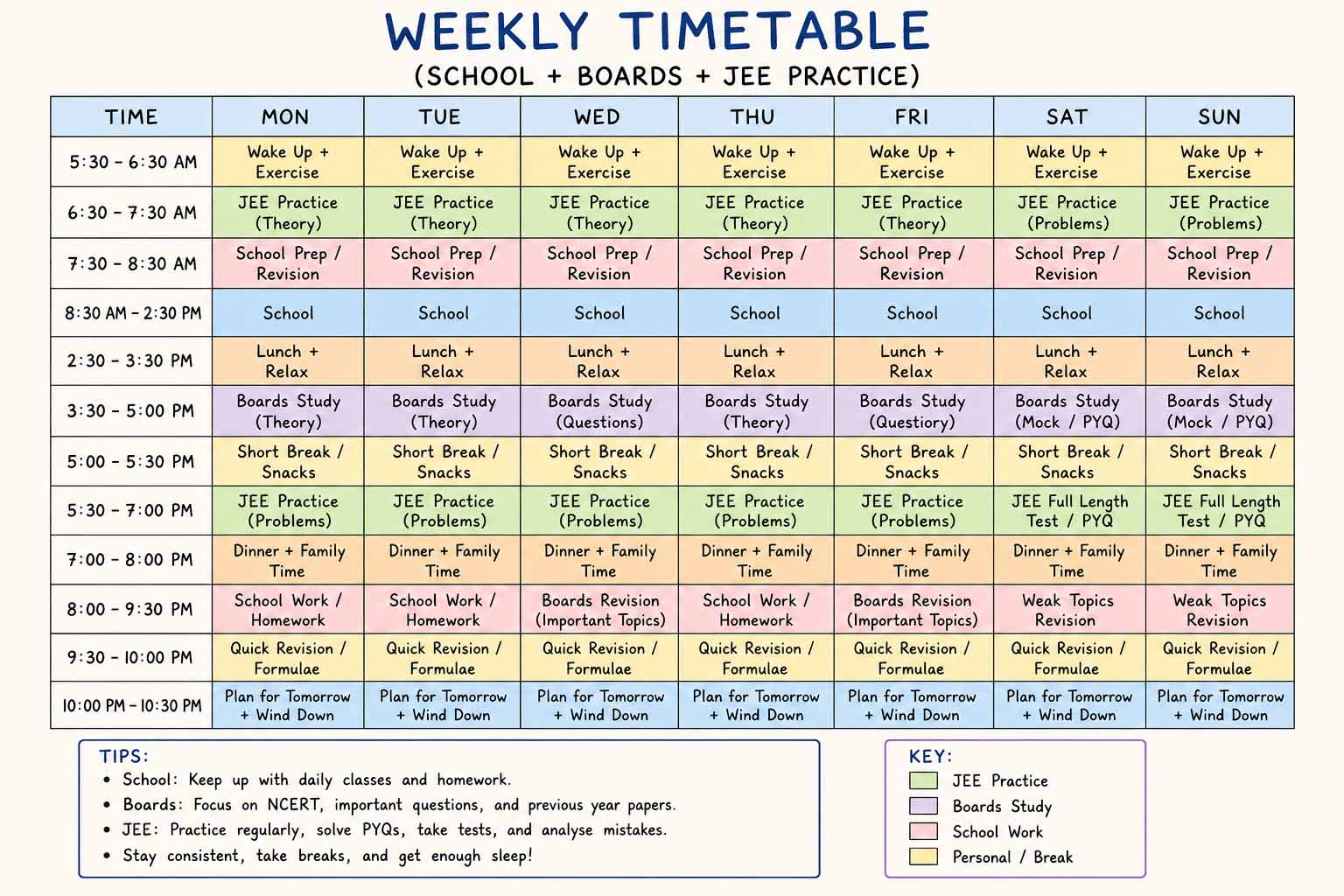
3. Create a weekly timetable with fixed study blocks
A daily timetable is useful, but a weekly timetable is more realistic for Classes 11–12. Some days school homework is heavy. Some days coaching tests or practical files take time. A weekly plan gives flexibility while still keeping targets visible.
Divide your week into four types of blocks:
-
Concept blocks: Learn or revise theory from NCERT, class notes, or coaching notes.
-
JEE practice blocks: Solve objective questions with a timer.
-
Board writing blocks: Practise long answers, derivations, sample-paper questions, and presentation.
-
Revision blocks: Revisit formulas, mistakes, short notes, and weak chapters.
For a school day, one to three focused blocks may be enough depending on your schedule. For weekends or holidays, you can add longer sessions for mock tests, backlog clearance, and deeper revision. The key is not to study every subject every day, but to touch every subject meaningfully across the week.
A balanced weekly pattern may include:
-
Physics concepts and numericals on alternate days.
-
Chemistry split into Physical, Organic, and Inorganic sessions.
-
Mathematics problem practice almost daily, even if the session is short.
-
One board-answer writing session for each subject every week.
-
One test or timed practice session on the weekend.
-
One backlog slot reserved for unfinished topics.
4. Use school classes as your first revision cycle
Many students mentally separate school from JEE preparation and then feel they have no time. Instead, use school classes as the first layer of revision. Listen actively, mark doubts, complete classwork seriously, and treat school tests as checkpoints. If a topic is being taught in school, revise the same topic at home before moving to unrelated advanced material.
This saves time because the topic stays fresh. After school explains a chapter, your home study can focus on strengthening it through NCERT exercises, board-style writing, and selected JEE questions. You do not need to “restart” the chapter later from zero.
School exams also train presentation, speed, and answer structure. These skills matter in CBSE board exams but are often ignored by JEE aspirants until pre-boards begin. If you practise them throughout the year, board preparation becomes a steady habit rather than a last-minute emergency.
5. Select jee study materials carefully
Too many books can damage consistency. The goal is not to collect every recommended resource; it is to complete a limited set properly. Choose jee study materials that match your current level and allow gradual progress from basic to advanced questions.
A practical resource stack can include:
-
NCERT textbooks for theory, examples, exercises, and board alignment.
-
School or coaching notes for classroom explanations and quick revision.
-
One main question bank per subject for JEE practice.
-
Previous years’ JEE questions for exam-pattern familiarity.
-
CBSE sample papers or board-style papers for written practice.
-
A mistake notebook for repeated errors, formulas, and tricky concepts.
Avoid switching materials every time you find a difficult chapter. Difficulty is not always a sign that the book is bad; often it means your concept base or practice sequence needs repair. Finish basic and medium questions before attempting advanced ones. Quality of completion matters more than the number of resources on your shelf.
6. Separate board writing from JEE problem-solving
The same chapter may require two different outputs. In boards, you must show steps, write definitions correctly, draw neat diagrams, mention units, and present answers clearly. In JEE, you must solve quickly, eliminate wrong options, manage time, and avoid calculation traps.
For each chapter, set aside separate practice time for both formats. For example, after studying Electrostatics, you might solve NCERT questions and derivations for board preparation, then practise JEE numericals on electric field, potential, and capacitance. After studying Chemical Bonding, you may revise NCERT theory for boards and then attempt conceptual objective questions for JEE.
Board writing practice should include:
-
Writing full answers, not just reading solutions.
-
Practising derivations step by step.
-
Labelling diagrams clearly.
-
Using correct terms and units.
-
Reviewing answer presentation after completion.
JEE practice should include:
-
Timed sets of questions.
-
Mixed-topic practice after chapter completion.
-
Error analysis after every test.
-
Formula recall without looking at notes.
-
Revisiting unsolved questions after a gap.
7. Make revision non-negotiable
Revision is where most plans succeed or fail. A chapter studied once is not a chapter mastered. Without revision, formulas fade, reactions mix up, concepts become slow, and old mistakes return during tests.
Use three layers of revision. First, revise the same day you study a topic by reviewing notes and solving a few questions. Second, revise at the end of the week by checking formulas, errors, and weak examples. Third, revise monthly through mixed practice and short tests.
Your revision tools should be simple:
-
Formula sheets: Keep Physics and Mathematics formulas chapter-wise.
-
Reaction lists: Maintain Organic and Inorganic Chemistry reactions separately.
-
Mistake notebook: Record why you got a question wrong, not just the correct answer.
-
Short notes: Keep one-page chapter summaries for fast recall.
-
Marked questions: Reattempt questions that were difficult, tricky, or important.
Do not wait for the syllabus to finish before revising. Revision must run beside new learning. This is especially important for Class 11 students because weak Class 11 chapters can quietly create problems throughout Class 12.
8. Clear backlogs with a controlled plan
Backlogs are common, but they become dangerous when ignored. The wrong approach is to stop current studies completely and try to finish all old chapters at once. This creates a new backlog in ongoing school topics.
Use a controlled backlog plan instead:
-
List every pending chapter. Be honest and specific.
-
Rank chapters by dependency. Prioritise topics needed for upcoming lessons or tests.
-
Assign small slots. Use three to five backlog sessions per week, depending on workload.
-
Complete basics first. Read theory, solve standard examples, and make notes.
-
Add practice gradually. Move from NCERT to JEE questions only after the foundation is stable.
-
Track closure. A backlog is closed only when you can solve basic questions without help.
If the backlog is very large, do not aim for perfection immediately. Aim first for functional understanding so the chapter stops blocking future topics. You can deepen practice during revision cycles.
How should you handle the final months before CBSE board exams?
In the final months before CBSE board exams, shift more time toward NCERT revision, sample papers, school notes, practical work, and written answer practice while keeping JEE concepts alive through short daily problem sets. This is not the time to abandon JEE completely, but the balance should temporarily favour boards because presentation and syllabus coverage need focused attention.
Use this phase to consolidate rather than start too many new resources. Solve board-style papers under timed conditions and review how your answers look on paper. Check whether you are missing steps, writing incomplete definitions, skipping units, or losing marks through careless presentation.
A sensible final-phase routine includes:
-
Daily NCERT revision for the board subject closest to the exam.
-
Written practice for long answers, derivations, and numerical solutions.
-
Short JEE problem sets to maintain speed and memory.
-
Formula and reaction revision every day.
-
Regular review of previous mistakes.
-
Enough sleep to avoid burnout during exams.
After board exams, you can increase JEE mock tests and problem-solving intensity again. The transition becomes easier if you maintained at least light JEE practice during boards.
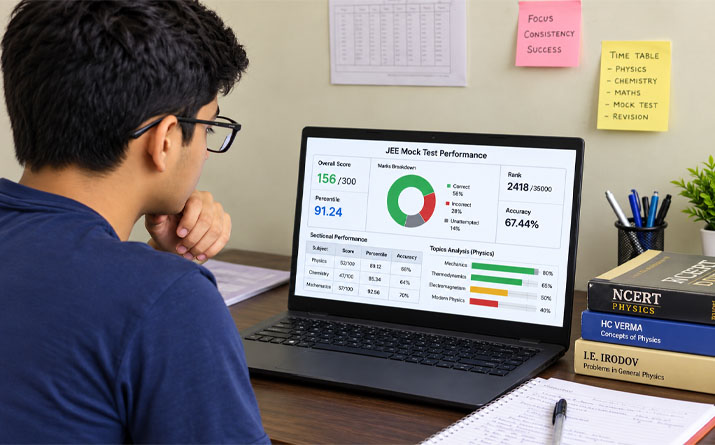
9. Use tests to diagnose, not just score
Tests are not only for marks. They show you where your preparation is weak: concept gaps, speed issues, silly mistakes, poor revision, calculation errors, or panic under time pressure. A low score is useful if it tells you exactly what to fix next.
After every test, spend time analysing it before starting new chapters. Divide mistakes into categories such as concept not clear, formula forgotten, calculation mistake, question misread, time pressure, or guessed incorrectly. This turns test review into a study plan.
Follow this post-test routine:
-
Re-solve wrong questions without seeing the solution. Check whether the issue was knowledge or execution.
-
Read the solution only after trying again. Understand the method, not just the answer.
-
Mark repeat errors. If the same mistake appears often, it needs urgent revision.
-
Update your short notes. Add formulas, traps, or exceptions.
-
Reattempt marked questions later. A question is truly fixed only when you can solve it after a gap.
For board tests, also review answer presentation. For JEE tests, review speed, accuracy, and question selection. Both reviews are important, but they measure different skills.
10. Protect your health and consistency
Classes 11–12 can become exhausting if every hour is treated as a battle. Long-term preparation needs sleep, breaks, meals, movement, and realistic planning. A tired brain may sit with books for hours without absorbing much.
Build consistency with small habits. Study at fixed times when possible. Keep your phone away during focused blocks. Take short breaks between sessions. Avoid comparing your daily routine with someone else’s because school hours, coaching load, commute, and learning speed differ for every student.
Watch for warning signs such as constant fatigue, inability to revise, frequent headaches, panic before tests, or complete loss of motivation. If that happens, reduce the load briefly, reorganise your plan, and speak to a teacher, parent, mentor, or counsellor. Sustainable preparation is not lazy preparation; it is preparation that lasts.
A practical weekly checklist
Use this checklist at the end of every week to keep your plan under control:
-
Did I revise all three subjects at least once?
-
Did I complete school homework and class notes properly?
-
Did I solve NCERT or board-style questions for current chapters?
-
Did I practise JEE questions from selected jee study materials?
-
Did I analyse at least one test or timed practice set?
-
Did I update my mistake notebook?
-
Did I clear at least one small backlog target?
-
Did I revise formulas, reactions, or short notes?
-
Did I sleep enough to study well the next week?
If you miss targets, do not rewrite the entire plan dramatically. Carry forward only the most important pending work and reduce low-priority tasks. Consistency grows from weekly correction, not perfect execution.
Turn preparation into a repeatable system
The best way to balance CBSE boards and JEE preparation is to connect them through a repeatable cycle: learn the concept, finish NCERT, practise board answers, solve JEE questions, revise, test, and correct mistakes. This cycle works because it respects both exam formats without doubling your workload.
Classes 11–12 are demanding, but they become manageable when every week has clear priorities. Keep your resources limited, your revision active, and your tests diagnostic. With steady planning, cbse boards jee preparation becomes less about pressure and more about building control one chapter at a time.


 STUDY MATERIALS
 COURSES
 MORE
MORE
 SUCCESS STORY
 ADMISSION
 STORE
STORE