How to Balance CBSE Boards and NEET Preparation in Classes 11–12
Balancing CBSE boards with NEET preparation in Classes 11–12 is less about studying all day and more about making one smart system for both goals. Since Physics, Chemistry, and Biology overlap heavily, the right approach is to use CBSE concepts as your base, then add NEET-level objective practice, revision, and mock tests. This practical neet preparation guide shows you how to plan your week, study each subject, revise efficiently, and avoid the common mistakes that make students feel overloaded.
What is the best way to manage CBSE and NEET together?
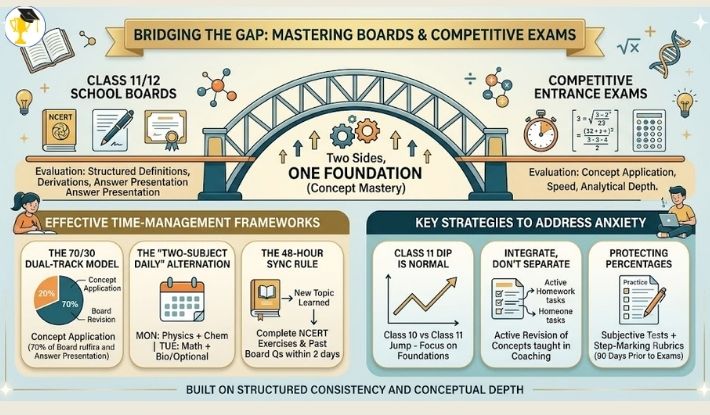
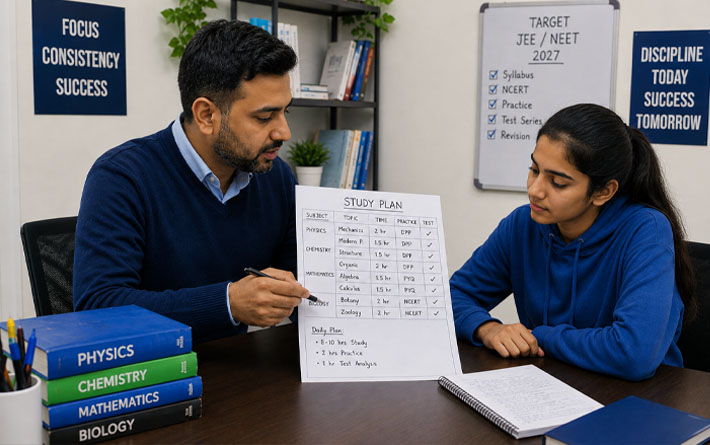
The best way to manage CBSE and NEET together is to treat them as connected exams, not separate battles. CBSE preparation builds your theory, diagrams, derivations, and written presentation, while NEET preparation sharpens your speed, accuracy, MCQ practice, and application skills. Your neet study plan should therefore start with NCERT-based learning, include daily question practice, and reserve regular time for board-style writing and school exams.
The key is consistency. If you ignore CBSE during NEET preparation, school tests become stressful and your basics suffer. If you study only for boards, you may understand chapters but lack the speed and accuracy required for NEET. A balanced routine gives both exams their place without doubling your workload.
Start with a realistic combined study calendar
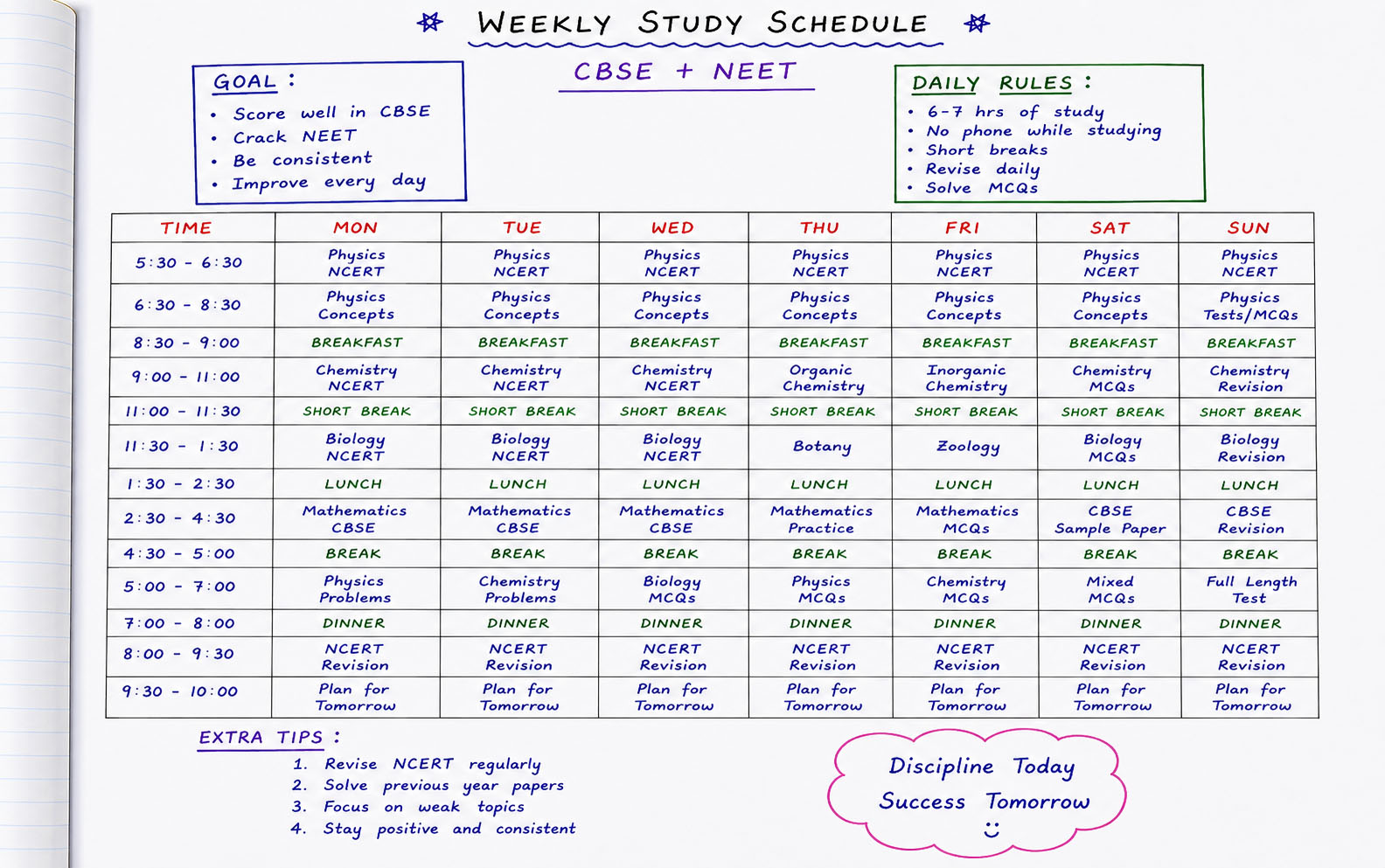
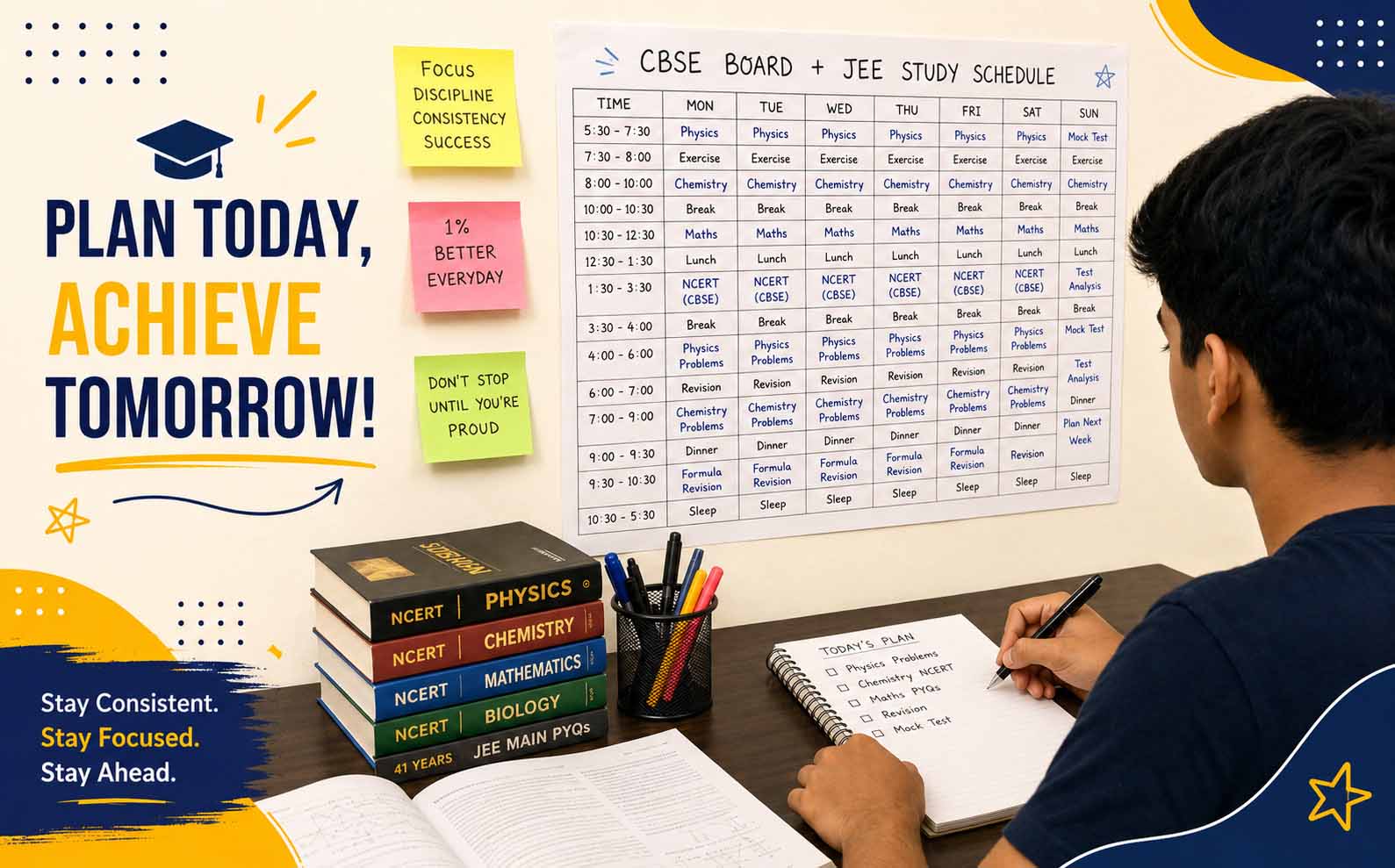
Before making a timetable, list your fixed commitments: school hours, coaching classes, travel time, homework, sleep, meals, and weekly tests. Many students create ideal schedules that look impressive but collapse within three days because they ignore real-life energy levels. A useful neet study plan should fit your actual day, not an imaginary perfect day.
Plan in weekly blocks instead of only daily targets. For example, decide which chapters you will complete in Biology, which Physics numericals you will practise, and which Chemistry reactions or concepts need revision by Sunday. This gives you flexibility if one day gets disturbed by school work or a test.
A strong weekly plan should include:
-
Concept learning: NCERT reading, class notes, and teacher explanations.
-
NEET MCQ practice: Topic-wise questions after finishing each concept.
-
CBSE writing practice: Definitions, derivations, diagrams, long answers, and sample questions.
-
Revision slots: Short, repeated reviews instead of last-minute cramming.
-
Mock or test analysis: Time to check mistakes, not just attempt tests.
-
Buffer time: One light slot per week to catch up on pending topics.
1. Build every chapter from NCERT first
Start each chapter with NCERT because it is the common foundation for cbse neet preparation. Read the chapter actively, underline definitions, mark diagrams, and note important examples. Do not rush to advanced question banks before you can explain the basic idea in simple language.
For Biology, NCERT should be read line by line. Many NEET Biology questions test direct facts, processes, examples, and terminology, while CBSE answers also require clear wording and labelled diagrams. After reading, close the book and recall the main headings, flow of the topic, and important terms.
For Chemistry, NCERT helps you organise theory, reactions, trends, exceptions, and definitions. In Physical Chemistry, understand formulas and conditions before solving questions. In Organic and Inorganic Chemistry, keep a separate revision notebook for reactions, mechanisms, named reactions, exceptions, and key observations.
For Physics, NCERT alone may not be enough for practice, but it is still important for definitions, derivations, conceptual clarity, and board-style explanations. Read the theory once, understand formulas, and then move quickly into numerical practice.
2. Convert each CBSE chapter into NEET practice
Once you understand a topic, practise NEET-style MCQs immediately. This step connects board learning with exam speed. If you wait too long, you may remember the theory but struggle to apply it under pressure.
Use this simple chapter flow:
-
Read the NCERT topic carefully. Focus on meaning, examples, diagrams, and formulas.
-
Revise class or coaching notes. Fill gaps and clarify doubts.
-
Solve basic questions first. Build confidence before moving to mixed or difficult MCQs.
-
Attempt NEET-level MCQs. Practise accuracy, speed, and elimination.
-
Write one or two CBSE-style answers. This protects your board preparation.
-
Mark mistakes in an error notebook. Record the concept, not just the wrong option.
This method prevents the common problem of studying theory for boards and then starting NEET preparation from zero. Each chapter becomes complete only when you can write about it, solve questions from it, and revise it quickly.
3. Give Biology daily attention
Biology carries major weight in NEET preparation and also demands strong memory, clarity, and repeated revision. Study Biology every day, even if only for a short focused session. Long gaps make factual chapters harder to retain.
A useful Biology session can be divided into three parts. First, read or revise NCERT for 25 to 40 minutes. Second, practise topic-wise MCQs for 30 to 45 minutes. Third, review mistakes and reread the exact lines connected to those mistakes.
For CBSE boards, add answer-writing practice. Learn how to present differences, flowcharts, labelled diagrams, and process-based answers. For NEET, train yourself to spot keywords in questions because small words can change the answer.
Strong Biology neet study tips include:
-
Revise diagrams with labels, functions, and related terms.
-
Make short lists for examples, classifications, diseases, hormones, enzymes, and cycles.
-
Use active recall instead of only rereading.
-
Practise assertion-reason and statement-based questions regularly.
-
Keep NCERT as your final authority when notes and books differ.
4. Practise Physics in small daily sets
Physics becomes difficult when students only watch explanations and postpone problem-solving. To balance CBSE and NEET, solve Physics every day in manageable sets. Even 20 quality questions with proper analysis are better than three hours of passive reading.
Begin with formulas and concepts, then solve examples, then attempt MCQs. For board exams, also practise derivations, definitions, diagrams, graphs, and stepwise solutions. NEET tests the same concepts differently, so your goal is to move from understanding to quick application.
When a Physics question goes wrong, identify the real reason. Was the formula wrong? Was the concept unclear? Did you make a calculation error? Did you miss a unit conversion? This analysis is one of the most important cbse exam tips because it improves both written solutions and MCQ accuracy.
A balanced Physics routine may include:
-
10 minutes revising formulas from one chapter.
-
30 to 45 minutes solving numerical questions.
-
15 minutes checking mistakes and rewriting key steps.
-
Two or three board-style derivations per week.
-
One mixed-topic practice session every weekend.
5. Separate Chemistry into three study methods
Chemistry becomes easier when you stop treating it as one subject with one method. Physical, Organic, and Inorganic Chemistry need different kinds of preparation. A good neet study plan gives each branch its own approach.
For Physical Chemistry, focus on concepts, formulas, units, graphs, and numerical practice. Maintain a formula sheet and revise it often. After solving a question, check whether you used the right concept or simply copied a familiar pattern.
For Organic Chemistry, learn mechanisms and reaction logic instead of memorising everything separately. Understand electron movement, reagents, conditions, and product formation. For CBSE, practise conversion questions and reasoning-based answers; for NEET, practise reaction sequences and concept-linked MCQs.
For Inorganic Chemistry, repeated NCERT revision is essential. Make short notes for trends, exceptions, colours, ores, compounds, and reactions. Do not leave Inorganic Chemistry for the end because it improves with frequent exposure, not one-time reading.
How much time should you give to boards and NEET each week?
Most weeks, NEET-style preparation can take the larger share because it includes deep concept learning and MCQ practice, but CBSE work must remain consistent. During regular school months, keep short board-focused slots for writing practice, diagrams, derivations, and school test preparation. As board exams come closer, increase board-style revision while maintaining NEET MCQs to avoid losing speed.
A practical weekly balance can look like this:
-
Monday to Friday: Focus on current school and coaching topics, with daily MCQs.
-
Saturday: Revise the week’s chapters and complete pending assignments.
-
Sunday: Attempt a test, analyse errors, and practise one board-style paper section.
-
Before school exams: Shift more time to CBSE presentation and written answers.
-
After school exams: Return to stronger NEET question practice and backlog clearing.
Do not measure preparation only by hours. Measure it by completed chapters, corrected mistakes, revised concepts, and test improvement. Six focused hours are more valuable than ten distracted hours with no review.
6. Use school exams as revision checkpoints
School exams are not interruptions if you use them properly. They force you to revise chapters in a fixed time and reveal weak areas before the final board exam. Instead of complaining that school tests disturb NEET preparation, convert them into structured revision.
Before a school test, revise NCERT theory, diagrams, definitions, and derivations. After the test, return to the same chapter and solve NEET MCQs from the weak topics. This creates a powerful two-layer revision: first written clarity, then objective accuracy.
For better CBSE performance, practise presentation. Write answers in points where suitable, label diagrams neatly, show steps in numerical solutions, and use correct scientific terms. These cbse exam tips may look simple, but they protect marks when you already know the content.
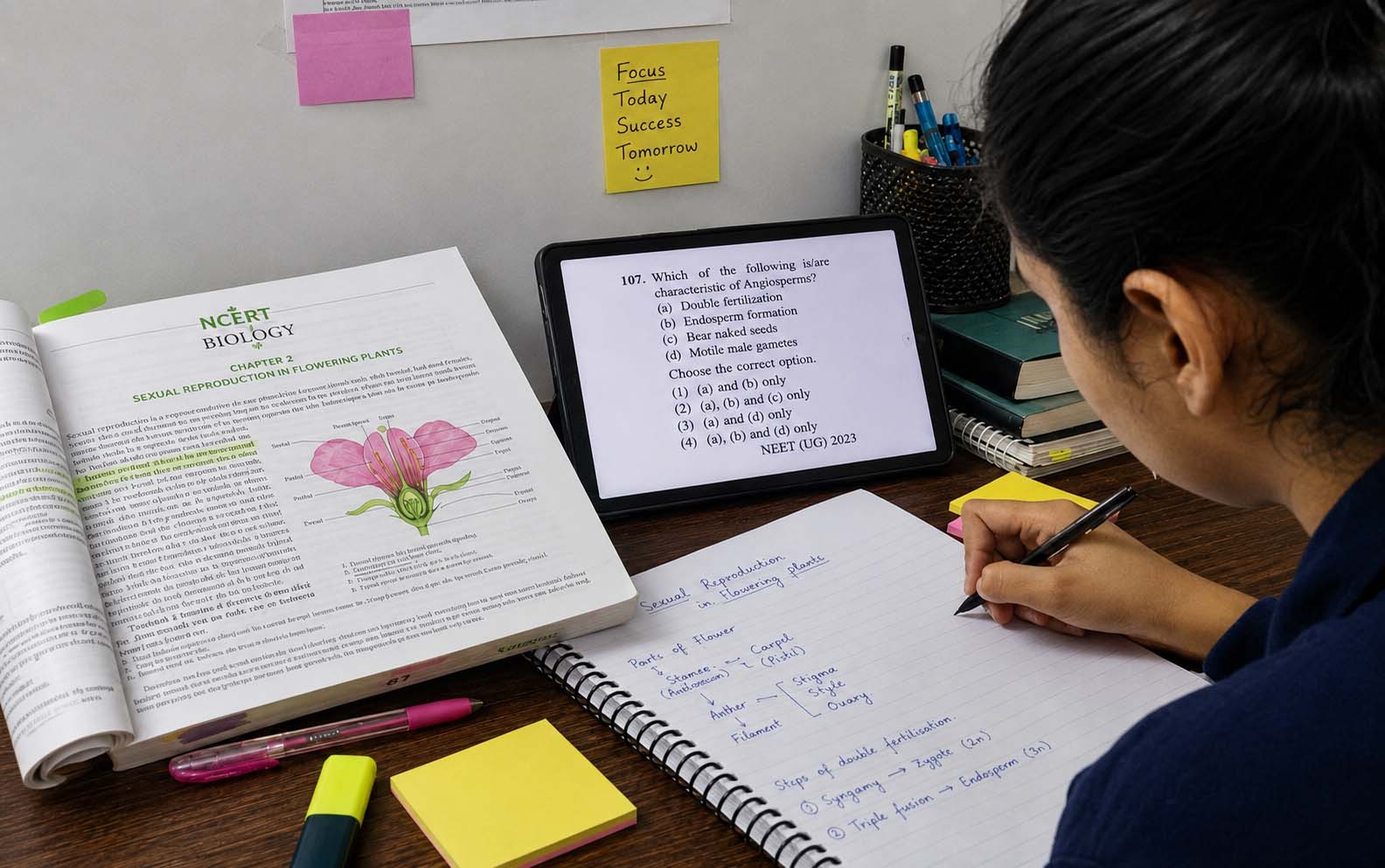
7. Create and maintain an error notebook
An error notebook is one of the simplest and most effective neet study tips. It prevents you from repeating the same mistakes across tests. Keep it short, organised, and easy to revise.
Do not copy full questions unless necessary. Write the chapter name, the mistake type, the correct concept, and the lesson learned. For example, if you made an error in electrostatics, note whether it was due to sign convention, formula confusion, unit conversion, or weak theory.
Your error notebook can include:
-
Misread Biology statements.
-
Confusing NCERT facts or examples.
-
Incorrect formulas or conditions.
-
Organic reaction errors.
-
Inorganic exceptions.
-
Calculation mistakes.
-
Time-management problems during tests.
-
Board answer points you forgot to include.
Revise this notebook before every mock test, school exam, and major revision cycle. Over time, it becomes more valuable than any random new question bank because it targets your personal weak spots.
8. Take mock tests without ignoring analysis
Mock tests are necessary, but test analysis is where improvement happens. Many students attempt test after test without understanding why their score is stuck. After every test, spend enough time reviewing wrong answers, guessed answers, and questions that took too long.
Divide your test mistakes into categories. Concept mistakes need theory revision. Silly mistakes need slower reading and better checking habits. Time mistakes need practice with section strategy. Guessing mistakes need better decision-making and stronger elimination skills.
For NEET, practise full-length tests when your syllabus coverage improves, but also use part tests for current chapters. For CBSE, attempt sample-style papers and timed writing sections so your hand, speed, and presentation are exam-ready. Both exams reward preparation under realistic conditions.
9. Revise in cycles instead of cramming
Revision should not begin after the syllabus ends. In Classes 11–12, chapters are long, and forgetting is natural if you do not revisit them. Use short revision cycles to keep older topics alive while learning new ones.
Try this revision rhythm:
-
Same day: Review class notes and solve a few questions.
-
After three days: Revisit formulas, diagrams, and marked NCERT lines.
-
After one week: Solve mixed MCQs and check your error notebook.
-
After one month: Attempt a chapter test or combined revision set.
-
Before exams: Practise board answers and NEET questions together.
This method reduces panic before both boards and NEET. You do not need to relearn everything from scratch because you have already kept the material active.
What should you do when backlogs start building?
When backlogs build, stop trying to finish everything at once and prioritise chapters based on urgency, dependency, and exam relevance. First, protect current topics because they are being taught now. Then clear older backlogs in small fixed slots instead of sacrificing sleep or skipping new lessons.
Use a three-list method:
-
Must do now: Topics needed for current class tests, coaching tests, or connected chapters.
-
Must do soon: Important chapters that need concept repair or MCQ practice.
-
Can schedule later: Topics that need revision but are not blocking current learning.
Set a backlog slot three or four times a week. Keep it focused: one subtopic, one concept video or note review if needed, and one question set. Backlogs feel huge when they are vague; they become manageable when they are broken into exact tasks.
Avoid the trap of restarting the entire syllabus every time you feel behind. Restarting gives emotional comfort but wastes time. Continue with current work, repair old gaps steadily, and use tests to identify which backlogs truly need attention.
10. Protect sleep, health, and attention
A balanced plan fails if your body and mind are exhausted. NEET and CBSE preparation require memory, calculation, reading accuracy, and emotional stability. Sleep is not a reward after studying; it is part of studying well.
Keep your phone away during deep study blocks. Use short breaks, stretch, drink water, and avoid comparing your timetable with every topper routine online. Your goal is not to copy someone else’s day but to build a routine you can repeat for months.
If stress becomes intense, talk to a parent, teacher, mentor, or counsellor. Asking for help early is better than silently losing confidence. A sustainable routine will always beat a dramatic routine that lasts only one week.
A simple daily routine you can adapt
Use this sample as a starting point, not a rule. Adjust it around school, coaching, commute, and your energy levels.
-
Morning quick revision: Revise formulas, Biology facts, or Chemistry reactions for 20 to 30 minutes.
-
School hours: Pay attention in class and mark doubts immediately.
-
Post-school reset: Rest, eat, and take a short break before serious study.
-
Main study block: Complete the day’s primary chapter or coaching topic.
-
MCQ practice: Solve topic-wise NEET questions from the same concept.
-
CBSE reinforcement: Write one answer, derivation, diagram, or numerical solution.
-
Error review: Update your mistake notebook for 10 minutes.
-
Night revision: Quickly recall what you studied before sleeping.
This routine works because it connects learning, practice, writing, and revision in the same day. You can shorten it on heavy school days and expand it on holidays.
Final checklist for balanced preparation
Before ending each week, ask yourself whether your preparation covered both exams in a practical way. This checklist will help you stay honest without overthinking.
-
Did I read the relevant NCERT topics carefully?
-
Did I solve NEET MCQs from the chapters I studied?
-
Did I practise CBSE-style written answers, diagrams, or derivations?
-
Did I revise older topics at least once?
-
Did I analyse my mistakes after tests?
-
Did I clear at least part of my backlog?
-
Did I sleep enough to study effectively the next day?
Balancing boards and NEET is a long process, but it becomes manageable when your daily actions are clear. Build concepts through CBSE, sharpen application through NEET practice, revise in cycles, and keep correcting mistakes. With a steady plan, Classes 11–12 can become the foundation for both strong board performance and confident medical entrance preparation.


 STUDY MATERIALS
 COURSES
 MORE
MORE
 SUCCESS STORY
 ADMISSION
 STORE
STORE