Small-Batch vs Large-Batch Coaching: What Changes for a Student?
Coaching format can change how a student learns, asks questions, stays accountable, and builds confidence. Small-batch coaching usually offers a more personal, focused coaching experience with fewer students in the room, while large-batch coaching often gives learners access to a wider peer group, broader discussion, and a more scalable structure. The better choice depends on the student’s goals, learning habits, need for feedback, and comfort level in a group coaching environment.
Which coaching format helps a student learn better?
The best coaching format is the one that matches how the student actually learns. A student who needs regular feedback, correction, and closer guidance will usually benefit more from small-batch coaching. A student who is already self-driven, comfortable learning in a crowd, and able to filter general advice may do well in large-batch coaching.
The difference is not simply the number of students. It is the learning experience created by that number. When the batch is smaller, the coach can often notice patterns faster, respond to individual gaps, and adjust explanations based on the group’s progress. When the batch is larger, the structure may be more standardized, which can help students who prefer a fixed pace and a broad classroom rhythm.
For most students, the decision comes down to three questions:
-
How much individual attention does the student need to stay on track?
-
How comfortable is the student with asking questions in front of others?
-
How much structure, peer interaction, and independent practice does the student want?
The core difference between small-batch and large-batch coaching
Small-batch coaching typically creates a closer learning loop between the coach and the student. The coach has fewer learners to observe, so mistakes, confusion, hesitation, and improvement can be easier to identify. This often makes the session feel more interactive and less anonymous.
Large-batch coaching works differently. The coach teaches to a bigger group, so the session is usually designed around common needs rather than individual learning gaps. This can still be effective, especially when the subject is structured, the student is disciplined, and the program provides strong materials or practice routines.
A simple way to compare the two:
-
Small-batch coaching: More individual attention, more chances to ask questions, stronger visibility for each student, and a learning pace that may feel more responsive.
-
Large-batch coaching: More group energy, a broader mix of student questions, more exposure to different learning styles, and a format that may suit students who can learn independently.
Neither model is automatically better. A focused student can succeed in either format. But the coaching environment changes the amount of support the student receives day to day.
Attention and feedback change the most
The biggest practical change for a student is feedback. In small-batch coaching, the coach can usually spend more time noticing how each student is solving problems, writing answers, speaking, presenting, preparing, or practicing. That matters because many students do not struggle only with content. They struggle with the way they apply it.
In a large batch, feedback often becomes broader. The coach may explain common mistakes, answer selected questions, or review patterns that affect many students. This helps the group, but a student with a specific issue may need to take extra initiative to get clarity.
What this means for the student
-
In small-batch coaching: The student is more likely to be seen, questioned, corrected, and encouraged directly. There is less room to hide and more opportunity to build steady improvement.
-
In large-batch coaching: The student may need to self-diagnose more often. They must listen carefully, compare their doubts with those raised by others, and seek help outside the main session when needed.
-
In both formats: Feedback only works if the student acts on it. Coaching can point out the gap, but the student still has to practice, revise, and return with better work.
This is where focused coaching becomes valuable. The more specific the feedback, the easier it becomes for a student to know what to fix next.
Which format gives more confidence to quieter students?
Small-batch coaching often gives quieter students a better chance to participate because the setting feels less intimidating. With fewer people present, asking a question may feel safer, and the coach can invite participation without putting the student under too much pressure. This can gradually build confidence, especially for students who hesitate in large classrooms.
In large-batch coaching, quieter students may remain silent even when they are confused. They might worry that their question is too basic, or they may not get the chance to ask it before the session moves on. Some students adapt well by writing down doubts, using support channels, or asking after class, but others slowly fall behind.
The choice depends on the student’s personality as much as the subject. If a student learns best through discussion, correction, and reassurance, a smaller batch can make participation feel natural. If the student is comfortable observing, taking notes, and following up independently, a larger group can still work well.
Peer learning feels different in each model
Group coaching is not only about the coach. Students also learn by hearing other students ask questions, make mistakes, explain ideas, and share approaches. Both small and large batches offer peer learning, but the quality of that interaction changes.
In small-batch coaching, peer learning is usually more personal. Students may become familiar with each other’s strengths and struggles. Discussions can go deeper because there is more room for back-and-forth conversation.
In large-batch coaching, peer learning is broader. A student may hear many types of questions, including ones they had not considered. The diversity of doubts can be useful, but the experience may feel less connected.
Peer learning comparison
-
Small-batch coaching is stronger for: Collaborative problem-solving, direct discussion, accountability among a close group, and students who learn through conversation.
-
Large-batch coaching is stronger for: Exposure to many question types, a competitive atmosphere, broader classroom energy, and students who like learning from a wide range of examples.
-
Possible challenge in small batches: If the group is too quiet or uneven, discussion may depend heavily on the coach.
-
Possible challenge in large batches: Students may feel like spectators rather than active participants.
The best peer environment is one where the student stays engaged instead of simply attending.
Pace, structure, and flexibility affect daily progress
Small-batch coaching can feel more flexible because the coach may be able to slow down, revisit a topic, or adjust examples when the group needs it. This is helpful when students have uneven foundations or when the subject requires step-by-step correction. The format supports learning that develops through repeated practice and refinement.
Large-batch coaching often follows a firmer plan. The syllabus, schedule, and session flow may be set in advance to serve a wider group. This can be useful for students who need discipline, momentum, and clear coverage of topics over time.
The trade-off is simple: flexibility versus scale. A smaller batch may respond better to student needs, while a larger batch may offer a more fixed rhythm. Students should ask whether they need adaptation or whether they perform better with a predetermined structure.
Which option is better for accountability?
Small-batch coaching usually creates stronger accountability because the coach can more easily notice attendance, participation, homework quality, and repeated mistakes. The student is less likely to disappear into the background. For learners who need external motivation, this can make a meaningful difference.
Large-batch coaching can still build accountability, but it often depends more on systems than personal attention. Assignments, tests, progress tracking, reminders, and doubt-clearing sessions may keep students moving. However, the student must take more responsibility for using those systems consistently.
Accountability differences that matter
-
Small-batch coaching: Better when the student needs regular check-ins, personal nudges, and direct review.
-
Large-batch coaching: Better when the student is disciplined enough to follow a schedule without much personal prompting.
-
Small-batch risk: The student may become too dependent on the coach if independent study is not encouraged.
-
Large-batch risk: The student may attend sessions but avoid the hard work of practice and review.
A good coaching program should build independence in either format. Accountability should not only keep the student present; it should help the student become more consistent.
The student experience side by side
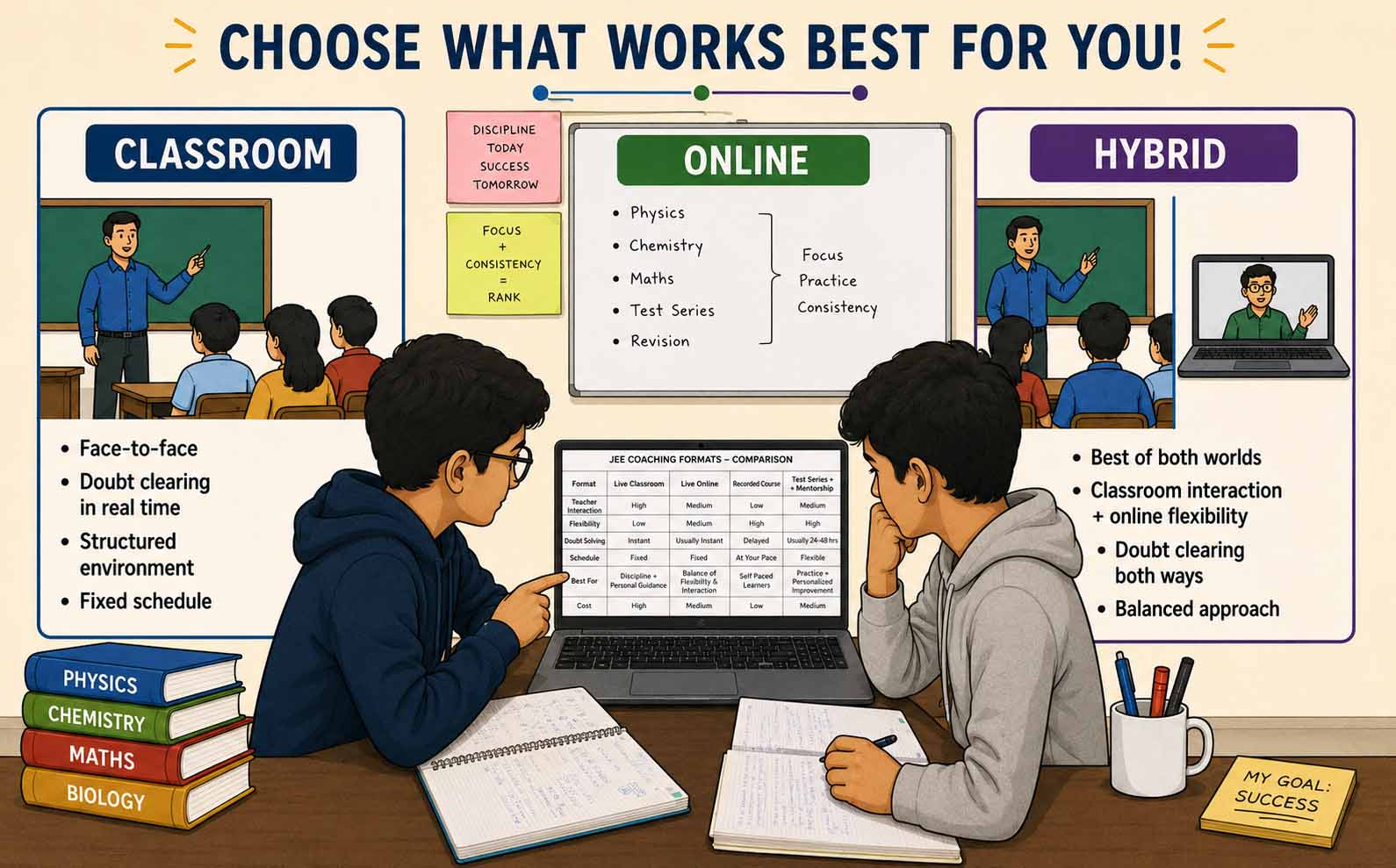
Here is a practical comparison using the same decision points for both formats.
Small-batch coaching
-
Individual attention: Usually higher because the coach works with fewer students.
-
Question asking: Easier for many students, especially those who hesitate in a crowd.
-
Feedback: More likely to be specific to the student’s work, habits, and mistakes.
-
Pace: May be more adaptable if the group needs extra support.
-
Peer learning: More personal and discussion-based.
-
Accountability: Often stronger because participation is more visible.
-
Best fit: Students who need guidance, confidence, correction, and a closer relationship with the coach.
-
Possible limitation: The group may offer less variety in questions and perspectives than a large batch.
Large-batch coaching
-
Individual attention: Usually lower during the main session because the coach is addressing many students.
-
Question asking: Works well for confident students, but quieter students may hold back.
-
Feedback: More general unless the program includes separate review or support options.
-
Pace: Often more standardized and syllabus-driven.
-
Peer learning: Broader, with exposure to more doubts and learning styles.
-
Accountability: Depends more on the student’s discipline and the program’s systems.
-
Best fit: Students who are independent, motivated, comfortable in groups, and able to learn from general instruction.
-
Possible limitation: A student with specific learning gaps may need extra help outside the main class.
Cost and value are not the same thing
Large-batch coaching may seem more accessible because the format can serve more students at once. Small-batch coaching may require more coach time per student. But students should avoid judging value only by the size of the class or the assumed cost.
The better question is what the student receives for the time invested. If a student needs repeated clarification and does not get it, a large batch can become inefficient even if it looks convenient. If a student already understands the basics and only needs structure, a small batch may offer more support than necessary.
Look at value through practical outcomes:
-
Does the format help the student identify mistakes quickly?
-
Does the student get enough chances to practice and receive correction?
-
Does the environment keep the student motivated?
-
Does the program match the student’s current level?
-
Does the student know what to do between sessions?
The right choice is not the one that sounds most premium. It is the one that helps the student make steady progress.
How to choose the right coaching format
Before choosing between small-batch coaching and large-batch group coaching, students and parents should think honestly about learning behavior. A format that works beautifully for one student may frustrate another. The goal is not to choose the most popular option, but the one that removes the student’s biggest barriers.
Use this checklist before enrolling:
-
Identify the student’s main challenge. Is it understanding concepts, staying consistent, asking doubts, practicing enough, or building confidence?
-
Look at participation style. Does the student ask questions easily, or do they need a smaller setting to speak up?
-
Check independence level. Can the student study without reminders, or do they need closer follow-up?
-
Consider the subject difficulty. Topics that require detailed correction may benefit from focused coaching.
-
Review support beyond class. Doubt-solving, assignments, feedback, and progress reviews can change the effectiveness of either model.
-
Match the environment to the goal. Exam preparation, skill-building, confidence development, and remedial support may require different levels of attention.
If the student needs personal guidance, small-batch coaching is often the safer choice. If the student is self-motivated and wants broad exposure in a structured setting, large-batch coaching can be effective.
A clear decision summary
Choose small-batch coaching when the student needs focused coaching, frequent feedback, confidence-building, and a setting where questions are easier to ask. It is especially useful for students who have learning gaps, need accountability, or benefit from a coach noticing their progress closely.
Choose large-batch coaching when the student is independent, comfortable in a bigger group, and able to learn from structured teaching with less personal attention. It can work well for students who want momentum, broad peer exposure, and a consistent group coaching routine.
In the end, the most important change for the student is not batch size alone. It is how that batch size affects attention, feedback, accountability, and confidence. When the coaching format fits the learner, students do more than attend classes; they participate, improve, and know what to work on next.


 STUDY MATERIALS
 COURSES
 MORE
MORE
 SUCCESS STORY
 ADMISSION
 STORE
STORE