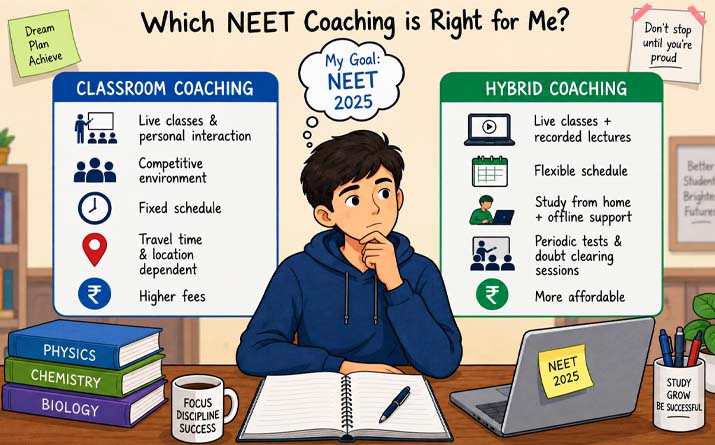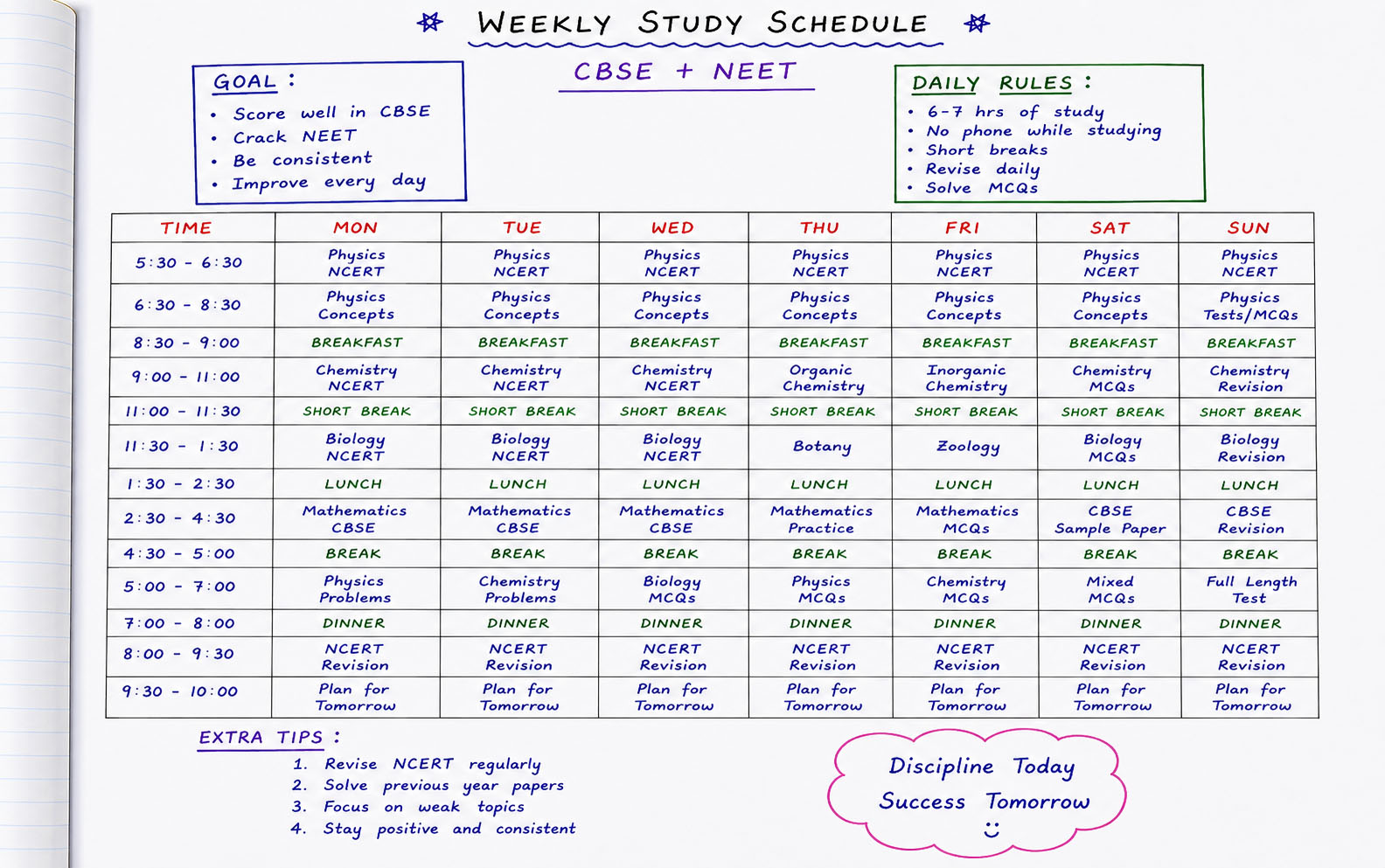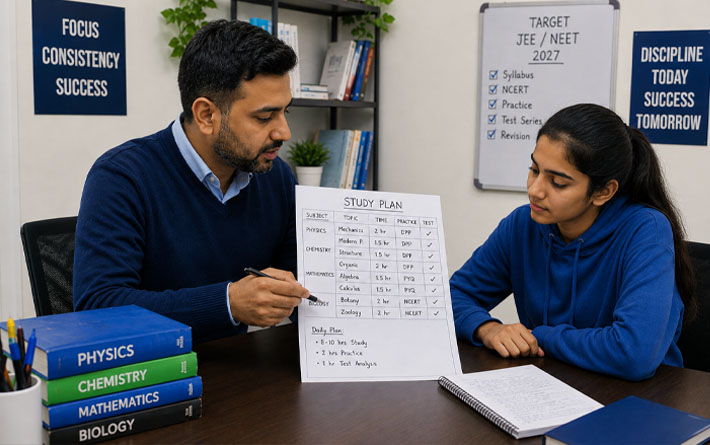


The National Eligibility cum Entrance Test (NEET UG) 2026 is tentatively expected to be conducted on May 3, 2026. While the National Testing Agency (NTA) has not yet released the official exam notification or information bulletin, lakhs of aspirants have already begun focused preparation.
To score well in NEET, it is crucial to prioritise high-weightage and frequently repeated topics, along with Previous Year Questions (PYQs). These help aspirants understand the exam pattern, question trends, and the level of difficulty.
Aspirants are strongly advised to revise each topic thoroughly before attempting PYQs, as this improves accuracy and confidence.
Subject-wise Most Repeated Topics in NEET UG
Physics:
|
High-Frequency Topics |
|---|
|
Units and Measurements |
|
Laws of Motion |
|
Work, Energy and Power |
|
Current Electricity |
|
Electrostatics |
|
Magnetic Effects of Current |
|
Alternating Current |
|
Ray Optics |
|
Semiconductor Electronics |
Physics questions are largely formula-based and conceptual. Regular numerical practice is key.
Chemistry – Physical:
|
High-Frequency Topics |
|---|
|
Thermodynamics |
|
Chemical Equilibrium |
|
Ionic Equilibrium |
|
Electrochemistry |
|
Solutions |
|
Chemical Kinetics |
Focus on formulas, graphs, and numerical problem-solving.
Chemistry – Organic:
|
High-Frequency Topics |
|---|
|
General Organic Chemistry (GOC) |
|
Hydrocarbons |
|
Alcohols, Phenols and Ethers |
|
Aldehydes, Ketones and Carboxylic Acids |
|
Biomolecules |
Reaction mechanisms and name reactions are extremely important.
Chemistry – Inorganic:
|
High-Frequency Topics |
|---|
|
Periodic Table & Periodicity |
|
Chemical Bonding |
|
Coordination Compounds |
|
p-Block Elements |
|
d- and f-Block Elements |
NCERT-based factual questions dominate this section.
Biology – Botany:
|
High-Frequency Topics |
|---|
|
Cell Structure and Function |
|
Photosynthesis |
|
Respiration in Plants |
|
Plant Growth and Development |
|
Genetics |
Biology – Zoology:
|
High-Frequency Topics |
|---|
|
Human Physiology |
|
Neural Control and Coordination |
|
Reproductive Health |
|
Biomolecules |
|
Evolution |
Biology contributes the maximum number of questions—NCERT line-by-line reading is essential.
NEET PYQs with Answers (Concept-Based)
1. What is the SI unit of electric current?
A. Volt
B. Ampere
C. Ohm
D. Coulomb
Answer: B. Ampere
2. The dimensional formula of force is:
A. MLT?¹
B. ML²T?²
C. MLT?²
D. M²LT?²
Answer: C. MLT?²
3. Which of the following has the highest boiling point?
A. Methane
B. Ethane
C. Propane
D. Butane
Answer: D. Butane
4. Which functional group is present in glucose?
A. Aldehyde
B. Ketone
C. Carboxylic acid
D. Ester
Answer: A. Aldehyde
5. Which element has the highest electronegativity?
A. Oxygen
B. Nitrogen
C. Fluorine
D. Chlorine
Answer: C. Fluorine
6. Photosynthesis occurs in which cell organelle?
A. Mitochondria
B. Ribosome
C. Chloroplast
D. Nucleus
Answer: C. Chloroplast
7. The hormone insulin is secreted by:
A. Thyroid gland
B. Adrenal gland
C. Pancreas
D. Pituitary gland
Answer: C. Pancreas
8. DNA replication takes place during which phase of the cell cycle?
A. G1 phase
B. S phase
C. G2 phase
D. M phase
Answer: B. S phase
9. Which blood cells help in clotting of blood?
A. RBC
B. WBC
C. Platelets
D. Plasma
Answer: C. Platelets
10. pH value of a neutral solution at 25°C is:
A. 0
B. 7
C. 14
D. 1
Answer: B. 7
NEET UG Exam Pattern Snapshot
Total Duration: 180 minutes
Total Questions: 200 (180 to be attempted)
Marking Scheme:
+4 for correct answer
−1 for incorrect answer
0 for unattempted
How to Use PYQs Effectively for NEET UG 2026
Solve last 10–15 years PYQs topic-wise
Identify repeated concepts and question patterns
Analyse mistakes and revise weak areas
Combine PYQs with mock tests for time management
Final Preparation Tips:
Prioritise NCERT textbooks, especially for Biology & Inorganic Chemistry
Focus on high-weightage chapters first
Revise formulas and diagrams daily
Practice PYQs under timed conditions
Smartachivers
Jan 20,2026
Smartachivers
Jan 20,2026
Smartachivers
Jan 20,2026
Smartachivers
Jan 20,2026
Smartachivers
Jan 19,2026
Smartachivers
Jan 19,2026
Smartachivers
Jan 19,2026
Smartachivers
Jan 19,2026
Smartachivers
Jan 19,2026
Smartachivers
Jan 19,2026
Smartachivers
Jan 17,2026
Smartachivers
Jan 17,2026
Smartachivers
Jan 17,2026
Smartachivers
Jan 16,2026
Smartachivers
Jan 16,2026
Smartachivers
Jan 16,2026
Smartachivers
Jan 15,2026
Smartachivers
Jan 13,2026
Smartachivers
Jan 13,2026
Smartachivers
Jan 13,2026