NCERT Solutions for Class 9 Science How Forces Affect Motion | Free PDF Download
Are you looking for NCERT Solutions for Class 9 Science How Forces Affect Motion? Understanding how forces influence the movement of objects is one of the most important topics in Physics. This chapter helps students explore the relationship between force and motion through practical examples from everyday life.
Our comprehensive NCERT Solutions Class 9 – Free PDF Download guide provides detailed answers, concept explanations, important questions, and exam-oriented solutions. Whether you're preparing for school examinations, unit tests, or building a strong foundation in Physics, these solutions will help you understand every concept with ease.
How Forces Affect Motion Solutions: Click
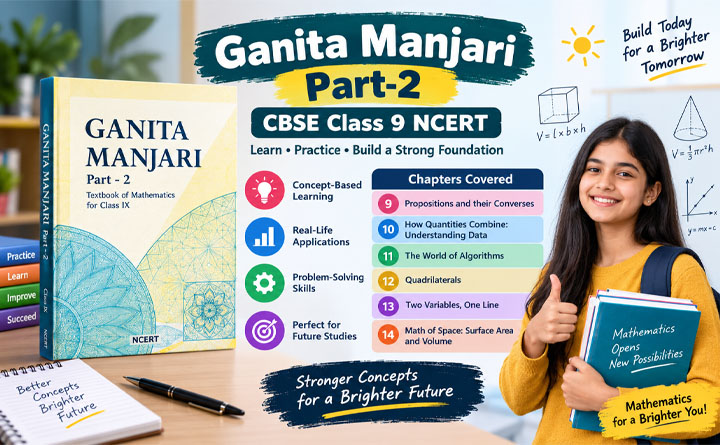
Complete Class 9 Maths NCERT Solutions | Ganita Manjari Part 1 PDF: Download Now
NCERT Solutions for Class 9 Science (New Book) – Chapter-wise PDF: Download Now
Chapter Overview: How Forces Affect Motion
Force is an interaction that can change the state of motion of an object. It can start movement, stop movement, increase speed, decrease speed, or change direction.
From kicking a football to applying brakes on a bicycle, forces are continuously acting around us.
Learning Outcomes
By studying this chapter, students will learn:
- What force is
- Types of forces
- Effects of force on motion
- Balanced and unbalanced forces
- Friction and its effects
- Inertia and Newton's First Law of Motion
- Real-life applications of force
Complete Class 9 Maths NCERT Solutions | Ganita Manjari Part 1 PDF: Download Now
NCERT Solutions for Class 9 Science (New Book) – Chapter-wise PDF: Download Now
What is Force?
Force is defined as a push or pull acting on an object.
Examples of Force
- Pushing a shopping cart
- Pulling a drawer
- Kicking a football
- Stretching a rubber band
The SI unit of force is Newton (N).
How Forces Affect Motion
Force can produce various changes in an object.
1. Force Can Start Motion
A stationary object begins moving when force is applied.
Example:
A football starts rolling when kicked.
2. Force Can Stop Motion
A moving object can be stopped using force.
Example:
Applying brakes stops a moving bicycle.
3. Force Can Change Speed
Force may increase or decrease the speed of an object.
Example:
Pedaling harder makes a bicycle move faster.
4. Force Can Change Direction
A force can alter the direction of movement.
Example:
A batsman changes the direction of a cricket ball.
5. Force Can Change Shape
Applying force may deform an object.
Example:
Pressing a sponge changes its shape.
Complete Class 9 Maths NCERT Solutions | Ganita Manjari Part 1 PDF: Download Now
NCERT Solutions for Class 9 Science (New Book) – Chapter-wise PDF: Download Now
Balanced and Unbalanced Forces
Balanced Forces
Balanced forces act equally in opposite directions.
Characteristics:
- Net force equals zero
- No change in motion
- Object remains at rest or continues moving uniformly
Example:
A tug-of-war where both teams pull with equal force.
Unbalanced Forces
Unbalanced forces occur when forces acting on an object are unequal.
Characteristics:
- Cause acceleration
- Change speed or direction
- Start or stop motion
Example:
One team pulling harder during a tug-of-war competition.
Friction: The Opposing Force
Friction is the force that opposes motion between two surfaces in contact.
Advantages of Friction
- Helps us walk
- Allows vehicles to move safely
- Enables writing on paper
- Provides grip
Disadvantages of Friction
- Produces heat
- Causes wear and tear
- Reduces machine efficiency
Complete Class 9 Maths NCERT Solutions | Ganita Manjari Part 1 PDF: Download Now
NCERT Solutions for Class 9 Science (New Book) – Chapter-wise PDF: Download Now
Inertia and Motion
Inertia is the tendency of an object to resist changes in its state of rest or motion.
The greater the mass of an object, the greater its inertia.
Types of Inertia
Inertia of Rest
Objects at rest tend to remain at rest.
Example:
Passengers move backward when a bus starts suddenly.
Inertia of Motion
Moving objects tend to continue moving.
Example:
Passengers move forward when a bus stops suddenly.
Inertia of Direction
Objects resist changes in direction.
Example:
Passengers lean sideways when a vehicle turns sharply.
Newton's First Law of Motion
Newton's First Law states:
"An object remains at rest or continues moving with uniform velocity unless acted upon by an external unbalanced force."
This law is also known as the Law of Inertia.
NCERT Solutions for Class 9 Science How Forces Affect Motion
Question 1: What is force?
Answer:
Force is a push or pull that can change the state of motion, speed, direction, or shape of an object.
Question 2: Name the effects of force.
Answer:
Force can:
- Start motion
- Stop motion
- Change speed
- Change direction
- Change shape
Question 3: What are balanced forces?
Answer:
Balanced forces are equal forces acting in opposite directions. Their resultant force is zero, and they do not change the state of motion.
Question 4: What are unbalanced forces?
Answer:
Unbalanced forces are unequal forces acting on an object. They cause acceleration and changes in motion.
Complete Class 9 Maths NCERT Solutions | Ganita Manjari Part 1 PDF: Download Now
NCERT Solutions for Class 9 Science (New Book) – Chapter-wise PDF: Download Now
Question 5: Define friction.
Answer:
Friction is a force that opposes the relative motion between two surfaces in contact.
Question 6: What is inertia?
Answer:
Inertia is the property of matter that resists changes in its state of rest or motion.
Question 7: State Newton's First Law.
Answer:
An object remains at rest or in uniform motion unless acted upon by an external unbalanced force.
Complete Class 9 Maths NCERT Solutions | Ganita Manjari Part 1 PDF: Download Now
NCERT Solutions for Class 9 Science (New Book) – Chapter-wise PDF: Download Now
Important Exam Questions
Short Answer Questions
- Define force.
- Explain balanced forces.
- What is friction?
- State Newton's First Law.
- What is inertia?
Long Answer Questions
- Explain how force affects motion with examples.
- Differentiate between balanced and unbalanced forces.
- Describe the advantages and disadvantages of friction.
- Explain inertia and its types with examples.
MCQs for Practice
1. The SI unit of force is:
A. Joule
B. Newton
C. Watt
D. Pascal
Answer: Newton
2. Friction acts:
A. Along motion
B. Opposite motion
C. Upward
D. Downward
Answer: Opposite motion
3. Balanced forces result in:
A. Acceleration
B. Motion
C. No change in motion
D. Change in speed
Answer: No change in motion
4. Inertia depends on:
A. Speed
B. Shape
C. Mass
D. Direction
Answer: Mass
5. Newton's First Law is also called:
A. Law of Gravitation
B. Law of Acceleration
C. Law of Inertia
D. Law of Action-Reaction
Answer: Law of Inertia
Why Use These NCERT Solutions?
Our NCERT Solutions For Class 9 Science Exploration are designed to help students:
- Understand concepts easily
- Prepare for CBSE examinations
- Revise important topics quickly
- Improve problem-solving skills
- Score higher marks in school exams
Free PDF Download Benefits
Students searching for NCERT Solutions Class 9 – Free PDF Download can use these chapter-wise solutions for:
- Quick revision
- Homework assistance
- Exam preparation
- Self-study
- Concept clarification
Complete Class 9 Maths NCERT Solutions | Ganita Manjari Part 1 PDF: Download Now
NCERT Solutions for Class 9 Science (New Book) – Chapter-wise PDF: Download Now
Conclusion
The chapter How Forces Affect Motion forms the foundation of Physics and introduces students to concepts that are used throughout higher classes. Understanding force, friction, inertia, and Newton's Laws is essential for academic success and real-world applications.
These NCERT Solutions for Class 9 Science How Forces Affect Motion provide clear explanations, detailed answers, and exam-focused preparation material to help students build confidence and achieve excellent results in CBSE examinations.
NCERT Solutions for Class 9 Science, Motion and Laws of Motion Class 9 Solutions, Gravitation Class 9 NCERT Solutions, Work and Energy Class 9 Solutions, Class 9 Science Notes PDF Download, CBSE Class 9 Science Important Questions and Answers etc.


 STUDY MATERIALS
 COURSES
 MORE
MORE
 SUCCESS STORY
 ADMISSION
 STORE
STORE