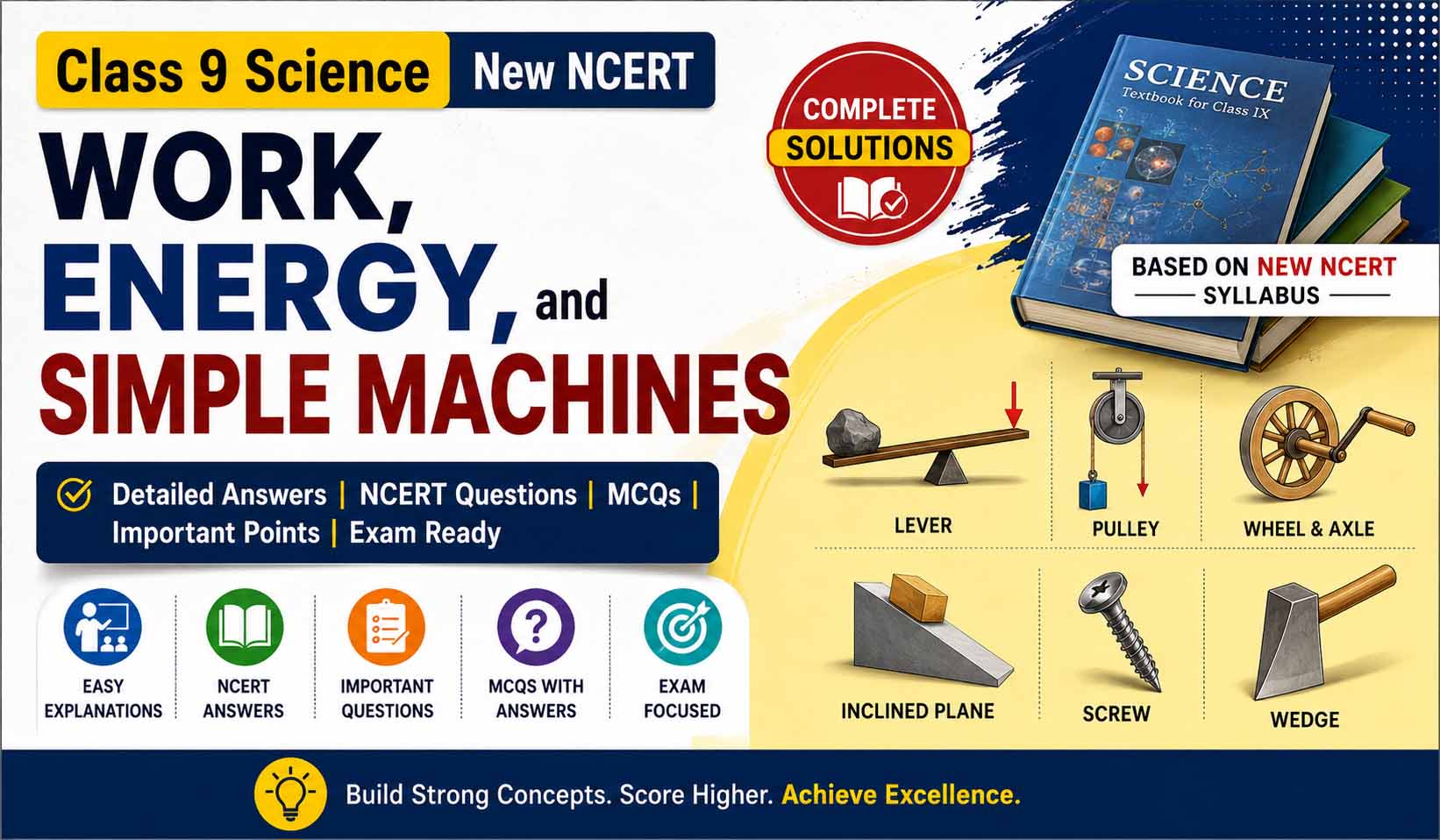
Class 9 Science Work, Energy and Simple Machines Solutions | New NCERT Chapter Answers
Work, Energy, and Simple Machines are fundamental concepts in Physics that help us understand how things move and how tasks are accomplished efficiently. From lifting a school bag to riding a bicycle, these concepts play an important role in our daily lives.
The chapter "Work, Energy, and Simple Machines" in the New NCERT Class 9 Science textbook introduces students to the concepts of work, energy, power, machines, and mechanical advantage. Understanding these concepts is essential for building a strong foundation in Physics.
How Forces Affect Motion Solutions: Click
In this article, you will find complete Class 9 Science Work, Energy and Simple Machines Solutions, important questions, explanations, and exam-oriented answers.
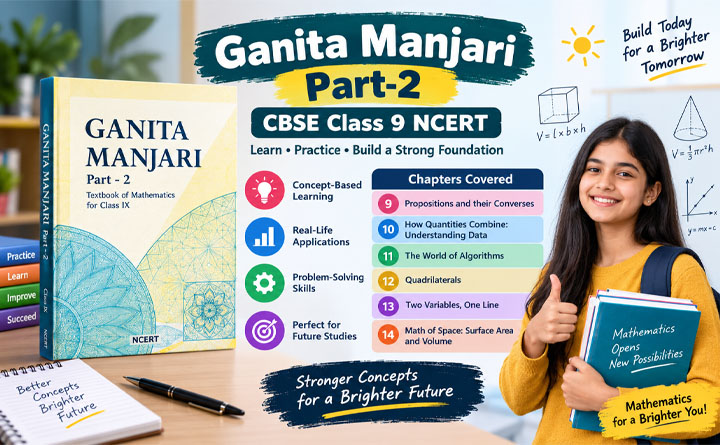
Complete Class 9 Maths NCERT Solutions | Ganita Manjari Part 1 PDF: Download Now
NCERT Solutions for Class 9 Science (New Book) – Chapter-wise PDF: Download Now
What is Work?
In Physics, work is said to be done when a force causes displacement in the direction of the force.
The formula for work is:
W = F \times d
Where:
-
W = Work done
-
F = Force applied
-
d = Displacement
SI Unit of Work
The SI unit of work is Joule (J).
Examples of Work
Conditions for Work to be Done
Two conditions must be satisfied:
-
A force must act on the object.
-
The object must move in the direction of the force.
If there is no displacement, no work is done.
Example:
Pushing a wall that does not move results in zero work.
Complete Class 9 Maths NCERT Solutions | Ganita Manjari Part 1 PDF: Download Now
NCERT Solutions for Class 9 Science (New Book) – Chapter-wise PDF: Download Now
What is Energy?
Energy is the capacity to do work.
Every activity requires energy.
Examples
-
Running requires muscular energy.
-
A moving car possesses kinetic energy.
-
Food provides chemical energy.
Forms of Energy
1. Kinetic Energy
The energy possessed by a moving object is called kinetic energy.
Examples:
-
Moving bicycle
-
Rolling ball
-
Flying bird
Formula:
KE = \frac{1}{2}mv^2
Where:
Complete Class 9 Maths NCERT Solutions | Ganita Manjari Part 1 PDF: Download Now
NCERT Solutions for Class 9 Science (New Book) – Chapter-wise PDF: Download Now
2. Potential Energy
The energy possessed by an object due to its position or configuration is called potential energy.
Examples:
-
Water stored in a dam
-
Stretched rubber band
-
Book kept on a shelf
Formula:
Where:
Law of Conservation of Energy
Energy can neither be created nor destroyed. It can only be transformed from one form to another.
Examples:
-
Electric bulb: Electrical energy → Light energy
-
Fan: Electrical energy → Mechanical energy
-
Car engine: Chemical energy → Mechanical energy
What is Power?
Power is the rate at which work is done.
Formula:
P = \frac{W}{t}
Where:
-
P = Power
-
W = Work done
-
t = Time taken
SI Unit of Power
The SI unit of power is Watt (W).
Complete Class 9 Maths NCERT Solutions | Ganita Manjari Part 1 PDF: Download Now
NCERT Solutions for Class 9 Science (New Book) – Chapter-wise PDF: Download Now
Simple Machines
A simple machine is a device that makes work easier by changing the magnitude or direction of force.
Examples
-
Lever
-
Pulley
-
Wheel and Axle
-
Inclined Plane
-
Screw
-
Wedge
Types of Simple Machines
Lever
A lever is a rigid bar that rotates around a fixed point called the fulcrum.
Examples:
Parts of a Lever
Pulley
A pulley is a wheel with a groove used to lift heavy loads.
Examples:
Wheel and Axle
This machine consists of a wheel attached to a smaller axle.
Examples:
-
Bicycle
-
Door knob
-
Steering wheel
Inclined Plane
An inclined plane is a sloping surface used to move objects with less effort.
Examples:
Mechanical Advantage
Mechanical Advantage tells us how much a machine multiplies the effort applied.
Formula:
MA = \frac{Load}{Effort}
A higher mechanical advantage means less effort is required.
Complete Class 9 Maths NCERT Solutions | Ganita Manjari Part 1 PDF: Download Now
NCERT Solutions for Class 9 Science (New Book) – Chapter-wise PDF: Download Now
Important NCERT Questions and Answers
Q1. What is work?
Answer: Work is done when a force causes displacement in the direction of the force.
Q2. What is energy?
Answer: Energy is the capacity to do work.
Q3. State the SI unit of work.
Answer: Joule (J).
Q4. What is kinetic energy?
Answer: Kinetic energy is the energy possessed by a moving object.
Q5. What is potential energy?
Answer: Potential energy is the energy possessed due to position or configuration.
Q6. What is power?
Answer: Power is the rate of doing work.
Q7. What is a simple machine?
Answer: A simple machine is a device that makes work easier by changing force or direction.
Q8. Define mechanical advantage.
Answer: Mechanical advantage is the ratio of load to effort.
Multiple Choice Questions (MCQs)
1. The SI unit of work is:
A. Newton
B. Joule
C. Watt
D. Pascal
Answer: Joule
2. Energy is the capacity to:
A. Sleep
B. Move
C. Do work
D. Rest
Answer: Do work
3. The SI unit of power is:
A. Joule
B. Newton
C. Watt
D. Meter
Answer: Watt
4. A pulley is used to:
A. Write
B. Lift loads
C. Cut wood
D. Measure force
Answer: Lift loads
5. Mechanical Advantage equals:
A. Effort ÷ Load
B. Load ÷ Effort
C. Work × Time
D. Power × Time
Answer: Load ÷ Effort
Exam Preparation Tips
-
Learn all important definitions.
-
Practice numerical problems on work, energy, and power.
-
Understand different simple machines and their uses.
-
Revise formulas regularly.
-
Solve NCERT exercise questions and MCQs.
Key Takeaways
-
Work is done when force causes displacement.
-
Energy is the capacity to do work.
-
Kinetic energy is due to motion.
-
Potential energy is due to position.
-
Power is the rate of doing work.
-
Simple machines reduce effort and make work easier.
-
Mechanical advantage measures machine efficiency.
Complete Class 9 Maths NCERT Solutions | Ganita Manjari Part 1 PDF: Download Now
NCERT Solutions for Class 9 Science (New Book) – Chapter-wise PDF: Download Now
Conclusion
The chapter Work, Energy, and Simple Machines introduces students to essential Physics concepts used in everyday life. Understanding work, energy transformations, power, and machine efficiency helps students build a strong conceptual foundation for future studies. Regular practice of NCERT questions and numerical problems will help students perform well in examinations and gain confidence in Physics.


 STUDY MATERIALS
 COURSES
 MORE
MORE
 SUCCESS STORY
 ADMISSION
 STORE
STORE