Class 9 Science Sound Waves: Characteristics and Applications Solutions | New NCERT Answers
Sound is an essential part of our daily lives. From listening to music and communicating with others to hearing warning alarms, sound plays a crucial role in human life. Sound is produced by vibrations and travels through a medium in the form of waves.
The chapter "Sound Waves: Characteristics and Applications" in the New NCERT Class 9 Science textbook introduces students to the nature of sound, its properties, characteristics, and practical applications. Understanding sound waves helps students build a strong foundation for advanced Physics concepts.
Sound Waves: Characteristics and Applications Solutions: Download Now
Complete Class 9 Maths NCERT Solutions | Ganita Manjari Part 1 PDF: Download Now
NCERT Solutions for Class 9 Science (New Book) – Chapter-wise PDF: Download Now
This article provides complete Class 9 Science Sound Waves: Characteristics and Applications Solutions, important questions, MCQs, and detailed explanations for exam preparation.
What is Sound?
Sound is a form of energy produced by vibrating objects.
Examples:
-
Ringing bell
-
Guitar strings
-
Human vocal cords
-
Drum membrane
When an object vibrates, it creates disturbances in the surrounding medium, producing sound waves.
Complete Class 9 Maths NCERT Solutions | Ganita Manjari Part 1 PDF: Download Now
NCERT Solutions for Class 9 Science (New Book) – Chapter-wise PDF: Download Now
How is Sound Produced?
Sound is produced due to vibrations.
Examples:
-
A plucked guitar string vibrates and produces sound.
-
A struck tuning fork vibrates and creates sound waves.
-
Human vocal cords vibrate while speaking.
Without vibration, sound cannot be produced.
Sound as a Wave
Sound travels through a medium as a longitudinal wave.
In longitudinal waves, particles of the medium vibrate parallel to the direction of wave propagation.
Sound cannot travel through a vacuum because there are no particles to transfer vibrations.
Complete Class 9 Maths NCERT Solutions | Ganita Manjari Part 1 PDF: Download Now
NCERT Solutions for Class 9 Science (New Book) – Chapter-wise PDF: Download Now
Medium of Sound
Sound requires a material medium to travel.
Types of Medium
Sound travels fastest in solids and slowest in gases.
Example
Characteristics of Sound Waves
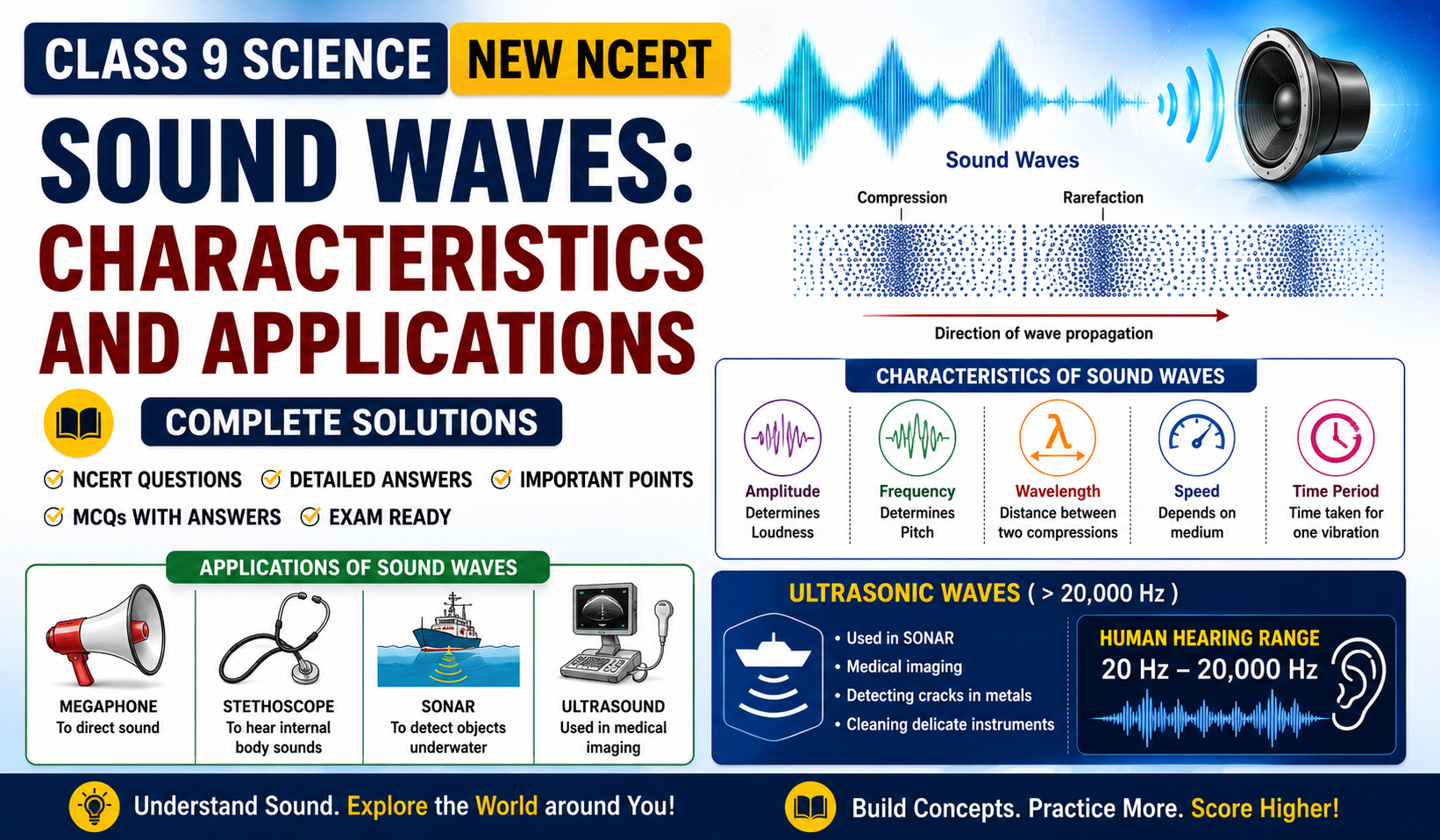
The main characteristics of sound waves are:
1. Amplitude
Amplitude is the maximum displacement of particles from their mean position.
Higher amplitude means louder sound.
Example
2. Frequency
Frequency is the number of vibrations produced in one second.
The SI unit of frequency is Hertz (Hz).
Formula
Frequency is represented as:
f = Number of vibrations per second
Example
Complete Class 9 Maths NCERT Solutions | Ganita Manjari Part 1 PDF: Download Now
NCERT Solutions for Class 9 Science (New Book) – Chapter-wise PDF: Download Now
3. Time Period
Time period is the time taken to complete one vibration.
Formula:
T = 1/f
Where:
-
T = Time Period
-
f = Frequency
4. Wavelength
Wavelength is the distance between two consecutive compressions or rarefactions.
It is represented by λ (lambda).
The SI unit is meter (m).
5. Speed of Sound
The speed of sound depends on the medium.
Formula:
Speed = Frequency × Wavelength
Factors Affecting Speed
-
Nature of medium
-
Temperature
-
Density
Loudness and Pitch
Loudness
Loudness depends upon amplitude.
Greater amplitude = Greater loudness
Examples:
Pitch
Pitch depends upon frequency.
Higher frequency = Higher pitch
Examples:
Reflection of Sound
Reflection occurs when sound waves strike a surface and bounce back.
Examples:
Echo
An echo is the repetition of sound caused by reflection.
Conditions for hearing an echo:
Examples:
-
Mountains
-
Large empty halls
Applications of Reflection of Sound
1. Megaphones
Used to direct sound in one direction.
2. Stethoscope
Doctors use it to hear internal body sounds.
3. Sound Boards
Used in auditoriums to improve sound quality.
4. Hearing Aids
Help people with hearing difficulties.
Ultrasonic Sound
Sounds having frequencies above 20,000 Hz are called ultrasonic sounds.
Humans cannot hear ultrasonic waves.
Applications
SONAR (Sound Navigation and Ranging)
SONAR uses ultrasonic waves to detect underwater objects.
Uses
Important NCERT Questions and Answers
Q1. What is sound?
Answer: Sound is a form of energy produced by vibrating objects and transmitted through a medium.
Q2. Why cannot sound travel through a vacuum?
Answer: Sound requires a material medium to travel. Since a vacuum has no particles, sound cannot propagate through it.
Q3. Define frequency.
Answer: Frequency is the number of vibrations produced in one second.
Q4. What is amplitude?
Answer: Amplitude is the maximum displacement of particles from their mean position.
Complete Class 9 Maths NCERT Solutions | Ganita Manjari Part 1 PDF: Download Now
NCERT Solutions for Class 9 Science (New Book) – Chapter-wise PDF: Download Now
Q5. What is wavelength?
Answer: Wavelength is the distance between two consecutive compressions or rarefactions.
Q6. What is an echo?
Answer: Echo is the repetition of sound due to reflection from a distant surface.
Q7. What are ultrasonic waves?
Answer: Ultrasonic waves are sound waves having frequencies greater than 20,000 Hz.
Multiple Choice Questions (MCQs)
1. Sound is produced by:
A. Light
B. Heat
C. Vibrations
D. Electricity
Answer: Vibrations
2. SI unit of frequency is:
A. Newton
B. Joule
C. Hertz
D. Watt
Answer: Hertz
3. Sound cannot travel through:
A. Solids
B. Liquids
C. Gases
D. Vacuum
Answer: Vacuum
4. Loudness depends on:
A. Frequency
B. Amplitude
C. Speed
D. Wavelength
Answer: Amplitude
5. Ultrasonic waves have frequency greater than:
A. 20 Hz
B. 200 Hz
C. 2000 Hz
D. 20,000 Hz
Answer: 20,000 Hz
Exam Preparation Tips
-
Learn definitions of amplitude, frequency, wavelength, and pitch.
-
Understand the difference between loudness and pitch.
-
Practice numerical problems based on sound waves.
-
Revise applications of ultrasonic waves and SONAR.
-
Solve NCERT questions and MCQs regularly.
Key Takeaways
-
Sound is produced by vibrations.
-
Sound travels through solids, liquids, and gases.
-
Sound cannot travel in a vacuum.
-
Frequency determines pitch.
-
Amplitude determines loudness.
-
Echo is caused by reflection of sound.
-
Ultrasonic waves have numerous practical applications.
Complete Class 9 Maths NCERT Solutions | Ganita Manjari Part 1 PDF: Download Now
NCERT Solutions for Class 9 Science (New Book) – Chapter-wise PDF: Download Now
Conclusion
The chapter Sound Waves: Characteristics and Applications helps students understand the nature of sound and its importance in everyday life. Concepts such as amplitude, frequency, wavelength, echo, and ultrasonic waves are essential for understanding Physics and various modern technologies. Thorough preparation of NCERT questions and concepts will help students excel in examinations and develop a strong scientific foundation.


 STUDY MATERIALS
 COURSES
 MORE
MORE
 SUCCESS STORY
 ADMISSION
 STORE
STORE