

NCERT Class 9 Maths Ganita Manjari Chapter 3 Solutions – The World of Numbers

NCERT Class 9 Maths Ganita Manjari Chapter 3 Solutions – The World of Numbers

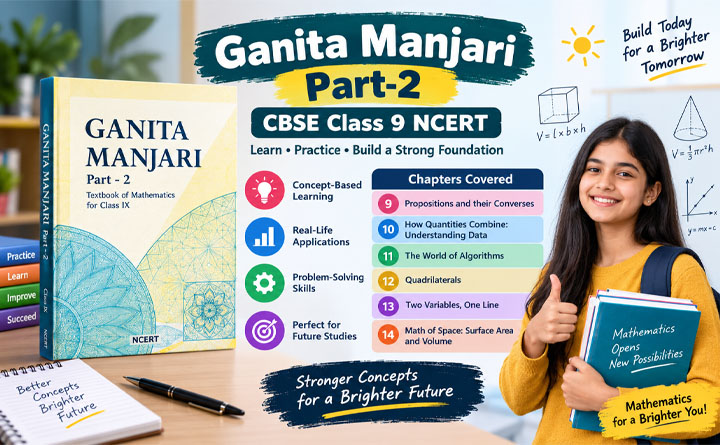
The NCERT Class 9 Maths Ganita Manjari book introduces students to mathematics through real-life applications and conceptual clarity. Chapter 3 – The World of Numbers is a crucial chapter that strengthens the foundation of number systems, helping students understand how numbers behave and interact.

If you’re looking for NCERT Class 9 Maths Ganita Manjari Chapter 3 Solutions, this blog provides detailed explanations, solved examples, key concepts, and exam tips in a simple and easy-to-understand format.

NCERT Class 9 Maths Ganita Manjari Chapter 3 Solutions: Download Now
Exercise Set 3.1 (Page 1 - 2)


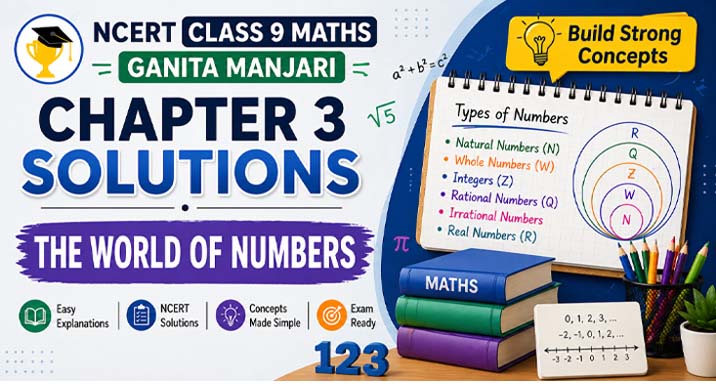
What is “The World of Numbers”?

This chapter focuses on different types of numbers and their properties. It helps students understand how numbers are classified and how they are used in calculations.


Key Concepts Covered in Chapter 3

1. Natural Numbers (N)

These are counting numbers starting from 1.

Examples: 1, 2, 3, 4, …


2. Whole Numbers (W)

Whole numbers include natural numbers and zero.

Examples: 0, 1, 2, 3, …


3. Integers (Z)

Integers include positive numbers, negative numbers, and zero.

Examples: -3, -2, -1, 0, 1, 2, 3


4. Rational Numbers (Q)

Numbers that can be written in the form p/q, where q ≠ 0.

Examples: 1/2, -3/4, 5


5. Irrational Numbers

Numbers that cannot be written as p/q.

Examples: √2, π


6. Real Numbers (R)

All rational and irrational numbers together form real numbers.


Important Properties of Numbers

Closure Property

If we add or multiply numbers, the result is still a number of the same type (in many cases).

Commutative Property

a + b = b + a
a × b = b × a

Associative Property

(a + b) + c = a + (b + c)

Distributive Property

a × (b + c) = ab + ac


NCERT Class 9 Chapter 3 Solutions (Sample Questions)

Question 1: Identify the type of number

Is √5 rational or irrational?

Solution:
√5 cannot be expressed as p/q → Irrational Number


Question 2: Simplify

(2/3) + (4/3)

Solution:
= 6/3 = 2


Question 3: Represent number on number line

Represent 3/2

Solution:
3/2 = 1.5 → Mark point between 1 and 2


Why This Chapter is Important

This chapter helps students:

  • Understand number classification

  • Build strong basics for algebra

  • Solve problems easily

  • Prepare for higher mathematics

  • Improve calculation skills


Exam Preparation Tips

Practice Regularly

Solve different types of number problems daily.

Learn Definitions

Understand each type of number clearly.

Solve NCERT Exercises

Focus on textbook questions and examples.

Revise Properties

Remember key properties for quick solving.


Common Mistakes to Avoid

  • Confusing rational and irrational numbers

  • Incorrect simplification

  • Forgetting properties

  • Calculation errors


Real-Life Applications

The concept of numbers is used in:

  • Banking and finance

  • Measurements

  • Engineering calculations

  • Data analysis

  • Computer programming


Benefits of Using These Solutions

  • Easy step-by-step explanations

  • Better understanding of concepts

  • Helps in homework and revision

  • Improves confidence

  • Saves time before exams


Topics:
3.1. The Dawn of Mathematics: The Human Need to Count
3.1.1 A History Written in Bone
3.1.2 The Indian Context: Trade and Astronomy

3.2 The Revolution of ?h?nya: When Nothing Became Something
3.2.1 From Philosophy to Mathematics: The Concept of ?h?nyat?
3.2.2 The Bakh?h?l? Manuscript and Brahmagupta’s Rules

3.3 Integers: Expanding the Horizon
3.3.1 The Arithmetic of Integers

3.4 Filling the Spaces: Fractions and Rational Numbers
3.4.1 Representation of Rational Numbers on the Number Line
3.4.2 The Density of Rational Numbers

3.5 Irrational Numbers
3.5.1 The Proof of Irrationality of
The first proof of the irrationality of 2
3.5.2 Construction of Length
3.5.3 The Story of Pi (π) and Madhava’s Infinite Series

3.6 Real Numbers: Decimals and Cyclic Patterns
3.6.1 Rational Decimals: Terminating and Repeating

Conclusion

NCERT Class 9 Maths Ganita Manjari Chapter 3 Solutions – The World of Numbers is a fundamental chapter that strengthens the understanding of number systems. With proper practice and conceptual clarity, students can master this topic and score high marks in exams.

Frequently Asked Questions (FAQs)

This chapter explains different types of numbers such as natural numbers, whole numbers, integers, rational numbers, irrational numbers, and real numbers, along with their properties and applications.
Natural numbers are counting numbers starting from 1. Example: 1, 2, 3, 4, …
Whole numbers include all natural numbers and zero. Example: 0, 1, 2, 3, …
Integers include positive numbers, negative numbers, and zero. Example: -3, -2, -1, 0, 1, 2, 3
Rational numbers are numbers that can be written in the form p/q, where q ≠ 0. Example: 1/2, -5/3, 7
Irrational numbers cannot be written in the form p/q and have non-terminating, non-repeating decimals. Example: √2, π
All rational and irrational numbers together form real numbers (R).
It builds the foundation of mathematics, which is important for algebra, equations, and higher-level concepts.
You can use online solution guides, NCERT books, and educational blogs for step-by-step explanations and practice.
Practice NCERT questions regularly, Understand concepts clearly, Revise definitions and properties, Solve sample papers

Recent Posts

Smart Achievers JEE Crash Course 2026

Smartachivers

Mar 02,2026

Why Parents Trust Smart Achievers

Smartachivers

Mar 02,2026

Can I Crack JEE Without Coaching?

Smartachivers

Mar 02,2026

Dropper Study Plan for NEET 2026

Smartachivers

Mar 02,2026

Mental Preparation for NEET

Smartachivers

Feb 27,2026