

Q 1 :

What will be the decreasing order of basic strength of the following conjugate bases?

-OH,RO-,CH3COO-,Cl-                    [2024]

  • OH->RO¯>CH3COO¯>Cl¯


  • Cl¯>RO¯>OH->CH3COO¯


  • RO¯>OH->CH3COO¯>Cl¯


  • Cl¯>OH->RO¯>CH3COO¯


(3)

Acidic strength order is : HCl>CH3COOH>HOH>ROH

Basic strength 1acid strength of conjugate acid

Thus basic strength order is: RO->OH->CH3COO->Cl-


Q 2 :

The correct sequence of acidic strength of the following aliphatic acids in their decreasing order is:                         [2024]


CH3CH2COOH, CH3COOH, CH3CH2CH2COOH, HCOOH

  • CH3COOH>CH3CH2COOH>CH3CH2CH2COOH>HCOOH


  • HCOOH>CH3CH2CH2COOH>CH3CH2COOH>CH3COOH


  • HCOOH>CH3COOH>CH3CH2COOH>CH3CH2CH2COOH


  • CH3CH2CH2COOH>CH3CH2COOH>CH3COOH>HCOOH

(3)

Electron releasing groups decreases stability of conjugate anion of an acid hence decreases acidic strength of the acid. Alkyl groups are +I groups. Larger is alkyl group more is its +I effect. Hence larger is alkyl group connected to –COOH group, lesser is the acid strength.

HCOOH>CH3COOH>CH3CH2COOH>CH3CH2CH2COOHIncreasing +I effect of alkyl groups, hence decreasing acidic strength of acid


Q 3 :

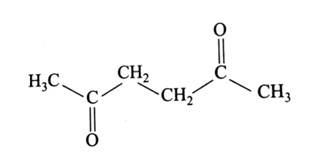
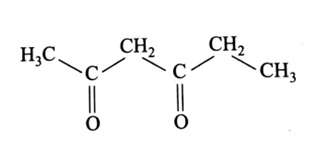
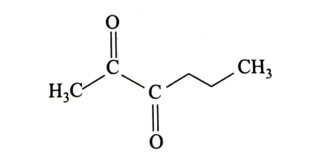
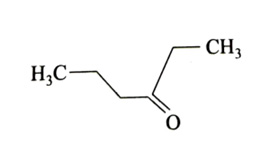
Which of the following has highly acidic hydrogen?                    [2024]


  •  

  •  

  •  

  •  

(2)

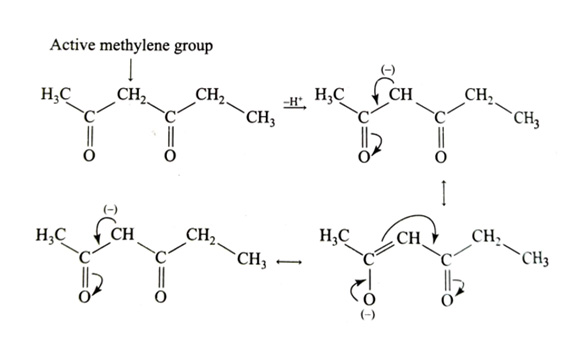
Acidic strength of an acid stability of conjugate base.

Conjugate base of (2) is stabilised by −M effect of two carbonyl groups whereas, in all other options conjugate base gets −M stability of only one carbonyl group. Thus (2) has most acidic hydrogen.


Q 4 :

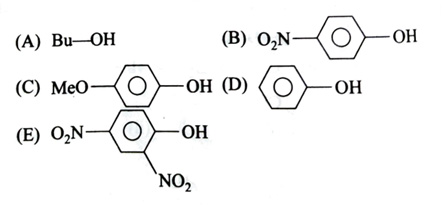
The ascending order of acidity of —OH group in the following compounds is:                        [2024]

Choose the correct answer from the options given below:

  • (A) < (D) < (C) < (B) < (E)


  • (A) < (C) < (D) < (B) < (E)


  • (C) < (A) < (D) < (B) < (E)


  • (C) < (D) < (B) < (A) < (E)


(2)

Phenoxide ion is stabilised by –M effect of phenyl group, whereas there is no resonance in alkoxide ion. Thus, phenols are more acidic than alcohols. Therefore (A) is least acidic among all.

In phenoxide ion, if there is an electron withdrawing group attached, it helps in more dispersal of negative charge on oxygen, which stabilises the conjugate base anion and hence increases acidic strength of the acid. Thus (E) is most acidic of all, as it has –M and –I effect of two nitro groups. (B) is more acidic than (D) but is less acidic than (E) as it has only one nitro group to exert –M and –I effect. Electron supplying groups destabilise conjugate base anion and hence decreases acidic strength of an acid. As methoxy group (OCH3) exerts +M effect from para position, (C) is less acidic than (D). Therefore, correct ascending order is A < C < D < B < E


Q 5 :

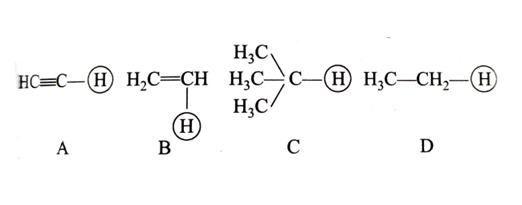
The ascending acidity order of the following H atoms is:                    [2024]

  • A < B < C < D


  • D < C < B < A


  • A < B < D < C


  • C < D < B < A


(4)

Stability of conjugate base increases hence acidic strength of corresponding acids increases. Therefore, correct order is: C < D < B < A


Q 6 :

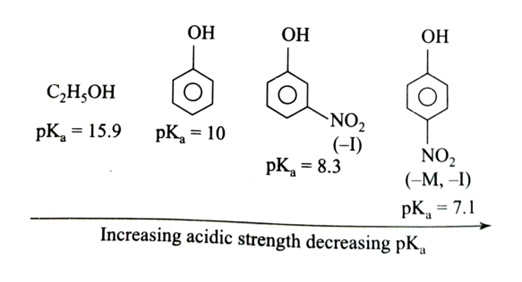
Match List I with List II                                                     [2024]

LIST I (Compound)     LIST II (pKa value)
A. Ethanol     I. 10.0
B. Phenol     II. 15.9
C. m-Nitrophenol     III. 7.1
D. p-Nitrophenol     IV. 8.3


Choose the correct answer from the options given below:

  • A-I, B-II, C-III, D-IV


  • A-II, B-I, C-IV, D-III


  • A-III, B-IV, C-I, D-II


  • A-IV, B-I, C-II, D-III


(2)


Q 7 :

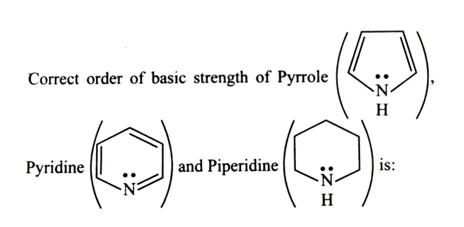
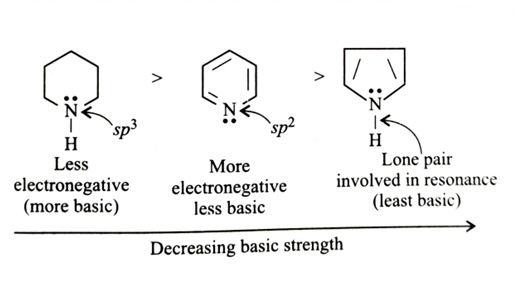
                                                    [2024]

  • Pyrrole > Pyridine > Piperidine  


  • Pyridine > Piperidine > Pyrrole


  • Piperidine > Pyridine > Pyrrole  


  • Pyrrole > Piperidine > Pyridine


(3)


Q 8 :

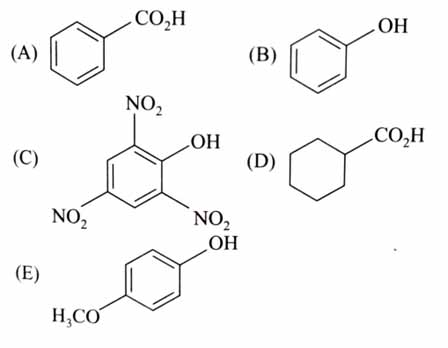
The compounds that produce CO2 with aqueous NaHCO3 solution are:                      [2025]

Choose the correct answer from the options given below:

  • (A), (C) and (D) only


  • (A) and (C) only


  • (A), (B) and (E) only


  • (A) and (B) only


(1)

Acid+NaHCO3Salt+H2CO3unstableCO2+H2O

Those acids which are stronger than H2CO3 evolve CO2 with NaHCO3. Carboxylic acids (A and D) are stronger acids than H2CO3, hence evolve CO2 with NaHCO3. Phenol (B) is weaker acid than H2CO3, hence does not evolve CO2 with NaHCO3. Presence of three nitro groups (strong –M and –I group) makes (C) stronger acid than H2CO3, hence it evolves CO2 with NaHCO3. Presence of OCH3 (+M group) makes (E) weaker acid than H2CO3, hence it does not evolve CO2 with NaHCO3.


Q 9 :

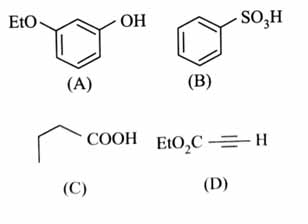
The least acidic compound, among the following is:                       [2025]

  • D


  • A


  • B


  • C


(1)

Acidic strength order of different functional groups is: sulphonic acids (B) > carboxylic acids (C) > phenols (A) > terminal alkynes (D)


Q 10 :

Given below are two statements, one is labelled as Assertion A and the other is labelled as Reason R.

Assertion A: Order of acidic nature of the following compounds is A > B > C.

Reason R: Fluoro is a stronger electron withdrawing group than Chloro group.  

In the light of the above statements, choose the correct answer from the options given below:           [2023]

  • A is true but R is false


  • Both A and R are correct and R is the correct explanation of A


  • A is false but R is true


  • Both A and R are correct but R is NOT the correct explanation of A


(4)

Acidic strength  I effect

1+I effect

F,Cl exerts I effect, Methyl exerts +I effect, C is least acidic. Among A and B; since inductive effect is distance dependent, Extent of I effect is higher in A followed by B even though F is stronger electron withdrawing group than Cl. Thus, A is more acidic than B.


Q 11 :

Find out the statements which are not true.                                                  [2026]

A. Resonating structures with more number of covalent bonds and lesser charge separation are more stable.
B. In electromeric effect, an unsaturated system shows +E effect with nucleophile and −E effect with electrophile.
C. Inductive effect is responsible for high melting point, boiling point and dipole moment of polar compounds.
D. The greater the number of alkyl groups attached to the doubly bonded carbon atoms, higher is the heat of hydrogenation.
E. Stability of carbanion increases with the increase in s-character of the carbon carrying the negative charge.

Choose the correct answer from the options given below:

  • B & D only


  • B, D & E only


  • A, D & E only


  • A, C & D only


(1)

Statement B & D are not true


Q 12 :

Which of the following incorrectly represent the acidic strength of given acids?

  •  

  •  

  • CH2FCOOH>CH2NO2COOH


  • CH3COOH>CH3CH2OH


(3)

1, 2, 4 are correct

Ka=15×10-10       Ka=77×10-10, Phenols are more acidic than alcohols.

Carboxylic acids are more acidic than alcohols and phenols.


Q 13 :

Assertion (A):

both compounds will have zero dipole moment.

Reason (R): –CN group is linear but –SH group is non linear with benzene ring.

  • Assertion (A) is True, Reason (R) is True; Reason (R) is a Correct explanation for Assertion (A)


  • Assertion (A) is True, Reason (R) is True; Reason (R) is NOT a Correct explanation for Assertion (A)


  • Assertion (A) is True, Reason (R) is False


  • Assertion (A) is False, Reason (R) is True


(4)


Q 14 :

Aromatic species among the following is

  •  

  •  

  •  

  •  

(4)


Q 15 :

Compare basic strength of below compounds?

[IMAGE 228]

  • A > B > C


  • B > A > C


  • C > A > B


  • C > B > A


(4)

Basic strength1stability of Anion