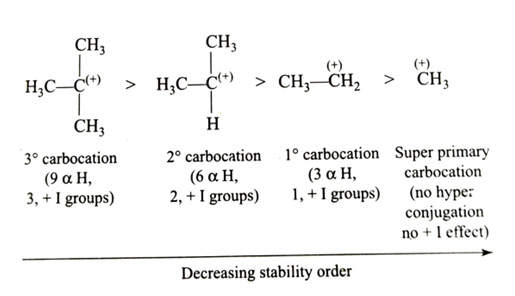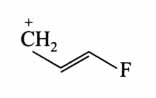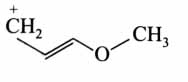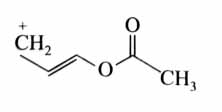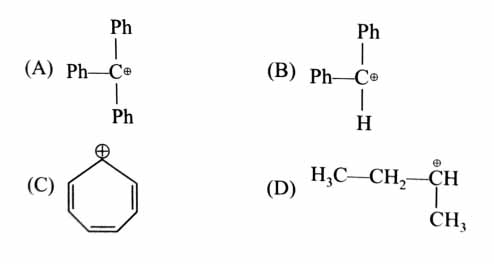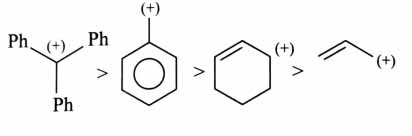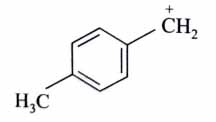


The correct stability order of carbocation is [2024]
(3)
Stability of carbocations follows the order: 3° > 2° > 1°. This is due to more hyperconjugation and +I stability in higher degree carbocations.

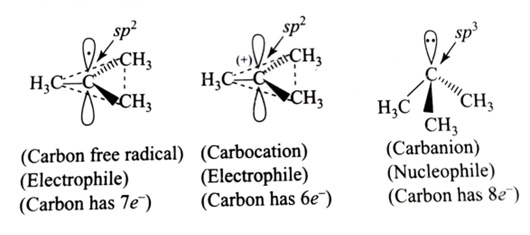
A species having carbon with sextet of electrons and can act as electrophile is called [2024]
pentavalent carbon
carbon free radical
carbocation
carbanion
(3)
Carbon can form maximum of four bond. There is nothing called pentavalent carbon.


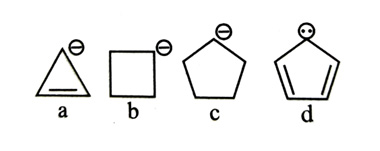
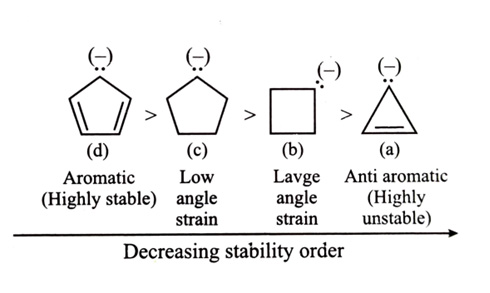
Correct order of stability of carbanion is [2024]
d > a > c > b
d > c > b > a
a > b > c > d
c > b > d > a
(2)

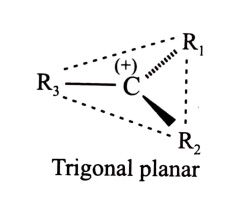
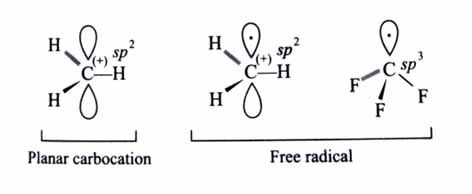
The shape of carbocation is: [2024]
tetrahedral
trigonal planar
diagonal pyramidal
diagonal
(2)

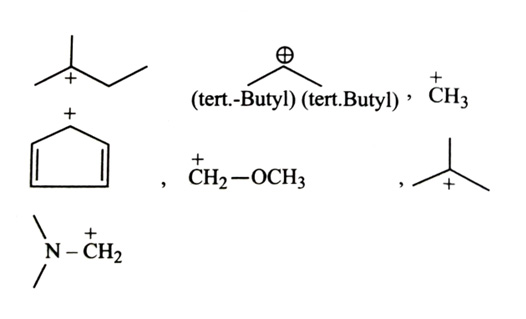
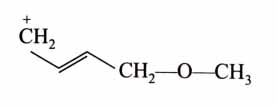
Number of carbocation from the following that are not stabilized by hyperconjugation is………. [2024]

(5)
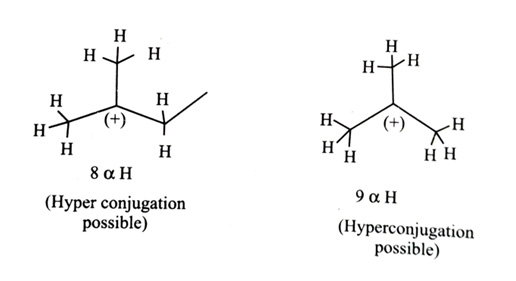
For hyperconjugation to occur in carbocations, carbon carrying positive charge should be connected to an hybridized carbon and that hybridized carbon should have at least one H atom (called as H).
Out of given seven structures, hyperconjugation is possible only in the following two structures:

Which one of the carbocations from the following is most stable? [2025]


(3)
+M groups stabilize a carbocation by supplying electrons. Order of +M effect is:

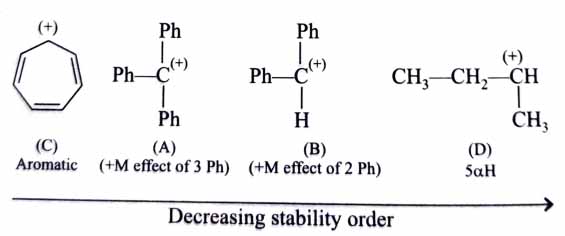
The correct order of stability of following carbocations is: [2025]

C > A > B > D
B > C > A > D
C > B > A > D
A > B > C > D
(1)

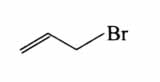
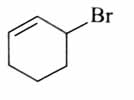
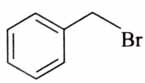
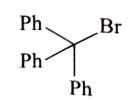
Which among the following halides will generate the most stable carbocation in the nucleophilic substitution reaction? [2025]


(4)
Carbocation formed by (4) is stabilized by +M effect of three Ph groups hence is most stable in the given options. Stability order of carbocations is:

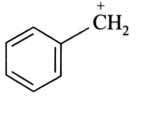
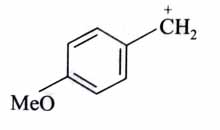
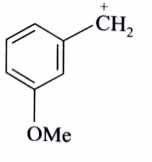
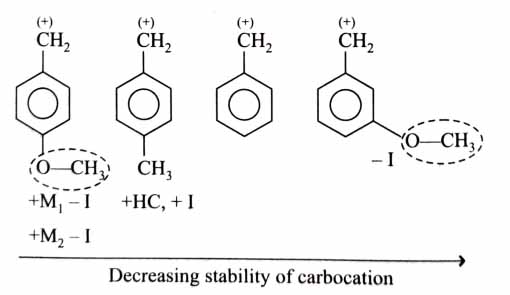
The most stable carbocation from the following is: [2025]


(2)
Electron donating groups increase stability of a carbocation. –OMe group can donate electrons by +M effect from ortho and para position. +M effect of –OMe dominates over its – effect. From meta position it withdraws electron density because of – effect. Electron donation by +M effect of –OMe is more than the electron donation by hyperconjugation and + effect of – group.

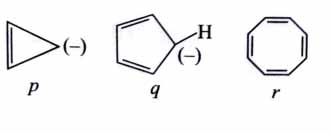
The correct stability order of the following species/molecules is: [2025]

(3)
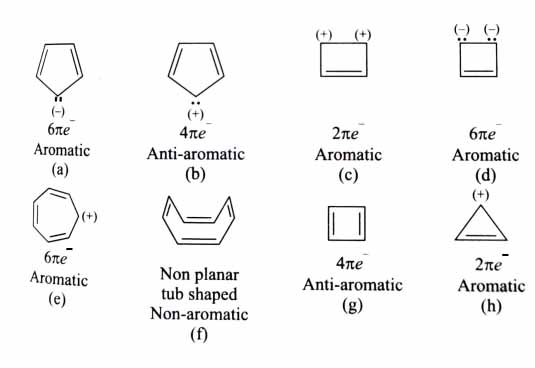
Cyclooctatetraene adopts non planar tub shaped structure to avoid anti aromaticity. So it is non aromatic. Thus stability order of given compounds is:
q (aromatic) > r (non aromatic) > p (anti aromatic)
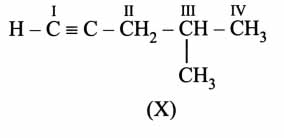
Consider the following compound (X)

The most stable and least stable carbon radicals, respectively, produced by homolytic cleavage of corresponding C–H bond are: [2025]
II, IV
III, II
I, IV
II, I
(4)
Radical at is stabilized by resonance, hyperconjugation and + effect.
Radicals at and are stabilized by hyperconjugation and + effect.
There is no stabilizing effect for radical at .
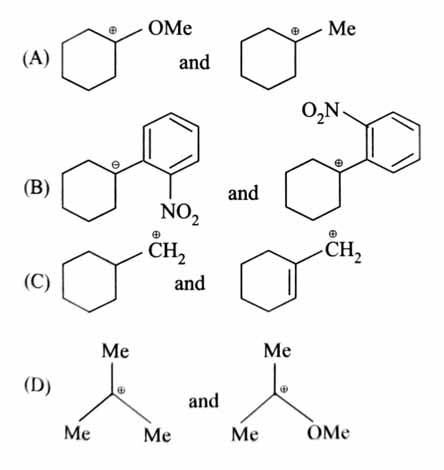
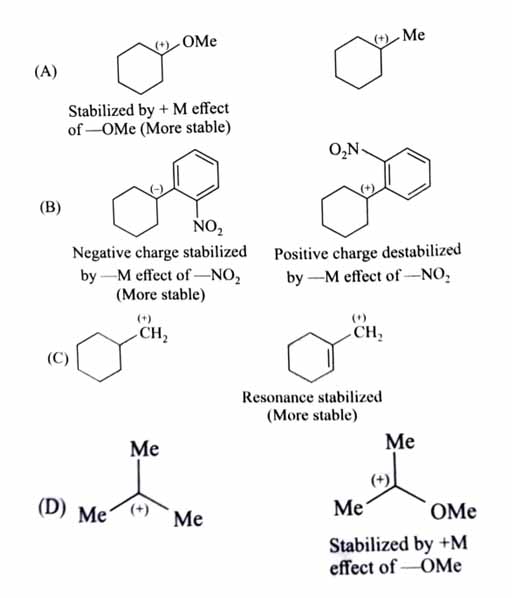
In which pairs, the first ion is more stable than the second? [2025]

(B) and (D) only
(A) and (B) only
(B) and (C) only
(A) and (C) only
(2)

Match the LIST-I with LIST-II [2025]
| List-I | List-II | ||
| A. | Carbocation | I. | Species that can supply a pair of electrons |
| B. | C-Free radical | II. | Species that can receive a pair of electrons. |
| C. | Nucleophile | III. | hybridized carbon with empty -orbital. |
| D. | Electrophile | IV. | hybridized carbon with one unpaired electron. |
Choose the correct answer from the options given below:
A-IV, B-II, C-III, D-I
A-II, B-III, C-I, D-IV
A-III, B-IV, C-II, D-I
A-III, B-IV, C-I, D-II
(4)

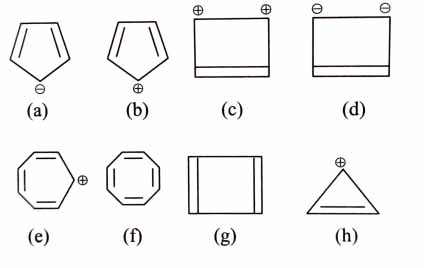
Designate whether each of the following compounds is aromatic or not aromatic. [2025]

e, g aromatic and a, b, c, d, f, h not aromatic
b, e, f, g aromatic and a, c, d, h not aromatic
a, b, c, d aromatic and e, f, g, h not aromatic
a, c, d, e, h aromatic and b, f, g not aromatic
(4)

The most stable carbocation for the following is: [2023]

c
d
b
a
(1)
Because +ve charge is delocalised with -bonds and lone pair of 'N' atom in groups.
The decreasing order of hydride affinity for following carbocations is: [2023]

Choose the correct answer from the options given below:
A, C, D, B
A, C, B, D
C, A, D, B
C, A, B, D
(4)
Stability of carbocation
Given below are two statements:
Statement I: ‘C–Cl’ bond is stronger in = CH–Cl than ––Cl.
Statement II: The given optically active molecule,
on hydrolysis gives a solution that can rotate the plane polarized light.
In the light of the above statements, choose the correct answer from the options given below: [2026]
Both Statement I and Statement II are false
Statement I is true but Statement II is false
Statement I is false but Statement II is true
Both Statement I and Statement II are true
(2)

Arrange the following carbanions in the decreasing order of stability.

Choose the correct answer from the options given below: [2026]
IV > I > II > V > III
I > IV > II > V > III
IV > II > I > III > V
I > II > IV > V > III
(1)
Electron withdrawing groups increases stability of carbanion and electron donating groups decreases stability of carbanion.
From the following, the least stable structure is: [2026]


(4)

This resonating structure having +ve charge on adjacent atoms so it is least stable.
The correct order of the rate of reaction of the following reactants with nucleophile by mechanism is:
(Given: Structures I and II are rigid) [2026]

IV < III < II < I
II < I < III < IV
I < II < III < IV
III < I < II < IV
(2)
Rate of Stability of formed
and are unstable due to Bredt's rule, has more effect.
Correct order of stability for the following is
[2026]
(1)