

Q 1 :

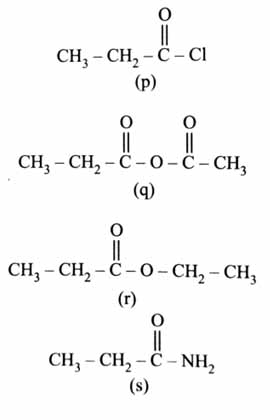
Consider the following molecules:

The correct order of rate of hydrolysis is:                  [2025]

  • r > q > p > s


  • q > p > r > s


  • p > r > q > s


  • p > q > r > s


(4)

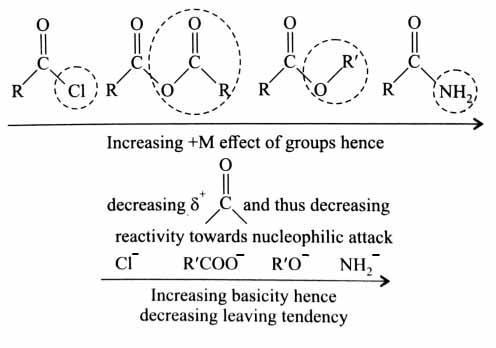
Hydrolysis of acid derivatives is a nucleophilic elimination reaction. For such reactions rate of reaction is acid chloride > anhydride > ester > amide.


Q 2 :

Assertion A: Hydrolysis of an alkyl chloride is a slow reaction but in the presence of NaI, the rate of the hydrolysis increases.

Reason R: I- is a good nucleophile as well as a good leaving group.

In the light of the above statements, choose the correct answer from the options given below:             [2023]

  • A is false but R is true


  • A is true but R is false


  • Both A and R are true but R is NOT the correct explanation of A


  • Both A and R are true and R is the correct explanation of A


(4)

I- being a good nucleophile forms RI which gets hydrolysed readily.


Q 3 :

The compound which will have the lowest rate towards nucleophilic aromatic substitution on treatment with OH- is                   [2023]

  • [IMAGE 44]


  • [IMAGE 45]


  • [IMAGE 46]


  • [IMAGE 47]


(2)

[IMAGE 48]

Chlorobenzene with strong EWG (i.e., NO2) undergoes nucleophilic aromatic substitution at a faster rate with OH-.


Q 4 :

Decreasing order towards SN1 reaction for the following compounds is:         [2023]

[IMAGE 49]

  • d > b > c > a


  • b > d > c > a


  • a > c > d > b


  • a > b > c > d


(2)

Rate of SN1 depends upon stability of carbocation.


Q 5 :

The correct order of reactivity of following haloarenes towards nucleophilic substitution with aqueous NaOH is:

[IMAGE 50]

Choose the correct answer from the options given below:                  [2023]

  • D > C > B > A


  • A > B > D > C


  • C > A > D > B


  • D > B > A > C


(4)

Chlorobenzene undergoes aromatic nucleophilic substitution via carbanion intermediate. In such a reaction greater the –M group (–NO2, –CN etc.) at o and p-position, greater the stability of carbanion intermediate and faster the rate of reaction.


Q 6 :

Arrange the following compounds in increasing order of rate of aromatic electrophilic substitution reaction.      [2023]

[IMAGE 51]

  • d, b, a, c


  • b, c, a, d


  • c, a, b, d


  • d, b, c, a


(3)

Due to increase in electron density in the ring, rate of ArSE2 increases, ERG increases the electron density.


Q 7 :

Decreasing order of reactivity towards electrophilic substitution for the following compounds is:         [2023]

[IMAGE 52]

  • a > d > e > b > c


  • d > a > e > c > b


  • e > d > a > b > c


  • c > b > a > d > e


(3)

Higher the electron density on benzene ring, higher is its reactivity towards electrophilic substitution reaction.

RateEDG1EWQ

Hence, the correct order is  e>d>a>b>c.


Q 8 :

Correct statements for the given reaction are:

[IMAGE 53]--------

(A) Compound ‘B’ is aromatic

(B) The completion of above reaction is very slow

(C) ‘A’ shows tautomerism

(D) The bond length of C–C in compound B are found to be same

Choose the correct answer from the options given below:                  [2023]

  • A, C and D only


  • A, B and C only


  • A, B and D only


  • B, C and D only


(1)

[IMAGE 54]

Compound (A) shows tautomerism.