

Given below are two statements:
Statement (I): The group in Aniline is ortho and para directing and a powerful activating group.
Statement (II): Aniline does not undergo Friedel-Craft's reaction (alkylation and acylation).
In the light of the above statements, choose the most appropriate answer from the options given below: [2024]
Both Statement I and Statement II are correct
Both Statement I and Statement II are incorrect
Statement I is incorrect but Statement II is correct
Statement I is correct but Statement II is incorrect
(1)
Statement (I): Due to its +M effect, group increases electron density at ortho and para positions of the benzene ring and hence it is ortho and para directing for electrophilic aromatic substitution reactions.
Statement (II): Aniline forms salt with aluminium chloride, a Lewis acid, used as a catalyst in Friedel-Crafts reaction. Due to this, nitrogen of aniline acquires positive charge and hence acts as a strong deactivating group for further reaction. Hence, Aniline does not undergo Friedel-Crafts reaction (alkylation and acetylation).
From 6.55 g of aniline, the maximum amount of acetanilide that can be prepared will be ______ g. [2024]
(95)
Number of moles of aniline
Maximum 0.07 mol of acetanilide can be obtained from 0.07 mol of aniline.
Maximum amount of acetanilide = number of moles × molar
mass of acetanilide =
The product A formed in the following reaction is [2024]


(4)

Identify the product (A) in the following reaction. [2024]


(4)

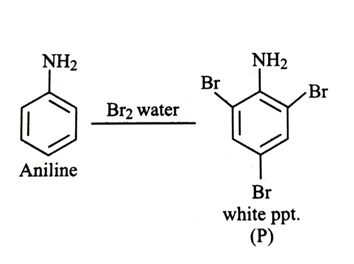
9.3 g of pure aniline is treated with bromine water at room temperature to give a white precipitate of the product ‘P’. The mass of product ‘P’ obtained is 26.4 g. The percentage yield is ______ %. [2024]
(80)

If the reaction was 100% complete, the moles of would be 0.1 mol.
9.3 g of pure aniline upon diazotisation followed by coupling with phenol gives an orange dye. The mass of orange dye produced (assume 100% yield/conversion) is _______ g. (nearest integer) [2024]
(20)

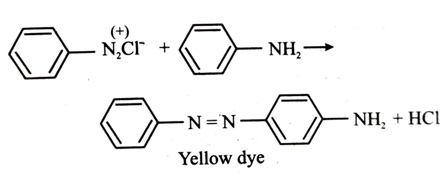
If 279 g of aniline is reacted with one equivalent of benzenediazonium chloride, the maximum amount of aniline yellow formed will be ______ g. (nearest integer)
(consider complete conversion) [2024]
(591)
Number of moles of aniline

Moles of yellow dye = moles of aniline = 3 mol
Mass of yellow dye = number of moles × molar mass
For reaction

The correct order of set of reagents for the above conversion is: [2025]
(2)

The sequence from the following that would result in giving predominantly 3, 4, 5-tribromoaniline is: [2025]


(3)

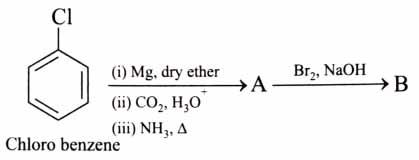
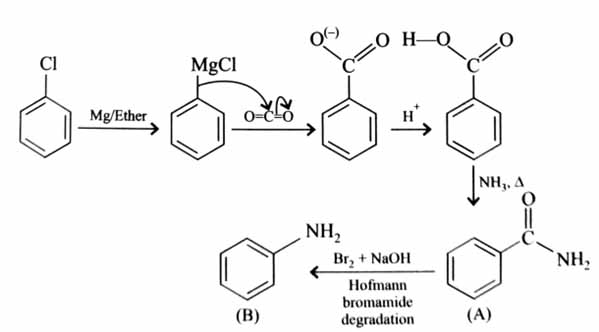
Consider the following sequence of reactions:

11.25 mg of chlorobenzene will produce ---- mg of product B.
(Consider the reactions result in complete conversion.)
[Given molar mass of C, H, O, N and Cl as 12, 1, 16, 14 and 35.5 g respectively] [2025]
(93)

Moles of chlorobenzene =
Moles of B = mol
Given below are two statements:
Statement I: Pure aniline and other arylamines are usually colourless.
Statement II: Arylamines get coloured on storage due to atmospheric reduction.
In the light of the above statements, choose the most appropriate answer from the options given below: [2023]
Both Statements I and Statements II are correct
Statements I is incorrect but Statements II is correct
Both Statements I and Statements II are incorrect
Statements I is correct but Statements II is incorrect
(4)
Arylamines get coloured due to atmospheric oxidation.

Compound A from the following reaction sequence is: [2023]

Salicylic acid
Phenol
Benzoic acid
Aniline
(4)

An organic compound (P) on treatment with aqueous ammonia under hot condition forms compound (Q) which on heating with and KOH forms compound (R) having molecular formula Names of P, Q and R respectively are. [2026]
Benzoic acid, benzamide, aniline
Phenylethanoic acid, phenylethanamide, benzamine
Toluic acid, methylbenzamide, 2-methylaniline
Benzoic acid, 4-methylbenzamide, 4-methylaniline
(1)

Consider the following reaction sequence

The percentage of nitrogen in product ‘T’ formed is ______ %. (Nearest integer)
(Given molar mass in g : H : 1, C : 12, N : 14, O : 16) [2026]
(20)

The mass of benzanilide obtained from the benzoylation reaction of 5.8 g of aniline, if yield of product is 82%, is ________ g (nearest integer).
(Given molar mass in g H : 1, C : 12, N : 14, O : 16) [2026]
(10)

Identify X in the sequence given:


(1)

Which of the following process will produce 2° amine?
Gabriel synthesis
Hoffmann bromamide reaction
Reduction of carbylamines
Reduction of nitro compounds
(3)
Reduction of RNC will produce .
Given below are two statements:
Statement I: Heating benzamide with bromine in an ethanolic solution of sodium hydroxide will give benzylamine.
Statement II: Nitration of aniline with at 288 K produces -nitroaniline in higher amount than -nitroaniline (pH adjusted).
In the light of the above statements, choose the correct answer from the options given below: [2026]
Both Statement I and Statement II are true
Both Statement I and Statement II are false
Statement I is true but Statement II is false
Statement I is false but Statement II is true
(4)
Statement I:

Statement II:

Identify the incorrect statements.

Choose the correct answer from the options given below: [2026]
A and D only
A and C only
B and C only
A and B only
(3)
(A) In aniline (), lone pair on N is delocalized due to resonance. In benzyl amine (), lone pair on N is localized. Thus is a stronger base than .
(B) Aromatic amines cannot be synthesised by Gabriel phthalimide synthesis.

Product C of the following reaction sequence will be [2026]

1-Bromo-4-nitrobenzene
1,3,5-Tribromo-2-nitrobenzene
4-Bromo-1-nitrobenzene
1,3,5-Tribromobenzene
(2)


Consider the following reactions sequence

When the product (P) is subjected to Carius analysis using , 1.0 g of the product (P) will produce _____ g of the precipitate of AgBr. (Nearest Integer).
(Given: molar mass in g C : 12, H : 1, O : 16, N : 14, Br : 80, Ag : 108) [2026]
(1)