Q 1 :

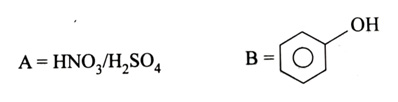
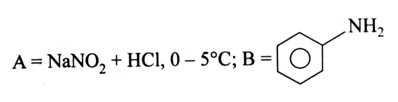
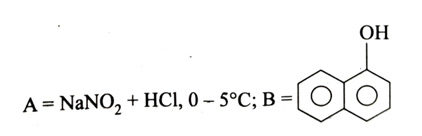
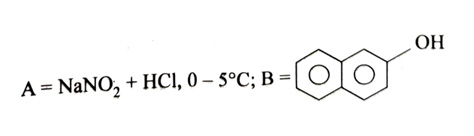
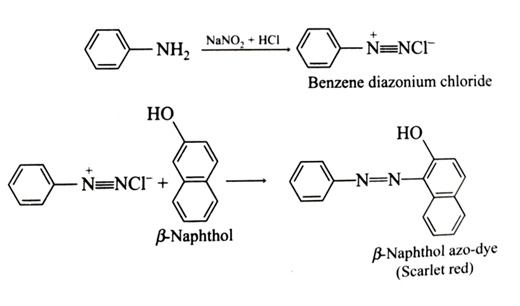
Following is a confirmatory test for aromatic primary amines. Identify reagent (A) and (B).                    [2024]

  •  

  •  

  •  

  •  

(4)

The presence of Aromatic primary amines is confirmed by azo dye test. Primary amine e.g., aniline reacts with nitrous acid generated in situ by the reaction of sodium nitrite with HCl at 0–5°C to produce diazonium salt. This couples with β-naphthol to give a scarlet red dye, which is sparingly soluble in water.


Q 2 :

Given below are two statements:                                                                                    [2024]

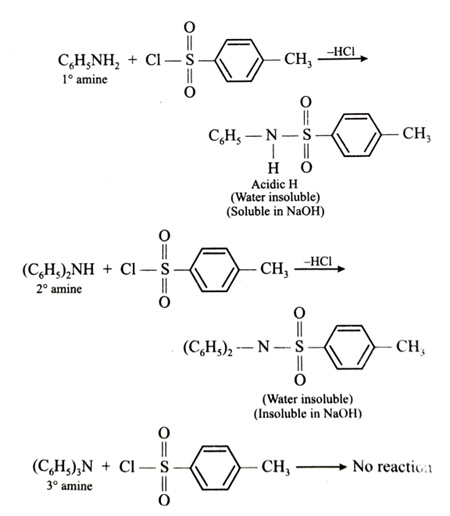
Statement (I): All the following compounds react with p-toluenesulfonyl chloride.

C6H5NH2                    (C6H5)2NH                        (C6H5)3N

Statement (II): Their products in the above reaction are soluble in aqueous NaOH.

In the light of the above statements, choose the correct answer from the options given below. 

  • Statement I is true but Statement II is false


  • Both Statement I and Statement II are true


  • Statement I is false but Statement II is true


  • Both Statement I and Statement II are false


(4)

Primary amines react with p-toluenesulfonyl chloride (Hinsberg’s reagent) to form sulphonamides which are soluble in NaOH. Secondary amines react with p-toluenesulfonyl chloride to form sulphonamides which are insoluble in NaOH. Tertiary amines do not react with p-toluenesulfonyl chloride.


Q 3 :

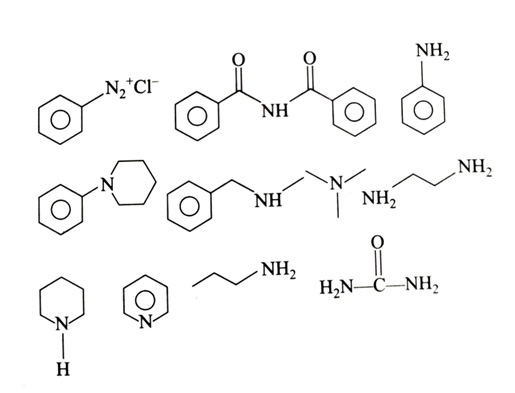
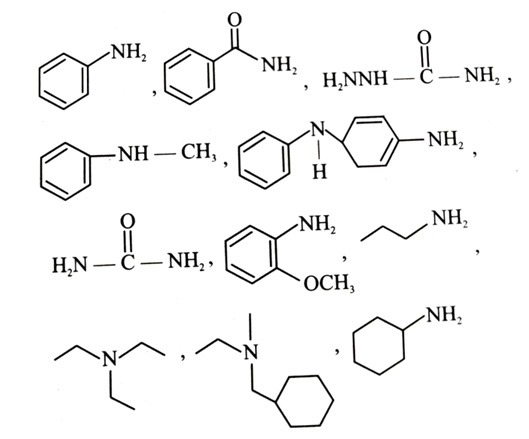
Number of compounds which give reaction with Hinsberg’s reagent is _______.                   [2024]


(5)

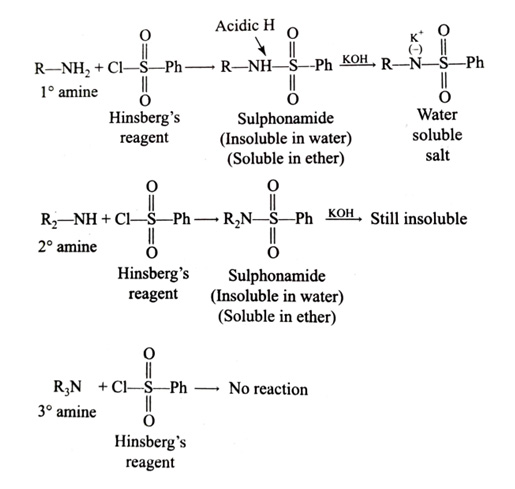
Primary and secondary (aliphatic or aromatic) amines react with Hinsberg’s reagent (benzene sulfonyl chloride) to form sulphonamides which are insoluble in water but soluble in ether. Sulphonamides formed by primary amines have acidic hydrogen, hence are soluble in aqueous KOH. Sulphonamides formed by secondary amines do not have acidic hydrogen, hence are insoluble in aqueous KOH. Tertiary amines do not react with Hinsberg’s reagent.

So among the given options, compounds that react with Hinsberg’s reagent are primary and secondary amines (aliphatic or aromatic).


Q 4 :

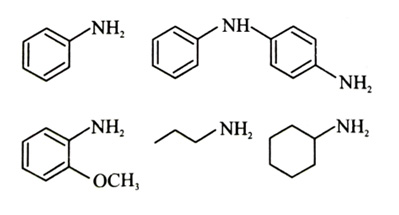
Number of amine compounds from the following giving solids which are soluble in NaOH upon reaction with Hinsberg’s reagent is _______.             [2024]


(5)

Primary amines (aliphatic or aromatic) react with Hinsberg’s reagent to form solids which are soluble in NaOH. Secondary amines react with Hinsberg’s reagent to form solids which are insoluble in NaOH. Tertiary amines do not react with Hinsberg’s reagent.

Amongst given options, following are primary amines and hence form solids soluble in NaOH upon reaction with Hinsberg’s reagent:


Q 5 :

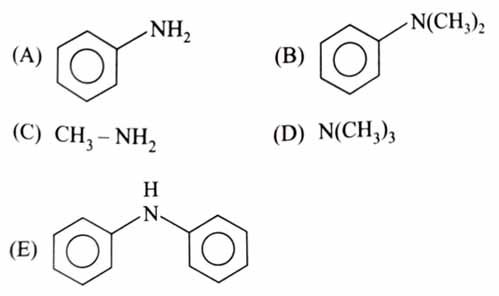
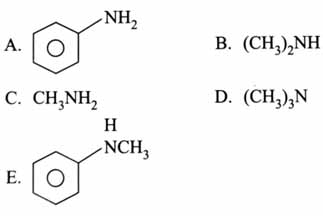
Which among the following react with Hinsberg’s reagent?

Choose the correct answer from the options given below:               [2025]

  • A, B and E only


  • C and D only


  • A, C and E only


  • B and D only


(3)

Primary and secondary amines react with Hinsberg’s reagent as these contain replaceable H atom.


Q 6 :

Identify correct statements:
(A) Primary amines do not give diazonium salts when treated with NaNO2 in acidic condition.
(B) Aliphatic and aromatic primary amines on heating with CHCl3 and ethanolic KOH form carbylamines.
(C) Secondary and tertiary amines also give carbylamine test.
(D) Benzenesulfonyl chloride is known as Hinsberg’s reagent.
(E) Tertiary amines react with benzenesulfonyl chloride very easily.

Choose the correct answer from the options given below:                [2025]

  • (B) and (C) only


  • (D) and (E) only


  • (B) and (D) only


  • (A) and (B) only


(3)

R-NH2NaNO2+HClRN2+Cl- (unstable)H2OROH+N2+HCl

Ar-NH2NaNO2+HClArN2+Cl- (stable at 0-5°C)

(B)(C) Carbylamine reaction - Aliphatic and aromatic primary amines on heating with chloroform and ethanolic potassium hydroxide form isocyanides or carbylamines which are foul smelling substances. Secondary and tertiary amines do not show this reaction. This reaction is known as carbylamine reaction or isocyanide test and is used as a test for primary amines.

Ar/R-NH2+CHCl3+3KOHAr/R-NC+3KCl+3H2O

(D)(E) Benzenesulphonyl chloride (C6H5SO2Cl), which is also known as Hinsberg’s reagent, reacts with primary and secondary amines to form sulphonamides. Tertiary amines do not have replaceable hydrogen connected to nitrogen and hence do not react with C6H5SO2Cl.


Q 7 :

Which of the following amine(s) show(s) positive carbylamines test?

Choose the correct answer from the options given below:                [2025]

  • A and E only


  • C only


  • A and C only


  • B, C and D only


(3)

Primary amines (aliphatic or aromatic) show positive carbylamine test.


Q 8 :

An organic compound [A] [C4H11N], shows optical activity and gives N2 gas on treatment with HNO2. The compound [A] reacts with PhSO2Cl producing a compound which is soluble in KOH. The structure of A is :                [2023]

  •  

  •  

  •  

  •  

(4)

Given,

(i) Compound is optically active contains chiral carbon/Nitrogen.

(ii) Compound liberates N2 gas with HNO2 It is primary amine.

(iii) Compound reacts with PhSO2Cl and the product is soluble in KOH It is primary amine.

Therefore, only  satisfy all the above conditions.


Q 9 :

Compound P is neutral, Q gives effervescence with NaHCO3 while R reacts with Hinsberg’s reagent to give a solid soluble in NaOH. Compound P is ________. [2023]

  •  

  •  

  •  

  •  

(2)


Q 10 :

Isomeric amines with molecular formula C8H11N give the following tests:

Isomer (P) Can be prepared by Gabriel phthalimide synthesis

Isomer (Q) Reacts with Hinsberg’s reagent to give solid insoluble in NaOH

Isomer (R) Reacts with HONO followed by β-naphthol in NaOH to give red dye

Isomers (P), (Q) and (R) respectively are ________.            [2023]

  •  

  •  

  •  

  •  

(1)

(P) Gabriel synthesis is used for the preparation of aliphatic primary amines. Aromatic primary amines cannot be prepared by this method.

(Q) 2° amine reacts with Hinsberg’s reagent to give solid insoluble in NaOH.

(R) Aromatic amines react with nitrous acid at low temperatures (273–278 K) to form diazonium salts, which form red/orange dye with β-Naphthol.


Q 11 :

Total number of alkali insoluble solid sulphonamides obtained by reaction of given amines with Hinsberg’s reagent is ________.

Aniline, N-Methylaniline, Methanamine, N, N-Dimethylmethanamine, N-Methyl methanamine, Phenylmethanamine, N-propylaniline, N-phenylaniline, N, N-Dimethylaniline, Allyl amine, Isopropyl amine   [2026]

  • 8


  • 4


  • 2


  • 5


(2)

2° Amine are insoluble with Hinsberg reagent.

Ph-NH-CH3, Me-NH-Me,

Ph-NH-CH2-CH2-CH3, Ph-NH-Ph

Ans. (2) 4


Q 12 :

A student performed analysis of aliphatic organic compound ‘X’ which on analysis gave C = 61.01%, H = 15.25%, N = 23.74%.

This compound, on treatment with HNO2/H2O produced another compound ‘Y’ which did not contain any nitrogen atom. However, the compound ‘Y’ upon controlled oxidation produced another compound ‘Z’ that responded to iodoform test.

The structure of ‘X’ is:   [2026]

  • CH3CH2CH2NH2


  •  

  •  

  •  

(2)


Q 13 :

Gabriel phthalimide synthesis is not applicable for?

  •  

  •  

  •  

  • CH3NH2


(3)

3°R-X Can’t undergo G.T.S