

Two charged conducting spheres of radii a and b are connected to each other by a conducting wire. The ratio of charges of the two spheres respectively is [2024]
(4)
An electric charge is placed at origin (0, 0) m of X-Y co-ordinate system. Two points P and Q are situated at and respectively. The potential difference between the points P and Q will be [2024]
(3)
Potential difference
As
So potential difference = 0.
Given below are two statements: one is labelled as Assertion (A) and the other is labelled as Reason (R).
Assertion (A): Work done by electric field on moving a positive charge on an equipotential surface is always zero.
Reason (R): Electric lines of forces are always perpendicular to equipotential surfaces.
In the light of the above statements, choose the most appropriate answer from the given below: [2024]
Both (A) and (R) are correct but (R) is not the correct explanation of (A)
(A) is correct but (R) is not correct
(A) is not correct but (R) is correct
Both (A) and (R) are correct and (R) is the correct explanation of (A)
(4)
Electric line of force are always perpendicular to equipotential surface so angle between force and displacement will always be . So work done is equal to 0.
At the centre of a half ring of radius R = 10 cm and linear charge density 4 n , the potential is . The value of is _______ . [2024]
(36) Potential at centre of half ring
The electric potential at the surface of an atomic nucleus of radius cm is ______ V [2024]
(8) Potential =
Three infinitely long wires with linear charge density are placed along the x-axis, y-axis and z-axis respectively. Which of the following denotes an equipotential surface? [2025]
xy + yz + zx = constant
(x + y)(y + z)(z + x) = constant
= constant
xyz = constant
(3)
Net potential due to all wires
for V to be constant
where c = constant
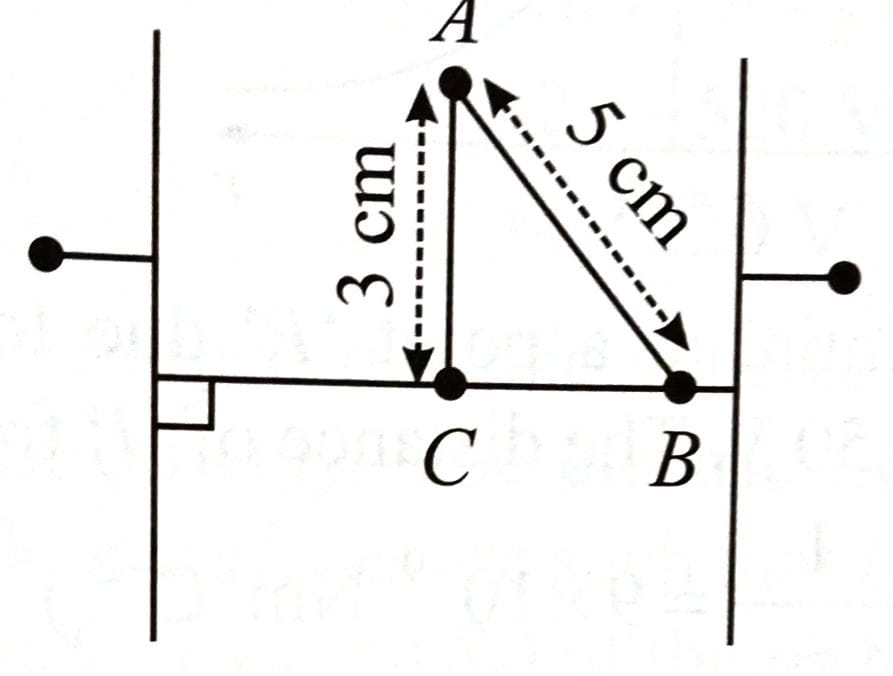
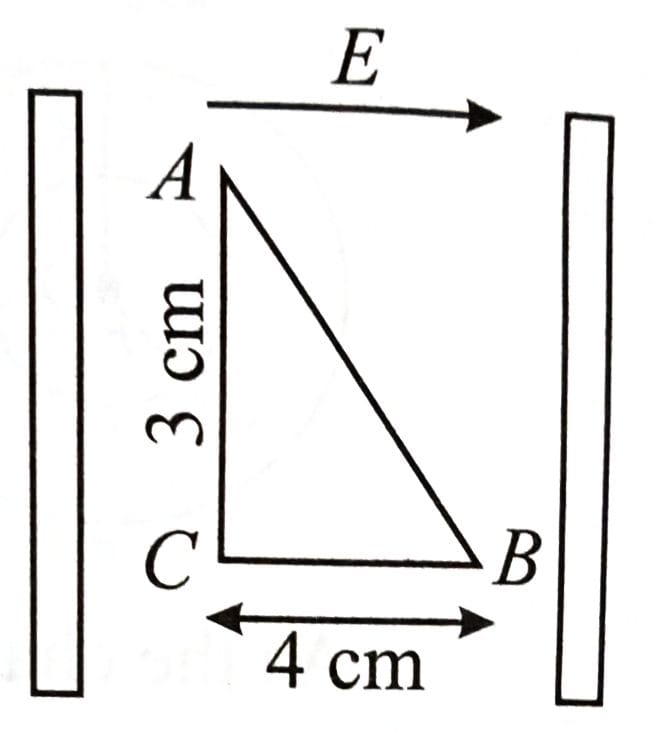
Two large plane parallel conducting plates are kept 10 cm apart as shown in figure. The potential difference between them is V. The potential difference between the points A and B (shown in the figure) is: [2025]

1 V
(2)

Using
V = E(10)
The electrostatic potential on the surface of uniformly charged spherical shell of radius R = 10 cm is 120 V. The potential at the centre of shell, at a distance r = 5 cm from centre, and at a distance r = 15 cm from the centre of the shell respectively, are: [2025]
120 V, 120 V, 80 V
40 V, 40 V, 80 V
0 V, 0 V, 80 V
0 V, 120 V, 40 V
(1)
Potential inside shell is equal to potential on surface
at r = 15 cm
Two metal spheres of radius R and 3R have same surface charge density . If they are brought in contact and then separated, the surface charge density on smaller and bigger sphere becomes and , respectively. The ratio is. [2025]
9
3
(4)
For conducting sphere,
After contact,
The electric potential at the centre of two concentric half rings of radii and , having same linear charge density is [2023]

(2)
Two isolated metallic solid spheres of radii and are charged such that both have same charge density . The spheres are then connected by a thin conducting wire. If the new charge density of the bigger sphere is , the ratio is: [2023]
(4)

Which of the following correctly represents the variation of electric potential of a charged spherical conductor of radius with radial distance from the centre? [2023]


(3)

Considering a group of positive charges, which of the following statements is correct? [2023]
Net potential of the system cannot be zero at a point but net electric field can be zero at that point.
Net potential of the system at a point can be zero but net electric field can't be zero at that point.
Both the net potential and the net field can be zero at a point.
Both the net potential and the net electric field cannot be zero at a point.
(1)
A point charge is moved from to in a uniform electric field of directed along positive -axis. If coordinates of and are (1, 2, 0) m and (0,0,0) m respectively, the work done by electric field will be [2023]
1200 mJ
600 mJ
− 600 mJ
− 1200 mJ
(3)
For a uniformly charged thin spherical shell, the electric potential radially away from the centre of the shell can be graphically represented as [2023]


(1)
Electric potential at a point due to a point charge of is . The distance of from the point charge is
(Assume, ) [2023]
3 cm
90 cm
9 cm
0.9 cm
(2)
For a charged spherical ball, electrostatic potential inside the ball varies with as Here, and are constants and is the distance from the center. The volume charge density inside the ball is . The value of is _________. (permittivity of the medium) [2023]
(12)
Three concentric spherical metallic shells , and of radius , and respectively have surface charge densities , and , respectively. The shells and are at the same potential. If the radii of and are 2 cm and 3 cm, respectively, the radius of shell is ________ cm. [2023]
(5)

64 identical drops, each charged up to a potential of 10 mV are combined to form a bigger drop. The potential of the bigger drop will be ______ mV. [2023]
(160)

...(i)
A point charge of is placed at the origin. The work done in moving a point charge from point is ______J. [2026]
0
(3)
Work done by external agent :
There are three co-centric conducting spherical shells A, B and C of radii , and respectively and they are charged with charges , and respectively. The potentials of the spheres A, B and C respectively, are: [2026]
(2)

The electrostatic potential in a charged spherical region of radius varies as where and are constants. The total charge in the sphere of unit radius is . The value of is _________.
(Permittivity of vacuum is ) [2026]
− 12
− 8
− 9
− 6
(1)
Electric field in a region is given by where and . If the electric potential at a point (10, 20) is 500 V, then the electric potential at the origin is ________ V. [2026]
1000
0
500
2000
(4)
Three small identical bubbles of water having same charge on each coalesce to form a bigger bubble. Then the ratio of the potentials on one initial bubble and that on the resultant bigger bubble is : [2026]
(4)
Five positive charges each having charge q are placed at the vertices of a pentagon as shown in the figure.The electric potential (V) and the electric field at the center O of the pentagon due to these five positive charges are: [2026]

(2)