

Q 1 :

Three capacitors of capacitances 25 μF, 30 μF, and 45 μF are connected in parallel to a supply of 100 V. Energy stored in the above combination is E. When these capacitors are connected in series to the same supply, the stored energy is 9xE. The value of x is _______ .               [2024]


(86)     In series combination: C1=25+30+45=100μF

            In parallel combination: 1C2=125+130+145⇒C2=45043μF

             Energy E=12CV2

             E2E1=C2C1=450/43100=986⇒E2=986E

             ⇒986E=9xE⇒x=86


Q 2 :

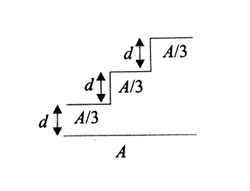
A capacitor is made of a flat plate of area A and a second plate having a stair-like structure as shown in the figure. If the area of each stair is A3 and the height is d, the capacitance of the arrangement is:      [2024]

  • 11ϵ0A18d


  • 13ϵ0A17d


  • 11ϵ0A20d 


  • 18ϵ0A11d


(1)

All capacitors are in parallel combination.

Also, effective area is common area only

Ceq=C1+C2+C3

=ϵ0A3×d+ϵ0A3×2d+ϵ0A3×3d

=6ϵ0A+3ϵ0A+2ϵ0A18d=11ϵ0A18d


Q 3 :

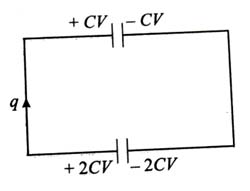
Two identical capacitors have same capacitance C. One of them is charged to the potential V and other to the potential 2V. The negative ends of both are connected together. When the positive ends are also joined together, the decrease in energy of the combined system is           [2024].

  • 14CV2


  • 2CV2


  • 12CV2


  • 34CV2


(1)

Initial energy =12CV2+12C×4V2=5CV22

2CV-qC=CV+qC

2CV-CV=2q

q=CV2

Final charge on capacitor =3CV2

Energyfinal=2×(3CV2)2×12C=9CV24

Decrease in Energy =5CV22-9CV24=CV24


Q 4 :

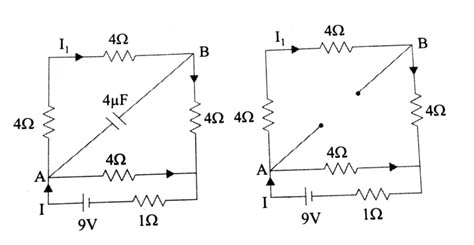
A 16Ω wire is bent to form a square loop. A 9V battery with internal resistance 1Ω is connected across one of its sides. If a 4μF capacitor is connected across one of its diagonals, the energy stored by the capacitor will be x/2 μJ, where x = ______.       [2024]


(81)

At steady state, the current supplied from the battery,

I=VReq=91+12×412+4=94A

I1=94×416=916A

VA-VB=I1×8=916×8=92V

∴ U=12×4×814 μJ=812 μJ

∴ x=81


Q 5 :

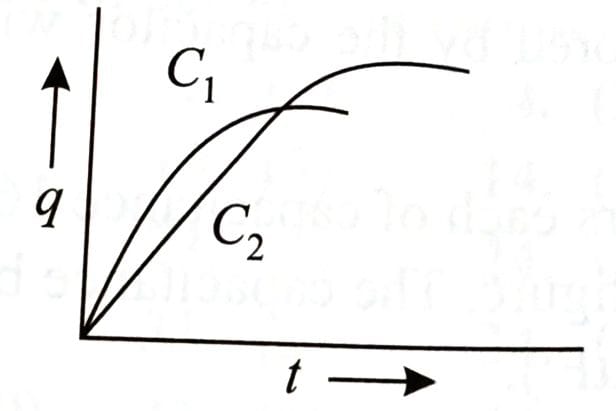
Two capacitors C1 and C2 are connected in parallel to a battery. Charge-time graph is shown below for the two capacitors. The energy stored with them are U1 and U2, respectively. Which of the given statements is true?          [2025]

  • C1>C2, U1>U2


  • C2>C1, U2>U1


  • C1>C2, U1<U2


  • C2>C1, U2<U1


(2)

For a capacitor at steady state

q = CV and U=12CV2

Since C1 and C2 are connected in parallel, V1=V2

Also from graph q1<q2

⇒ C1V1<C2V2

i.e., C1<C2 or C2>C1

U1U2=C1V12C2V22=C1C2<1

or U1<U2 or U2>U1


Q 6 :

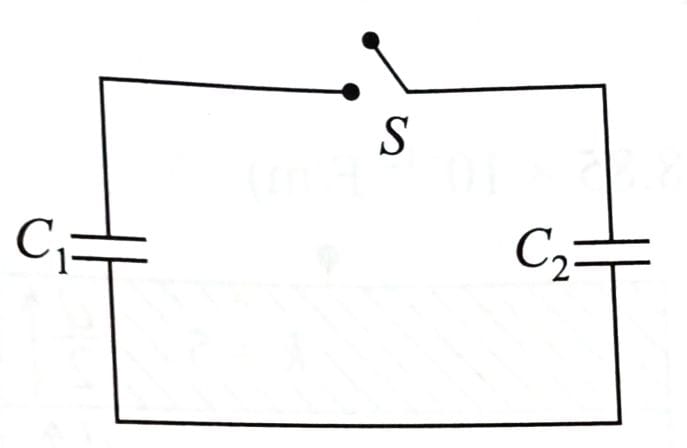
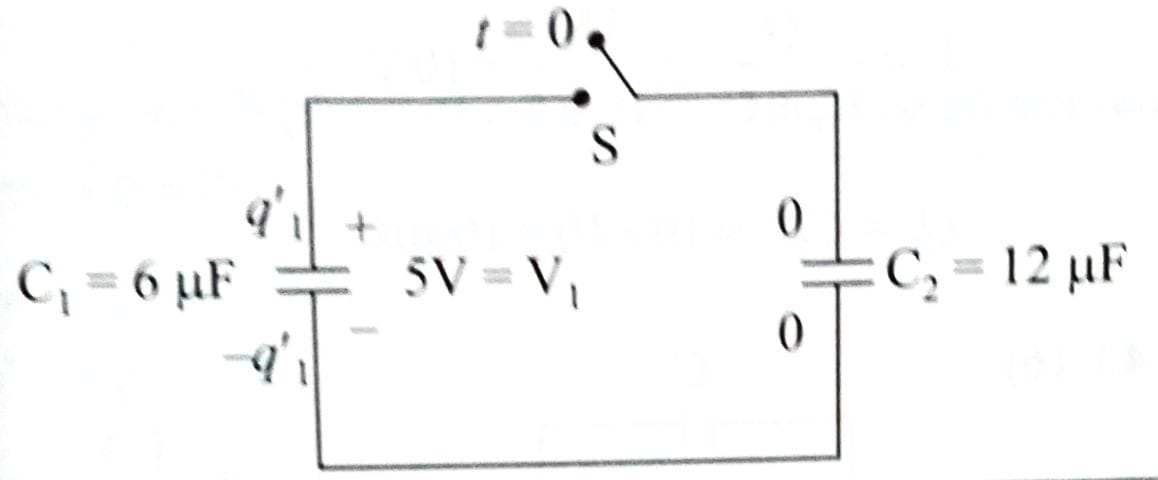
A capacitor, C1=6 μF is charged to a potential difference of V0=5 V using a 5 V battery. The battery is removed and another capacitor, C2=12 μF is inserted in place of the battery. When the switch 'S' is closed, the charge flows between the capacitors for some time until equilibrium condition is reached. What are the charges (q1 and q2) on the capacitors C1 and C2 when equilibrium condition is reached?          [2025]

  • q1=15 μC, q2=30 μC


  • q1=30 μC, q2=15 μC


  • q1=10 μC, q2=20 μC


  • q1=20 μC, q2=10 μC


(3)

Initially Finally
q1'=6×5=30 μC

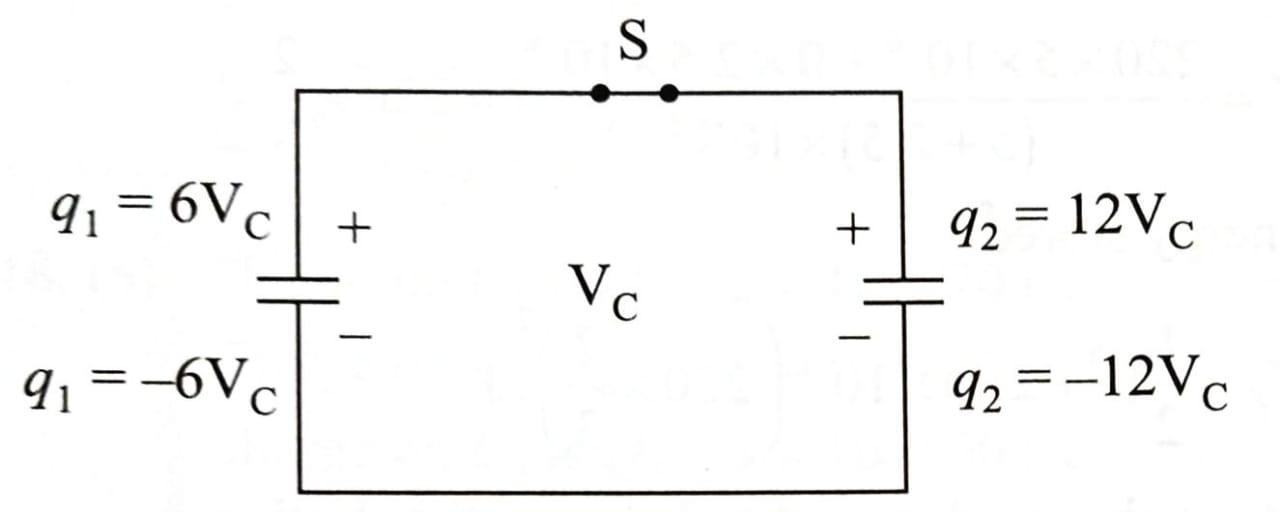
6VC+12VC=30+0

18VC=30

⇒ VC=3018=53 Volt

⇒ q1=6×53=10 μC

and q2=12×53=20 μC


Q 7 :

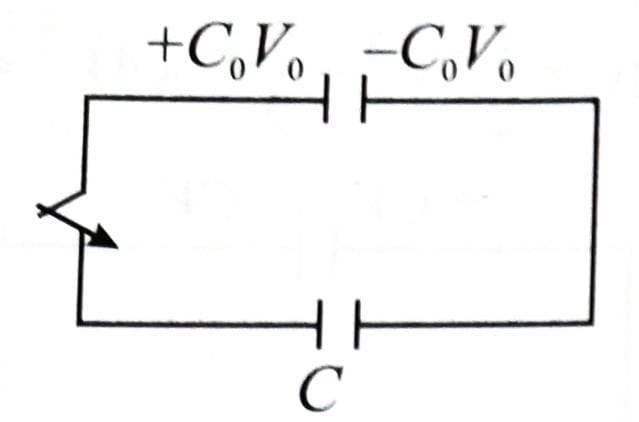
Using a battery, a 100 pF capacitor is charged to 60 V and then the battery is removed. After that, a second uncharged capacitor is connected to the first capacitor in parallel. If the final voltage across the second capacitor is 20 V, its capacitance is (in pF)          [2025]

  • 600


  • 200


  • 400


  • 100


(2)

New potential =C0V0C0+C=V03

3C0V0=C0V0+CV0

2C0V0=CV0

C=2C0=2×100=200 pF


Q 8 :

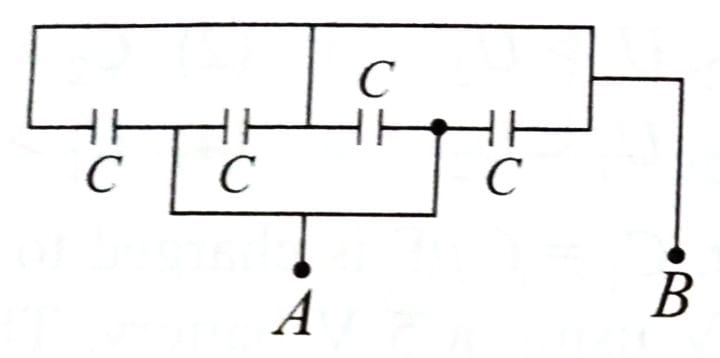
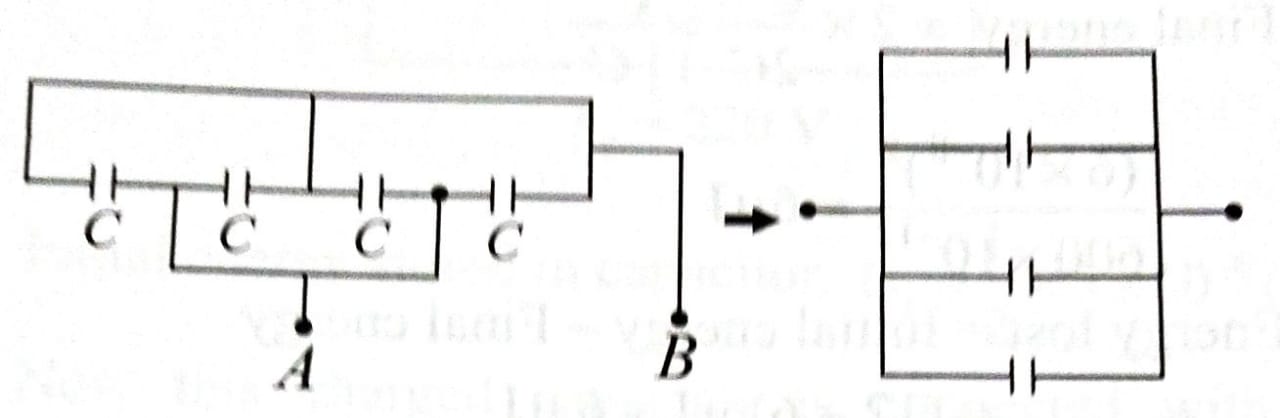
Four capacitors each of capacitance 16 μF are connected as shown in the figure. The capacitance between points A and B is : ______ (in μF).          [2025]


(64)

Ceq=4C=64


Q 9 :

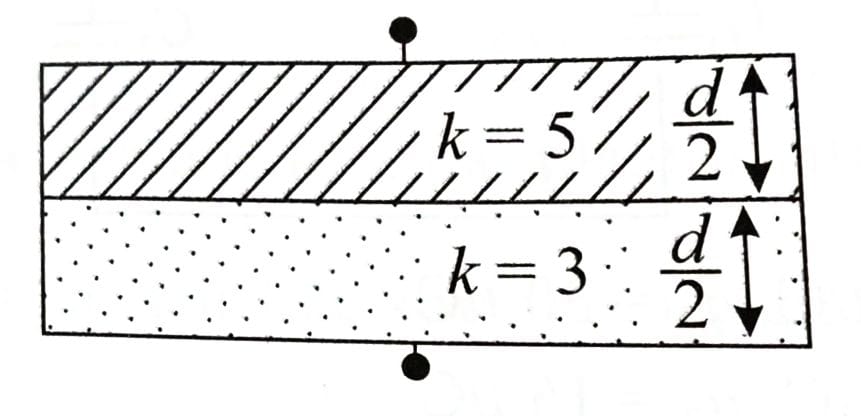
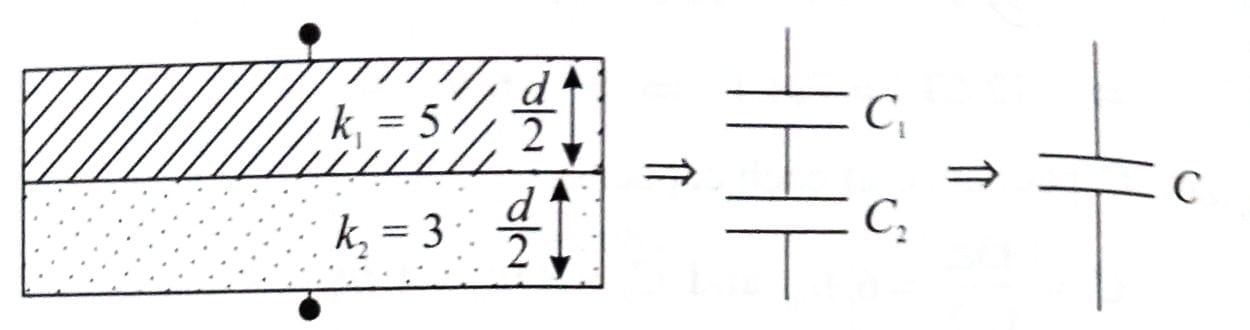
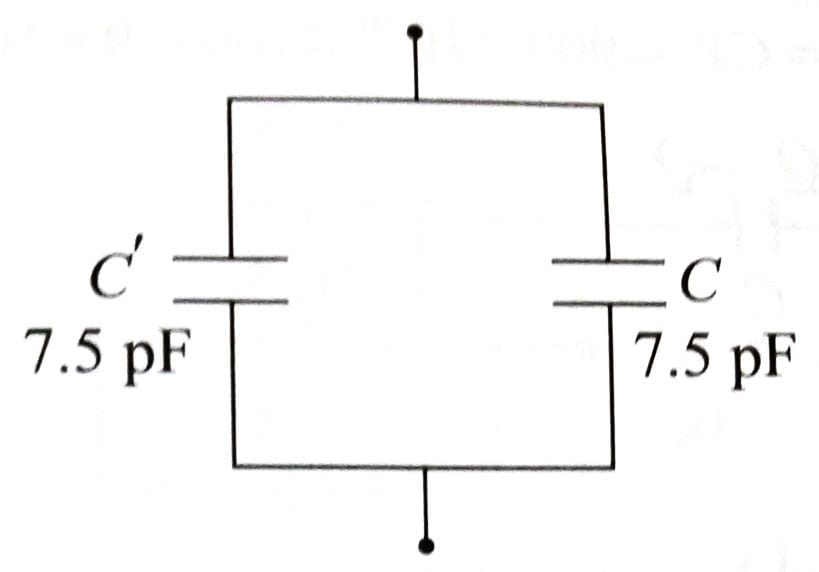
Space between the plates of a parallel plate capacitor of plate area 4 cm2 and separation of (d) 1.77 mm, is filled with uniform dielectric materials with dielectric constants (3 and 5) as shown in figure. Another capacitor of capacitance 7.5 pF is connected in parallel with it. The effective capacitance of this combination is ______ pF. (Given ε0=8.85×10⁻¹² F/m)        [2025]


(15)

1C=1C1+1C2=d/2Ak1ε0+d/2Ak2ε0

    =(1k1+1k2)d2Aε0=(13+15)d2Aε0

1C=415dAε0

C=154×Aε0d

     =154×4×10–4×8.85×10–121.77×10–3=7.5 pF

Finally equivalent capacitance (Ceq) = 7.5 + 7.5 = 15 pF


Q 10 :

The equivalent capacitance of the combination shown is             [2023]

  • C2


  • 4C


  • 2C


  • 53C


(3)

The circuit can be reduced to

Parallel combination Ceq=C+C=2C


Q 11 :

A parallel plate capacitor of capacitance 2F is charged to a potential V. The energy stored in the capacitor is E1. The capacitor is now connected to another uncharged identical capacitor in parallel combination. The energy stored in the combination is E2. The ratio E2/E1 is            [2023]

  • 2 : 1


  • 1 : 2


  • 1 : 4


  • 2 : 3


(2)

Initially,

Q1=CV=(2)V

E1=12CV2=12(2)V2=V2

Finally,

Charge on each capacitor,

       Q2=Q12=2V2=V

        E2=2(12Q22C)=V22

 ∴   E2E1=12


Q 12 :

A capacitor of capacitance  900 μFis charged by a 100 V battery. The capacitor is disconnected from the battery and connected to another uncharged identical capacitor such that one plate of the uncharged capacitor is connected to the positive plate and the other plate of the uncharged capacitor is connected to the negative plate of the charged capacitor. The loss of energy in this process is measured as x×10-2J. The value of x is ________ .           [2023]


(225)

C=900 μF

Hence Q=CV=900×10-6×100=9×10-2=90 mC

Common potential will be developed across both capacitors by KVL.

Total charge on left plates of capacitors should be conserved.

∴  90 mC+0=2CV0

CV0=45 mC

Heat dissipated=Ui-Uf    [Change in energy stored in the capacitors]

=12(90 mC)2900 μF-2×12(45 mC)2900 μF [U=Q22C]

=12×900×10-6(8100-4050)×10-6=2.25 Joule


Q 13 :

A 600 pF capacitor is charged by a 200 V supply. It is then disconnected from the supply and is connected to another uncharged 600 pF capacitor. Electrostatic energy lost in the process is __________μJ           [2023]


(6)

Q=CV=600×10-12×200=12×10-8 C

Initial energy=12CV2

                          =12×600×10-12×(200)2=12 μJ

When connected to another uncharged capacitor

charge will be equally distributed on identical capacitors

          Q'=Q2=6×10⁻⁸

Final energy=2×Q'22C=Q'2C

       =(6×10⁻⁸)2600×10-12=6 μJ

Energy lost=Initial energy-Final energy

                       =(12-6) μJ=6 μJ


Q 14 :

In the given circuit, C1=2 μF, C2=0.2 μF, C3=2 μF, C4=4 μF, C5=2 μF, C6=2 μF, the charge stored on capacitor C4 is ______ μC.                  [2023]


(4)

Ceq=0.5 μF

Q=0.5×10=5 μC

Q'=5 μC×0.80.8+0.2=4 μC


Q 15 :

In the given figure, the total charge stored in the combination of capacitors is 100 μC. The value of 'x' is _________ .       [2023]


(5)

Charge on C1 is Q1=2×10=20 μC                    ...(i)

Charge on C2 is Q2=x×10=10x μC                  ...(ii)

Charge on C3 is Q3=3×10=30 μC                     ...(iii)

Total charge =20+10x+30=100

⇒  x=5


Q 16 :

The space between the plates of a parallel plate capacitor of capacitance C (without any dielectric) is now filled with three dielectric slabs of dielectric constants K1=2, K2=3, and K3=5 (as shown in the figure). If the new capacitance is n3C, then the value of n is _______.                [2026]


(8)

C1=5ε0(A/2)d/2=5ε0Ad=5C

C2=2ε0(A/2)d/2=2ε0Ad=2C

C1 and C2 in series

C'=C1C2C1+C2=(5C)(2C)7C=107C

C3=3ε0(A/2)d/2=3C

C4=2ε0(A/2)d/2=2C

C4 and C3 in series; C''=(2C)(3C)5C=65C

C' and C'' in parallel; 

So, Ceq=C(65+107)=C(42+5035)=9235C

9235C=nC3

n=92×335=7.9≈8


Q 17 :

Three parallel plate capacitors each with area A and separation d are filled with two dielectrics (k1 and k2) in the following fashion. Which of the following is true? (k1>k2)     [2026]

  • CA>CC>CB


  • CC>CA>CB


  • CB>CC>CA


  • CC>CB>CA


(1)

For CA:

Let ε0Ad=C

∴  CA=K1C2+K1K2CK1+K2

     =K1C[K1+2K22(K1+K2)]

For CB:

CB=K2C2+K1K2CK1+K2

       =K2C[K1+2K22(K1+K2)]

For CC:

CC=2K1K2CK1+K2

CA>CC>CB


Q 18 :

A capacitor P with capacitance 10×10-6 F is fully charged with a potential difference of 6.0 V and disconnected from the battery. The charged capacitor P is connected across another capacitor Q with capacitance 20×10-6 F. The charge on capacitor Q when equilibrium is established will be α×10-5 C. 

(assume capacitor Q does not have any charge initially), the value of α is __________.   [2026]


(4)

V=C1V1+C2V2C1+C2=10-5×6+03×10-5

V=2 volt

Q2=C2V=2×10-5×2=4×10⁻⁵ C


Q 19 :

In the figure four identical plates 1, 2, 3 and 4 are placed at x = 0, d, 2d and 3d respectively. Graph shows variation of potential with position of plates. Capacitance of any one capacitor is C. Then equivalent capacitance between plates 1 and 3 is

  • C2


  • 3C


  • 3C2


  • 2C


(4)


Q 20 :

Six identical conducting plates of area A each are connected as shown. The separation 'd' between any two adjacent plates is same. ε0 is permittivity of free space between the plates. The effective capacitance between the terminals of battery is 3kε0A2d. The value of 'k' is


(1)

Redraw the circuit in series and parallel combination


Q 21 :

The equivalent capacitance between points A and B in below shown figure will be

  • 6 μF


  • 323μF


  • 32 μF


  • 2 μF


(1)

CAB=24×824+8=6 μF


Q 22 :

Six equal resistances are connected between points P, Q and R as shown in figure. Then net resistance will be maximum between:

  • P and R


  • P and Q


  • Q and R


  • any two points


(2)

Resistance between P and Q         rPQ=r∥(r3+r2)=r×56rr+56r=511r

Resistance between Q and R         rQR=r2∥(r+r3)=r2×43rr2+43r=411r

Resistance between P and R         rPR=r3∥(r2+r)=r3×32rr3+32r=311r

Hence, it is clear that rPQ is maximum.


Q 23 :

From the circuit given below, the capacitance between terminals A and B shown in the circuit is ________ μF.

(take C1=C2=C3=1 μF and C4=2 μF)                        [2026]

  • 2


  • 72


  • 73


  • 52


(1)

=Ceq=2 μF