Q 1 :

In alkaline medium, MnO4- oxidises I- to                   [2024]

  • IO-


  • IO4-


  • I2


  • IO3-


(4)

  In neutral or faintly alkaline medium, permanganate (MnO4-) oxidizes iodide (I-) to iodate (IO3-)

  2MnO4-+H2O+I-2MnO2+2OH-+IO3-


Q 2 :

KMnO4 decomposes on heating at 513K to form O2 along with                     [2024]

  • Mn and KO2


  • K2MnO4 and MnO2


  • K2MnO4 and Mn


  • MnO2 and K2O2


(2)

          2KMnO4(s)ΔMnO2(s)+K2MnO4(s)+O2(g)


Q 3 :

The orange colour of K2Cr2O7 and purple colour of KMnO4 is due to                            [2024]

  • Charge transfer transition in both.


  • d → d transitions in KMnO4 and charge transfer transitions in K2Cr2O7.


  • d → d transitions in K2Cr2O7 and charge transfer transitions in KMnO4.


  • d → d transitions in both


(1)

A compound is coloured if it has electronic energy levels where electrons can undergo transition by absorbing light in visible range. For most d-block elements, energy difference in d-orbitals lies in visible range. Hence due to d-d electronic transitions, these are coloured. But in K2Cr2O7 (orange) and KMnO4 (purple), central atom has no d-electron. Colour of these compounds is due to charge transfer from oxide to metal ion.


Q 4 :

Alkaline oxidative fusion of MnO2 gives ''A'' which on electrolytic oxidation in alkaline solution produces B. A and B respectively are              [2024]

  • Mn2O7 and MnO4-


  • MnO42- and MnO4-


  • Mn2O3 and MnO42-


  • MnO42- and Mn2O7


(2)

  Alkaline oxidative fusion of MnO2 gives manganate (MnO42-), which upon electrolytic oxidation gives permanganate.

  2MnO2+4KOH+O22K2MnO4+2H2O

  MnO42-Electrolytic oxidationMnO4-

  Manganate                               Permanganate

  This is commercial method of preparation of Permanganate


Q 5 :

Identify correct statements from below:

A.  The chromate ion is square planar.
B.  Dichromates are generally prepared from chromates.
C.  The green manganate ion is diamagnetic.
D.  Dark green coloured K2MnO4 disproportionates in a neutral or acidic medium to give permanganate.
E.  With increasing oxidation number of transition metal, ionic character of the oxides decreases. 

Choose the correct answer from the options given below:                     [2024]

  • B, C, D only


  • A, D, E only


  • A, B, C only


  • B, D, E only


(4)

       (A) The chromate ion is tetrahedral in shape.

       (B) Dichromates are prepared from chromates.

       (C) In manganate ion, Mn is in +6 oxidation state, hence has one unpaired electron and is paramagnetic.

       (D) The dark green K2MnO4 disproportionates in a neutral or acidic solution to give permanganate.

               2MnO2+4KOH+O22K2MnO4+2H2O

              3MnO42-+4H+2MnO4-+MnO2+2H2O

       (E) With increase in oxidation number of central metal atom, its polarising power increases and covalent character increase and therefore, ionic character decreases.


Q 6 :

Choose the correct statements from the following

A.  Mn2O7 is an oil at room temperature
B.  V2O4 reacts with acid to give VO22+
C.  CrO is a basic oxide
D.  V2O5 does not react with acid    

Choose the correct answer from the options given below:                 [2024]

  • A, B and D only


  • A and C only


  • A, B and C only


  • B and C only


(2)

        (A) Mn2O7 is a covalent green oil.

        (B) V2O4 is a basic oxide. It dissolves in acids to give VO2+ salts (not VO22+).

        (C) CrO is basic and Cr2O3 is amphoteric.

        (D) V2O5 is amphoteric. It reacts with alkalies as well as acids to give VO43- respectively.


Q 7 :

Which of the following compounds show colour due to d-d transition?                  [2024]

  • K2Cr2O7


  • CuSO4.5H2O


  • KMnO4


  • K2CrO4


(2)

A compound is coloured if it has electronic energy levels where electrons can undergo transition by absorbing light in visible range. For most d block elements energy difference in d orbitals lies in visible range. Hence, due to d-d electronic transitions, These are coloured. In CuSO4.5H2O, Cu2+(3d9) splits into t2g6,eg3. d-d transition from t2g to eg makes it coloured. But in K2Cr2O7 (orange), KMnO4 (purple) and K2CrO4 (yellow), central atom has no d electron. Colour of these compounds is due to charge transfer from oxide to metal ion.


Q 8 :

Iron (III) catalyses the reaction between iodide and persulphate ions, in which

A.  Fe3+ oxidises the iodide ion
B.  Fe3+ oxidises the persulphate ion
C.  Fe2+ reduces the iodide ion
D.  Fe2+ reduces the persulphate ion

Choose the most appropriate answer from the options given below:                 [2024]

  • B only


  • A only


  • B and C only


  • A and D only


(4)

         2I-+S2O82-I2+2SO42-

         In this reaction iron acts as catalyst as explained below:

         Fe3+ oxidizes the iodide ion

         2Fe3++2I-2Fe2++I2

         Fe2+ reduces the persulphate ion (oxygen is reduced from -1 to -2).

         2Fe2++S2O82-2Fe3++2SO42-


Q 9 :

Given below are two statements:

Statement (I): Fusion of MnO2 with KOH and an oxidising agent gives dark green K2MnO4.

Statement (II): Manganate ion on electrolytic oxidation in alkaline medium gives permanganate ion.

In the light of the above statements, choose the correct answer from the options given below.                    [2024]

  • Statement I is true but Statement II is false


  • Both Statement I and Statement II are false


  • Statement I is false but Statement II is true


  • Both Statement I and Statement II are true


(4)

Potassium permanganate is prepared by fusion of MnO2 with an alkali metal hydroxide and an oxidising agent. This produces the dark green K2MnO4 which disproportionates in a neutral or acidic solution to give permanganate.

 2MnO2+4KOH+O22K2MnO4+2H2O

 3MnO42-+4H+2MnO4-+MnO2+2H2O


Q 10 :

Number of moles of H+ ions required by 1 mole of MnO4- to oxidise oxalate ion to CO2 is _____________ .              [2024]


(8)

           MnO4-    +    8H+     +     5e-        Mn2+    +   4H2O] × 2

           C2O42-     2CO2   +    2e-                                                        ] × 5

         _____________________________________________

          2MnO4-   +  5C2O42-  +  16H+     2Mn2+  +  10CO2    +    8H2O


Q 11 :

Consider the following reaction

MnO2+KOH+O2A+H2O.

Product ‘A’ in neutral or acidic medium disproportionates to give products ‘B’ and ‘C’ along with water. The sum of spin-only magnetic moment values of B and C is ______ B.M. (nearest integer) (Given atomic number of Mn is 25).            [2024]


(4)

Potassium permanganate is prepared by fusion of MnO2 with an alkali metal hydroxide and an oxidising agent. This produces the dark green K2MnO4 which disproportionates in a neutral or acidic solution to give permanganate.

    2MnO2+4KOH+O22K2MnO4(A)+2H2O

    3MnO42-+4H+2MnO4-(B)+MnO2(C)+2H2O

Compound Electronic
configuration of
central metal ion
Number of
unpaired
electron in
central metal
ion (n)
Spin only
magnetic
moment (μ) =
n(n+2) BM
MnO4-(B) Mn7+=[Ar]183d0               0 0 BM
MnO2(C) Mn4+=[Ar]183d3              3 3(3+2) BM
 = 3.87 BM

  Sum = (0 + 3.87) BM = 3.87 BM

  Nearest integer is 4


Q 12 :

A first row transition metal with highest enthalpy of atomisation, upon reaction with oxygen at high temperature forms oxides of formula M2On (where n = 3,4,5). The ‘spin-only’ magnetic moment value of the amphoteric oxide from the above oxides is ___ B.M. (near integer)
(Given atomic number : Sc : 21, Ti : 22, V : 23, Cr : 24, Mn : 25, Fe : 26, Co : 27, Ni : 28, Cu : 29, Zn : 30)                    [2024]


(0)

    V has highest value of enthalpy of atomization for first transition series.

Element Sc Ti V Cr Mn Fe Co Ni Cu Zn
Ha(kJ mol-1) 326 473 515 397 281 416 425 430 339 126

      V2O3 is basic, V2O4 is less basic and V2O5 is amphoteric.

       Oxidation number of V in V2O5 is + 5

       V=[Ar]183d3 4s2,  V+5=[Ar]18  

       Number of unpaired electrons (n) in (V+5)=0

      Spin only magnetic moment (μ)=n(n+2)BM=0


Q 13 :

The fusion of chromite ore with sodium carbonate in the presence of air leads to the formation of products A and B along with the evolution of CO2. The sum of spin-only magnetic moment values of A and B is ______ B.M. (Nearest integer)

(Given atomic number: C : 6, Na : 11, O : 8, Fe : 26, Cr : 24)                        [2024]


(6)

Dichromates are generally prepared from chromate, which in turn are obtained by the fusion of chromite ore (FeCr2O4) with sodium or potassium carbonate in free access of air.

The fusion of chromite ore with sodium carbonate in the presence of air leads to the formation of sodium chromate (Na2CrO4) and ferric oxide (Fe2O3).

4FeCr2O4+8Na2CO3+7O28Na2CrO4(A)+2Fe2O3(B)+8CO2

Compound Electronic
configuration of
central atom
Spin only magnetic
moment
(μ=n(n+2)BM)
Na2CrO4(A) Cr6+=[Ar]183d04s0 0(0+2)BM=0BM
Fe2O3(B) Fe3+=[Ar]183d54s0 5(5+2)BM=5.92BM

Sum = 0 + 5.92  6.


Q 14 :

The difference in the ‘spin-only’ magnetic moment values of KMnO4 and the manganese product formed during titration of KMnO4 against oxalic acid in acidic medium is _____ B.M. (nearest integer)                   [2024]


(6)

In acidic medium while acting as an oxidizing agent, KMnO4 is reduced to Mn2+.

KMnO4+H2C2O4Mn2++CO2 (unbalanced)

Substance Electronic
configuration of
metal ion
Number
of
unpaired
electrons (n)
Spin only magnetic
moment
(μ) = n(n+2) BM
KMnO4 Mn7+=[Ar]183d04s0             0                 0 BM
Mn2+ Mn2+=[Ar]183d54s0           5 5(5+2)BM = 5.92 BM

Difference = 5.92 - 0  6


Q 15 :

Among CrOCr2O3 and CrO3, the sum of spin-only magnetic moment values of basic and amphoteric oxides is _______ 10-2 BM (nearest integer).

(Given atomic number of Cr is 24)                      [2024]


(877)

Oxide Nature Electronic
configuration of
central metal ion
Number
of unpaired
electrons
(n)
Spin only
magnetic
moment (μ) =n(n+2)BM
CrO Basic Cr+2=[Ar]183d44s0          4 4(4+2)BM=4.9 BM
Cr2O3 Amphoteric Cr+3=[Ar]183d34s0          3 3(3+2)BM=3.87 BM
CrO3 Acidic Cr+6=[Ar]183d04s0          0                     0

Sum = 4.9 + 3.87 = 8.77 = 877 ×10-2


Q 16 :

Among VO2+,MnO4- and Cr2O72-, the spin-only magnetic moment value of the species with least oxidizing ability is .......... B.M. (Nearest integer). (Given atomic number V = 23, Mn = 25, Cr = 24).             [2024]


(0)

Oxidizing ability of given oxoanions is

VO2+<Cr2O72-<MnO4-

This is due to increasing stability of lower species to which they are reduced.

Compound Electronic
configuration of
central metal ion
Number
of unpaired
electrons (n) 
Spin only
magnetic
moment (μ) = n(n+2) BM
VO2+ V5+=[Ar]183d04s0          0                    0 BM


Q 17 :

The 'spin only' magnetic moment value of MO42- is ______ B.M. (Where M is a metal having least metallic radii. among Sc, Ti, V, Cr, Mn, and Zn).

(Given atomic number: Sc = 21, Ti = 22, V = 23, Cr = 24, Mn = 25, and Zn = 30)                                   [2024]


(0)

Element Sc Ti V Cr Mn Zn
Metallic radius (pm) 164 147 135 129 137 137

Least metallic radius is of Cr among given elements.

Compound Electronic
configuration of
central atom
Number of
unpaired
electrons (n)
Spin only magnetic
moment (μ)= n(n+2)BM
CrO42- Cr+6=[Ar]183d04s0          0                     0


Q 18 :

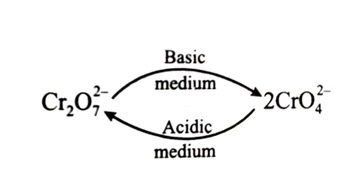
The equilibrium Cr2O72-2CrO42- is shifted to the right in:                                    [2024]

  • an acidic medium


  • a basic medium


  • a neutral medium


  • a weakly acidic medium


(2)


Q 19 :

The correct set of ions (aqueous solution) with same colour from the following is:            [2025]
 

  • Zn2+,V3+,Fe3+


  • Sc3+,Ti3+,Cr2+


  • Ti4+,V4+,Mn2+


  • V2+,Cr3+,Mn3+


(4)

Ions Colour
Sc3+ colourless
Ti4+ colourless
Ti3+ purple
V4+ blue
V3+ green
V2+ violet
Cr3+ violet
Mn3+ violet
Cr2+ blue
Mn2+ pink
Fe3+ yellow
Zn2+ colourless


Q 20 :

Match List–I with List–II.                    [2025]

  List–I   List–II
A. Bronze I. Cu, Ni
B. Brass II. Fe, Cr, Ni, C
C. UK silver coin III. Cu, Zn
D. Stainless steel IV. Cu, Sn


Choose the correct answer from the options given below:

  • A–III, B–IV, C–II, D–I


  • A–IV, B–II, C–III, D–I


  • A–IV, B–III, C–I, D–II


  • A–III, B–I, C–IV, D–II


(3)


Q 21 :

Consider the following reactions

K2Cr2O7-H2OKOH[A]-H2OH2SO4[B]+K2SO4

The products [A] and [B], respectively are:                  [2025]

  • K2CrO4 and K2Cr2O7


  • K2CrO4 and CrO


  • K2CrO4 and Cr2O3


  • K2Cr(OH)6 and Cr2O3


(1)

Chromate (CrO42-) and dichromate (Cr2O72-) are inter-convertible into each other depending upon the pH of the solution. In acidic medium, Cr2O72- is more stable and in basic medium, CrO42- is more stable.

K2Cr2O7-H2OKOHK2CrO4[A]-H2OH2SO4K2Cr2O7[B]+K2SO4


Q 22 :

Preparation of potassium permanganate from MnO2 involves a two-step process in which the first step is a reaction with KOH and KNO3 to produce       [2025]
 

  • K2MnO4


  • K3MnO4


  • KMnO4


  • K4[Mn(OH)6]


(1)

Potassium permanganate is prepared by fusion of MnO2 (pyrolusite) with an alkali metal hydroxide and an oxidising agent. This produces the dark green K2MnO4, which disproportionates in a neutral or acidic solution to give permanganate.

MnO2+2KOH+KNO3K2MnO4+KNO2+H2O

3MnO42-+4H+2MnO4-+MnO2+2H2O


Q 23 :

Which of the following oxidation reactions are carried out by both K2Cr2O7 and KMnO4 in acidic medium?          [2025]

(A)   I-I2                    

(B)    S2-S 

(C)   Fe2+Fe3+

(D)   I-IO3- 

(E)   S2O32-SO42-

Choose the correct answer from the options given below:

  • (C), (D) and (E) only


  • (A), (B) and (C) only


  • (B), (C) and (D) only


  • (A), (D) and (E) only


(2)

Reactant Product with acidic KMnO4 Product with faintly alkaline KMnO4 Product with acidic K2Cr2O7
I- I2 IO3- I2
S2- S S S
Fe2+ Fe3+ Fe3+ Fe3+
S2O32- SO42-+S SO42- SO42-+S


Q 24 :

The amphoteric oxide among V2O3, V2O4 and V2O5, upon reaction with alkali leads to formation of an oxide anion. The oxidation state of V in the oxide anion is:  [2025]

  • +4


  • +7


  • +3


  • +5


(4)

V2O3 – basic, V2O4 – less basic, V2O5 – amphoteric. V2O5 reacts with alkalies as well as acids to give VO43- and VO4+ respectively. Oxidation number of V in VO43- is +5.


Q 25 :

The molar mass of the water insoluble product formed from the fusion of chromite ore (FeCr2O4) with Na2CO3 in presence of O2 is ______ g mol-1.     [2025]


(160)

4FeCr2O4+8Na2CO3+7O28Na2CrO4+2Fe2O3+8CO2

Fe2O3 is insoluble in water. Its molar mass =[2×56+3×16]g/mol

=160 g/mol


Q 26 :

K2Cr2O7 paper acidified with dilute H2SO4 turns green when exposed to           [2023]

  • Hydrogen sulphide


  • Sulphur dioxide


  • Carbon dioxide


  • Sulphur trioxide


(2)

Cr2O72-+2H++3SO22Cr3+(green)+3SO42-+H2O


Q 27 :

Potassium dichromate acts as a strong oxidizing agent in acidic solution. During this process, the oxidation state changes from       [2023]

  • +6 to +3


  • +6 to +2


  • +3 to +1


  • +2 to +1


(1)

Cr+62O7-2 H+ Cr+3


Q 28 :

KMnO4 oxidises I- in acidic and neutral/faintly alkaline solution, respectively, to                             [2023]

  • IO3- and IO3-


  • I2 and IO3-


  • I2 and I2


  • IO3- and I2


(2)

In acidic medium

2MnO4-+10I-+16H+2Mn2++8H2O+5I2

In neutral or faintly alkaline medium

2MnO4-+I-+H2O2MnO2+2OH-+IO3-


Q 29 :

When Cu2+ ion is treated with KI, a white precipitate, X appears in solution. The solution is titrated with sodium thiosulphate, the compound Y is formed. X and Y respectively are:                [2023]

  • X=CuI2          Y=Na2S2O3


  • X=CuI2          Y=Na2S4O6


  • X=Cu2I2         Y=Na2S4O6


  • X=Cu2I2         Y=Na2S4O5


(3)

Cu2++4I-Cu2I2White'X'+I2

I2+2Na2S2O32Na2S4O6'Y'+2NaI

X=Cu2I2 and Y=Na2S4O6


Q 30 :

A solution of FeCl3, when treated with K4[Fe(CN)6] gives a Prussian blue precipitate due to the formation of                [2023]

  • Fe[Fe(CN)6]


  • K[Fe2(CN)6]


  • Fe4[Fe(CN)6]3


  • Fe3[Fe(CN)6]2


(3)

4Fe3++3[Fe(CN)6]4-Fe4[Fe(CN)6]3Prussian blue precipitate.