

Q 1 :

Which of the following acts as a strong reducing agent?
(Atomic number : Ce = 58, Eu = 63, Gd = 64, Lu = 71)                      [2024]

  • Lu3+


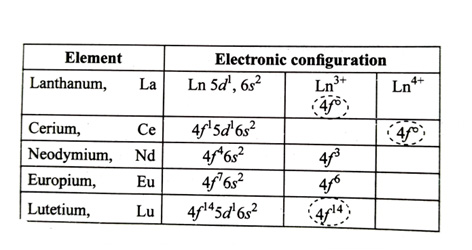
  • Ce4+


  • Gd3+


  • Eu2+


(4)

Common oxidation state of Lanthanoids is +3. Ce4+ has tendency to go to Ce3+ hence Ce4+ is good oxidising agent. Eu2+ has tendency to go to Eu3+, hence is good reducing agent.


Q 2 :

The number of element from the following that do not belong to lanthanoids is

Eu, Cm, Er, Tb, Yb and Lu                                   [2024]

  • 5


  • 1


  • 3


  • 4


(2)

Lanthanoid series elements are 

La57(Lanthanum), 58Ce(Cerium), 59Pr(Praseodymium), 60Nd(Neodymium), 61Pm(Promethium), Sm62(Samarium), 

63Eu(Europium), 64Gd(Gadolinium), 65Tb(Terbium), 66Dy(Dysprosium), Ho67(Holmium), 68Er(Erbium), 

69Tm(Thulium), 70Yb(Ytterbium), and 71Lu(Lutetium).

Cm96(Curium) is an actinoid.


Q 3 :

The electronic configuration of Einsteinium is

(Given atomic number of Einsteinium = 99)                    [2024]

  • [Rn]5f126d07s2


  • [Rn]5f116d07s2


  • [Rn]5f136d07s2


  • [Rn]5f106d07s2


(2)

         Es99=[Rn]865f116d07s2


Q 4 :

Number of colourless lanthanoid ions among the following is _________ .         

Eu3+,Lu3+,Nd3+,La3+,Sm3+                          [2024]


(2)

Lanthonoid ions are coloured because of f-f transitions.

Ions Electronic
configuration
f-f transition Colour
Eu3+ [Xe]544f6 possible Coloured
Lu3+ [Xe]544f14 Not possible as
there are no
unpaired f
electrons
Colourless
Nd3+ [Xe]544f3 possible Coloured
La3+ [Xe]544f0 Not possible as
there are no
f electrons
Colourless
Sm3+ [Xe]544f5 possible Coloured


Q 5 :

Diamagnetic Lanthanoid ions are:                        [2024]

  • Nd3+Eu3+


  • La3+Ce4+


  • Nd3+Ce4+


  • Lu3+Eu3+


(2)

Substances that are weakly repelled by magnetic field are called diamagnetic substances. Atoms having all electrons paired are diamagnetic.


Q 6 :

Lanthanoid ions with 4f7 configuration are:                 [2025]

(A)   Eu2+
(B)   Gd3+
(C)   Eu3+
(D)   Tb3+
(E)   Sm2+

  • (A) and (B) only


  • (B) and (C) only


  • (A) and (D) only


  • (B) and (E) only


(1)

Ions Electronic configuration
(A)  Eu2+63 [Xe]544f76s0
(B)  Gd3+64 [Xe]544f75d06s0
(C)  Eu3+63 [Xe]544f66s0
(D)  Tb3+65 [Xe]544f86s0
(E)  Sm2+62 [Xe]544f66s0


Q 7 :

Which of the following ions is the strongest oxidizing agent?

(Atomic Number of Ce = 58, Eu = 63, Tb = 65, Lu = 71)                    [2025]

  • Lu3+


  • Ce3+


  • Eu2+


  • Tb4+


(4)

+3 is common oxidation states of lanthanoids. Tb4+ has thus a tendency to get reduced to Tb3+ and is an oxidizing agent.


Q 8 :

Which one amongst the following are good oxidizing agents?

A. Sm2+  B. Ce2+

C. Ce4+  D. Tb4+

Choose the most appropriate answer from the options given below:                     [2023]

  • D only


  • C and D only


  • C only


  • A and B only


(2)

Both Ce4+ and Tb4+ act as oxidising agent.


Q 9 :

Nd2+= ____________                    [2023]

  • 4f3


  • 4f46s2


  • 4f26s2


  • 4f4


(4)

Nd (Z=60)=4f46s2

Nd2+=4f4


Q 10 :

Which of the following elements have half-filled f-orbitals in their ground state?

(Given: atomic number Sm = 62; Eu = 63; Tb = 65; Gd = 64; Pm = 61)         [2023]

(A) Sm
(B) Eu
(C) Tb
(D) Gd
(E) Pm

Choose the correct answer from the options given below:

  • A and B only


  • C and D only


  • B and D only


  • A and E only


(3)

Sm (Z=62)=4f6s2

Eu (Z=63)=4f76s2

Tb (Z=65)=4f96s2

Gd (Z=64)=4f75d16s2

Pm (Z=61)=4f56s2

Here Eu and Gd have half-filled configuration.


Q 11 :

Strong reducing and oxidizing agents among the following, respectively, are  [2023]

  • Eu2+ and Ce4+


  • Ce4+ and Eu2+


  • Ce4+ and Tb4+


  • Ce3+ and Ce4+


(1)

(ECe+4/Ce+30)=RP1.74 V

Eu+2 is a strong reducing agent converting to common oxidation state +3, where as Ce4+ is a strong oxidising agent converting to +3-oxidation state.


Q 12 :

Given below are two statements: one is labelled as Assertion A and the other is labelled as Reason R.

Assertion A: 5f electrons can participate in bonding to a far greater extent than 4f electrons.

Reason R: 5f orbitals are not as buried as 4f orbitals.

In the light of the above statements, choose the correct answer from the options given below.  [2023]

  • Both A and R are true but R is not the correct explanation of A


  • A is true but R is false


  • A is false but R is true


  • Both A and R are true and R is the correct explanation of A


(4)

As number of valence shell is higher, electrons of its orbitals can participate in bonding in greater extents. 4f electron is more shielded as compared to 5f electrons. 5f orbitals are not as buried as 4f orbitals.


Q 13 :

The pair of lanthanides in which both elements have high third-ionization energy is:  [2023]

  • Dy, Gd


  • Lu, Yb


  • Eu, Yb


  • Eu, Gd


(3)

Element Electronic configuration
Europium (Eu) [Xe]4f76s2
Gadolinium (Gd) [Xe]4f75d16s2
Dysprosium (Dy) [Xe]4f106s2
Ytterbium (Yb) [Xe]4f146s2
Lutetium (Lu) [Xe]4f145d16s2


Eu+2 and Yb+2 have high IE due to half-filled and fully filled configuration.


Q 14 :

The incorrect statements among the following is               [2025]

  • PH3 shows lower proton affinity than NH3.


  • PF3 exists but NF5 does not.


  • NO2 can dimerise easily.


  • SO2 can act as an oxidizing agent, but not as a reducing agent.


(4)


Q 15 :

Given below are two statements:                                       [2025]

Statement I: The N—N single bond is weaker and longer than that of P—P single bond.

Statement II: Compounds of group 15 elements in +3 oxidation states readily undergo disproportionation reactions.

In the light of the above statements, choose the correct answer from the options given below:

  • Statement I is true but Statement II is false.


  • Both Statement I and Statement II are false.


  • Both Statement I and Statement II are true.


  • Statement I is false but Statement II is true.


(2)


Q 16 :

Consider the following reactions,

A+NaClLittle amount+H2SO4CrO2Cl2+Side products

CrO2Cl2(Vapour)+NaOHB+NaCl+H2O

B+H+C+H2O

The number of terminal 'O' present in the compound 'C' is ________                   [2025]


(6)


Q 17 :

Consider the following reactions.

PbCl2+K2CrO4A+2KCl

(Hot solution)

A+NaOHB+Na2CrO4

PbSO4+4CH3COONH4(NH4)2SO4+X

In the above reactions, A, B, and X are respectively.    [2026]

  • Na2[Pb(OH)2], PbCrO4 and (NH4)2[Pb(CH3COO)4]


  • PbCrO4, Na2[Pb(OH)4] and [Pb(NH3)4]SO4


  • Na2[Pb(OH)2], PbCrO4 and [Pb(NH3)4]SO4


  • PbCrO4, Na2[Pb(OH)4] and (NH4)2[Pb(CH3COO)4]


(4)

PbCl2+K2CrO4PbCrO4+2KCl(Hot solution)(A)

PbCrO4+4NaOH (excess)Na2[Pb(OH)4]+Na2CrO4(B)

PbSO4+4CH3COONH4(NH4)2[Pb(CH3COO)4]+(NH4)2SO4(X)


Q 18 :

X and Y are the number of electrons involved, respectively, during the oxidation of I- to I2 and S2- to S by acidified K2Cr2O7. The value of X+Y is ____ .        [2026]


(12)

Cr2O72-+14H++6I-2Cr3++3I2+7H2O

no. of moles e- involved=x=6

Cr2O72-+3S2-+14H+S+2Cr3++7H2O

No. of moles e- involved=y=6

Sum of x+y=6+6=12


Q 19 :

Consider the following reactions 

NaCl+K2Cr2O7+H2SO4A+KHSO4+NaHSO4+H2O 

A+NaOHB+NaCl+H2O

B+H2SO4+H2O2C+Na2SO4+H2O

In the product 'C', 'X' is the number of O22- units, 'Y' is the total number oxygen atoms present and 'Z' is the oxidation state of Cr. The value of X + Y + Z is ______.    [2026]


(13)

ACrO2Cl2

BNa2CrO4

CCrO5


X=2,  Y=5 and Z=6


Q 20 :

Among the following oxides of 3d elements, the number of mixed oxides are ____________.

Ti2O3, V2O4, Cr2O3, Mn3O4, Fe3O4, Fe2O3, Co3O4        [2026]


(3)