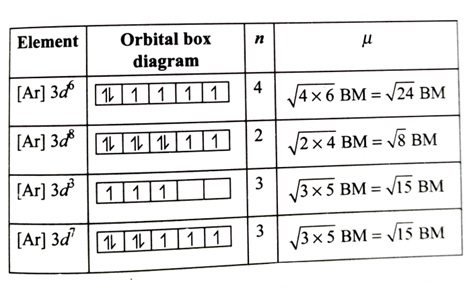


The electronic configuration for Neodymium is:
[Atomic Number for Neodymium 60] [2024]
(2)
Electronic configuration of Nd can be written by the following Aufbau rule as: .
Given below are two statements:
Statement (I): In the Lanthanoids, the formation is favoured by its noble gas configuration.
Statement (II): is a strong oxidant reverting to the common +3 state.
In the light of the above statements, choose the most appropriate answer from the options given below: [2024]
Statement I is false but Statement II is true
Both Statement I and Statement II are true
Statement I is true but Statement II is false
Both Statement I and Statement II are false
(2)
The common oxidation state of Lanthanoids is +3. Due to stable half-filled and fully-filled configurations other oxidation states of few elements such as and also exist. However, these have tendency to revert to common oxidation state of +3. Hence, and are good oxidizing agents, and are good reducing agents.
Choose the correct option having all the elements with electronic configuration from the following: [2024]
(2)
| Element | Electronic configuration |
Which of the following statements are correct about Zn, Cd and Hg?
A. They exhibit high enthalpy of atomization as the d-subshell is full.
B. Zn and Cd do not show variable oxidation state while Hg shows +I and +II.
C. Compounds of Zn, Cd and Hg are paramagnetic in nature.
D. Zn, Cd and Hg are called soft metals.
Choose the most appropriate from the options given below: [2024]
B, C only
A, D only
C, D only
B, D only
(4)
(A)(D) In transition series elements, melting point and enthalpy of atomization first increase, reaches a maxima and then decrease. This happens because unpaired electrons have a strong tendency to participate in metallic bonding. Since Zn, Cd and Hg have comparatively low melting points in respective transition series, these are called soft metals.
(B) Mercury shows +1 and +2 oxidation states.
(C) Oxidation state of Zn and Cd is +2 in their compounds i.e. they have configuration in their compounds, which makes them diamagnetic. is also and diamagnetic. In +1 oxidation state, mercury exists as a dimer , hence in +1 oxidation state also mercury is diamagnetic.
Match List - I with List - II.
| List - I | List - II | ||
| Species | Electronic distribution | ||
| (A) | (I) | ||
| (B) | (II) | ||
| (C) | (III) | ||
| (D) | (IV) |
Choose the correct answer from the options given below: [2024]
(A)-(I), (B)-(II), (C)-(III), (D)-(IV)
(A)-(III), (B)-(IV), (C)-(I), (D)-(II)
(A)-(IV), (B)-(III), (C)-(I), (D)-(II)
(A)-(II), (B)-(I), (C)-(IV), (D)-(III)
(2)
| Atom | Electronic configuration | Ion | Electronic configuration |
The transition metal having highest 3rd ionisation enthalpy is: [2024]
Mn
Fe
Cr
V
(1)
| Metal | Sc | Ti | V | Cr | Mn | Fe | Co | Ni | Cu | Zn |
| Third ionization energy () |
2393 | 2657 | 2833 | 2990 | 3260 | 2962 | 3243 | 3402 | 3556 | 3829 |
Ionization energy increases from left to right across a period. But third ionization energy of Mn is more than that of Fe because third electron from Mn is to be removed from stable configuration.
| Metal | Electronic configuration of M |
Electronic configuration of |
| Mn | ||
| Fe | ||
| Cr | ||
| V |
Hence among given options Mn has highest third ionization energy.
Given below are two statements: one is labelled as Assertion (A) and the other is labelled as Reason (R)
Assertion (A): In aqueous solutions is reducing while is oxidising in nature.
Reason (R): Extra stability to half filled electronic configuration is observed than incompletely filled electronic configuration.
In the light of the above statements, choose the most appropriate answer from the options given below: [2024]
(A) is true but (R) is false
Both (A) and (R) are true and (R) is the correct explanation of (A)
Both (A) and (R) are true but (R) is not the correct explanation of (A)
(A) is false but (R) is true
(2)
Assertion:
| Metal | Ti | V | Cr | Mn | Fe | Co |
| potential in V |
As potential is negative, potential is positive, i.e. has a tendency to get oxidized to . Thus aqueous solution of is reducing.
As potential is positive, has a tendency to get reduced to . Thus aqueous solution of is oxidizing.
Reason:
has stable half filled subshell. Thus has a tendency to be formed. This makes positive. has half filled orbital. Thus has a tendency to be formed. This makes potential positive.
The element which shows only one oxidation state other than its elemental form is : [2024]
Cobalt
Titanium
Scandium
Nickel
(3)
Sc shows only +3 oxidation state.
A first row transition metal in its +2 oxidation state has a spin-only magnetic moment value of 3.86 BM. The atomic number of the metal is [2024]
25
22
26
23
(4)
Spin only magnetic moment () is related to number of unpaired electrons by:
| Atomic number | Electronic configuration of M | Electronic configuration of | Number of unpaired electrons with |
| 25 | 5 | ||
| 22 | 2 | ||
| 26 | 4 | ||
| 23 | 3 |
The metal that shows highest and maximum number of oxidation state is: [2024]
Co
Ti
Mn
Fe
(3)
Oxidation states exhibited by various first transition series block elements are as follows:
| Ti | Mn | Fe | Co |
| +2 | +2 | +2 | +2 |
| +3 | +3 | +3 | +3 |
| +4 | +4 | +4 | +4 |
| +5 | |||
| +6 | +6 | ||
| +7 |
The number of ions from the following that have the ability to liberate hydrogen from a dilute acid is ___________ .
and . [2024]
3
0
1
2
(1)
________________________________________
If liberates hydrogen from dilute acid, then:
can liberate hydrogen from dilute acids.
Arrange the following elements in the increasing order of the number of unpaired electrons in it.
(A) Sc (B) Cr (C) V (D) Ti (E) Mn
Choose the correct answer from the options given below: [2024]
(A) < (D) < (C) < (B) < (E)
(B) < (C) < (D) < (E) < (A)
(A) < (D) < (C) < (E) < (B)
(C) < (E) < (B) < (A) < (D)
(3)
| Element and electronic configuration |
Number of unpaired electrons |
| (A) | 1 |
| (B) | 6 |
| (C) | 3 |
| (D) | 2 |
| (E) | 5 |
The electronic configuration of Cu(II) is whereas that of Cu(I) is . Which of the following is correct? [2024]
Cu(I) and Cu(II) are equally stable
Cu(II) is less stable
Cu(II) is more stable
Stability of Cu(I) and Cu(II) depends on nature of copper salts.
(3)
The stability of (aq) rather than (aq) is due to the much more negative of (aq) than (aq), which more than compensates for the second ionisation enthalpy of Cu.
Given below are two statements:
Statement I: The higher oxidation states are more stable down the group among transition elements unlike p-block elements.
Statement II: Copper can not liberate hydrogen from weak acids.
In the light of the above statements, choose the correct answer from the options given below: [2024]
Statement I is true but Statement II is false
Both Statement I and Statement II are true
Statement I is false but Statement II is true
Both Statement I and Statement II are false
(2)
Statement I: In d block elements stability of higher oxidation state increases down the group. For example, in group 6, Mo(VI) and W(VI) are found to be more stable than Cr(VI). Thus Cr(VI) in the form of dichromate in acidic medium is a strong oxidising agent, whereas and are not. In p block elements, stability of lower oxidation state increases down the group due to inert pair effect.
Statement II:
For the reaction:
Since potential of the reaction is negative copper cannot liberate hydrogen from dilute acids.
The spin-only magnetic moment value of the ion among and , that acts as strong oxidising agent in aqueous solution is _______ B.M. (Near integer).
(Given atomic numbers : Ti : 22, V : 23, Cr : 24, Co : 27) [2024]
(5)
Since is a strong oxidizing agent.
Number of unpaired electrons in
Spin only magnetic moment
Total number of ions from the following with noble gas configuration is _______ .
and [2024]
(2)
| Ion | Electronic configuration |
| (noble gas) | |
| (noble gas) | |
A transition metal ‘M’ among Sc, Ti, V, Cr, Mn and Fe has the highest second ionisation enthalpy. The spin-only magnetic moment value of ion is ______. B.M. (Near integer) (Given atomic number Sc : 21, Ti : 22, V : 23, Cr : 24, Mn : 25, Fe : 26) [2024]
(6)
Second ionization energy increases from left to right in periodic table.
| Metal | Sc | Ti | V | Cr | Mn | Fe | Co | Ni | Cu | Zn |
| Second ionization energy (kJ/mol) |
1235 | 1309 | 1414 | 1592 | 1509 | 1561 | 1644 | 1752 | 1958 | 1734 |
Cr has more second ionization energy than Mn and Fe because the electron is removed from stable configuration.
Thus the metal M is Cr. Number of unpaired electrons in = 5.
Spin only magnetic moment
Which of the following electronic configuration would be associated with the highest magnetic moment? [2024]
(1)
Spin only magnetic moment is given by the formula, BM. Where is number of unpaired electrons.

has maximum number of unpaired electrons among the given options, hence it has the highest magnetic moment.
Given below are two statements:
Statement I: is a stronger oxidizing agent than .
Statement II: Cr(VI) is more stable than Mo(VI).
In the light of the above statements, choose the correct answer from the options given below: [2025]
Statement I is false but Statement II is true.
Statement I is true but Statement II is false.
Both Statement I and Statement II are true.
Both Statement I and Statement II are false.
(2)
In block, stability of higher oxidation state increases down the group. Thus Mo(VI) is more stable than Cr(VI). Thus is easily reduced to and is better reducing agent than .
The metal ions that have the calculated spin-only magnetic moment value of 4.9 B.M. are [2025]
A.
B.
C.
D.
E.
Choose the correct answer from the options given below:
A, C and E only
A, D and E only
B and E only
A, B and E only
(4)
Thus, ions with 4 unpaired electrons have dipole moment 4.9 BM.
| Ion | Electronic configuration | Number of unpaired electrons (n) |
| (A) | 4 | |
| (B) | 4 | |
| (C) | 5 | |
| (D) | 3 | |
| (E) | 4 |
Pair of transition metal ions having the same number of unpaired electrons is : [2025]
(1)
| Ion | Electronic configuration | Number of unpaired electrons |
| 3 | ||
| 3 | ||
| 2 | ||
| 5 | ||
| 4 | ||
| 1 | ||
| 5 |
The correct decreasing order of spin only magnetic moment values (B.M.) of , , and ions is : [2025]
(3)
| Ion | Electronic configuration | Number of unpaired electrons (n) | Spin only magnetic moment () BM |
| 0 | 0 | ||
| 1 | |||
| 4 | |||
| 3 |
Thus, the decreasing order of spin-only magnetic moment is:
Match List I with List II. [2025]
| List I | List II | ||
| (Transition metal ion) | (Spin only magnetic moment (B.M.)) | ||
| A. | I. | 3.87 | |
| B. | II. | 0.00 | |
| C. | III. | 1.73 | |
| D. | IV. | 2.84 |
Choose the correct answer from the options given below:
A–III, B–I, C–IV, D–II
A–III, B–I, C–II, D–IV
A–IV, B–II, C–III, D–I
A–II, B–IV, C–I, D–III
(1)
| Transition metal ion | Electronic configuration | Number of unpaired electrons (n) | Spin only magnetic moment ()BM |
| 1 | |||
| 3 | |||
| 2 | |||
| 0 |
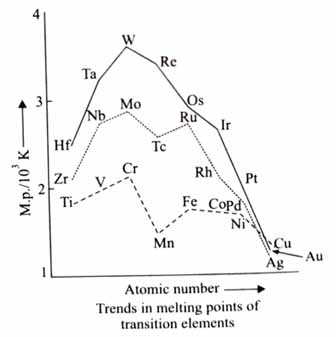
The correct option with order of melting points of the pairs (Mn, Fe), (Tc, Ru) and (Re, Os) is : [2025]
Mn < Fe, Tc < Ru and Os < Re
Fe < Mn, Ru < Tc and Re < Os
Mn < Fe, Tc < Ru and Re < Os
Fe < Mn, Ru < Tc and Os < Re
(1)

In any row the melting points of these metals rise to a maximum at except for anomalous values of Mn and Tc and fall regularly as the atomic number increases. The maxima at about the middle of each series indicate that one unpaired electron per orbital is particularly favourable for strong interatomic interaction. In general, greater the number of valence electrons, stronger is the resultant bonding. Because of stable half filled configurations, Mn and Tc have lesser tendency to participate in metallic bonding, hence have lower melting points than expected value.
The element that does not belong to the same period of the remaining elements (modern periodic table) is : [2025]
Platinum
Osmium
Palladium
Iridium
(3)
| GP-8 | GP-9 | GP-10 | |
| P-5 | Pd | ||
| P-6 | Os | Pt |
The number of valence electrons present in the metal among Cr, Co, Fe and Ni which has the lowest enthalpy of atomisation is [2025]
8
9
1
10
(3)
| Element | Cr | Fe | Co | Ni |
| Ionization enthalpy (kJ/mol) | 397 | 416 | 425 | 430 |
Cr has lowest enthalpy of atomization among given options.
Cr has 6 valence electrons.
The first transition series metal ‘M’ has the highest enthalpy of atomisation in its series. One of its aquated ions () exists in green colour. The nature of the oxide formed by the above ion is : [2025]
neutral
acidic
basic
amphoteric
(3)
In first transition series (3d series) Vanadium has highest enthalpy of atomization. is green in colour. Oxide formed by i.e. is basic in nature.
Among Sc, Mn, Co and Cu, identify the element with highest enthalpy of atomisation. The spin only magnetic moment value of that element in its +2 oxidation state is _____ B.M (in nearest integer). [2025]
(4)
| Element | Sc | Mn | Co | Cu |
| Enthalpy of atomization (kJ/mol) | 326 | 281 | 425 | 339 |
Co has highest enthalpy of atomization among Sc, Mn, Co and Cu.
, Number of unpaired electrons in = 3.
Spin only magnetic moment ()
Niobium (Nb) and ruthenium (Ru) have and number of electrons in their respective 4d orbitals. The value of is _______. [2025]
(11)
The spin only magnetic moment () value (B.M.) of the compound with strongest oxidising power among , TiO and VO is _______ B.M. (Nearest integer). [2025]
(5)
As reduction potential of is more than that of and , is a stronger oxidising agent than VO and TiO.
, number of unpaired electrons () = 4.
Spin only magnetic moment ()
(nearest integer is 5)