

Given below are two statements:
Statement - I : Along the period, the chemical reactivity of the elements gradually increases from group 1 to group 18.
Statement - II : The nature of oxides formed by group 1 elements is basic while that of group 17 elements is acidic.
In the light of the above statements, choose the most appropriate from the options given below: [2024]
Both Statement I and Statement II are True
Statement I is True but Statement II is False
Statement I is False but statement II is true
Both Statement I and Statement II are False
(3)
Statement (I): Chemical reactivity decreases across a period from left to right. Group 18 elements are inert.
Statement (II): Metals (group 1 elements) form basic oxides (dissolve in water to form base) e.g. etc. Non metals (group 17 elements) form acidic oxides (dissolve in water to form acids) e.g. , etc.
Arrange the bonds in order of increasing ionic character in the molecules. and . [2024]
(3)
More is electronegativity difference between atoms more will be the ionic character of the molecule. So, the order of increasing ionic character in the given molecules is
Match List I with List II
| List-I | List-II | ||
| (Elements) | (Properties in their respective groups) | ||
| A. | Cl, S | I. | Elements with highest electronegativity |
| B. | Ge, As | II. | Elements with largest atomic size |
| C. | Fr, Ra | III. | Elements which show properties of both metals and non-metal |
| D. | F, O | IV. | Elements with highest negative electron gain enthalpy |
Choose the correct answer from the options given below : [2024]
A-IV, B-III, C-II, D-I
A-III, B-II, C-I, D-IV
A-II, B-I, C-IV, D-III
A-II, B-III, C-IV, D-I
(1)
(A)
| Group | Electron gain enthalpy becomes less negative in the order |
| 16 | |
| 17 |
(B) Ge and As are metalloids
(C)
| Group | Atomic radius increases down the group |
| 1 | |
| 2 |
(D) Order of electronegativity values for few elements in periodic table is:
Identify the correct statements about p-block elements and their compounds.
(A) Non metals have higher electronegativity than metals.
(B) Non metals have lower ionisation enthalpy than metals.
(C) Compounds formed between highly reactive non metals and highly reactive metals are generally ionic.
(D) The non metal oxides are generally basic in nature.
(E) The metal oxides are generally acidic or neutral in nature.
Choose the correct answer from the options given below: [2024]
(D) and (E) only
(B) and (E) only
(B) and (D) only
(A) and (C) only
(4)
Non metals are more electronegative than metals. Non metal oxides (such as , etc) are acidic and metal oxides (such as , CaO etc ) are basic. Compounds formed between highly electronegative (non metals) and highly electropositive (metals) elements are ionic (such as ).
Match List-I with List-II. [2025]
| List-I | List-II | ||
| A. | I. | Ionisation Enthalpy | |
| B. | II. | Metallic character | |
| C. | III. | Electronegativity | |
| D. | IV. | Ionic radii |
Choose the correct answer from the options given below:
A-IV, B-I, C-III, D-II
A-III, B-IV, C-II, D-I
A-II, B-III, C-IV, D-I
A-IV, B-I, C-II, D-III
(4)
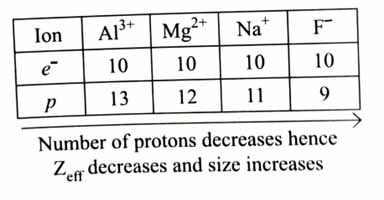
(A) For isoelectronic species radius

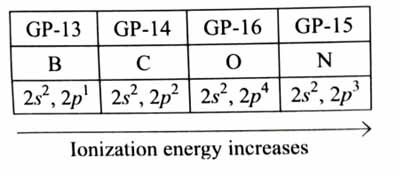
(B) In a period, ionization enthalpy increases from left to right because of increase in . But ionization enthalpy of group 15 elements is more than that of group 16 elements in respective periods. This is because stable half filled configuration of group 15 elements makes removal of an electron difficult.

(C) 
(D) 
Which of the following electronegativity order is incorrect? [2025]
S < Cl < O < F
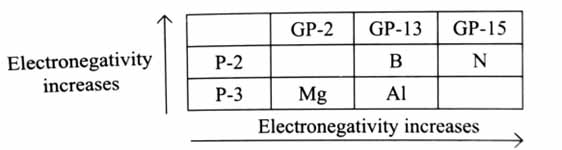
Al < Mg < B < N
Al < Si < C < N
Mg < Be < B < N
(2)

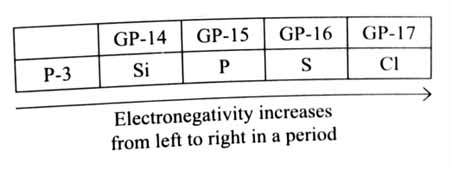
Correct order of electronegativity is : Mg < Al < B < N.
Electronic configuration of four elements A, B, C and D are given below : [2025]
(A)
(B)
(C)
(D)
Which of the following is the correct order of increasing electronegativity (Pauling’s scale)?
A < D < B < C
A < C < B < D
A < B < C < D
D < A < B < C
(4)
Which of the following statements are correct? [2025]
A. The process of adding an electron to a neutral gaseous atom is always exothermic.
B. The process of removing an electron from an isolated gaseous atom is always endothermic.
C. The 1st ionization energy of boron is less than that of beryllium.
D. The electronegativity of C is 2.5 in and .
E. Li is the most electropositive among elements of group .
Choose the correct answer from the options given below:
B and C only
A, C and D only
B and D only
B, C and E only
(1)
(A) For noble gases, N, Be and Mg electron affinity is negative i.e. energy is absorbed when an electron is added to an isolated neutral atom.
(C) It is slightly more difficult to remove an electron from fully filled orbital of Be than from orbital of B . Thus first ionization energy of B is less than that of Be.
(D) Four Cl atoms increase the partial positive charge on C hence increase its electronegativity. Thus electronegativity of C in .
(E) Cs is most electropositive element of group 1.
Given below are two statements : [2025]
Statement I: An element in the extreme left of the periodic table forms acidic oxides.
Statement II: Acid is formed during the reaction between water and oxide of a reactive element present in the extreme right of the periodic table.
In the light of the above statements, choose the correct answer from the options given below :
Both Statement I and Statement II are false
Both Statement I and Statement II are true
Statement I is true but Statement II is false
Statement I is false but Statement II is true
(4)
Extreme left side of periodic table (-block) has metals which form basic oxides. Acidic oxides (i.e.oxides which form acid upon reaction with water, e.g. ) are formed by non-metals. Non-metals occupy extreme right side of periodic table.
Which of the following represents the correct order of metallic character of the given elements? [2023]
Be < Si < Mg < K
K < Mg < Be < Si
Be < Si < K < Mg
Si < Be < Mg < K
(4)
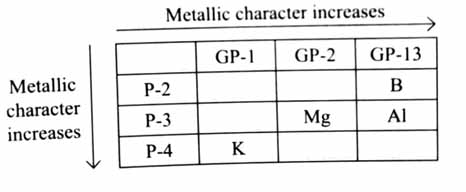
According to electropositive character Si is having non metallic character.
The correct order of basicity of oxides of vanadium is [2023]
(3)
Basic strength of oxides
The correct order of electronegativity for given elements is: [2023]
Br > C > At > P
P > Br > C > At
C > P > At > Br
Br > P > At > C
(1)
| Element | C | P | Br | At |
| Electronegativity | 2.5 | 2.1 | 2.9 | 2.2 |
The correct order of metallic character is: [2023]
Ca > K > Be
Be > Ca > K
K > Be > Ca
K > Ca > Be
(4)

Total number of acidic oxides among is_______ . [2023]
(4)
| Acidic oxides | Basic oxides | Neutral oxides |
The correct statements from the following are: [2026]
A. Ionic radii of trivalent cations of group 13 elements decreases down the group.
B. Electronegativity of group 13 elements decreases down the group.
C. Among the group 13 elements, boron has the highest first ionisation enthalpy.
D. The trichloride and triiodide of group 13 elements are covalent in nature.
Choose the correct answer from the options given below:
A and D only
B and D only
A and C only
C and D only
(4)
(A) < < < < : ionic size
(B) B > Tl > In > Ga > Al : EN
(C) B > Tl > Ga > Al > In : IE
(D) Trichlorides and triiodides of group elements are covalent in nature
Given below are two statements :
Statement I: The number of pairs among which contain oxides that are both amphoteric is 2.
Statement II: is an electron deficient molecule, can act as a Lewis acid, forms adduct with and has a trigonal planar geometry.
In the light of the above statements, choose the correct answer from the options given below [2026]
Statement I is false but Statement II is true
Both Statement I and Statement II are false
Statement I is true but Statement II is false
Both Statement I and Statement II are true
(4)
is Lewis acid according to Lewis octet theory and has hybridization with trigonal planar geometry and it can accept lone pair from ammonia to form adduct.
Consider the elements N, P, O, S, Cl and F. The number of valence electrons present in the elements with most and least metallic character from the above list is respectively. [2026]
6 and 7
7 and 5
5 and 6
5 and 7
(4)
Least metallic = F, valence electrons = 7
Most metallic = P, valence electrons = 5
It is noticed that is more stable than is less stable than . Observe the following reactions.
Identify the correct set from the following: [2026]
(2)
Elements X and Y belong to Group 15. The difference between the electronegativity values of ‘X’ and phosphorus is higher than that of the difference between phosphorus and ‘Y’. ‘X’ & ‘Y’ are respectively [2026]
As & Sb
As & Bi
N & As
Bi & N
(3)
Element EN
N 3.0
P 2.1
As 2.0
Sb 1.9
Bi 1.9
X = Nitrogen (N)
Y = Arsenic (As)
Given below are two statements :
Statement I : The correct order in terms of bond dissociation enthalpy is .
Statement II : The correct trend in the covalent character of the metal halides is
In the light of the above statements, choose the correct answer from the options given below : [2026]
Both Statement I and Statement II are true
Statement I is true but Statement II is false
Both Statement I and Statement II are false
Statement I is false but Statement II is true
(2)
Given below are two statements :
Statement I : Elements ‘X’ and ‘Y’ are the most and least electronegative elements, respectively among N, As, Sb and P. The nature of the oxides and is acidic and amphoteric, respectively.
Statement II : is covalent in nature and gets hydrolysed in water. It produces and in aqueous medium.
In the light of the above statements, choose the correct answer from the options given below : [2026]
Both Statement I and Statement II are true
Statement I is false but Statement II is true
Statement I is true but Statement II is false
Both Statement I and Statement II are false
(3)
Most electronegative Least electronegative
Which of the following order is not correct?
[covalent character]
[melting point]
[melting point]
[ ionization enthalpy]
(3)