

Q 1 :

Consider the following elements.

GroupC'D'A'B'Period

Which of the following is/are true about A', B', C' and D'?

A.  Order of atomic radii: B' < A' < D' < C'

B. Order of metallic character: B' < A' < D' < C'

C. Size of the element: D' < C' < B' < A'

D. Order of ionic radii: B'+<A'+<D'+<C'+

Choose the correct answer from the options given below:              [2024]

  • B, C and D only


  • A and B only


  • A, B and D only


  • A only


(3) 

Atomic and metallic radii decreases from left to right across a period and increase down the group. The same trend is followed by metallic character.


Q 2 :

Given below are two statements:

Statement (I): Both metals and non-metals exist in p and d-block elements.

Statement (II): Non-metals have higher ionisation enthalpy and higher electronegativity than the metals.

In the light of the above statements, choose the most appropriate answer from the options given below:              [2024]

  • Both Statement I and Statement II are false


  • Both Statement I and Statement II are true


  • Statement I is false but Statement II is true


  • Statement I is true but Statement II is false


(3)

Statement (I): s, d, and f block has only metals while p block has metals, non-metals and metalloids. Thus statement (I) is false.

Statement (II): Non-metals are electronegative i.e. have a tendency to attract electrons. Statement (II) is true.


Q 3 :

Given below are two statements: 

Statement I: The metallic radius of Na is 1.86 A° and the ionic radius of Na+ is lesser than 1.86 A°.

Statement II: Ions are always smaller in size than the corresponding elements.

In the light of the above statements, choose the correct answer from the options given below :          [2024]

  • Statement I is correct but Statement II is false


  • Both Statement I and Statement II are false


  • Both Statement I and Statement II are true


  • Statement I is incorrect but Statement II is true


(1)

Cations are formed by losing electrons hence are smaller than parent atom. Anions are formed by gaining electrons hence are larger than parent atom.


Q 4 :

Match List I with List II.

  List I   List II
A. Melting Point [K] I. Tl>ln>Ga>Al>B
B. Ionic Radius [M+3/pm] II. B>Tl>AlGa>ln
C. iH1[kJ mol-1] III. Tl>In>Al>Ga>B
D. Atomic Radius [pm] IV. B>Al>Tl>In>Ga


Choose the correct answer from the options given below:               [2024]

  • A-IV, B-I, C-II, D-III


  • A-II, B-III, C-IV, D-I


  • A-III, B-IV, C-I, D-II


  • A-I, B-II, C-III, D-IV


(1)

A. 

Element B Al Ga In Tl
Melting point (K) 2453 (Unusually high) 933 303 (liquid in summers) 430 576

        Order of melting point is : B>Al>Tl>In>Ga.

B.   Ionic radius increases down the group due to increase in number of shells. Order of ionic radius is: Tl>In>Ga>Al>B.

C.   Ionization energy decreases down the group. But Ga and Tl have ionization energy more than expected value because of poor shielding of d and f electrons respectively. Order of ionization energy is : B>Tl>Ga>Al>In

D.    Atomic radius increases down the group due to increase in number of shells but Ga is smaller than Al due to poor shielding of d electrons.

Element B Al Ga In Tl
Atomic radius (pm) 88 143 135 167 170

Order of atomic radius is: Tl>In>Al>Ga>B.


Q 5 :

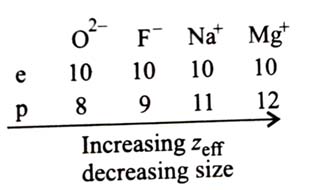
The statement(s) that are correct about the species O2-, F-, Na+ and Mg2+.

(A) All are isoelectronic
(B) All have the same nuclear charge
(C) O2- has the largest ionic radii
(D) Mg2+ has the smallest ionic radii

Choose the most appropriate answer from the options given below:           [2024]

  • (A), (B), (C) and (D)


  • (B), (C) and (D) only


  • (A), (C) and (D) only


  • (C) and (D) only


(3)

For isoelectronic species, more are number of protons, more is effective nuclear charge hence smaller is the size.


Q 6 :

The incorrect decreasing order of atomic radii is                  [2025]

  • Mg > Al > C > O


  • Be > Mg > Al > Si


  • Al > B > N > F


  • Si > P > Cl > F


(2)

Radius increases down the group because of more number of shells, hence radius of Mg is more than that of Be.


Q 7 :

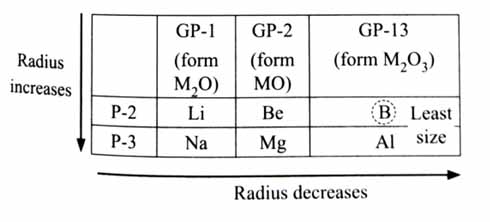
The type of oxide formed by the element among Li, Na, Be, Mg, B and Al that has the least atomic radius is :                      [2025]
 

  • A2O


  • AO


  • A2O3


  • AO2


(3)


Q 8 :

Choose the incorrect trend in the atomic radii (r) of the elements :                 [2025]
 

  • rBr<rKt


  • rMg<rAl


  • rRb<rCs


  • rAt<rCs


(2)

From left to right across a period, atomic radius decreases, so rAl<rMg.


Q 9 :

The correct order of hydration enthalpies is                               

(A) K+                           (B) Rb+                       (C) Mg2+                        (D) Cs+                          (E) Ca2+

Choose the correct answer from the options given below:              [2023]

  • C > E > A > B > D


  • C > E > A > D > B


  • C > A > E > B > D


  • E > C > A > B > D


(1)

Mg2+>Ca2+>K+>Rb+>Cs+

Decreasing the size, hydration energy increases.


Q 10 :

The correct increasing order of the ionic radii is                     [2023]

  • Ca2+<K+<Cl-<S2-


  • S2-<Cl-<Ca2+<K+


  • K+<S2-<Ca2+<Cl-


  • Cl-<Ca2+<K+<S2-


(1)

The correct increasing order of size is Ca2+<K+<Cl-<S2-


Q 11 :

Which one of the following sets of ions represents a collection of isoelectronic species?                   

(Given: Atomic Number: F : 9, Cl : 17, Na = 11, Mg = 12, Al = 13, K = 19, Ca = 20, Sc = 21)          [2023]

  • N3-,O2-,F-,S2-


  • Li+,Na+,Mg2+,Ca2+


  • Ba2+,Sr2+,K+,Ca2+


  • K+,Cl-,Ca2+,Sc3+


(4)

Ca+2,K+,Sc3+,Cl- contain same no. of electrons, i.e. 18.

Hence they are iso-electronic species.


Q 12 :

The total number of isoelectronic species from the given set is ________.

O2-,F-,Al,Mg2+,Na+,O+,Mg,Al3+,F                                   [2023]


(5)

Species: O2- F- Al Mg2+ Na+ O+ Mg Al3+ F
No. of electron 10 10 13 10 10 7 12 10 9


Q 13 :

The correct orders among the following are:                  [2025]

A. Atomic radius : B < Al < Ga < In < Tl

B. Electronegativity : Al < Ga < In < Tl < B

C. Density : Tl < In < Ga < Al < B

D. 1st Ionisation Energy : In < Al < Ga < Tl < B

Choose the correct answer from the options given below:

  • B and D Only


  • A and C Only


  • C and D Only


  • A and B Only


(1)


Q 14 :

Given below are two statements:                              [2025]

Statement I : Nitrogen forms oxides with +1 to +5 oxidation states due to the formation of pπpπ bond with oxygen.

Statement II : Nitrogen does not form halides with +5 oxidation state due to the absence of d-orbital in it.

In the light of given statements, choose the correct answer from the options given below.

  • Statement I is true but Statement II is false


  • Both Statement I and Statement II are false


  • Statement I is false but Statement II is true


  • Both Statement I and Statement II are true


(4)


Q 15 :

Given below are the pairs of group 13 elements showing their relation in terms of atomic radius.

(B<Al), (Al<Ga), (Ga<In) and (In<Tl)

Identify the elements present in the incorrect pair and in that pair find out the element (X) that has higher ionic radius (M3+) that the other one. The atomic number of the element (X) is                 [2025]

  • 31


  • 49


  • 13


  • 81


(1)


Q 16 :

Given below are two statements:

Statement I: K > Mg > Al > B is the correct order in terms of metallic character.

Statement II: Atomic radius is always greater than the ionic radius for any element.

In the light of the above statements, choose the correct answer from the options given below:        [2026]

  • Both Statement I and Statement II are false


  • Statement I is true but Statement II is false


  • Statement I is false but Statement II is true


  • Both Statement I and Statement II are true


(2)

Metallic character of s-block elements is greater than p-block elements.

Anionic radius is greater than atomic radius but cationic radius is always less than atomic radius for any element.


Q 17 :

Which of the following represents the correct trend for the mentioned property ?

A. F > P > S > B

First Ionization Energy

B. Cl > F > S > P

Electron Affinity

C. K > Al > Mg > B

Metallic character

D. K2O>Na2O>MgO>Al2O3

Basic character

Choose the correct answer from the options given below :                                  [2026]

  • A and B only


  • B and C only


  • A, B and D only


  • A, B, C and D


(3)

⇒ On moving left to right in a period IE increases and from top to bottom in a group IE decreases.

F > P > S > B (IE order)

⇒ On moving left to right in a period metallic and basic character decreases.

K > Mg > Al > B (Metallic character order)

⇒ On moving top to bottom in a group metallic and basic character increases.

K2O>Na2O>MgO>Al2O3

⇒ EA : Group 17 > Group 16 > Group 15

Cl > F > S > P



Q 18 :

Given below are two statements:                                              [2026]

Statement I: The halogen that makes the longest bond with hydrogen in HX, has the smallest covalent radius in its group.

Statement II: A group 15 element’s hydride EH3 has the lowest boiling point among corresponding hydrides of other group 15 elements. The maximum covalency of that element E is 4.

In the light of the above statements, choose the correct answer from the options given below.

  • Both Statement I and Statement II are true


  • Statement I is true but Statement II is false


  • Both Statement I and Statement II are false


  • Statement I is false but Statement II is true


(3)

HF<HCl<HBr<HI  (bond length order)

F<Cl<Br<I  (radius order)

PH3<AsH3<NH3<SbH3<BiH3   (Boiling point order)

Maximum possible covalency of phosphorus is 6


Q 19 :

Given below are two statements:

Statement I: The second ionisation enthalpy of Na is larger than the corresponding ionisation enthalpy of Mg.

Statement II: The ionic radius of O2-is larger than that of F-.

In the light of the above statements, choose the correct answer from the options given below:   [2026]

  • Both Statement I and Statement II are false


  • Both Statement I and Statement II are true


  • Statement I is false but Statement II is true


  • Statement I is true but Statement II is false


(2)

Na+:1s22s22p6 (fully filled electronic configuration)

Mg+:1s22s22p63s1

IE2 of Na>IE2 of Mg

Size of O2->F-


Q 20 :

Given below are two statements :

Statement I : The correct order in terms of atomic/ionic radii is Al>Mg>Mg2+>Al3+.

Statement II : The correct order in terms of the magnitude of electron gain enthalpy is Cl>Br>S>O

In the light of the above statements, choose the correct answer from the options given below :      [2026]

  • Both Statement I and Statement II are true


  • Statement I is true but Statement II is false


  • Statement I is false but Statement II is true


  • Both Statement I and Statement II are false


(3)

Correct order of size is Mg>Al>Mg2+>Al3+

Atomic size depends mainly upon Zeffective and shell number.

Generally on moving down the group electron affinity decreases 

and on moving across the period electron affinity increases.

In the periodic table Cl has maximum electron affinity.

Halogen has higher electron affinity than Chalcogen.

Cl>Br>S>O


Q 21 :

The correct increasing order of C–H (A), C–O (B), C=O (C) and C≡N (D) bonds in terms of covalent bond length is :      [2026]

  • D < C < A < B


  • D < C < B < A


  • A < B < C < D


  • A < D < C < B


(4)

C-H (A)  107 pm

CN (D)  116 pm

C-O (B)  143 pm

C=O (C)  121 pm


Q 22 :

In period 4 of the periodic table, the elements with highest and lowest atomic radii are respectively:  [2026]

  • K & Se


  • Rb & Br


  • Na & Cl


  • K & Br


(4)

In a period moving from left to right atomic size decreases.


Q 23 :

Consider the following statement:

(i) Atomic radii decreases across a row of the periodic table when we move from left to right

(ii) Atomic radii increases down the column as we move from top to bottom

(iii) Screening effect order s>p>d>f

Correct statements are

  • (i) and (ii) only


  • (i) and (iii) only


  • (ii) and (iii) only


  • (i), (ii) and (iii)


(4)

periodic property