Given below are two statements:
Statement I: The correct order of first ionization enthalpy values of Li, Na, F and Cl is Na < Li < Cl < F.
Statement II: The correct order of negative electron gain enthalpy values of Li, Na, F and Cl is Na < Li < F < CI
In the light of the above statements, choose the correct answer from the options given below : [2024]
Both Statement I and Statement II are true
Both Statement I and Statement II are false
Statement I is true but Statement II is false
Statement I is false but Statement II is true
(1)
Statement (l): Ionization energy decreases down the group and increases from left to right across a period. Hence order is
Statement (II): Electron affinity decreases (or electron gain enthalpy becomes less negative) down the group and increases (or electron gain enthalpy becomes more negative) from left to right across a period. But electron gain enthalpy of F is less negative than that of Cl. This is because due to small size of F, incoming electron,feels significant repulsion from other electrons. So, the order is
The electron affinity value are negative for
A.
B.
C.
D.
E.
Choose the most appropriate answer from the options given below: [2024]
A, B and C only
D and E only
A and D only
A, B, D and E only
(1)
Electron affinity is negative for Be, Mg, N and noble gases. So (A) and (B) has negative value of electron affinity. Sum of first and second electron affinity for every element is negative. So (C) has negative electron affinity.
Given below are two statements :
Statement (I): The oxidation state of an element in a particular compound is the charge acquired by its atom on the basis of electron gain enthalpy consideration from other atoms in the molecule.
Statement (II): bond formation is more prevalent in second period elements over other periods.
In the light of the above statements, choose the most appropriate answer from the options given below: [2024]
Both Statement I and Statement II are incorrect
Both Statement I and Statement II are correct
Statement I is incorrect but Statement II is correct
Statement I is correct but Statement II is incorrect
(3)
Statement I: The oxidation state, or oxidation number, is the hypothetical charge of an atom if all of its bonds to other atoms were fully ionic i.e. shift the bond pair of electrons towards more electronegative atom, the charge acquired after this shift is oxidation number of the atom. Hence oxidation number is charge acquired on the basis of electronegativity difference.
Statement II: Because of small size, strength of bonds in second period elements is more, hence bonds are more prevalent in second period elements,
Given below are two statements:
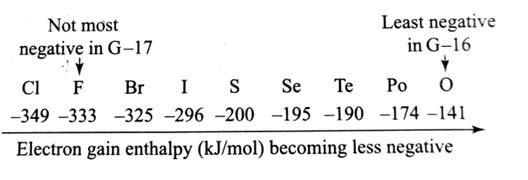
Statement I: Fluorine has most negative electron gain enthalpy in its group.
Statement II: Oxygen has least negative electron gain enthalpy in its group.
In the light of the above statements, choose the most appropriate from the options given below. [2024]
Statement I is false but Statement II is true
Both Statement I and Statement II are true
Both Statement I and Statement II are false
Statement I is true but Statement II is false
(1)

Given below are two statements:
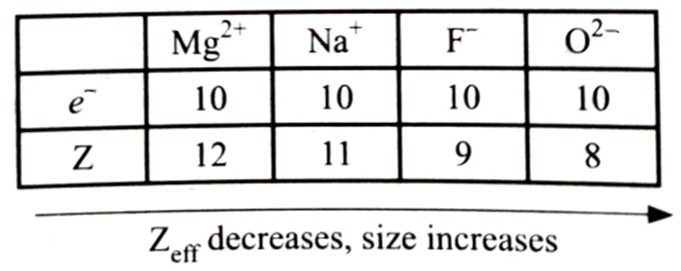
Statement I: The radii of isoelectronic species increases in the order.
Statement II: The magnitude of electron gain enthalpy of halogen decreases in the order.
In the light of the above statements, choose the most appropriate answer from the options given below: [2025]
Both Statement I and Statement II are incorrect
Statement I is correct but Statement II is incorrect
Statement I is incorrect but Statement II is correct
Both Statement I and Statement II are correct
(4)
Statement I:

For isoelectronic species,
Statement II: Electron affinity decreases down the group because as we move down the group, incoming electron is added farther away from the nucleus hence feels less attraction. However, electron affinity of F is less than expected value because of inter-electronic repulsion faced by the incoming electron on account of extremely small size of F.
For electron gain enthalpies of the elements denoted as , the incorrect option is: [2023]
(4)
Negative electron gain enthalpy of Cl is more than F.
Negative electron gain enthalpy of S is more than Se.
The difference between electron gain enthalpies will be maximum between: [2023]
Ar and Cl
Ne and Cl
Ne and F
Ar and F
(2)
Cl has maximum –ve and Ne has most +ve , hence difference will be maximum for Ne and Cl.
| Element | |
| F | – 333 |
| Cl | – 349 |
| Ne | + 48 |
| Ar | + 116 |
Given below are two statements:
Statement I: The increasing order of boiling point of hydrogen halides is HCl < HBr < HI < HF.
Statement II: The increasing order of melting point of hydrogen halides is HCl < HBr < HF < HI.
In the light of the above statements, choose the correct answer from the options given below: [2026]
Both Statement I and Statement II are true
Statement I is false but Statement II is true
Statement I is true but Statement II is false
Both Statement I and Statement II are false
(1)
Given below are two statements :
Statement I : C < O < N < F is the correct order in terms of first ionization enthalpy values.
Statement II : S > Se > Te > Po > O is the correct order in terms of the magnitude of electron gain enthalpy values.
In the light of the above statements, choose the correct answer from the options given below : [2026]
Both Statement I and Statement II are false
Both Statement I and Statement II are true
Statement I is false but Statement II is true
Statement I is true but Statement II is false
(2)

If the enthalpy of sublimation of Li is 155 kJ enthalpy of dissociation of is , ionization enthalpy of Li is electron gain enthalpy of F is standard enthalpy of formation of LiF is The magnitude of lattice enthalpy of LiF is __________ (Nearest Integer) [2026]
(1031)

Correct electron gain enthalpy order is
Ne > S > F > Cl
He > Ne > Ar = Kr > Xe
O > S > Ne > He
Ne > S > Cl > F
(1)
The formation of the oxide ion , from oxygen atom requires first an exothermic and then an endothermic step as shown below:
Thus process of formation of in gas phase is unfavourable even though is isoelectronic with neon. It is due to the fact that
electron repulsion out weighs the stability gained by achieving noble gas configuration
ion has comparatively smaller size than oxygen atom
Oxygen is more electronegative
Addition of electron in oxygen results in larger size of the ion.
(1)
2nd electron affinity is positive