

 SUCCESS STORY
 ADMISSION
 STORE
STORE
In general on moving from left to right in a period ionization energy increases as increases.
(Ionisation energy of phosphorus is more because of half filled stable configuration)
 STUDY MATERIALS
 COURSES
 MORE
MORE
Given below are two statements: one is labelled as Assertion A and the other is labelled as Reason R:
Assertion A: The first ionization enthalpy decreases across a period.
Reason R: The increasing nuclear charge outweighs the shielding across the period.
In the light of the above statements, choose the most appropriate from the options given below: [2024]
A is false but R is true
A is true but R is false
Both A and R are true and R is the correct explanation of A
Both A and R are true but R is NOT the correct explanation of A
(1)
From left to right across a period, number of protons as well as number of electrons increase. Increase in number of protons results in stronger attraction of outermost electron which contributes towards increase of ionization energy. Increase in number of electrons increases inter-electronic repulsion, which contributes towards decrease of ionization energy. Effect of increase in number of protons outweighs the effect of increase in number of electrons. Thus ionization energy increases from left to right across a period. (If nothing is mentioned then trend is taken as left to right across a period).
The element having the highest first ionization enthalpy is [2024]
C
Al
Si
N
(4)
The correct order of first ionization enthalpy values of the following elements is:
(A) O
(B) N
(C) Be
(D) F
(E) B
Choose the correct answer from the options given below :
E < C < A < B < D
B < D < C < E < A
C < E < A < B < D
A < B < D < C < E
(1)
Ionization enthalpy increases from left to right across a period. Thus in second period element expected order of ionization enthalpy is:
But removal of electron from stable fully filled subshell of Be and half flled subshell of N is difficult. Thus Be and N have ionization energy more than expected value. Hence actual order of ionization energy is:
(E) (C) (A) (B) (D)
The correct order of the first ionization enthalpy is [2024]
(2)
Ionization enthalpy decreases down the group. In group 13, and have more ionization enthalpy than expected value because of poor shielding of and electrons respectively. Actual order of first ionization enthalpy for group 13 elements is:
The successive 5 ionisation energies of an element are 800, 2427, 3658, 25024 and 32824 kJ/mol, respectively. By using the above values predict the group in which the above element is present: [2025]
Group 14
Group 13
Group 4
Group 2
(2)
There is huge jump on moving from to . This means removing fourth electron is very difficult. In other words, removing three electrons are relatively easy. i.e. the element has 3 valence electrons. So it is a group 13 element.
An element ‘E’ has the ionisation enthalpy value of 374 kJ . ‘E’ reacts with elements A, B, C and D with electron gain enthalpy values of –328, –349, –325 and –295 kJ , respectively.
The correct order of the products EA, EB, EC and ED in terms of ionic character is: [2025]
EA > EB > EC > ED
EB > EA > EC > ED
ED > EC > EA > EB
ED > EC > EB > EA
(2)
More negative is the electron gain enthalpy value, more is non metallic character in the element and hence more is electronegativity. More is electronegativity of the element (A, B, C or D), higher will be the electronegativity difference between the element and ‘E’. More is electronegativity difference, more is ionic character. As electron gain enthalpy becomes less negative in the order: B > A > C > D, ionic character decreases in the order: EB > EA > EC > ED.
The incorrect relationship in the following pairs in relation to ionisation enthalpies is : [2025]
(4)
Ionization energy of is more than that of , as has stable half-filled configuration.
Given below are two statements: [2025]
Statement (I): The first ionisation enthalpy of group 14 elements is higher than the corresponding elements of group 13.
Statement (II): Melting points and boiling points of group 13 elements are in general much higher than those of corresponding elements of group 14.
In the light of the above statements, choose the most appropriate answer from the options given below:
Statement I is correct but Statement II is incorrect
Statement I is incorrect but Statement II is correct
Both Statement I and Statement II are incorrect
Both Statement I and Statement II are correct
(1)
Statement I: Ionization energy increases from left to right in a periodic table, hence group 14 elements have higher ionization energy than group 13 elements in respective periods.
Statement II: Group 14 elements have higher boiling points than group 13 elements of respective periods.
| B | Al | Ga | In | Tl | |
| First ionization enthalpy (kJ/mol) | 801 | 577 | 579 | 558 | 589 |
| Melting point (K) | 2453 | 933 | 303 | 430 | 576 |
| Boiling point (K) | 3923 | 2740 | 2676 | 2353 | 1730 |
| C | Si | Ge | Sn | Pb | |
| First ionization enthalpy (kJ/mol) | 1086 | 786 | 761 | 708 | 715 |
| Melting point (K) |
|
1693 | 1218 | 505 | 600 |
| Boiling point (K) | 3550 | 3123 | 2896 | 2024 |
The elements of Group 13 with highest and lowest first ionisation enthalpies are respectively: [2025]
B and Ga
B and Tl
Tl and B
B and In
(4)
Order of first ionization enthalpy of group 13 elements is: B > Tl > Ga > Al > In.
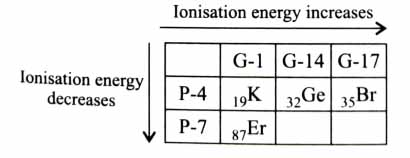
The atomic number of the element from the following with lowest 1st ionisation enthalpy is: [2025]
32
35
87
19
(3)
has lowest energy among given elements.
Given below are two statements:
Statement I: The decrease in first ionization enthalpy from B to Al is much larger than that from Al to Ga.
Statement II: The d-orbitals in Ga are completely filled.
In the light of the above statements, choose the most appropriate answer from the options given below [2023]
Both the statements I and II are incorrect.
Statement I is correct but statement II is incorrect.
Both the statements I and II are correct.
Statement I is incorrect but statement II is correct.
(3)
| Element | B | Al | Ga | In | Tl |
| (kJ/mol) | 801 | 577 | 579 | 558 | 589 |
of B and is greater than of and Ga.
This is due to completely filled -orbitals in Ga and -electron have low screening effect to compensate the increase in nuclear charge.
Given below are two statements: one is labelled as Assertion (A) and the other is labelled as Reason (R).
Assertion (A): The first ionization enthalpy of 3d series elements is more than that of group 2 metals.
Reason (R): In 3d series of elements successive filling of d-orbitals takes place.
In the light of the above statements, choose the correct answer from the options given below: [2023]
Both (A) and (R) are true and (R) is the correct explanation of (A).
(A) is true but (R) is false.
(A) is false but (R) is true.
Both (A) and (R) are true but (R) is not the correct explanation of (A).
(1)
| Metal | Sc | Ti | V | Cr | Mn | Fe | Co | Ni | Cu | Zn |
| IE (kJ/mol) | 631 | 656 | 650 | 653 | 717 | 762 | 758 | 736 | 745 | 906 |
| Metal | Be | Mg | Ca | Sr | Ba | Ra |
| IE (kJ/mol) | 899 | 737 | 590 | 549 | 503 | 509 |
For elements B, C, N, Li, Be, O and F, the correct order of first ionization enthalpy is [2023]
Li < Be < B < C < O < N < F
Li < Be < B < C < N < O < F
Li < B < Be < C < O < N < F
B > Li > Be > C > N > O > F
(3)
The correct increasing order of first ionization enthalpies is
Li < B < Be < C < O < N < F
Li – 520 kJ/mol
Be – 899 kJ/mol
B – 801 kJ/mol
C – 1086 kJ/mol
N – 1402 kJ/mol
O – 1314 kJ/mol
F – 1681 kJ/mol
The correct trend in the first ionization enthalpies of the elements in the 3rd period of the periodic table is: [2026]
S < Si < Al < P < Cl
Al < S < P < Si < Cl
Si < S < Al < P < Cl
Al < Si < S < P < Cl
(4)
In general on moving from left to right in a period ionization energy increases as increases.
(Ionisation energy of phosphorus is more because of half filled stable configuration)
A -block element (E) and hydrogen form a binary cation , while on treatment with in alkaline medium gives a precipitate of basic mercury(II) amido-iodine. Given below are first ionisation enthalpy values for first element each from group 13, 14, 15 and 16. Identify the correct first ionisation enthalpy value for element E. [2026]
1402
1312
801
1086
(1)
Element E is N, the species is , among B, C, N and O, N has highest first ionization energy.
The correct order of C, N, O and F in terms of second ionisation potential is [2026]
C < F < N < O
C < N < F < O
C < O < N < F
F < N < C < O
(2)
To compare second ionization potential, configuration of mono-cation is observed
|
Half-filled stable |
The first and second ionization potentials of an element M (atomic weight = 25) are 800 and 1500 kJ/mol respectively. Calculate the percentage of ions formed if 5 (g) of M(g) absorbs 250 kJ of energy.
(30)
Statement 1: The second ionization energy of ‘O’ is greater than that of ‘N’
Statement 2: The half filled p-orbitals cause greater stability.
Statement 1 and Statement 2 both are correct and Statement 2 is the correct explanation of Statement 1
Statement 1 and Statement 2 both are correct, but Statement 2 is not the correct explanation of Statement 1
Statement 1 is true, but Statement 2 is false
Statement 1 and Statement 2 both are false
(1)
Statement 2 is the reason for statement 1