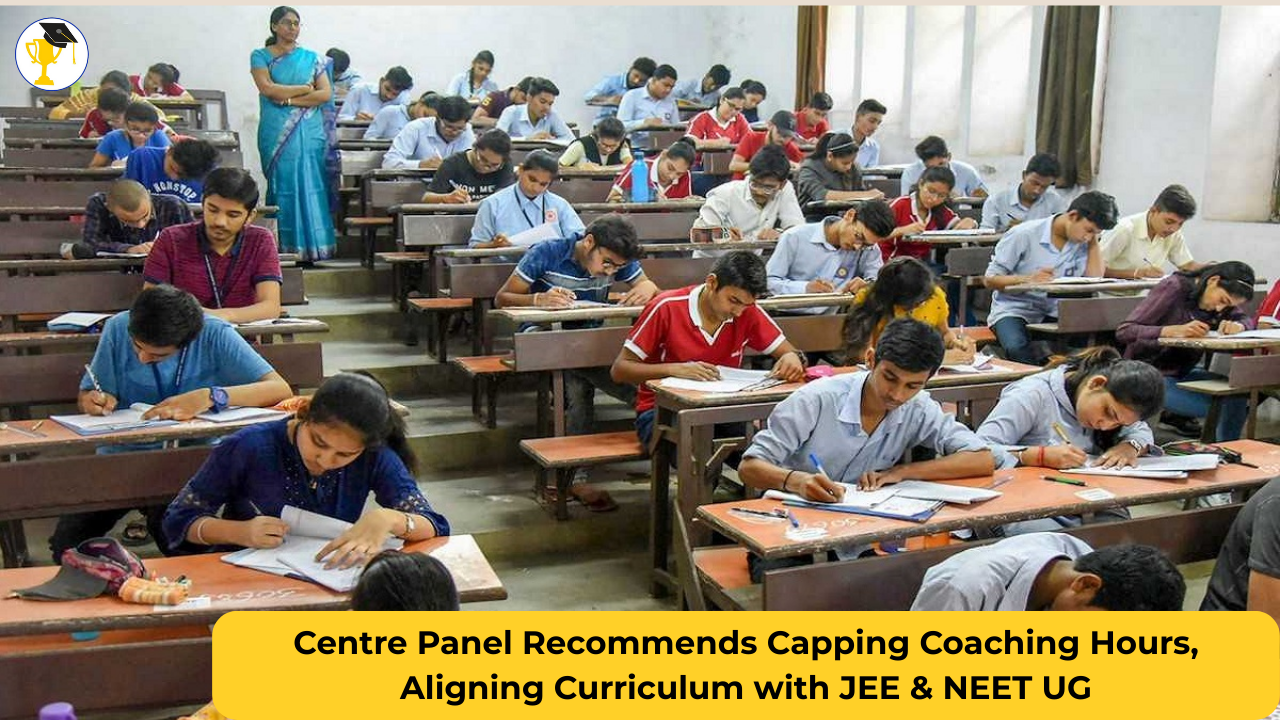


Centre Panel Recommends Capping Coaching Hours, Aligning Curriculum with JEE & NEET UG

Centre Panel Recommends Capping Coaching Hours, Aligning Curriculum with JEE & NEET UG

A high-level committee appointed by the central government has proposed a major overhaul of India’s high school education system to reduce students’ dependence on private coaching centres, The Indian Express has learnt.

Among its key recommendations are capping coaching classes at 2–3 hours a day, aligning school curricula with the requirements of competitive examinations such as JEE and NEET, giving greater weightage to board exam scores in college admissions, and exploring the possibility of introducing competitive assessments in Class 11.

The committee, headed by Vineet Joshi, Secretary, Department of Higher Education, was constituted by the Ministry of Education on June 17, 2025. It was tasked with examining gaps in school education, the fairness and effectiveness of entrance exams, the rise of dummy schools, and the growing influence of coaching institutes on students’ academic choices.

The panel includes CBSE Chairman Rahul Singh, NTA Director General Rajesh Lakhani, and senior faculty members from IIT Kanpur, IIT Madras, and NIT Trichy. It met at Shastri Bhawan in New Delhi on August 26 and November 15 last year.

During deliberations, the committee observed that coaching centres have emerged to fill gaps left by the school system, but stressed that the long-term solution lies in strengthening schools, not expanding parallel education structures. Members raised concerns about the impact of coaching on student well-being, educational equity, and the role of formal schooling.


Curriculum–Exam Disconnect

The committee identified a significant disconnect between school curricula and the demands of competitive exams such as JEE and NEET. It flagged the transition from Class 10 to Class 11 as a major stress point for students.

According to the panel, the mismatch between CBSE’s conceptual and analytical approach and the objective, MCQ-based format of entrance exams has fuelled the rise of coaching institutes and dummy schools, creating a parallel education economy that sidelines regular schooling.

The committee also noted that many school teachers are not adequately trained to teach beyond board exam requirements, while coaching centres often employ subject experts such as engineers and medical graduates. Schools, it said, lack the structured ecosystem of frequent testing, performance analytics, and curated study material that coaching institutes provide.


Student Well-being and Reform Measures

Highlighting the psychological toll of high-stakes, single-attempt entrance exams, the panel warned that excessive academic pressure and early enrolment in coaching narrow students’ definition of success. The absence of systematic career counselling in schools was identified as a key gap.

Among the major recommendations discussed:

  • NCERT, with support from NTA and CBSE, to act as the nodal agency for aligning school syllabi with competitive exam requirements

  • Limiting coaching classes to 2–3 hours daily to reduce student stress

  • Increasing the frequency of entrance exams and giving more importance to board exam results in admissions

  • CBSE to introduce remedial and mentoring programmes within schools

  • NTA to share detailed exam data with IIT Kanpur to assess the validity and reliability of entrance tests

  • Engagement of psychometric experts to analyse exam difficulty and differentiation

  • Regulation of coaching centres, including transparency in advertising, faculty credentials, and success claims

  • Introduction of a hybrid assessment model combining MCQs and subjective questions

  • Strengthening teacher training for competency-based education

  • Launch of a national aptitude and career guidance portal, with counselling starting from Class 8

The committee also proposed a “Professor of Practice” model, allowing domain experts from academia and industry to serve as visiting faculty in schools.

The recommendations are expected to guide future policy decisions aimed at restoring the central role of schools and reducing the excessive reliance on private coaching.

Frequently Asked Questions (FAQs)

To reduce academic stress and encourage students to rely more on school learning and self-study.
It will bridge the gap between board exams and entrance tests, reducing dependence on coaching centres.
Yes, the panel has suggested increasing the weightage of board exam marks alongside entrance exams.