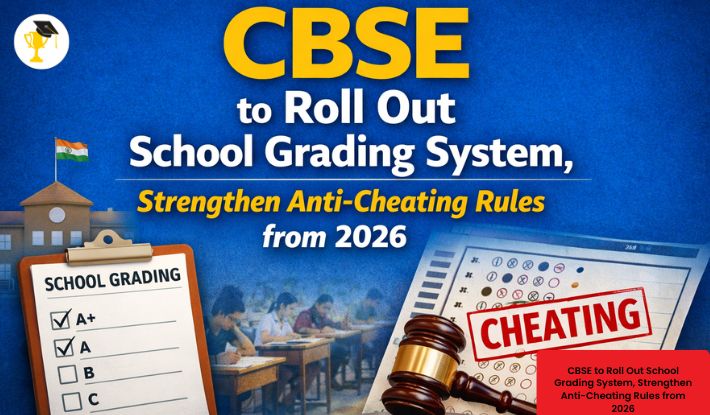


The Central Board of Secondary Education (CBSE) has approved a series of major reforms, including the introduction of an inspection-based school grading system, stricter unfair means rules in board exams, and the launch of an ‘Annual Young Culinary Championship’ for students of Classes 6 to 12 by December 2026.
The decisions were taken at the Board’s 142nd Governing Body meeting held in December 2025, with the minutes released recently.
CBSE to Introduce Inspection-Led School Grading System
CBSE will pilot a revamped quality assurance framework called SQAA Plus, shifting from the earlier compliance-based self-assessment model to a more rigorous inspection-led rating system.
Initially, the framework will apply to centrally managed schools, including:
Kendriya Vidyalayas (KVs)
Jawahar Navodaya Vidyalayas (JNVs)
Eklavya Model Residential Schools (EMRS)
Under the new model, schools will be graded A+, A, B+, B or C based on defined performance and quality benchmarks.
The system will include:
Real-time, on-site inspections
Multi-domain assessments
Evaluation of academics, governance, infrastructure and inclusivity
Student well-being indicators
CBSE plans to roll out the pilot in 500 selected schools with the help of a dedicated team of inspection specialists.
Schools will receive categorical ratings along with clearly identified improvement pathways aimed at strengthening institutional accountability.
Consultancy Support and Budget
To support monitoring and impact assessment, CBSE has approved the engagement of consultants from Ernst & Young LLP (NICSI-empanelled).
The 18-month pilot project, covering framework development, training and field validation, is estimated to cost INR 2.89 crore.
Although the framework is currently limited to centrally run schools, many CBSE-affiliated private school principals believe it may eventually extend to private institutions, as happened with the earlier SQAA model.
Education leaders have welcomed the move but stressed that inspections must remain supportive rather than punitive, considering the diverse contexts of schools.
Annual Young Culinary Championship from December 2026
Among other key approvals, CBSE will launch the ‘Annual Young Culinary Championship’ for students of Classes 6 to 12.
The initiative aims to:
Promote culinary skills through fire and non-fire cooking
Build awareness about nutrition and food sustainability
Encourage hygiene practices
Introduce students to hospitality and culinary career pathways
The competition will progress from school level to national level under industry mentorship. Detailed guidelines are expected by April 2026, with the first championship scheduled by December 2026.
Stricter Unfair Means (UFM) Rules from 2026 Board Exams
CBSE has also approved significant changes to its Unfair Means (UFM) policy.
From the 2026 board exams onwards:
If malpractice is detected in a subject (UFM Category-1), that subject will be cancelled.
The student will be placed in the Compartment category.
Reappearance in that specific subject will be mandatory.
Previously, students booked under UFM Category-1 could still pass by replacing the cancelled paper with their 6th or 7th subject. This provision will now be discontinued.
The move aims to strengthen exam integrity and discourage malpractice.
RTE Impact Study and Revised Certificate Correction Fees
CBSE has approved engaging an NGO or non-profit organisation to study the impact of the Right to Education (RTE) Act on students admitted under inclusive education provisions in private unaided schools. The study is estimated to cost around INR10 lakh.
Additionally, the Board has increased the fee for corrections in certificates (including date of birth changes) to:
INR 5,000 for students passing from 2026 onwards
Plus INR 1,000 for each additional year
Students who passed until 2025 will continue under the earlier INR 1,000 correction fee structure.
A Major Reform Push
With the introduction of inspection-based grading, tighter exam discipline, and skill-focused initiatives like the culinary championship, CBSE’s latest reforms signal a shift toward stronger accountability, holistic education, and enhanced academic standards beginning in 2026.