

The displacement of a particle executing SHM is given by . The time period of motion is 3.14s. The velocity of the particle at is _______ m/s. [2024]
(10)
A particle is doing simple harmonic motion of amplitude 0.06 m and time period 3.14 s. The maximum velocity of the particle is ________ cm/s. [2024]
(12)
An object of mass 0.2 kg executes simple harmonic motion along x axis with frequency of . At the position the object has kinetic energy 0.5 J and potential energy 0.4 J. The amplitude of oscillation is ________ cm. [2024]
(6)
The position, velocity and acceleration of a particle executing simple harmonic motion are found to have magnitudes of and at a certain instant. The amplitude of the motion is where is ________. [2024]
(17)
A particle of mass 0.50 kg executes simple harmonic motion under force . The time period of oscillation is . The value of is _______ [2024]
(22) Time period
On comparing
A particle executes simple harmonic motion with an amplitude of 4 cm. At the mean position, velocity of the particle is 10 cm/s. The distance of the particle from the mean position when its speed becomes 5 cm/s is cm, where ______ . [2024]
(12)
which gives,
When the displacement of a simple harmonic oscillator is one third of its amplitude, the ratio of total energy to the kinetic energy is x/8, where x = __________. [2024]
(9)
Ratio =
A particle performs simple harmonic motion with amplitude A. Its speed is increased to three times at an instant when its displacement is 2A/3. The new amplitude of motion is . The value of is ______ . [2024]
(7)
at
New amplitude =
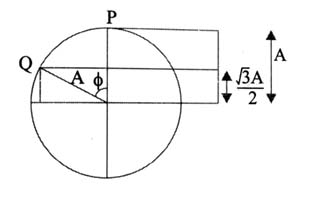
A simple harmonic oscillator has an amplitude A and time period seconds. Assuming the oscillation starts from its mean position, the time required by it to travel from to will be where _________ . [2024]
(2)
From phasor diagram particle has to move from P to Q in a circle of radius equal to the amplitude of SHM.

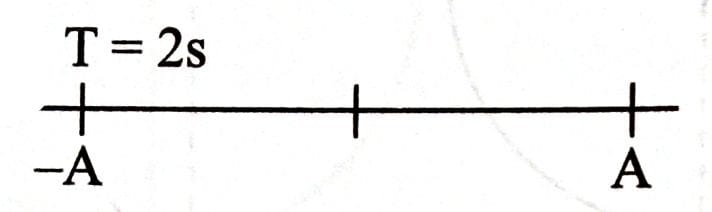
A particle is executing simple harmonic motion with time period 2 s and amplitude 1 cm. If D and d are the total distance and displacement covered by the particle in 12.5 s, then is [2025]
25
10
(2)
Time period,

In 12.5 s, 6 total oscillations and 1 quarter oscillation.
So, D = (6 4A) + A = 25A
d = A
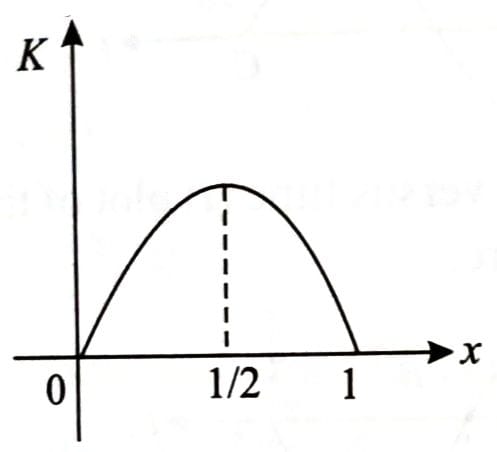
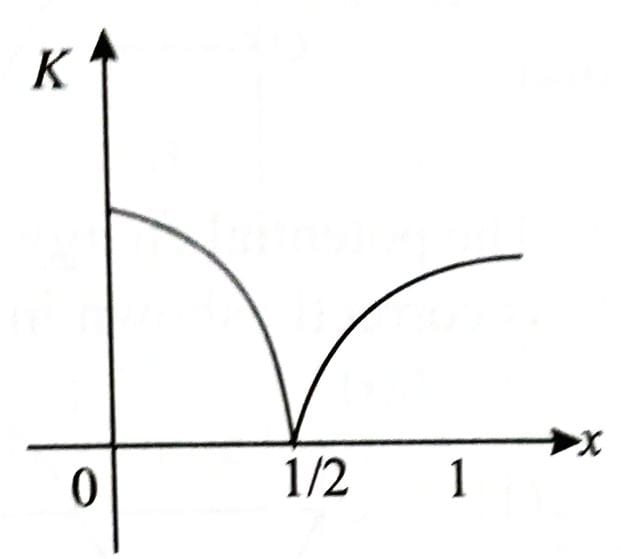
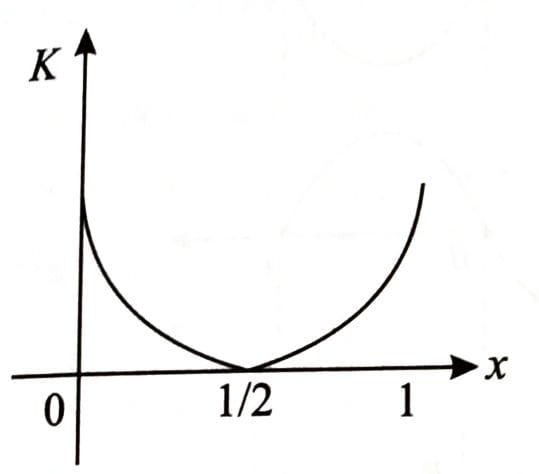
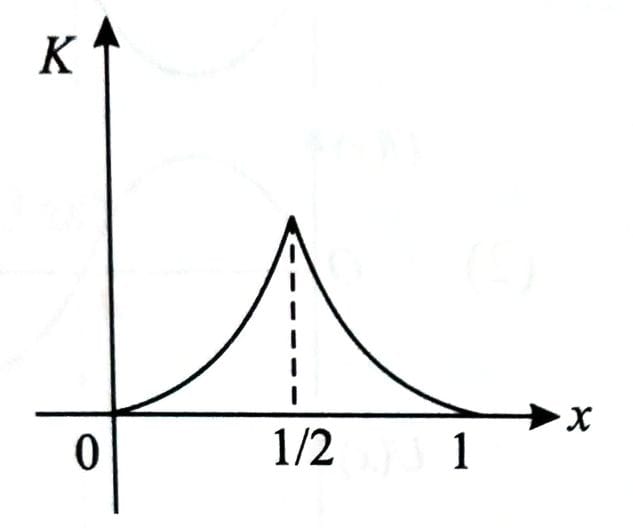
A particle oscillates along the x-axis according to the law, where . The kinetic energy (K) of the particle as a function of x is correctly represented by the graph. [2025]


(1)

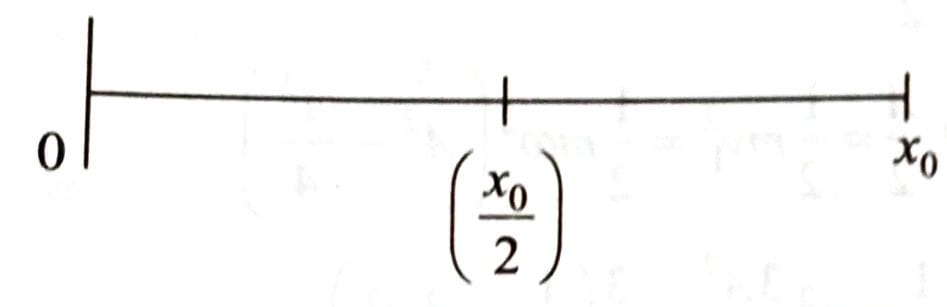
Clearly is mean position, Particle is oscillating between

Given below are two statements. One is labelled as Assertion (A) and the other is labelled as Reason (R).
Assertion (A): Knowing initial position and initial momentum is enough to determine the position and momentum at any time t for a simple harmonic motion with a given angular frequency .
Reason (R) : The amplitude and phase can be expressed in terms of and .
In the light of the above statements, choose the correct answer from the options given below: [2025]
Both (A) and (R) are true but (R) is NOT the correct explanation of (A).
(A) is false but (R) is true.
(A) is true but (R) is false.
Both (A) and (R) are true and (R) is the correct explanation of (A).
(4)
... (i)
... (ii)
(ii)/(i)
From (i),
Hence both position and linear momentum of a particle can be expressed as a function of time if we know initial momentum and position.
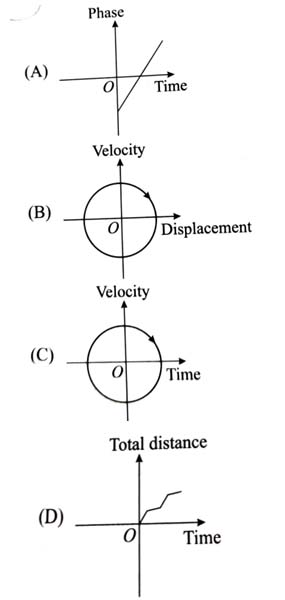
Which of the following curves possibly represent one-dimensional motion of a particle? [2025]

Choose the correct answer from the options given below:
A, B and D only
A, B and C only
A and B only
A, C and D only
(1)
A. Phase increase with time in SHM, = kt + C
For example, in SHM, x = A sin
Correct
B. In SHM Velocity and displacement are related in elliptical/circular relation
i.e., = constant, it can be 1 D motion
Correct
C. At same time particle can't have two velocities Incorrect.
D. Distance always increases Correct
Hence A, B and D are correct.
A particle executes simple harmonic motion between and . If the time taken by the particle to go from to is , then the time taken by the particle in going from to is [2023]
1.5 s
3 s
4 s
2 s
(3)

Let time from 0 to is and from to is
Then
The maximum potential energy of a block executing simple harmonic motion is 25 J. is the amplitude of oscillation. At , the kinetic energy of the block is [2023]
37.5 J
9.75 J
18.75 J
12.5 J
(3)
A particle executes S.H.M. of amplitude along the -axis. At , the position of the particle is and it moves along the positive -axis. The displacement of the particle is given by then the value of will be [2023]
(1)
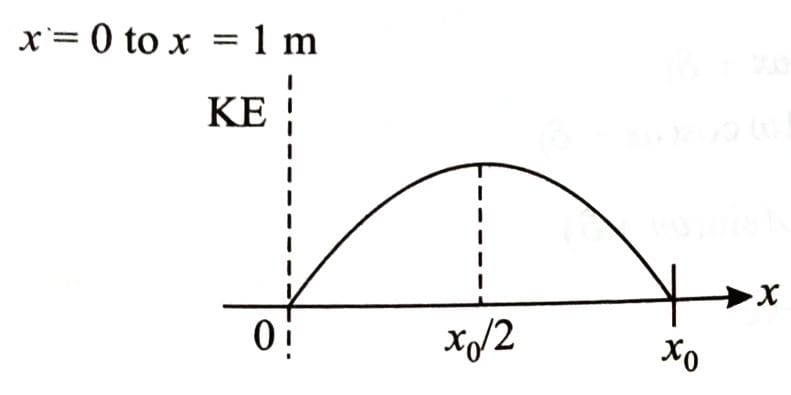
The variation of kinetic energy (KE) of a particle executing simple harmonic motion with the displacement , starting from mean position to extreme position , is given by [2023]


(4)
A particle is executing Simple Harmonic Motion (SHM). The ratio of potential energy and kinetic energy of the particle when its displacement is half of its amplitude will be [2023]
1 : 1
2 : 1
1 : 4
1 : 3
(4)
Which graph represents the difference between total energy and potential energy of a particle executing SHM vs its distance from mean position? [2023]


(4)
A particle executes SHM of amplitude . The distance from the mean position when its kinetic energy becomes equal to its potential energy is _______ [2023]
(3)
In a linear simple harmonic motion (SHM) [2023]
(A) Restoring force is directly proportional to the displacement.
(B) The acceleration and displacement are opposite in direction.
(C) The velocity is maximum at mean position.
(D) The acceleration is minimum at extreme points.
Choose the correct answer from the options given below:
(A), (B) and (C) only
(C) and (D) only
(A), (B) and (D) only
(A), (C) and (D) only
(1)
A true
B true
C true
D false
A particle of mass 250 g executes a simple harmonic motion under a periodic force . The particle attains a maximum speed of 4 m/s during its oscillation. The amplitude of the motion is ________cm. [2023]
(40)
The general displacement of a simple harmonic oscillator is . Let be its time period. The slope of its potential energy (U) – time (t) curve will be maximum when The value of is ________. [2023]
(8)
The velocity of a particle executing SHM varies with displacement as . The time period of oscillations is . The value of is _______. (Take ) [2023]
(88)
The amplitude of a particle executing SHM is 3 cm. The displacement at which its kinetic energy will be 25% more than the potential energy is ______ cm. [2023]
(2)
At a given point of time the value of displacement of a simple harmonic oscillator is given as . If amplitude is 40 cm and kinetic energy at that time is 200 J, the value of force constant is . The value of is __________ . [2023]
(4)
The kinetic energy of a simple harmonic oscillator is oscillating with angular frequency of 176 rad/s. The frequency of this simple harmonic oscillator is ______ Hz.
[2026]
14
176
28
88
(1)
The displacement of a particle, executing simple harmonic motion with time period T, is expressed as where A is the amplitude. The maximum value of potential energy of this oscillator is found at The value of is ______. [2026]
(2)
Potential energy is maximum at extreme position. The particle starting at mean position reaches extreme position in time .