Q 1 :

A body of mass 4 kg experiences two forces F1=5i^+8j^+7k^ and F2=3i^-4j^-3k^. The acceleration acting on the body is                  [2024]

  • -2i^-j^-k^


  • 4i^+2j^+2k^


  • 2i^+j^+k^


  • 2i^+3j^+3k^


(3)  

       Fnet=F1+F2=8i^+4j^+4k^

       Fnetm=2i^+j^+k^


Q 2 :

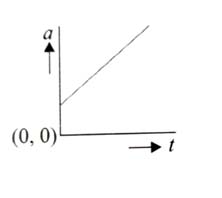
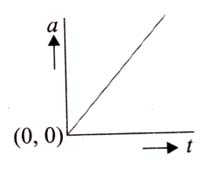
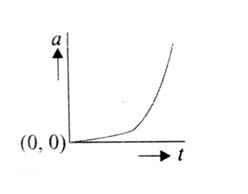
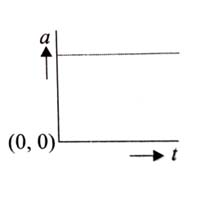
A wooden block, initially at rest on the ground, is pushed by a force that increases linearly with time t. Which of the following curves best describes the acceleration of the block with time?        [2024]

  •  

  •  

  •  

  •  

(2)

Let F=kt

F=maa=Fm=(km)t

It means the acceleration vs. time graph will be a straight line passing through the origin.


Q 3 :

A block of mass 1 kg, moving along x with speed vi = 10 m/s enters a rough region ranging from x = 0.1 m to x = 1.9 m. The retarding force acting on the block in this range is Fr = – kx N, with k = 10 N/m. Then the final speed of the block as it crosses rough region is          [2025]

  • 10 m/s


  • 4 m/s


  • 6 m/s


  • 8 m/s


(4)

a=Fm=10x  vdvdx=10x

10vvdv=100.11.9xdx

v21002=10((1.9)2(0.1)22)

 v=8 m/s


Q 4 :

An object with mass 500 g moves along x-axis with speed v=4xm/s. The force acting on the object is :          [2025]

  • 8 N


  • 5 N


  • 6 N


  • 4 N


(4)

The force acting on the object, F = ma

v=4x  v2=16x

2vdvdx=16

a=vdvdx=162=8 ms2

 F=0.5×8=4 N


Q 5 :

A body of mass 2 kg moving with velocity of vin=3i^+4j^ ms1 enters in to a constant force field of 6 N directed along positive z-axis. If the body remains in the field for a period of 53 seconds, then velocity of the body when it emerges from force field is         [2025]

  • 4i^+3j^+5k^


  • 3i^+4j^+5k^


  • 3i^+4j^5k^


  • 3i^+4j^+5k^


(2)

a=62(k^)ms2=3(k^)ms2, t=53s

u=(3i^+4j^)ms1

v=u+at=(3i^+4j^+5k^)ms1


Q 6 :

Force acts for 20 s on a body of mass 20 kg, starting from rest, after which the force ceases and then body describes 50 m in the next 10 s. The value of force will be     [2023]

  • 40 N


  • 5 N


  • 20 N


  • 10 N


(2)

[IMAGE 17]

50=V×10  V=5 m/s

V=0+a×20

 5=a×20  a=14m/s2

F=ma=20×14=5 N


Q 7 :

At any instant the velocity of a particle of mass 500 g is (2ti^+3t2j^)m s-1. If the force acting on the particle at t= 1 s is (i^+xj^) N, then the value of x will be        [2023]

  • 3


  • 6


  • 2


  • 4


(1)

v=2ti^+3t2j^

a=2i^+6tj^

At t=1, a=2i^+6j^

F=ma=0.5(2i^+6j^)=i^+3j^

F=i^+xj^

Hence x = 3


Q 8 :

Given below are two statements: one is labelled as Assertion A and the other is labelled as Reason R.

Assertion A: An electric fan continues to rotate for some time after the current is switched off.

Reason R: Fan continues to rotate due to inertia of motion.

In the light of above statements, choose the most appropriate answer from the options given below.        [2023]

  • A is correct but R is not correct.


  • Both A and R are correct and R is the correct explanation of A.


  • A is not correct but R is correct.


  • Both A and R are correct but R is NOT the correct explanation of A.


(2)

Fan continue to rotate due to inertia of motion.


Q 9 :

The position vector of a particle related to time t is given by r^=(10ti^+15t2j^+7k^)m

The direction of net force experienced by the particle is              [2023]

  • Positive y-axis


  • Positive x-axis


  • Positive z-axis


  • In xy plane


(1)

r^=10ti^+15tj^+7k^

v=10i^+30tj^

a=30j^

So, net force is along the +y direction.