

Q 1 :

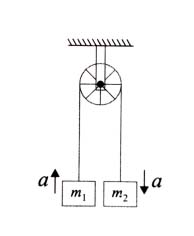
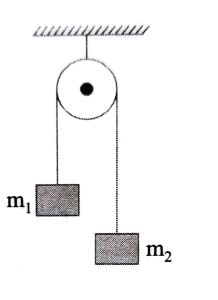
A light stretchable string passing over a smooth light pulley connects two blocks of masses m1 and m2. If the acceleration of the system is g8, then the ratio of the masses m2m1 is:                             [2024]

  • 9 : 7


  • 4 : 3


  • 5 : 3


  • 8 : 1


(1)  

       ac=(m2-m1)g(m1+m2)g8=(m2-m1m1+m2)g

        18=(m2m1-1m2m1+1)m2m1+1=8m2m1-8m2m1=97


Q 2 :

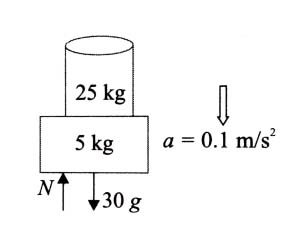
A wooden block of mass 5 kg rests on a soft horizontal floor. When an iron cylinder of mass 25 kg is placed on top of the block, the floor yields, and the block and the cylinder together go down with an acceleration of 0.1 ms-2.

The action force of the system on the floor is equal to        [2024].

  • 294 N


  • 196 N


  • 297 N


  • 291 N


(4)

30g-N=30a

Taking g=9.8m/s2

30×9.8-N=30×0.1

N=291 N


Q 3 :

A light string passing over a smooth light pulley connects two blocks of masses m1 and m2 (where m2>m1). If the acceleration of the system is g2, then the ratio of the masses m1m2 is:              [2024]

  • 3+12-1


  • 1+52-1


  • 1+55-1


  • 2-12+1


(4)

a=(m2-m1m1+m2)gg2=(m2-m1m1+m2)g

(m1+m2)=2m2-2m1

m1m2=(2-12+1)


Q 4 :

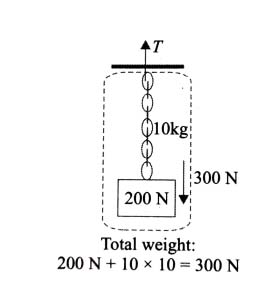
A body of weight 200 N is suspended from a tree branch through a chain of mass 10 kg. The branch pulls the chain by a force equal to (if g = 10 m/s2)     [2024]

  • 300 N


  • 150 N


  • 100 N


  • 200 N


(1)

Chain block system is in equilibrium, so T = 200 + 100 = 300 N.


Q 5 :

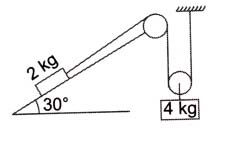
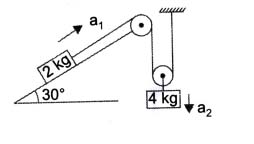
All surfaces shown in the figure are assumed to be frictionless and the pulleys and the string are light.

The acceleration of the block of mass 2 kg is            [2024].

  • g


  • g3


  • g2


  • g4


(2)

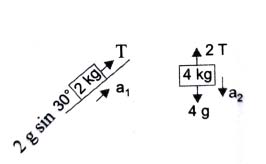
By constrained motion

-a1+a2+a2=0

a1-2a2=0 or a2=a12

T-2gsin30°=2a1

T-g=2a1               ...(1)

4g-2T=4a2

4g-2T=2a1

2g-T=a1            ...(2)

Adding equation (1) and (2), g=3a1a1=g3


Q 6 :

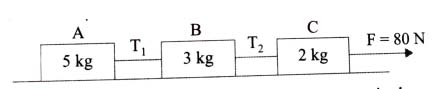
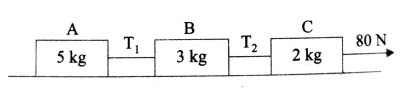
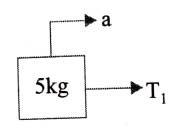
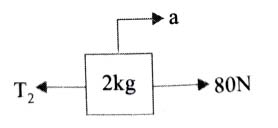
Three blocks A, B, and C are pulled on a horizontal smooth surface by a force of 80 N as shown in the figure.

The tensions T1 and T2 in the string are respectively:         [2024]

  • 40 N, 64 N


  • 60 N, 80 N


  • 88 N, 96 N


  • 80 N, 100 N


(1)

a=8010=8 m/s2

F.B.D of 5 kg

T1=5(a)

T1=5(8)=40N

80-T2=2(8)

T2=80-16=64N


Q 7 :

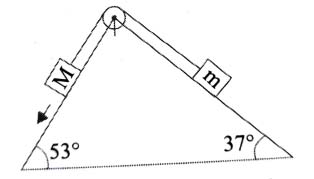
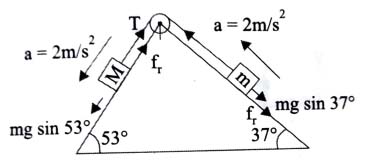
In the given arrangement of a doubly inclined plane, two blocks of masses M and m are placed. The blocks are connected by a light string passing over an ideal pulley as shown. The coefficient of friction between the surface of the plane and the blocks is 0.25. The value of m, for which M = 10 kg will move down with an acceleration of 2 m/s2, is (take g = 10 m/s2 and tan 37° = 3/4)       [2024]

  • 6.5 kg


  • 4.5 kg


  • 2.25 kg


  • 9 kg


(2)

For M block

10gsin53°-μ(10g)cos53°-T=10×2

T=80-15-20

T=45N

For m block

T-mgsin37°-μmgcos37°=m×2

45=10m

m=4.5 kg


Q 8 :

A light string passing over a smooth light fixed pulley connects two blocks of masses m1 and m2.

If the acceleration of the system is g/8, then the ratio of masses is     [2024].

  • 97


  • 81


  • 43


  • 53


(1)

a=(m1-m2)g(m1+m2)=g8

8m1-8m2=m1+m2

7m1=9m2

m1m2=97


Q 9 :

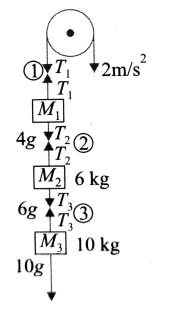
Three blocks M1, M2, M3 having masses 4 kg, 6 kg, and 10 kg respectively are hanging from a smooth pulley using rope 1, 2, and 3 as shown in the figure. The tension in the rope 1, T1, when they are moving upward with an acceleration of 2 ms-2, is ________ N (if g = 10 m/s2).    [2024]


(240)

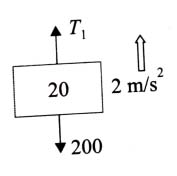
FBD of M1

T1-200=(4+6+10)×2  

  T1=240 N


Q 10 :

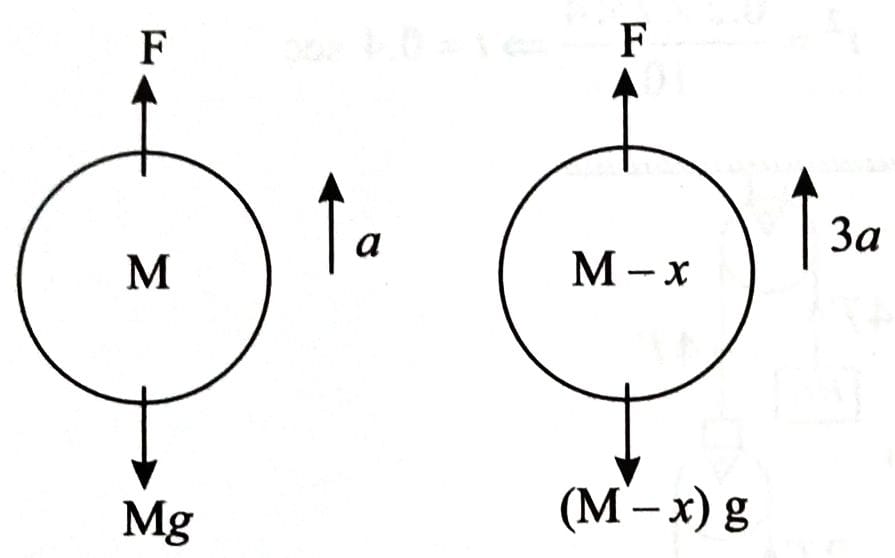
A balloon and its content having mass M is moving up with an acceleration 'a'. The mass that must be released from the content so that the balloon starts moving up with an acceleration '3a' will be: (Take 'g' as acceleration due to gravity)          [2025]

  • 3Ma2ag


  • 3Ma2a+g


  • 2Ma3a+g


  • 2Ma3ag


(3)

FMg=Ma  F=Ma+Mg          ... (i)

F(Mx)g=(Mx)3a                        ... (ii)

From (i) and (ii)

Ma+MgMg+xg=3Ma3xa  x=2Mag+3a


Q 11 :

Given below are two statements:

Statement I: An elevator can go up or down with uniform speed when its weight is balanced with the tension of its cable.

Statement II: Force exerted by the floor of an elevator on the foot of a person standing on it is more than his/her weight when the elevator goes down with increasing speed.

In the light of the above statements, choose the correct answer from the options given below:          [2023]

  • Statement I is false but Statement II is true


  • Statement I is true but Statement II is false


  • Both Statement I and Statement II are false


  • Both Statement I and Statement II are true


(2)

Statement-1

When elevator is moving with uniform speed, T=Fg

Statement-2

When elevator is going down with increasing speed, its acceleration is downward.

Hence W-N=Wg×a

N=W(1-ag), i.e., less than weight.


Q 12 :

A small block of mass m slides down from the top of a frictionless inclined surface, while the inclined plane is moving towards left with constant acceleration a0. The angle between the inclined plane and ground is θ and its base length is L. Assuming that initially the small block is at the top of the inclined plane, the time it takes to reach the lowest point of the inclined plane is ________.   [2026]

  • 2Lgsinθ-a0cosθ


  • 4Lgsin2θ-a0(1+cos2θ)


  • 4Lgcos2θ-a0sinθcosθ


  • 2Lgsin2θ-a0(1+cos2θ)


(2)

mgsinθ-ma0cosθ=ma

a=gsinθ-a0cosθ

Now using,

S=ut+12adownt2

Lcosθ=12(gsinθ-a0cosθ)t2

t=2Lgsinθcosθ-a0cos2θ

t=4Lgsin2θ-a0(1+cos2θ)


Q 13 :

A block is sliding down on an inclined plane of slope θ and at an instant t=0 this block is given an upward momentum so that it starts moving up on the inclined surface with velocity u. The distance (S) travelled by the block before its velocity becomes zero is ______.

(g = gravitational acceleration)  [2026]

  • u24gsinθ


  • 2u2gcosθ


  • u22gcosθ


  • None of these


(4)

a=-gsinθ

V2=U2+2as

0=u2-2gsinθ·s

s=u22gsinθ


Q 14 :

A particle of mass m falls from rest through a resistive medium having resistive force, F=kv, where v is the velocity of the particle and k is a constant. Which of the following graphs represents velocity (v) versus time (t)?   [2026]

  •  

  •  

  •  

  •  

(2)

m·dvdt=mg-kv

0vdvmg-kv=0tdtm

-1kln(mg-kvmg)=tm

v=mgk(1-e-kt/m)