

One of the commonly used electrodes is calomel electrode. Under which of the following categories calomel electrode come? [2024]
Metal ion – Metal electrodes
Oxidation – Reduction electrodes
Metal – Insoluble Salt – Anion electrodes
Gas – Ion electrodes
(3)
Calomel electrode is a metal-metal insoluble salt-anion half cell. It is commonly used as a reference like standard hydrogen electrode.
How can an electrochemical cell be converted into an electrolytic cell?
Reversing the flow of ions in salt bridge.
Applying an external opposite potential greater than .
Exchanging the electrodes at anode and cathode.
Applying an external opposite potential lower than .
(2)
When in an electrochemical cell, external voltage greater than is applied, then direction of flow of charge is reversed. Now external source supplies energy to the cell and cell is now electrolytic cell.
Reduction potential of ions are given below:
The correct order of their oxidising power is: [2024]
(2)
Oxidising power reduction potential.
So more is reduction potential of a specie, more is its ability to oxidize the other substance.
Match List I with List II.
| List I | List II | ||
| (Cell) | (Use/Property/Reaction) | ||
| A. | Leclanche cell | I. | Converts energy of combustion into electrical energy |
| B. | Ni-Cd cell | II. | Does not involve any ion in solution and is used in hearing aids |
| C. | Fuel cell | III. | Rechargeable |
| D. | Mercury cell | IV. | Reaction at anode |
Choose the correct answer from the options given below: [2024]
A–II, B–III, C–IV, D–I
A–III, B–I, C–IV, D–II
A–I, B–II, C–III, D–IV
A–IV, B–III, C–I, D–II
(4)
A. Leclanche cell: It is commonly used dry cell in our clocks. The cell consists of a zinc container that also acts as anode and the cathode is a carbon (graphite) rod surrounded by powdered manganese dioxide and carbon. The space between the electrodes is filled by a moist paste of ammonium chloride and zinc chloride.
Anode reaction:
Cathode reaction:
B. Ni-Cd cell: It is a rechargeable cell. It is more expensive to manufacture than a lead storage battery.
C. Fuel cell: These are galvanic cells that are designed to convert the energy of combustion of fuels like hydrogen, methane, methanol, etc., directly into electrical energy.
D. Mercury cell:
The cell potential is approximately 1.35 V and remains constant during its life as the overall reaction does not involve any ion in solution whose concentration can change during its lifetime.
The standard reduction potentials at 298 K for the following half cells are given below: [2024]
Consider the given electrochemical reactions,
The number of metal(s) which will be oxidized be in aqueous solution is __________.
(3)

For the above reaction to be spontaneous:
Thus Fe, Ni and Ag will be oxidized by .
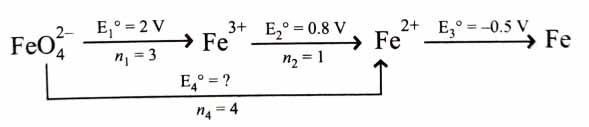
In the above diagram, the standard electrode potentials are given in volts (over the arrow).
The value of is [2025]
2.1 V
1.7 V
1.2 V
1.4 V
(2)

When two reactions are added their Gibbs energy change is added, as Gibbs energy change is an extensive property.
For the given cell
The standard cell potential of the above reaction is:
Given:
[2025]
(1)
gives the required equation:
Based on the data given below:
The strongest reducing agent is: [2025]
(4)
Strongest reducing agent is the specie which has highest tendency to get oxidized i.e. the one with highest oxidation potential.
| Reduction potential | Oxidation potential |
The standard reduction potential values of some of the -block ions are given below. Predict the one with the strongest oxidising capacity. [2025]
(2)
Specie with highest reduction potential (i.e. highest willingness to get reduced) is strongest oxidizing agent.
The standard electrode potential for V, Cr, Mn and Co are - 0.26 V, - 0.41 V, + 1.57 V and + 1.97 V, respectively. The metal ions which can liberate from a dilute acid are [2023]
and
and
and
and
(4)
The metal ion for which have less value of reduction potential that can release on reaction with dilute acid. So, and reduce to .
The standard electrode potential of in aqueous solution does not depend on [2023]
Sublimation of a solid metal
Ionisation of a solid metal atom
Hydration of a gaseous metal ion
Ionisation of a gaseous metal atom
(2)
The standard electrode potential of in aqueous solution depends on:
• Ionisation of a gaseous metal atom
• Hydration of a gaseous metal ion
• Sublimation of a solid metal
The reaction
occurs in which of the given galvanic cells? [2023]
(1)

The standard reduction potentials at 298 K for the following half cells are given below:
The number of metal(s) which will be oxidized by in aqueous solution is _____________ . [2023]
(3)
can oxidise V, Fe and Ag.
At 298 K, the standard reduction potential for the electrode is 0.34 V.
The reduction potential at pH = 14 for the above couple is V. The value of is __________ . [2023]
(25)
Consider the following electrochemical cell at 298 K:
If the reaction quotient at a given time is , then the cell EMF is __________ (Nearest integer).
Given the standard half-cell reduction potentials as:
and [2026]
(4)
Consider the following reduction processes:
The tendency to act as reducing agent decreases in the order: [2026]
(4)
Electrolysis of aqueous was carried out is two cells I and II. In I, the electrodes are of Cu and is II they were of Pt. As the electrolysis proceeds pH of the electrolyte solution will
decrease is II and remain the same in I
remain the same in both I and II
increase in both I and II
increase in I and decrease is II
Saturated solution of with agar-agar is used to make 'salt bridge' because:
size of is greater than that of
velocity of is greater than that of
velocities of both and are nearly the same
both velocities and size of and ions are same