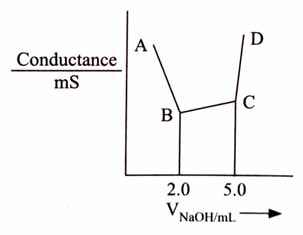


Q 1 :

40 mL of a mixture of CH3COOH and HCl (aqueous solution) is titrated against 0.1 M NaOH solution conductometrically. Which of the following statement is correct?
[2025]

  • The concentration of CH3COOH in the original mixture is 0.005 M.


  • The concentration of HCl in the original mixture is 0.005 M.


  • CH3COOH is neutralised first followed by neutralisation of HCl.


  • Point ‘C’ indicates the complete neutralisation of HCl.


(2)

First NaOH reacts with HCl. Point B indicates complete neutralization of HCl. 2 mL of NaOH is used to neutralize HCl.

When NaOH completely neutralizes HCl:

mmol of NaOH=mmol of HCl

MNaOH×VNaOH(that reacts with HCl)=MHCl×VHCl

0.1×2=MHCl×40

MHCl=0.005 M

When HCl is completely neutralized, then NaOH reacts with CH3COOH.  Thus, (5−2) mL = 3 mL of NaOH reacts with CH3COOH.  Point C indicates complete neutralization of CH3COOH.

When NaOH completely neutralizes CH3COOH:

mmol of NaOH=mmol of CH3COOH

MNaOH×VNaOH (that reacts with CH3COOH)

=MCH3COOH×VCH3COOH

0.1×3=MCH3COOH×40

MCH3COOH =0.0075 M


Q 2 :

Given below are two statements:                      [2025]

Statement I: Corrosion is an electrochemical phenomenon in which pure metal acts as an anode and impure metal as a cathode.

Statement II: The rate of corrosion is more in alkaline medium than in acidic medium.

In the light of the above statements, choose the correct answer from the options given below:

  • Both Statement I and Statement II are false


  • Both Statement I and Statement II are true


  • Statement I is true but Statement II is false


  • Statement I is false but Statement II is true


(3)

Rate of corrosion is generally more in acidic medium.


Q 3 :

For a closed circuit Daniell cell, which of the following plots is the accurate one at a given temperature?      [2026]

  •  

  •  

  •  

  •  

(2)

Ecell remain constant with time.


Q 4 :

MX is a sparingly soluble salt that follows the given solubility equilibrium at 298 K.

MX(s)M+(aq)+X- (aq);  Ksp=10-10

If the standard reduction potential for M+(aq)+e-M(s) is (EM+/M)=0.79 V, then the value of the standard reduction potential for the metal/metal insoluble salt electrode EX-/MX(s)/M is ___________________mV. (nearest integer).      

[Given: 2.303RTF=0.059 V]       [2026]


(200)

EX-/MX(s)/M=EM+/M+0.0591nlogKsp

=0.79+0.0591log(10-10)

=0.79-0.59

=0.20 V=200 mV


Q 5 :

Consider the following electrochemical cell :

Pt|O2(g) (1 bar)|HCl(aq)M2+(aq,1.0M)|M(s)

The pH above which, oxygen gas would start to evolve at anode is ________ (nearest integer).   

            [2026]


(4)

For spontaneity Ecell>0

At limiting condition :

Eoxi(anode)=-Ered(cathode)

H2O2H++12O2+2e-

E=E°-0.0592log[[H+]2×PO21/21]

-0.997=-1.23+0.059×pH

pH=3.94

pH4


Q 6 :

Concentration of K+ ions inside a biological cell was found to be 25 times higher than that outside. The magnitude of the potential difference between the two sides of the cell in close to _____ mV (nearest integer) (2.303RTF=59 mV, log5=0.7) (difference in concentration of other ions can be taken as negligible).


(83)


Q 7 :

In a saturated solution of AgBr(Ksp=2×10-13), if 10-7 moles of AgNO3 are added to 1 litre of this solution, find specific conductance of this solution in terms of 10-7Sm-1 units.

Given: λ(Ag+)=6×10⁻³Sm2/mol

           λ(NO3-)=7×10⁻³Sm2/mol

          λ(Br-)=8×10⁻³Sm2/mol


(69)

AgBr(s)Ag+(s+10-7)+Br-s

s2+10-7s-20×10-14=0

s=-10-7+10-14+80×10-142=4×10⁻⁷

[Ag+]=5×10⁻⁷M

[Br-]=4×10⁻⁷M

[NO3-]=1×10⁻⁷M

Λ°=K1000CKAg+1=6×10-3×1000×5×10-7

=30×10-7s-1m2/mol

KNO3-1=7×1×10-7sm2/mol

KBr-1=8×4×10-7sm2/mol=32×10-7

Ktotal1=69×10-7sm2/mol


Q 8 :

Given below are two statements:

Statement I: The limiting molar conductivity of KCl (strong electrolyte) is higher compared to that of CH3COOH (weak electrolyte).

Statement II: Molar conductivity increases with decrease in concentration of electrolyte.

In the light of the above statements, choose the most appropriate answer from the options given below:

  • Statement I is true but Statement II is false.


  • Statement I is false but Statement II is true.


  • Both Statement I and Statement II are true.


  • Both Statement I and Statement II are false.


(2)

Ion H+ K+ Cl- CH3COO-
Λm(Scm2mol-1) 349.8 73.5 76.3 40.9


So, Λm(CH3COOH)=Λm(H+)+Λm(CH3COO-)=349.8+40.9=390.7Scm2mol-1

Λm(KCl)=Λm(K+)+Λm(Cl-)=73.5+76.3=149.8Scm2/mole

So statement-I is wrong or false.

As the concentration decreases, the dilution increases, which increases the degree of dissociation, thus increasing the number of ions, which increases the molar conductance.

[IMAGE 48]


Q 9 :

The specific conductance of a saturated solution of silver bromide is k Scm-1. The limiting ionic conductivity of Ag+ and Br- ions are x and y, respectively. The solubility of silver bromide in gL-1 is:

(molar mass of AgBr = 188)

  • k×1000x-y


  • kx+y×188


  • k×1000×188x+y


  • x+yk×1000188


(3)

Λm=kM×1000·(x+y)=kM×1000

                          M=1000×kx+y

Solubility (in g L-1)=k×1000×188x+y