

Q 1 :

Sugar which does not give reddish brown precipitate with Fehling’s reagent, is:              [2024]

  • Sucrose


  • Lactose


  • Glucose


  • Maltose


(1)

Sucrose does not have an aldehydic or ketonic group. Hence sucrose is a non-reducing sugar and does not give reddish brown precipitate with Fehling’s reagent. All monosaccharides (such as glucose) are reducing sugars.


Q 2 :

Match List I with List II

  List I   List II
A. α-Glucose and α-Galactose I. Functional isomers
B. α-Glucose and β-Glucose II. Homologous
C. α-Glucose and α-Fructose III. Anomers
D. α-Glucose and α-Ribose IV. Epimers


Choose the correct answer from the options given below:              [2024]

  • A-III, B-IV, C-II, D-I


  • A-III, B-IV, C-I, D-II


  • A-IV, B-III, C-II, D-I


  • A-IV, B-III, C-I, D-II


(4)

    A. Epimers are diastereomers that differ in configuration at only one chiral centre. α-Glucose and α-Galactose are C-4 epimers.

   B. Anomers are epimers which differ in configuration at acetal or hemiacetal carbon. α-D-glucose and β-D-glucose are anomers.

   C. Glucose is an aldohexose and fructose is a ketohexose. These are thus functional isomers.

   D. Formula of glucose (C6H12O6) differs by — CH2 unit with the formula of ribose (C5H10O5). So, Homologns


Q 3 :

The incorrect statement about Glucose is:                   [2024]

  • Glucose remains in multiple isomeric form in its aqueous solution


  • Glucose is one of the monomer unit in sucrose


  • Glucose is an aldohexose


  • Glucose is soluble in water because of having aldehyde functional group.


(4)

        1.  Glucose exists as equilibrium mixture of α-D-glucose, open chain structure and β-D-glucose.

        2.  Sucrose is a disaccharide formed by glycosidic linkage between C1 of α-D-glucose and C2 of β-D-fructose.

        3.  Glucose is an aldohexose.

        4.  Water solubility of glucose is because it forms extensive hydrogen bonding with water.


Q 4 :

Match List I with List II                                                             [2024]

LIST I LIST II
A. Glucose/NaHSO3/Δ I. Gluconic acid
B. Glucose/HNO3 II. No reaction
C. Glucose/HI/Δ III. n-hexane
D. Glucose/Bromine water IV. Saccharic acid


Choose the correct answer from the options given below:

  • A-IV, B-I, C-III, D-II


  • A-I, B-IV, C-III, D-II


  • A-II, B-IV, C-III, D-I


  • A-III, B-II, C-I, D-IV


(3)

(A) Despite having the aldehyde group, glucose does not give Schiff’s test and it does not form the hydrogensulphite addition product with NaHSO3. This shows glucose exists in cyclic structure.

Note: In question, NaHCO3 should be replaced by NaHSO3.


Q 5 :

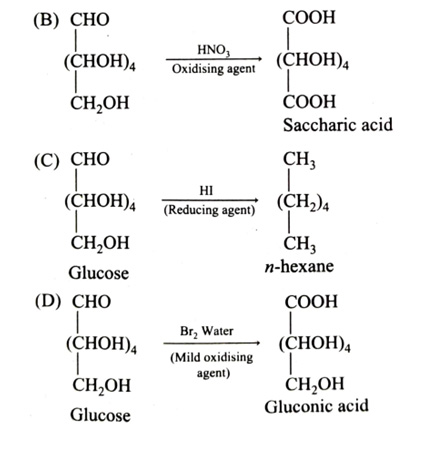
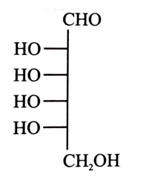
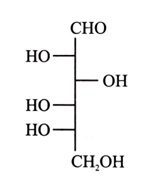
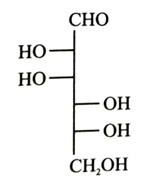
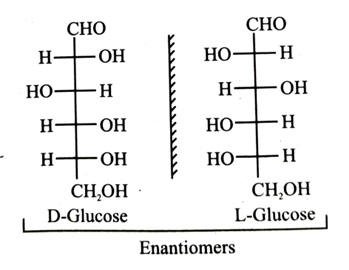
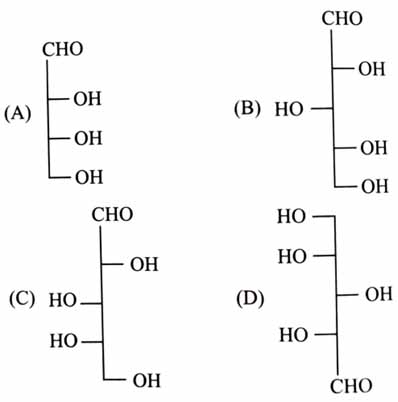
Which of the following is the correct structure of L-Glucose?                       [2024]

  •  

  •  

  •  

  •  

(2)


Q 6 :

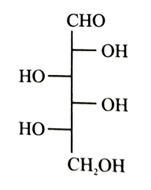
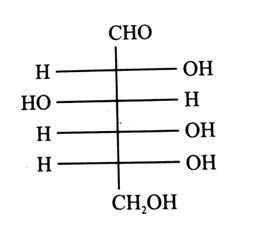
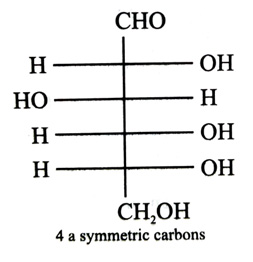
The incorrect statement regarding the given structure is:                          [2024]

  • has 4-asymmetric carbon atom


  • will coexist in equilibrium with 2 other cyclic structures


  • can be oxidized to a dicarboxylic acid with Br2 water


  • despite the presence of –CHO does not give Schiff’s test


(3)

1.    

2.    Two cyclic forms of glucose exist in equilibrium with its open chain structure.

3.    Bromine water is a mild oxidizing agent, it oxidizes easily oxidisable aldehyde group to carboxylic acid, but cannot oxidize alcoholic group.

4.    Despite having the presence of –CHO group, glucose does not give Schiff’s test because under the reaction conditions, it exists as cyclic form and free –CHO group is thus not available.


Q 7 :

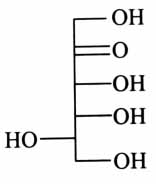
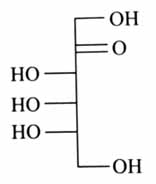
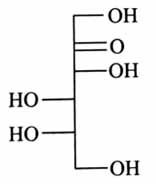
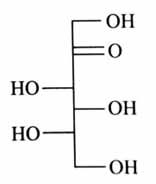
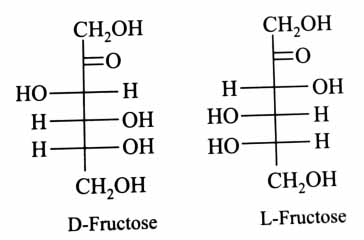
Which of the following is the correct structure of L-fructose?           [2025]

  •  

  •  

  •  

  •  

(3)

L-fructose is enantiomer of D-fructose.


Q 8 :

Given below are two statements :                            [2025]

Statement I : Wet cotton clothes made of cellulose-based carbohydrate takes comparatively longer time to get dried than wet nylon polymer-based clothes.

Statement II : Intermolecular hydrogen bonding with water molecule is more in nylon-based clothes than in the case of cotton clothes.

In the light of above statements, choose the Correct answer from the options given below

  • Statement I is false but Statement II is true.


  • Statement I is true but Statement II is false.


  • Both Statement I and Statement II are true.


  • Both Statement I and Statement II are false.


(2)

Cellulose has more number of OH bonds, hence more hydrogen bonding with water and takes more time to dry.


Q 9 :

Given below are two statements :                                   [2025]

Statement I : D-(+)-glucose + D-(+)-fructose -H2O sucrose

sucrose Hydrolysis D-(+)-glucose + D-(+)-fructose

Statement II : Invert sugar is formed during sucrose hydrolysis.

In the light of the above statements, choose the correct answer from the options given below –

  • Both Statement I and Statement II are true.


  • Statement I is false but Statement II are true.


  • Statement I is true but Statement II is false.


  • Both Statement I and Statement II are false.


(2)

Hydrolysis of sucrose gives D(+)-glucose and D(–)-fructose (not D(+)-fructose as given in statement I).


Q 10 :

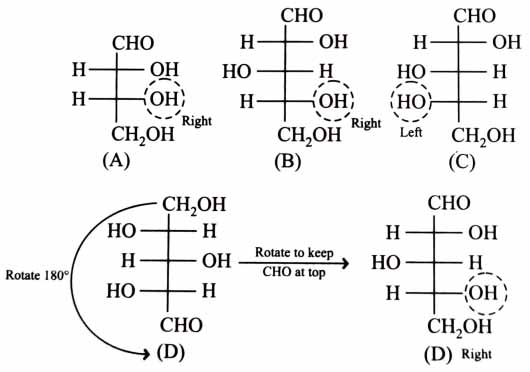
Identify the number of structure/s from the following which can be correlated to D-glyceraldehyde.          [2025]

  • one


  • two


  • four


  • three


(4)

In Fischer structure keep the most oxidized carbon (i.e. CHO in given question) at top and all the carbons on vertical line. Now if OH of last chiral carbon is to the right, the compound is said to have ‘D’ configuration. Compounds A, B and D have ‘D’ configuration.


Q 11 :

Given below are two statements:                        [2025]

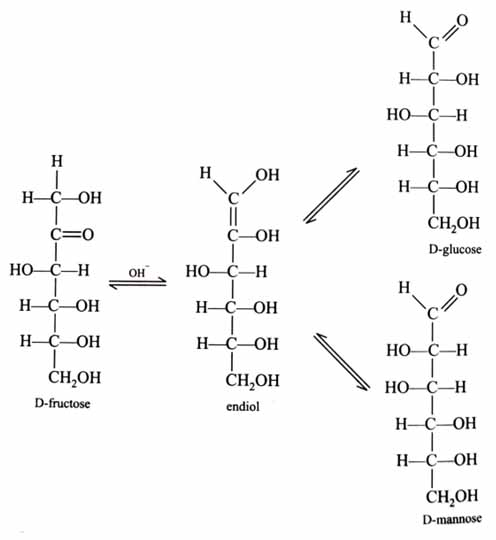
Statement I: Fructose does not contain an aldehydic group but still reduces Tollen’s reagent.

Statement II: In the presence of base, fructose undergoes rearrangement to give glucose.

In the light of the above statements, choose the correct answer from the options given below:

  • Statement I is false but Statement II is true


  • Both Statement I and Statement II are true


  • Both Statement I and Statement II are false


  • Statement I is true but Statement II is false


(2)


Q 12 :

Given below are two statements:                                    [2025]

Statement I: D-glucose pentacetate reacts with 2,4-dinitrophenylhydrazine.

Statement II: Starch, on heating with concentrated sulfuric acid at 100°C and 2–3 atmosphere pressure produces glucose.

In the light of the above statements, choose the correct answer from the options given below:

  • Both Statement I and Statement II are false


  • Both Statement I and Statement II are true


  • Statement I is true but Statement II is false


  • Statement I is false but Statement II is true


(4)

The pentaacetate of glucose does not react with 2,4-dinitrophenylhydrazine indicating the absence of free —CHO group.

Starch is a polymer of α-D-glucose, hence upon hydrolysis of starch, glucose is produced.


Q 13 :

Match List I with List II                             [2025]

  List I   List II
  (Saccharides)   (Glycosidic-linkages found)
(A) Sucrose (I) α 1 – 4
(B) Maltose (II) α 1 – 4 and α 1 – 6
(C) Lactose (III) α 1 – β 2
(D) Amylopectin (IV) β 1 – 4


Choose the correct answer from the options given below:

  • (A)-(II), (B)-(IV), (C)-(III), (D)-(I)


  • (A)-(I), (B)-(II), (C)-(III), (D)-(IV)


  • (A)-(IV), (B)-(II), (C)-(I), (D)-(III)


  • (A)-(III), (B)-(I), (C)-(IV), (D)-(II)


(4)

Sucrose: Its structure consists of a glycosidic linkage between C1 of α-D-glucose and C2 of β-D-fructose.

Maltose: It is composed of two α-D-glucose units in which C1 of one glucose (I) is linked to C4 of another glucose unit (II).

Lactose: It is composed of β-D-galactose and β-D-glucose. The linkage is between C1 of galactose and C4 of glucose.

Amylopectin: It is a branched chain polymer of α-D-glucose units in which chain is formed by C1C4 glycosidic linkage whereas branching occurs by C1C6 glycosidic linkage.


Q 14 :

Identify correct conversion during acidic hydrolysis from the following:

(A) Starch gives galactose.
(B) Cane sugar gives equal amount of glucose and fructose.
(C) Milk sugar gives glucose and galactose.
(D) Amylopectin gives glucose and fructose.
(E) Amylose gives only glucose.

Choose the correct answer from the options given below:                  [2025]

  • (B), (C) and (E) only


  • (A), (B) and (C) only


  • (C), (D) and (E) only


  • (B), (C) and (D) only


(1)

(A)(D)(E) Starch – Starch is the main storage polysaccharide of plants. Amylose and Amylopectin are two components of starch. Amylose is a long unbranched chain with 200–1000 α-D-(+)-glucose units held together by C1C4 glycosidic linkage. Amylopectin is a branched chain polymer of α-D-glucose units in which chain is formed by C1C4 glycosidic linkage whereas branching occurs by C1C6 glycosidic linkage. Hence hydrolysis of starch/amylose/amylopectin gives α-D-(+)-glucose.

(B) Sucrose (cane sugar) consists of a glycosidic linkage between C1 of α-D-glucose and C2 of β-D-fructose. Hence on hydrolysis it gives equal amount of glucose and fructose.

(C) Lactose (milk sugar): It is composed of β-D-galactose and β-D-glucose. The linkage is between C1 of galactose and C4 of glucose. Hence on hydrolysis it gives galactose and glucose.


Q 15 :

Match List I with List II                             [2025]

  List I   List II
  (Carbohydrate)   (Linkage Source)
(A) Amylose (I) βC1C4, plant
(B) Cellulose (II) αC1C4, animal
(C) Glycogen (III) αC1C4. αC1C6, plant
(D) Amylopectin (IV) αC1C4, plant


Choose the correct answer from the options given below:

  • (A)-(II), (B)-(III), (C)-(I), (D)-(IV)


  • (A)-(IV), (B)-(I), (C)-(III), (D)-(II)


  • (A)-(III), (B)-(II), (C)-(I), (D)-(IV)


  • (A)-(IV), (B)-(I), (C)-(II), (D)-(III)


(4)

(A) (D) Starch is the main storage polysaccharide of plants. Amylose and Amylopectin are two components of starch. Amylose is a long unbranched chain with 200–1000 α-D-(+)-glucose units held together by C1C4 glycosidic linkage. Amylopectin is insoluble in water and constitutes about 80–85% of starch. It is a branched chain polymer of α-D-glucose units in which chain is formed by C1C4 glycosidic linkage whereas branching occurs by C1C6 glycosidic linkage.

(B) Cellulose is a predominant constituent of the cell wall of plant cells. Cellulose is a straight chain polysaccharide composed only of β-D-glucose units which are joined by glycosidic linkage between C1 of one glucose unit and C4 of the next glucose unit.

(C) The carbohydrates are stored in the animal body as glycogen. It is also known as animal starch because its structure is similar to amylopectin and is rather more highly branched.


Q 16 :

Match items of Row I with those of Row II.                  

Row I :

Row II:
(i) α-D-(–)-Fructofuranose
(ii) β-D-(–)-Fructofuranose
(iii) α-D-(–)-Glucopyranose
(iv) β-D-(–)-Glucopyranose

Correct match is                                       [2023]

  • A → iii, B → iv, C → ii, D → i


  • A → iv, B → iii, C → i, D → ii


  • A → iii, B → iv, C → i, D → ii


  • A → i, B → ii, C → iii, D → iv


(3)


Q 17 :

The correct representation in six-membered pyranose form for the following sugar [X] is           [2023]

  •  

  •  

  •  

  •  

(1)

Pyranose form has a 6 membered cycle, similar to pyran 


Q 18 :

L-isomer of tetrose X (C4H8O4) gives positive Schiff’s test and has two chiral carbons. On acetylation, 'X' yields triacetate. ‘X’ also undergoes the following reactions.

'A'HNO3'X'NaBH4'B'chiral compound

‘X’ is _______                                                       [2023]

  •  

  •  

  •  

  •  

(4)


Q 19 :

D-(+)-Glyceraldehydeii)H2O/H+iii)HNO3i) HCN

The products formed in the above reaction are        [2023]

  • One optically active and one meso product


  • One optically inactive and one meso product


  • Two optically active products


  • Two optically inactive products


(1)


Q 20 :


‘A’ formed in the above reaction is               [2023]

  •  

  •  

  •  

  •  

(1)


Q 21 :

Given below are two statements:                                                 [2026]

Statement I: Sucrose is dextrorotatory. However, sucrose upon hydrolysis gives a solution having a mixture of products. This solution shows laevorotation.

Statement II: Hydrolysis of sucrose gives glucose and fructose. Since the laevorotation of glucose is more than the dextrorotation of fructose, the resulting solution becomes laevorotatory.

In the light of the above statements, choose the correct answer from the options given below.

  • Statement I is false but Statement II is true


  • Both Statement I and Statement II are false


  • Both Statement I and Statement II are true


  • Statement I is true but Statement II is false


(4)

C12H22O11+H2OHClC6H12O6+C6H12O6

                                    D-Glucose + D-Fructose

[α]D-sucrose=+66.5°,  [α]D-glucose=+52.5°,  [α]D-fructose=-92.4°

Sucrose is dextrorotatory and the hydrolysed product is laevorotatory.


Q 22 :

Structures of four disaccharides are given below. Among the given disaccharides, the non-reducing sugar is:   [2026]

  •  

  •  

  •  

  •  

(2)

Structure (1) given is of sucrose which is non reducing.

For non reducing sugar compound should have acetal linkage not hemi acetal linkage.


Q 23 :

Match List – I with List – II

List – I

Reaction of Glucose with

List – II

Product formed

A

Hydroxylamine

I

Gluconic acid

B

Br2 water

II

Glucose pentaacetate

C

Excess acetic anhydride

III

Saccharic acid

D

Concentrated HNO3

IV

Glucoxime

Choose the correct answer from the options given below :          [2026]

  • A-IV, B-III, C-II, D-I


  • A-III, B-I, C-IV, D-II


  • A-I, B-III, C-IV, D-II


  • A-IV, B-I, C-II, D-III


(4)