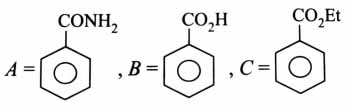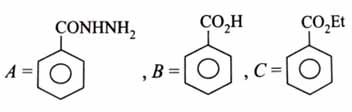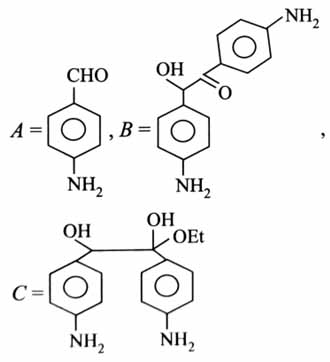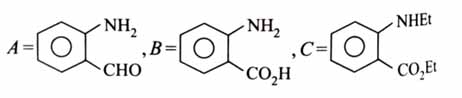


Q 1 :

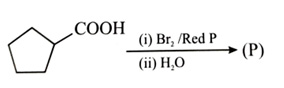
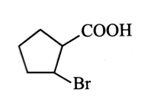
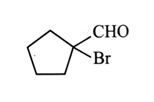
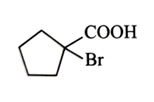
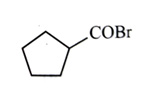
Identify the product (P) in the following reaction:                       [2024]

  •  

  •  

  •  

  •  

(3)

This is Hell-Volhard-Zelinsky reaction


Q 2 :

Which of the following compounds is least likely to give effervescence of CO2 in presence of aq. NaHCO3?           [2025]

  •  

  •  

  • Ph-N(+)H3Cl(-)


  •  

(4)

(4) is less acidic than H2CO3, hence does not give effervescence of CO2 with aq. NaHCO3.


Q 3 :

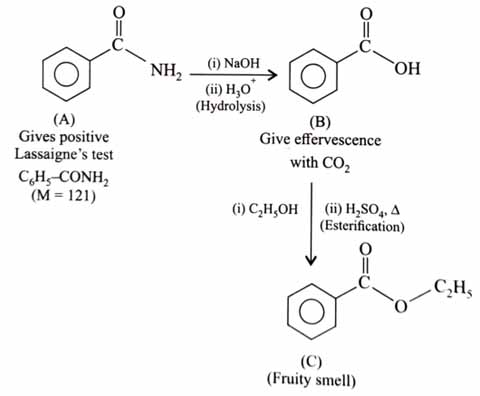
A(ii) H3O+(i) NaOHB(ii) H2SO4,Δ(i) EtOHC

‘A’ shows positive Lassaigne’s test for N and its molar mass is 121.

‘B’ gives effervescence with aq. NaHCO3.

‘C’ gives fruity smell.

Identify A, B, and C from the following.           [2025]

  •  

  •  

  •  

  •  

(1)


Q 4 :

Which will undergo deprotonation most readily in basic medium?          [2023]

  • Both a and c


  • a only


  • b only


  • c only


(2)

Most stable anion is produced by 


Q 5 :

In a reaction,

reagents 'X' and 'Y' respectively are:              [2023]

  • CH3OH/H+,Δ and CH3OH/H+,Δ


  • (CH3CO)2O/H+ and CH3OH/H+,Δ


  • (CH3CO)2O/H+ and (CH3CO)2O/H+


  • CH3OH/H+,Δ and (CH3CO)2O/H+


(2)


Q 6 :

Given below are two statements: One is labelled as Assertion A and the other is labelled as Reason R.

Assertion A: α-halo carboxylic acid on reaction with dil. NH3 gives good yield of α-amino carboxylic acid whereas the yield of amines is very low when prepared from alkyl halides.

Reason R: Amino acids exist in zwitter ion form in aqueous medium.

In the light of the above statements, choose the correct answer from the options given below:                          [2023]

  • Both (A) and (R) are correct and (R) is the correct explanation of (A)


  • (A) is not correct but (R) is correct


  • Both (A) and (R) are correct but (R) is not the correct explanation of (A)


  • (A) is correct but (R) is not correct


(1)

α-halocarboxylic acid react with dil. NH3 at faster rate than amines and amino acids exist in zwitter ion form in aqueous medium.


Q 7 :

The major product formed in the following reaction is                        [2023]

  •  

  •  

  •  

  •  

(3)

LiBH4/EtOH is selective reducing agent which reduces esters against carboxylic acids into alcohol. Reaction is chemoselective.


Q 8 :

Major product ‘P’ formed in the following reaction is:                    [2023]

  •  

  •  

  •  

  •  

(4)


Q 9 :

The descending order of acidity for the following carboxylic acid is:

A. CH3COOH
B. F3CCOOH
C. ClCH2COOH
D. FCH2COOH
E. BrCH2COOH

Choose the correct answer from the options given below:             [2023]

  • E > D > B > A > C


  • B > D > C > E > A


  • D > B > A > E > C


  • B > C > D > E > A


(2)

–I effect decreases as F > Cl > Br. Greater the extent of –I effect, greater the acidity.


Q 10 :

The major product 'P' formed in the following sequence of reaction is

                               [2023]

  •  

  •  

  •   


  •      


(3)


Q 11 :

Number of compounds from the following which will not dissolve in cold NaHCO3 and NaOH solutions but will dissolve in hot NaOH solutions is ________.         [2023]


(3)

Will not dissolve in cold NaHCO3 and NaOH solution show that this is not carboxylic acid and phenol group. But will dissolve in hot NaOH solution means that an ester functional group.


Q 12 :

A trisubstituted compound 'A', C10H12O2, gives neutral FeCl3 test positive. Treatment of compound 'A' with NaOH and CH3Br gives C11H14O2, with hydroiodic acid gives methyl iodide and with hot concentrated NaOH gives a compound B, C10H12O2. Compound 'A' also decolourises alkaline KMnO4. The number of π bond(s) present in the compound 'A' is _____________ .              [2023]


(4)

C10H12O2, DU=5 (1-phenyl ring present with unsaturation in side alkyl chain)

Given information: Neutral FeCl3 test positive Phenol present

Compound 'A' also decolourises alkaline KMnO4Unsaturation in side alkyl chain

Number of π-bonds present in compound 'A'=4


Q 13 :

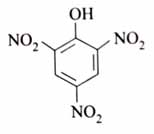
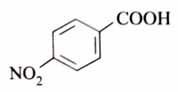
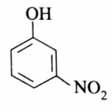
The correct order of acidity for the following compounds is

  • I > II > III > IV


  • III > I > II > IV


  • III > IV > II > I


  • I > III > IV > II


(1)

   Acidity order is I>II>III>IV