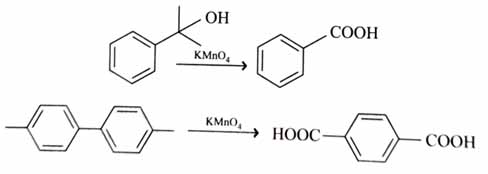


Q 1 :

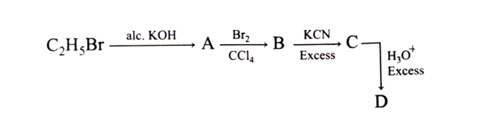
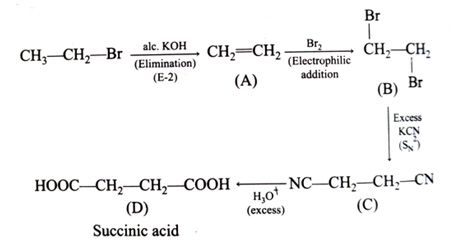
Acid D formed in above reaction is:                                   [2024]

  • Malonic acid


  • Oxalic acid


  • Succinic acid


  • Gluconic acid


(3)


Q 2 :

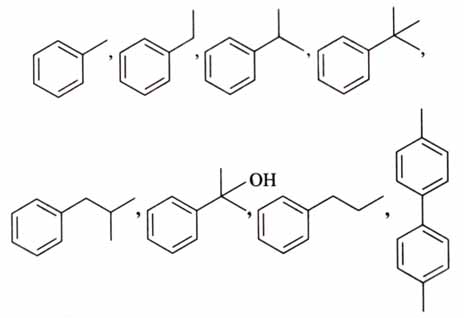
The total number of compounds from below when treated with hot KMnO4 giving benzoic acid is:           [2025]

  • 3


  • 5


  • 4


  • 6


(2)

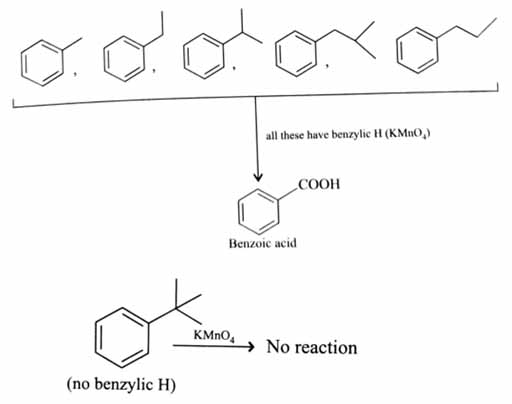
According to NTA following five compounds give benzoic acid upon oxidation with KMnO4, because presence of a benzylic hydrogen is necessary for oxidation of side chain to –COOH.

But if there is oxygen or multiple bond at benzylic position, then also oxidation occurs.


Q 3 :

The major product ‘P’ formed in the given reaction is

                                             [2023]

  •  

  •  

  •  

  •  

(4)

Benzylic carbon gets oxidised into carboxylic acid in presence of KMnO4 and heat.


Q 4 :

Grignard reagent RMgBr (P) reacts with water and forms a gas (Q). One gram of Q occupies 1.4 dm3 at STP. (P) on reaction with dry ice in dry ether followed by H3O+ forms a compound (Z). 0.1 mole of (Z) will weigh ______ g. (Nearest integer)                [2026]


(6)

1.4 dm3 (or 1.4 mL) occupied by 1 g

∴  Molecular weight of Q=22.41.4=16

∴  Q is CH4 gas and Grignard reagent is CH3MgBr

       CH3MgBr→(ii) H3O+(i) CO2 (dry ice)CH3COOH

                                                      (Molecular weight 60)

∴  Weight of 0.1 mole of CH3COOH=6


Q 5 :

Incorrect statement is

  • In carboxylic acids, the bonds to the carboxyl carbon lie in one plane and are separated by about 120°.


  • The carboxylic carbon is less electrophilic than carbonyl carbon because of the resonance in carboxylic acid.


  • Aliphatic carboxylic acids upto nine carbon atoms are colorless liquids at room temperature with pleasant odours.


  • Most carboxylic acids exist as dimer in the vapour phase.


(3)

Aliphatic carboxylic acids upto nine carbon atoms are colorless liquids at room temperature with unpleasant odours.


Q 6 :

Assertion: p-hydroxybenzoic acid has a lower boiling point than o-hydroxybenzoic acid.

Reason: o-hydroxybenzoic acid has intramolecular hydrogen bonding.

  • A is correct but R is not correct


  • Both A and R are correct but R is not the correct explanation of A


  • A is not correct but R is correct


  • Both A and R are correct and R is the correct explanation of A


(3)

Conceptual