

Which of the following phenomena is not explained by wave nature of light?
(A) reflection
(B) diffraction
(C) photoelectric effect
(D) interference
(E) polarization
Choose the most appropriate answer from the options given below: [2024]
E only
A, C only
B, D only
C only
(4)
Photoelectric effect cannot be explained by wave nature of light. Reflection, diffraction, interference, and polarization are shown by wave nature of light.
Two coherent monochromatic light beams of intensities I and 4I are superimposed. The difference between maximum and minimum possible intensities in the resulting beam is xl. The value of x is ______. [2024]
(8)
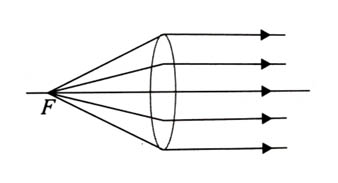
Light emerges out of a convex lens when a source of light is kept at its focus. The shape of wavefront of the light is [2024]
both spherical and cylindrical
plane
cylindrical
spherical
(2)

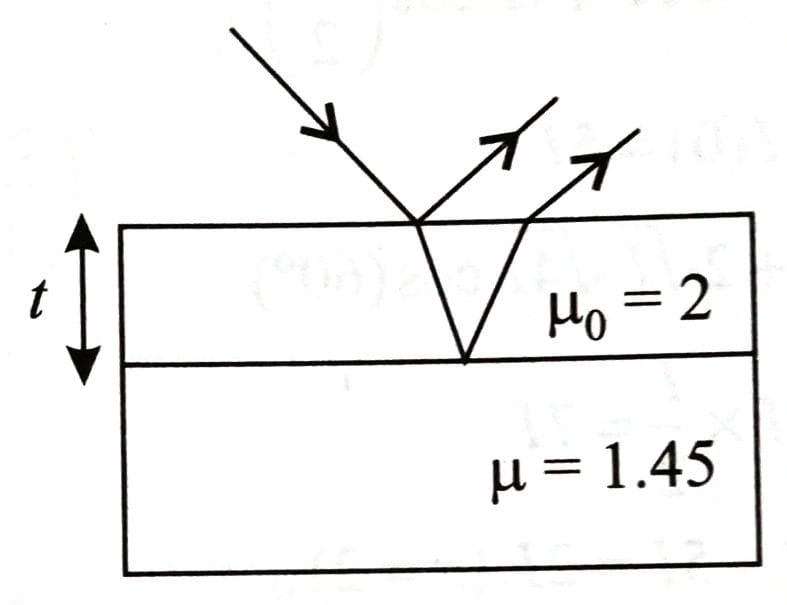
A transparent film of refractive index, 2.0 is coated on a glass slab of refractive index, 1.45. What is the minimum thickness of transparent film to be coated for the maximum transmission of Green light of wavelength 550 nm. [Assume that the light is incident nearly perpendicular to the glass surface.] [2025]
94.8 nm
68.7 nm
137.5 nm
275 nm
(3)
For maximum transmission, reflection is zero.
For green light there should be minima for interference of two reflected lights.

For transmitted green light to be maxima, reflected green should be minima.
Which of the following phenomena can not be explained by wave theory of light? [2025]
Reflection of light
Diffraction of light
Refraction of light
Compton effect
(4)
Compton effect refers to scattering of a photon by free electrons.
This phenomenon provides an evidence for particle nature of light.
Width of one of the two slits in a Young's double slit interference experiment is half of the other slit. The ratio of the maximum to the minimum intensity in the interference pattern is: [2025]
9 : 1
3 : 1
(2)
Two monochromatic light beams have intensities in the ratio 1 : 9. An interference pattern is obtained by these beams. The ratio of the intensities of maximum to minimum is [2025]
8 : 1
9 : 1
3 : 1
4 : 1
(4)
A monochromatic light of frequency Hz travelling through air, is incident on a medium of refractive index '2'. Wavelength of the refracted light will be: [2025]
300 nm
600 nm
400 nm
500 nm
(1)
Wave speed,
As = 2 therefore; speed
Given below are two statements: one is labelled as Assertion (A) and the other is labelled as Reason (R)
Assertion (A) : Refractive index of glass is higher than that of air.
Reason (R) : Optical density of a medium is directly proportionate to its mass density which results in a proportionate refractive index.
In the light of the above statements, choose the most appropriate answer from the options given below: [2025]
(A) is not correct but (R) is correct
Both (A) and (R) are correct and (R) is the correct explanation of (A)
(A) is correct but (R) is not correct
Both (A) and (R) are correct but (R) is not the correct explanation of (A)
(3)
Speed of light
for air v c, for glass v < c so
Refractive index has no relation with mass density because both have different meaning. Hence reason is incorrect.
It means (A) is correct but (R) is not correct.
A thin transparent film with refractive index 1.4, is held on circular ring of radius 1.8 cm. The fluid in the film evaporates such that transmission through the film at wavelength 560 nm goes to a minimum every 12 seconds. Assuming that the film is flat on its two sides, the rate of evaporation is _________ . [2025]
(54)
Maxima condition,
Minima condition,
Rate of evaporation
Two coherent monochromatic light beams of intensities 4 and 9 are superimposed. The difference between the maximum and minimum intensities in the resulting interference pattern is x. The value of x is ________. [2025]
(24)
Which of the following are true? [2023]
A. Speed of light in vacuum is dependent on the direction of propagation.
B. Speed of light in a medium is independent of the wavelength of light.
C. The speed of light is independent of the motion of the source.
D. The speed of light in a medium is independent of intensity.
Choose the correct answer from the option given below:
A and C only
B and D only
B and C only
C and D only
(4)
Speed of light does not depend on the motion of source as well as intensity.
Given below are two statements: one is labelled as Assertion A and the other is labelled as Reason R [2023]
Assertion A: The phase difference of two light waves change if they travel through different media having same thickness, but different indices of refraction.
Reason R: The wavelengths of waves are different in different media.
In the light of the above statements, choose the most appropriate answer from the options given below:
Both A and R are correct but R is NOT the correct explanation of A
A is correct but R is not correct
Both A and R are correct and R is the correct explanation of A
A is not correct but R is correct
(3)
As medium changes, optical path changes.
Also,
Hence phase difference changes.
The ratio of intensities at two points P and Q on the screen in a Young’s double slit experiment where phase difference between two wave of same amplitude are and , respectively are [2023]
1 : 3
3 : 1
3 : 2
2 : 3
(3)
In a Young’s double slits experiment, the ratio of amplitude of light coming from slits is 2 : 1. The ratio of the maximum to minimum intensity in the interference pattern is [2023]
9 : 4
9 : 1
2 : 1
25 : 9
(2)
A point source is kept at the center of a spherically enclosed detector. If the volume of the detector increases by 8 times, the intensity will [2026]
decrease by 8 times
increase by 8 times
decrease by 4 times
increase by 64 times
(3)
Given below are two statements:
Statement I: A plane wave after passing through a prism remains a plane wave but passing through a small pin hole may become a spherical wave.
Statement II: The curvature of a spherical wave emerging from a slit will increase for increasing slit width.
In the light of the above statements, choose the correct answer from the options given below: [2026]
Statement I is true but Statement II is false
Both Statement I and Statement II are false
Statement I is false but Statement II is true
Both Statement I and Statement II are true
(1)
Increasing the slit width ‘a’ decreases the diffraction angle and reduces the spreading of the wave. A narrower slit produces a more pronounced spherical wave (high curvature) while a wider slit leads to a flatter, less curved wave.