

Q 1 :

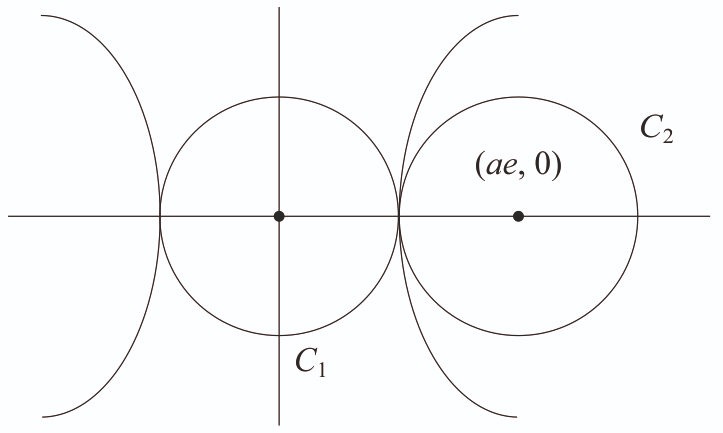
Consider a hyperbola H having centre at the origin and foci on the x-axis. Let C1 be the circle touching the hyperbola H and having the centre at the origin. Let C2 be the circle touching the hyperbola H at its vertex and having the centre at one of its foci. If areas (in sq. units) of C1 and C2 are 36π and 4π, respectively, then the length (in units) of latus rectum of H is          [2024]

  • 283


  • 143


  • 103


  • 113


(1)

         C1:x2+y2=a2

⇒ Area=πa2=36π ⇒ a=6

         C2:(x–ae)2+y2=(ae–a)2

⇒ Area=π(ae–a)2=4π ⇒ 36(e–1)2=4

⇒ e–1=13 ⇒ e=43 ⇒ b2=28

∴  Length of Latus Rectum = 2b2a=2×286=283 units.


Q 2 :

Let H:–x2a2+y2b2=1 be the hyperbola, whose eccentricity is 3 and the length of the latus rectum is 43. Suppose the point (α, 6), α > 0 lies on H. If β is the product of the focal distances of the point (α, 6), then α2+β is equal to          [2024]

  • 169


  • 171


  • 172


  • 170


(2)

H : y2b2 – x2a2 = 1 and e=3

Now, e=1+a2b2=3

⇒  a2b2=2 ⇒ a2=2b2

Length of latus rectum =2a2b=4b2b=4b=43        [Given]

⇒ b=3 ⇒ a=6           [∵  a > 0]

Now, P(α, 6) lies on H : y23 – x26 = 1

⇒ 12–α26=1 ⇒ α2=66

Now, foci of hyperbola = (0, ±be) = (0, ±3)

Let d1 and d2 be focal distancee of (α, 6)

⇒ d1=α2+(6–3)2,   d2=α2+(6+3)2

⇒ d1=66+9,   d2=66+81

           d1=75,   d2=147

Now, β=d1d2=11025=105

Now, α2+β=66+105=171.


Q 3 :

Let the foci of a hypebola H coincide with the foci of the ellipse E:(x–1)2100+(y–1)275=1 and the eccentriticy of the hyperbola H be the reciprocal of the eccentricity of the ellipse E. If the length of the transverse axis of H is α and the length of its conjugate axis is β, then 3α2+2β2 is equal to          [2024]

  • 237


  • 225


  • 205


  • 242


(2)

Eccentricity of ellipse E i.e., eE=1–b2a2

=1–75100=25100=12

So, eccentricity of hyperbola = 2

Now, foci of ellipse = (1 ± ae, 1) = (1 ± 5, 1)

= (6, 1) and (–4, 1) = Foci of hyperbola

Now, distance between foci = 2aeH

⇒ 102+0=4a ⇒ a=52

Also,  eH2=1+b2a2

⇒ (2)2=1+4b225 ⇒ 754=b2 ⇒ b=752

Length of transverse axis of H = 2a = 2×52

⇒ α=5

Length of conjugate axis of H = 2b = 75

⇒ β=75

Now, 3α2+2β2=75+150=225.


Q 4 :

For 0 < θ < π/2, if the eccentricity of the hyperbola x2–y2 cosec2 θ=5 is 7 times eccentricity of the ellipse x2cosec2θ+y2=5, then the value of θ is          [2024]

  • π/6


  • π/3


  • 5π/12


  • π/4


(2)

Given, x25–y25 sin2θ=1

a=5>b=5sinθ

e=1+b2a2=1+sin2θ          ... (i)

Also, x25 sin2θ+y25=1          (Given)

a=5sinθ<b=5

e=1–a2b2=1–sin2θ          ... (ii)

Given, eqn. (i) =  7 eqn. (ii)

1+sin2θ=71–sin2θ

Squaring on both sides.

1+sin2θ=7(1–sin2θ) ⇒ 1+sin2θ=7 –7sin2θ

⇒ 8 sin2θ=6

sin2θ=68=34 ⇒ sin θ=32

So, θ=π3.


Q 5 :

Let e1 be the eccentricity of the hyperbola x216–y29=1 and e2 be the eccentricity of the ellipse x2a2+y2b2=1, a > b, which passes through the foci of the hyperbola. If e1e2=1, then the length of the chord of the ellipse parallel to the x-axis and passing through (0, 2) is          [2024]

  • 45


  • 1053


  • 853


  • 35


(2)

Given hyperbola is x216–y29=1

e1 = eccentricity of hyperbola = 16+94=54

Foci of hyperbola = (±5, 0)

Given e1e2=1

⇒ e2=45 = eccentricity of ellipse x2a2+y2b2=1

⇒a2–b2a=45          ... (i)

∴  The ellipse also passes through the foci of the hyperbola.

⇒ a2=25

From (i), b2=9

Thus, the equation of ellipse is x225+y29=1          ... (ii)

Now, equation of chord of ellipse which passes through (0, 2) and parallel to x-axis is y = 2.

From (ii),

x225=59 ⇒ x2=25×59 ⇒ x=±553

Thus, the end point of chord are (–553,2)  and  (553,2).

∴  Length of chord = (553+553)2+(2–2)2=1053.


Q 6 :

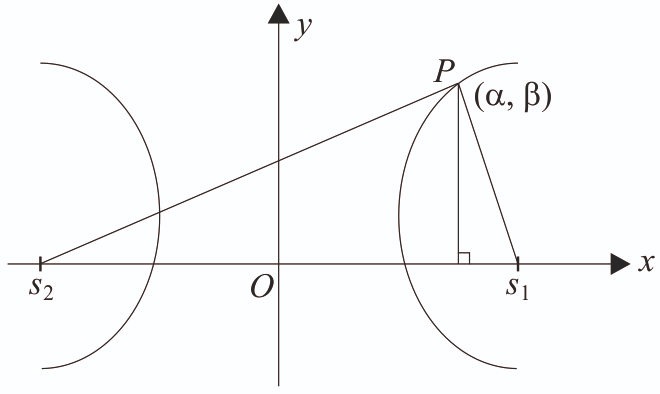
Let P be a point on the hyperbola H:x29–y24=1 in the first quadrant such that the area of triangle formed by P and the two foci of H is 213. Then, the square of the distance of P from the origin is          [2024]

  • 20


  • 18


  • 26


  • 22


(4)

We have, x29–y24=1

Here, a2=9, b2=4

b2=a2(e2–1) ⇒ e2=1+b2a2 ⇒ e2=1+49=139

⇒ e=133 ⇒ s1s2=2ae=2×3×133=213

Area of △PS1S2=12×β×s1s2=213

⇒ 12×β×(213)=213 ⇒ β=2

α29–β24=1 ⇒ α29=2 ⇒α2=18 ⇒ α=32

Distance of P from origin = α2+β2=18+4=22.


Q 7 :

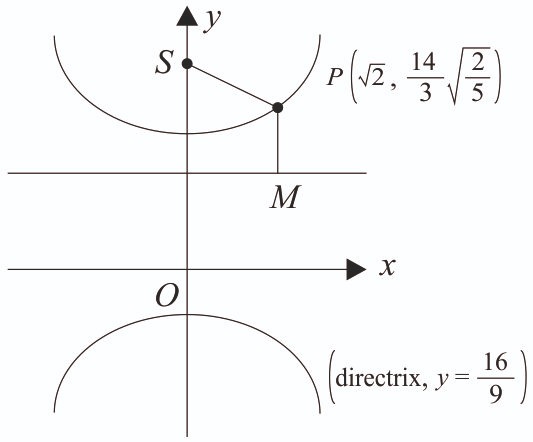
If the foci of a hyperbola are same as that of the ellipse x29+y225=1 and the eccentricity of the hyperbola is 158 times the eccentricity of the ellipse, then the smaller focal distance of the point (2,14325) on the hyperbola, is equal to          [2024]

  • 725–83


  • 1425–165


  • 1425–43


  • 725+83


(1)

We have, E : x29+y225=1

            a=5, b = 3

foci : (0, ±5e)

Since, for an ellipes, b2=a2(1–e2) ⇒ 9=25(1–e2)

e2=1–925=1625 ⇒ e=45

Eccentricity of hyperbola = e'=158×45=32

Focus of hyperbola = (0, ±5e) = (0, ±4)

⇒ a·e'=4 ⇒ a=4×23=83

Since, e'2=1+b2a2 ⇒ 94=1+b21×964 ⇒ b2=809

∴   The equation of hyperbola 9y264–9x280=1

PS = e'pM

        =32×(14325–169)

        =725–83.


Q 8 :

Let A be a square matrix of order 2 such that |A| = 2 and the sum of its diagonal elements is –3. If the points (x, y) satisfying A2 + xA + yI = O lie on a hyperbola, whose transverse axis is parallel to the x-axis, eccentricity is e and the length of the latus rectum is l, then e4+l4 is equal to ___________.          [2024]


(*)

The given data is inadequate.


Q 9 :

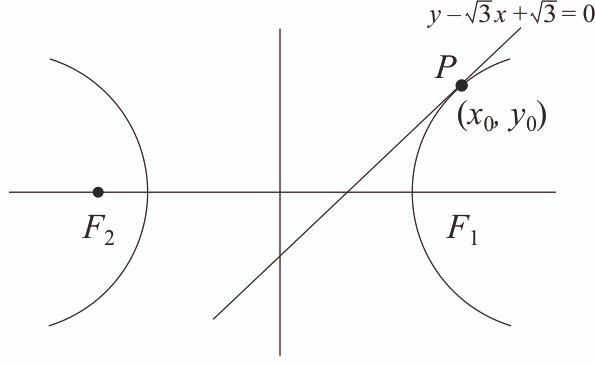
The length of the latus rectum and directrices of a hyperbola with eccentricity e are 9 and x=±43, respectively. Let the line y–3x+3=0 touch this hyperbola at (x0, y0). If m is the product of the focal distances of the point (x0, y0), then 4e2+m is equal to __________.          [2024]


(*)

Equation of tangent to hyperbola is given by y=mx±a2m2–b2

⇒ m=3

and  a2m2–b2=3

⇒ 3a2–b2=3          ... (i)

Now, length of latus rectum of hyperbola = 9

⇒ 2b2a=9

⇒ b2=9a2          ... (ii)

From equation (i) and (ii), we get

3a2–9a2=3

⇒ 6a2–9a–6=0 ⇒ 2a2–3a–2=0

⇒ 2a2–4a+a–2=0 ⇒ (2a+1)(a–2)=0

⇒ a=2, –12 (ignore) ⇒ a=2  and  b=3

Equation of hyperbola is x24–y29=1

Solving for tangent y=3x–3, we get

x24–3x2+3–6x9=1

⇒ 9x2–12x2–12+24x=36

⇒ 3x2–24x+48=0

⇒ x2–8x+16=0 ⇒ (x–4)2=0

⇒ x=4  and  y=33, e=1+94=132

So, (x0,y0)≡(4,33) is the point of contact.

Focus of hyperbola is (±13, 0)

∴  PF1·PF2

    =((4–13)2+(33)2)((4+13)2+(33)2)

    =2304=48=m

∴  4e2+m=4×13/4+48=61

Note: Here equation of directrix should be x=±413, but in given question it is given x=±43 which is wrong because eccentricity should be greater than 1, So, this question is bonus.


Q 10 :

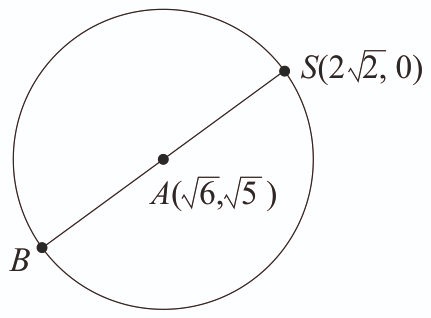
Let S be the focus of the hyperbola x23–y25=1, on the positive x-axis. Let C be the circle with its centre at A(6,5) and passing through the point S. If O is the origin and SAB is a diameter of C, then the square of the area of the triangle OSB is equal to __________.          [2024]


(40)

x33–y25=1 ⇒a= 3, b=5

∴  e=1+53 ⇒ e=83

∴  ae=8=22      ∴  S=(22, 0)

A is mid-point of BS ⇒ B(26–22,25)

Area of △(OSB), A=|12|001220126–22251||=210

⇒ A2=40.


Q 11 :

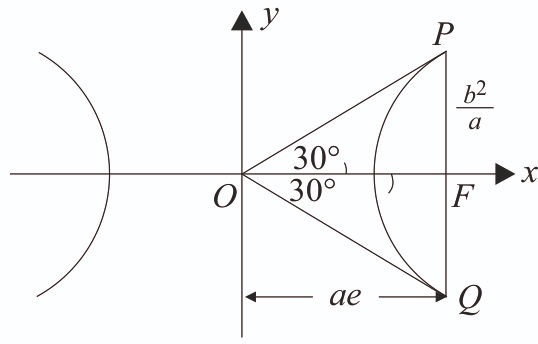
Let the latus rectum of the hyperbola x29–y2b2=1 subtend an angle of π3 at the centre of the hyperbola. If b2 is equal to lm(1+n), where l and m are co-prime numbers, then l2+m2+n2 is equal to __________.          [2024]


(182)

In right triangle OFP, we have tan 30°=PFOF

⇒ 13=b2a2e ⇒ e=3b2a2

e=3b29          (Given a2=9)

Squaring both sides, we get

e2=3b481          ... (i)

and  e2=1+b2a2 ⇒ e2=1+b29          ... (ii)

Comparing equation (i) and (ii), we get

3b481=1+b29 ⇒ b4=27+3b2

⇒ b4–3b2–27=0 ⇒ b2=32(1+13)

According to given condition, b2=lm(1+n)

On comparing, we get l = 3, m = 2 and n = 13

⇒ l2+m2+n2=(3)2+(2)2+(13)2=9+4+160=182.


Q 12 :

Let the foci and length of the latus rectum of an ellipse x2a2+y2b2=1, a > b be (±5, 0) and 50, respectively. Then, the square of the eccentricity of the hyperbola x2b2–y2a2b2=1 equals          [2024]


(51)

Here ae = 5 and 2b2a=50

     b2a=522

     a2e2=a2–b2 ⇒ e2=1–b2a2

     25=a2–522a ⇒ 2a2–52a–50=0

⇒ [a–52][2a+52]=0 ⇒ a=52  or  a=–522

⇒ e=5a=12

Also, b2=52×522=25 ⇒ b=5

Now, e=1+a2b2b2=1+a2 ⇒ e2=1+a2=51.


Q 13 :

Let one focus of the hyperbola H : x2a2–y2b2=1 be at (10,0) and the corresponding directrix be x=910. If e and l respectively are the eccentricity and the length of the latus rectum of H, then 9(e2+l) is equal to :          [2025]

  • 16


  • 15


  • 12


  • 14


(1)

We have, ae=10 and ae=910

⇒ a2=9 and e=103

Now, (ae)2=a2+b2 ⇒ 10=9+b2 ⇒b2=1

and l=2b2a=2(1)3=23

∴  9(e2+l)=9(109+23)=10+6=16


Q 14 :

Let the sum of the focal distances of the point P(4, 3) on the hyperbola H:x2a2–y2b2=1 be 853. If for H, the length of the latus rectum is l and the product of the focal distances of the point P is m, then 9l2+6m is equal to :          [2025]

  • 187


  • 184


  • 185


  • 186


(3)

Given, hyperbola (H) : x2a2–y2b2=1

Sum of focal distance of P(4, 3) = 853

⇒ 2ex=853 ⇒ 2e(4)=853 ⇒ e2=53

∵ b2=a2(53–1) ⇒ b2=23a2          ... (i)

⇒ 16a2–9b2=1          ... (ii)

Using (i) and (ii), we get

⇒ a2=52, b2=53

Now, length of latus rectum, l=2b2a ⇒ l2=4b4a2

⇒ l2=4×(5/3)25/2 ⇒ 9l2=40

Also, m=(ex+a)(ex–a)=(ex)2–(a)2

=53(16)–52=1456

⇒ 6m=145

∴  9l2+6m=40+145=185.


Q 15 :

Let e1 and e2 be the eccentricities of the ellipse x2b2+y225=1 and the hyperbola x216–y2b2=1, respectively. If b < 5 and e1e2=1, then the eccentricity of the ellipse having its axes along the coordinate axes and passing through all four foci (two of the ellipse and two of the hyperbola) is :          [2025]

  • 32


  • 45


  • 35


  • 74


(3)

We have, e12=1–b225 and e22=1+b216

∵  e1e2=1     (Given)

∴  e12e22=1

⇒ (1–b225)(1+b216)=1

⇒ 1+b216–b225–b4400=1

⇒ 9b2400=b4400

⇒ b2=9

We get, x29+y225=1 and x216–y29=1

Here, e1=1–925=45 and e2=1+916=54

Foci : (0,±4) and (±5,0)

The ellipse passing through all four foci is x225+y216=1

Now, the eccentricity is given by e=1–1625=35.


Q 16 :

Let the foci of a hyperbola be (1, 14) and (1, –12). If it passes through the point (1, 6) then the length of its latus-rectum is :          [2025]

  • 256


  • 245


  • 1445


  • 2885


(4)

Distance between foci (1–1)2+(14+12)2

⇒ 2be=26 ⇒ be=13

Mid-point of foci =(1+12,14–122)=(1,1)

Equation of hyperbola is (x–1)2a2+(y–1)2b2=1

Hyperbola passes through (1, 6)

∴  (6–1)2b2=1 ⇒ b2=25

Now, a2=b2(e2–1)=b2e2–b2=169–25=144

∴  a2=144 and b2=25

∴   Length of latus rectum =2a2b=2×1445=2885


Q 17 :

Let E : x2a2+y2b2=1, a > b and H : x2A2–y2B2=1. Let the distane between the foci of E and the foci of H be 23. If a – A = 2, and the ratio of the eccentricities of E and H is 13, then the sum of the lengths of their latus rectums is equal to:          [2025]

  • 9


  • 7


  • 10


  • 8


(4)

We have, E : x2a2+y2b2=1, whose foci are (±ae, 0) and H : x2A2–y2B2=1, whose foci are (±Ae', 0).

Given, 2ae=23 and 2Ae'=23

⇒ ae=3 and Ae'=3

⇒ aeAe'=1 ⇒ ee'=Aa

⇒ 13=Aa ⇒a=3A          [Given ee'=13]

Now, a – A = 2 ⇒ 2A = 1          [a = 3A]

⇒ A=1, a=3

∴  e=13 and e'=3

Also, b2=a2(1–e2) and B2=A2((e')2–1)

⇒ b2=9(1–(13)2) and B2=(1)2((3)2–1)

⇒ b2=6 and B2=2

∴   Sum of latus rectum =2b2a+2B2A=8.


Q 18 :

If A and B are the points of intersection of the circle x2+y2–8x=0 and the hyperbola x29–y24=1 and a point P moves on the line 2x – 3y + 4 = 0, then the centroid of △PAB lies on the line :         [2025]

  • x + 9y = 36


  • 9x – 9y = 32


  • 4x – 9y = 12


  • 6x – 9y = 20


(4)

We have, x2+y2–8x=0          ... (i)

and x29–y24=1 ⇒ 4x2–9y2=36          ... (ii)

Solving (i) and (ii), we get

4x2–9(8x–x2)=36

⇒ 13x2–72x–36=0

⇒ (13x+6)(x–6)=0

⇒ x=–613,6

∴  x=6          [∵  x=–613 not possible]

From (i), y2=8(6)–(6)2=48–36=12 ⇒ y=±12

∴   (6,12) and (6,–12) are the points of intersection of circle and hyperbola.

Let P(α,β) be the point moves on the line 2x – 3y + 4 = 0 such that

2α–3β+4=0          ... (iii)

Centroid of △PAB is given by (α+6+63,β3)=(h,k)

∴  α=3h–12 and β=3k

From (iii), 2(3h –12) – 3(3k) + 4 = 0

⇒ 6h–24–9k+4=0 ⇒ 6h–9k=20

i.e., 6x – 9y = 20.


Q 19 :

Let the product of focal distances of the point P(4,23) on the hyperbola H : x2a2–y2b2=1 be 32. Let the length of the conjugate axis of H be p and the length of its latus rectum be q. Then p2+q2 is equal to __________.          [2025]


(120)

We have, P(4,23)

Now, PS1·PS2=32          ... (i)

where S1=(ae,0) and S2=(–ae,0)

ALso, |PS1–PS2|=2a

Now, P(4,23) lies on H

∴  16a2–12b2=1

⇒ 16b2–12a2=a2b2          ... (ii)

Now, |PS1–PS2|2=4a2

⇒ PS12+PS22–2PS1·PS2=4a2

⇒ (ae–4)2+12+(ae+4)2+12–64=4a2

⇒ 2a2e2–8=4a2 ⇒ a2+b2–4=2a2

⇒ b2–a2=4          ... (iii)

From equation (ii) and (iii)

⇒ 16(a2+4)–12a2=a2(a2+4)

⇒ 16a2+64–12a2=a4+4a2

⇒ a4=64 ⇒ a2=8     ∴ b2=12

Now, p2+q2=4b2+4b4a2=120.


Q 20 :

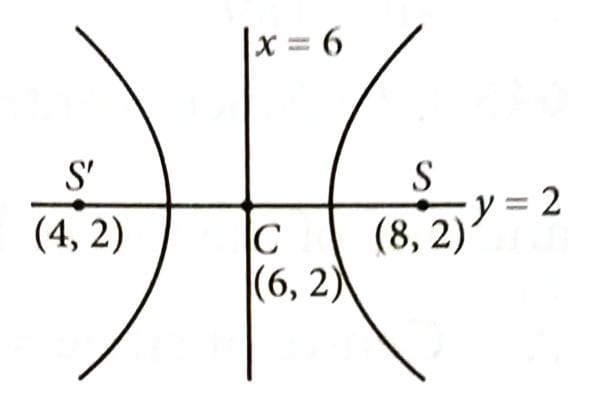
If the equation of the hyperbola with foci (4, 2) and (8, 2) is 3x2–y2–αx+βy+γ=0, then α+β+γ is equal to __________.          [2025]


(141)

Equation of hyperbola is (x–6)2a2–(y–2)24–a2=1

⇒ (4–a2)(x–6)2–a2(y–2)2=a2(4–a2)

⇒ (4–a2)x2–a2y2+(12a2–48)x+4a2y+144–44a2+a4=0

On comparing with 3x2–y2–αx+βy+γ=0, we get a2=1 and α=36, β=4 and γ=101

∴  α+β+γ=141


Q 21 :

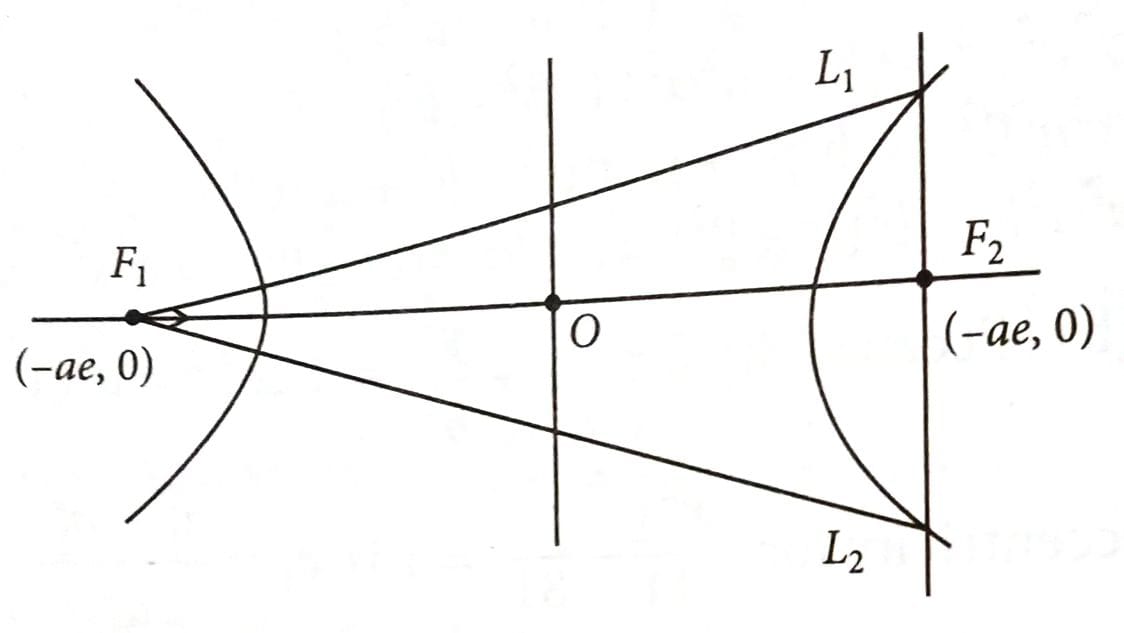
Consider the hyperbola x2a2–y2b2=1 having one of its focus at P(–3, 0). If the latus rectum through its other focus subtends a right angle at P and a2b2=α2–β, α, β∈N, then α+β is ___________.          [2025]


(1944)

We have, F1≡(–ae,0)≡P(–3,0) ⇒ ae=3

L1L2=2b2a

In △F1F2L2,

tan 45°=L2F2F1F2=b2/a2ae

⇒ 2ae=b2a

⇒ b2=6a          [∵ ae = 3]

Also, a2e2=a2+b2

⇒ 9=a2+6a          [∵ ae=3 and b2=6a]

⇒ a2+6a–9=0

a=–3±32=–3(1±2)

Now, a2b2=a2·6a=6a3           [∵ b2=6a]

                      =6(1352–189)

On comparing, we get α = 810 and β = 1134

∴  α+β=1944.


Q 22 :

Let the lengths of the transverse and conugate axes of a hyperbola in standard form be 2a and 2b, respectively, and one focus and the corresponding directrix of this hyperbola be (–5, 0) and 5x + 9 = 0, respectively. If the product of the focal distances of a point (α,25) on the hyperbola is p, then 4p is equal to __________.          [2025]


(189)

Given, focus = (–5, 0)

⇒ ae=5 and ae=95

Also, a=3, e=53 and b=4

⇒x29–y216=1

Since, hyperbola passes through (α,25), we get

α29–4(5)16=1

⇒ α2=9(3616)=814

Now, P=e2α2–a2=259×814–9=1894

∴  4p=189.


Q 23 :

Let the circle C touch the line x – y + 1 = 0, have the centre on the positive x-axis, and cut off a chord of length 413 along the line –3x + 2y = 1. Let H be the hyperbola x2α2–y2β2=1, whose one of the foci is the centre of C and the length of the transverse axis is the diameter of C. Then 2α2+3β2 is equal to __________.          [2025]


(19)

Since, centre of circle lies on positive x-axis and one of the foci of hyperbola x2α2–y2β2=1 are same.

∴   Centre of circle = (α,0)

Since, x – y + 1 = 0 is tangent to the circle.

∴  |α+12|=r          [where 'r' is the radius of circle]

⇒ (α+1)2=2r2          ... (i)

Also, –3x + 2y = 1 is the chord of the circle

∴  |–3α–19+4|2+(213)2=r2          [∵ Length of chord = 413]

∴  (3α+1)213+413=r2

⇒ 9α2+1+6α+413=(α2+1+2α)2

⇒ 5α2–14α–3=0          

⇒ α=3                                        [∵ α>0]

∴  r=22

Now, αe=3 and 2α=42

∴  α2e2=9 and α=22

⇒ α2(1+β2α2)=9 ⇒ 8+β2=9 ⇒ β2=1

∴  2α2+3β2=2(8)+3×1=16+3=19.


Q 24 :

Let H1:x2a2–y2b2=1 and H2:–x2A2+y2B2=1 be two hyperbolas having length of latus rectums 152 and 125 respectively. Let their eccentricities be e1=52 and e2 respectively. If the product of the lengths of their transverse axes is 10010, then 25e22 is equal to __________.          [2025]


(55)

Given, Hyperbola : H1:x2a2–y2b2=1 and e1=52 and H2:–x2A2+y2B2=1

Using H1, length of latus rectum = 152

⇒ 2b2a=152          ... (i)

Since, e1=52 ⇒ 1+b2a2=52 ⇒ b2a2=32           ... (ii)

Using (i) and (ii), we get a=52 and b=53

Now, for H2, 2A2B=125          ... (iii)

Since, product of transverse axes is 10010, then

      2a·2B=10010

⇒ 2×52×2B=10010 ⇒ B=55

∴  A=56          [Using (iii)]

Now, eccentricity of H2 is given by

e22=1+A2B2=1+150125=1+3025=5525

⇒ 25e22=55.


Q 25 :

Let P(x0,y0) be the point on the hyperbola 3x2-4y2=36, which is nearest to the line 3x+2y=1. Then 2 (y0-x0) is equal to        [2023]

  • - 9


  • 3


  • 9


  • - 3


(1)

We have, 3x2-4y2=36

The slope of 3x+2y=1 is m=-32 

The point of hyperbola is (12secθ, 3tanθ).

The equation of normal is 12 xcosθ+3ycotθ=21

⇒Slope =-12cosθ3cotθ

According to questions, (-32)(-12cosθ3cotθ)=-1

⇒3sinθ=-1  ⇒ sinθ=-13 ⇒ cosθ=23

∴ (x0,y0)≡(62,-32)  ∴ 2 (y0-x0)=-9


Q 26 :

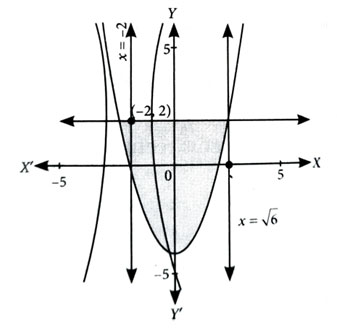
Let T and C respectively be the transverse and conjugate axes of the hyperbola 16x2-y2+64x+4y+44=0. Then the area of the region above the parabola x2=y+4, below the transverse axis T and on the right of the conjugate axis C is:           [2023]

  • 46+443


  • 46-283


  • 46+283


  • 46-443


(3)

We have given 16x2-y2+64x+4y+44=0

16(x2+4x)-(y2-4y)+44=0

16(x2+4x+4)-64-(y2-4y+4)+4+44=0

16(x+2)2-64-(y-2)2+48=0

16(x+2)2-(y-2)2=16

(x+2)21-(y-2)216=1

⇒Centre: (-2, 2)

Vertices: (-1,2), (-3,2)

Equation of parabola: x2=y+4

Required area=∫-26{2-(x2-4)}dx

=∫-26(6-x2)dx=[6x-x33]-26

=46+283


Q 27 :

Let H be the hyperbola, whose foci are (1±2,0) and eccentricity is 2. Then the length of its latus rectum is ___________ .        [2023]

  • 3


  • 52


  • 2


  • 32


(3)

Distance between two foci=2ae=22

⇒ae=2 ⇒ a(2)=2 (∵e=2)

⇒a=1

We know that e2=1+b2a2 ⇒ 2=1+b21

⇒b2=1 ⇒ b=1

∴ Length of latus rectum =2b2a=2(1)21=2


Q 28 :

Let the eccentricity of an ellipse x2a2+y2b2=1is reciprocal to that of the hyperbola 2x2-2y2=1. If the ellipse intersects the hyperbola at right angles, then the square of the length of the latus rectum of the ellipse is ________.          [2023]


(2)

We have, equation of hyperbola as x21/2-y21/2=1

∴  eH=1+b2a2=2

So, eE=12    (Given that eE=1eH)

∵   Ellipse and hyperbola intersect at 90°.

∴  They are confocal.

Now, foci of hyperbola=(1,0)

∴  aeE=1⇒a=2, b=1

So, Latus rectum of ellipse =2b2a=22=2

∴ Square of latus rectum is 2.


Q 29 :

Let Hn:x21+n-y23+n=1, n∈N. Let k be the smallest even value of n such that the eccentricity of Hk is a rational number. If l is the length of the latus rectum of Hk, then 21l is equal to _________.         [2023]


(306)

Hn=x21+n-y23+n=1  be a hyperbola

Eccentricity of hyperbola,  e=1+b2a2=1+3+n1+n=2n+4n+1

For rational eccentricity,  2n+4n+1 should be a perfect square.

∴ n=48  (smallest even value for which e∈Q)

∴  e=107

Now, a2=n+1=49,    b2=n+3=51

l=length of latus rectum=2b2a

⇒ l=2·517=1027   ∴  21l=306


Q 30 :

Let the tangent to the parabola y2=12x at the point (3,α) be perpendicular to the line 2x+2y=3. Then the square of distance of the point (6, - 4) from the normal to the hyperbola α2x2-9y2=9α2 at its point (α-1,α+2) is equal to ____ .            [2023]


(116)

Given, line is 2x+2y=3

⇒y=-x+32                                      ...(i)

Slope of (i) is m=-1

∴  Tangent at (3,α) has slope 1.

Now, α2=12(3)=36⇒α=6  [∵ α=-6 reject]

Equation of tangent to y2=12x at point (3,6) is given by

       y-6=x-3 ⇒ x-y+3=0

Equation of hyperbola is α2x2-9y2=9α2

⇒x29-y236=1

Equation of normal to the hyperbola at point (α-1,α+2),

i.e., (5,8) is 9x5+36y8=45⇒2x+5y-50=0

Now, distance of (6,-4) from 2x+5y-50=0 is given by

d=|2(6)-5(4)-504+25|=5829

∴  Square of distance =(5829)2=116.