Q 1 :

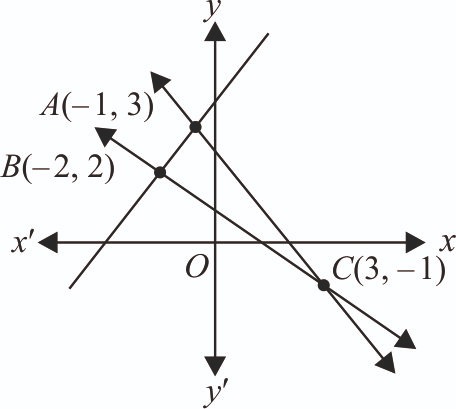
The vertices of a triangle are A(–1, 3), B(–2, 2) and C(3, –1). A new triangle is formed by shifting the sides of the triangle by one unit inwards. Then the equation of the side of the new triangle nearest to origin is            [2024]

  • -x+y-(2-2)=0


  • x-y-(2+2)=0


  • x+y+(2-2)=0


  • x+y-(2-2)=0


(4)

Equation of ACy - 3 = -44 (x + 1)

   x + y = 2

Equation ABy - 2 = 11 (x + 2)

   x - y + 4 = 0

Equation BCy + 1 = -35 (x - 3)

   3x + 5y = 4

Distance of AC from origin O(0, 0) = |-2|2 = 2

Distance of AB from origin O(0, 0) = |4|2 = 22

Distance of BC from origin O(0, 0) = |-4|9 + 25 = 434

When each side of ABC shifted by one unit inwards distance of new sides from origin are 2 - 1, 22 - 1, 434 + 1 respectively.

Clearly new position of AC is nearest to the origin.

Equation of AC when shifted by one unit inwareds can be chosen as x + y = c

Thus, we have |c - 2|2 = 1    c = 2 - 2

  Required equation is x + y - 2 + 2 = 0.


Q 2 :

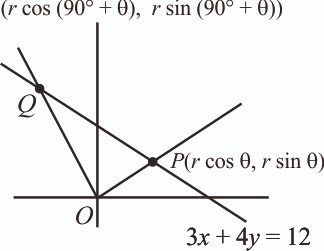
Let two straight lines drawn from the origin O intersect the line 3x + 4y = 12 at the points P and Q such that OPQ is an isosceles triangle and POQ=90°. If l=OP2+PQ2+QO2, then the greatest integer  less than or equal to l is:           [2024]

  • 44


  • 42


  • 46


  • 48


(3)

Let P(r cos θ, r sin θ) and Q(-r sin θ, r cos θ)

   OP2 = OQ2 = r2

Now, in POQ, POQ = 90°, PQ2 = 2r2

Now, l = OP2 + PQ2 + OQ2 = 4r2

   P and Q lies on 3x + 4y = 12

   3(r cos θ) + 4(r sin θ) = 12

   3 cos θ + 4 sin θ = 12r            ... (i)

and 3(-r sin θ) + 4(r cos θ) = 12

   -3 sin θ + 4 cos θ = 12r          ... (ii)

From (i) and (ii), we have

25 = 288r2    r2 = 28825

Now, l = 4r2 = 4 × 28825 = 46.08

So, [l] =46.


Q 3 :

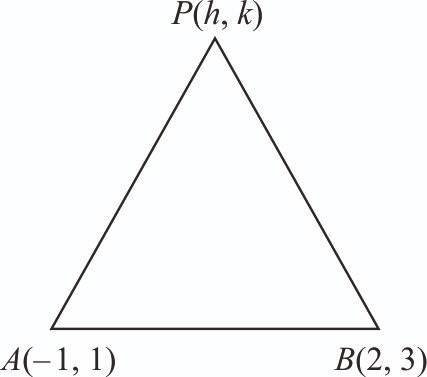
Let A(–1, 1) and B(2, 3) be two points and P be a variable point above the line AB such that the area of PAB is 10. If the locus of P is ax + by = 15, then 5a + 2b is:          [2024]

  • 6


  • 4


  • - 65


  • - 125


(4)

Let coordinates of P be (h, k).

Area of PAB = 10sq. units

   10 = 12|h-12 k13 111|

   ±20 = h(-2) - k(-3) + 1(-5)

   -2h + 3k = 25

(  P is above the line AB, so we take only +ve value)

   -2 × 35 h + 3 × 35 k = 3 × 255

   -65 h + 95 k = 15

On comparing it with ax + by = 15, we get a = -65 and b = 95

.5a + 2b = - 6 + 185 = -125


Q 4 :

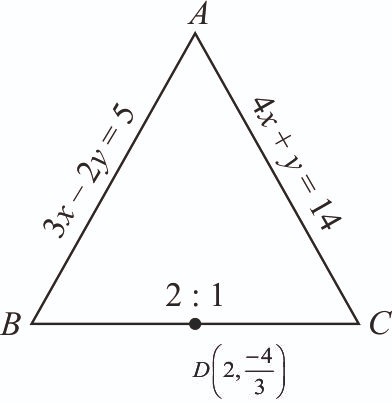
The equations of two sides AB and AC of a triangle ABC are 4x + y = 14 and 3x – 2y = 5, respectively. The point (2,-43) divides the third side BC internally in the ratio 2 : 1, the equation of the side BC is          [2024]

  • x + 3y + 2 = 0


  • x – 3y – 6 = 0


  • x + 6y + 6 = 0


  • x – 6y – 10 = 0


(1)

Let D(2, -43) be the point on BC which divides BC in ratio 2 : 1.

Let coordinates of B be (x1, 14 - 4x1) and coordinates of C be (x2, 3x2 - 52)

Now, 2x2 + x13 = 22(3x2 - 52) + 14 - 4x13 = -43

   2x2 + x1 = 6, 3x2 - 4x1 = -4 + 5 - 14

   2x2 + x1 = 6, 3x2 - 4x1 = -13

On solving these two equations, we get, x1 = 4, x2 = 1

So B(4, –2) and C(1, –1) are the required points.

Equation of BC : y+1=-13(x-1)3y+x+2=0


Q 5 :

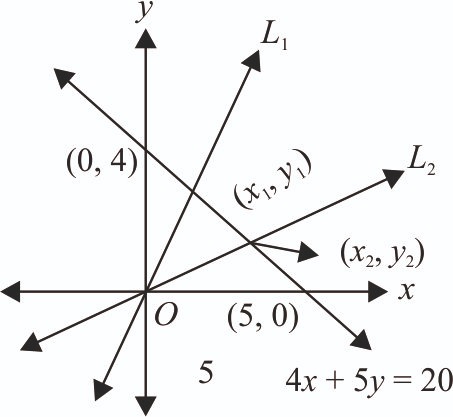
The Portion of the line 4x + 5y = 20 in the first quadrant is trisected by the lines L1 and L2 passing through the origin. The tangent of an angle between the lines L1 and L2 is:          [2024]

  • 3041


  • 2541


  • 25


  • 85


(1)

Lines L1 and L2 trisect the line 4x + 5y = 20.

x1 = 5 × 1 + 0 × 21 + 2 = 53

y1 = 0 × 1 + 4 × 21 + 2 = 83

(x1, y1)  (53, 83)

Similarly,

x2 = 0 × 1 + 5 × 21 + 2 = 103

y2 = 4 × 1 + 0 × 21 + 2 = 43, (x2, y2)  (103, 43)

Slope of line L1 : m1 = 83 × 35 = 85

Slope of line L2 : m2 = 43 × 310 = 25

Tangent angle between the lines L1 and L2:

tan θ =|m1 - m21 + m1m2|= |85 - 251 + 85 × 25|= 3041


Q 6 :

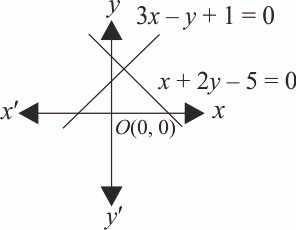
Let R be the interior region between the lines 3xy + 1 = 0 and x + 2y – 5 = 0 containing the origin. The set of all values of a, for which the points (a2,a+1) lie in R, is:          [2024]

  • (-3,-1)(13,1)


  • (-3,0)(23,1)


  • (-3,-1)(-13,1)


  • (-3,0)(13,1)


(4)

It is given that, region R lies between the lines 3xy + 1 = 0 and x + 2y – 5 = 0.

The point (a2, a + 1) and (0, 0) lie in the region R.

   (a2, a + 1) and (0, 0) are on same side of both the line.

For Line 3xy + 1 = 0, O(0, 0) is on the right side of the line.

So, point (a2, a + 1) will also be on right side of the line.

   3a2 - a - 1 + 1 > 0

   a(3a - 1) > 0

   a  (-, 0)  (13, )          ... (i)

For line x + 2y – 5 = 0, O(0, 0) is on the left side of the line.

So, point (a2, a + 1) will also be on left side of the line.

   a2 + 2a + 2 - 5 < 0

   (a + 3)(a - 1) < 0

   a  (-3, 1)         ... (ii)

From the intersection of (i) and (ii), we get

a  (-3, 0)  (13, 1)


Q 7 :

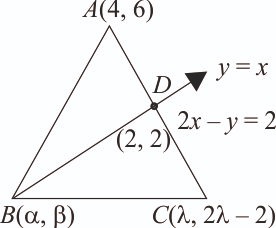
In a ABC, Suppose y = x is the equation of the bisector of the angle B and the equation of the side AC is 2xy = 2. If 2AB = BC and the points A and B are respectively (4, 6) and (α,β), then α+2β is equal to          [2024]

  • 39


  • 42


  • 48


  • 45


(2)

We have, y = x          ... (i)

and    2xy = 2          ... (ii)

Solving (i) and (ii), we get x = 2 and y = 2

As, ABD =~ CBD

   ABBC = ADDC = 12

D (λ + 83, 2λ - 2 + 123) lies on y = x

   λ + 83 = 2λ + 103      λ = -2. So, C (-2, -6)

The image of the point A will lies on the line BC.

Let A' = (6, 4)

Now, β - 4α - 6 = 108      α - 4α - 6 = 54   (   α = β)

   4α - 16 = 5α - 30    14 = α = β

   α + 2β = 14 + 2 × 14 = 42


Q 8 :

The distance of the point (2, 3) from the line 2x – 3y + 28 = 0, measured parallel to the line 3x-y+1=0, is equal to          [2024]

  • 4+63


  • 42


  • 63


  • 3+42


(1)

Slope of a line passing through (2, 3) and parallel to line 3x - y + 1 = 0 is same as that of line 3x - y + 1 = 0

So, slope of line = 3

   tan θ = 3    sin θ = 32, cos θ = 12

So, equation of line passing through (2, 3) and having slope 3 in normal form is,

x - 21/2 = y - 33/2 = r    x =r2 + 2,  y = 32 r + 3

This line passes through 2x – 3y + 28 = 0

   2(r2 + 2) - 3(32 r + 3) + 28 = 0    (2 - 332) r = -23

   r = -23 × 22 - 33 × 2 + 332 + 33    r = 2(2 + 33) = 4 + 63


Q 9 :

Let A be the point of intersection of the lines 3x + 2y = 14, 5xy = 6 and B be the point of intersection of the lines 4x + 3y = 8, 6x + y = 5. The distance of the point P(5, –2) from the line AB is          [2024]

  • 8


  • 52


  • 132


  • 6


(4)

Point of intersection of lines 3x + 2y = 14 and 5xy = 6 is A(2, 4)

Point of intersection of lines 4x + 3y = 8 and 6x + y = 5 is B = (12, 2)

So, equation of line AB is, y - 4 = 2 - 412 - 2 (x - 2)

   y - 4 = 43 (x - 2)      4x - 3y + 4 = 0

  Distance of point P(5, –2) from 4x – 3y + 4 is given as

d = |4 × 5 - 3 × (-2) + 416 + 9|  d = 6 units


Q 10 :

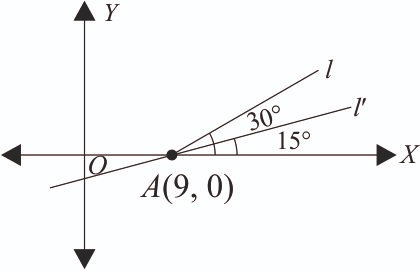
A line passing through the point A(9, 0) makes an angle of 30° with the positive direction of x-axis. If this line is rotated about A through an angle of 15° in the clockwise direction, then its equations in the new position is          [2024]

  • x3+2+y=9


  • y3-2+x=9


  • x3-2+y=9


  • y3+2+x=9


(2)

Let l be the line passing through point A(9, 0) making angle 30° with x-axis.

Line is rotated clockwise by 15° then l' is the new position of line where it make 15° angle with x-axis.

So, equation of line passing through (9, 0) and making angle 15° with x-axis is (y – 0) = tan 15° (x – 9)

   y = tan (45° – 30°)(x – 9) = (tan 45°  tan 30°1 + tan 45° · tan 30°) (x  9)

   y = (2  3) (x  9)

   y2  3 = x  9      y3  2 + x = 9


Q 11 :

If x2y2+2hxy+2gx+2fy+c=0 is the locus of a point, which moves such that it is always equidistant from the lines x + 2y + 7 = 0 and 2xy + 8 = 0, then the value of g + c + hf equals          [2024]

  • 29


  • 6


  • 8


  • 14


(4)

Let point P(x, y) be equidistant from the given lines.

   x + 2y + 75 = ± 2x  y + 85

   (x + 2y + 7)2 = (2x  y + 8)2

   x2 + 4y2 + 49 + 4xy + 28y + 14x = 4x2 + y2 + 64  4xy  16y + 32x

   3x2 3y2  8xy + 18x  44y + 15 = 0

   x2  y2  83 xy + 6x  443 y + 5 = 0          ... (i)

This is the locus of the point P(x, y).

Now, compare equation (i) with given equation of locus, we get

2h = 83  h = -43,

2g = 6  g = 3,

2f = 443  223,

and c = 5

   g + c + h  f = 3 + 5  43 + 223 = 14.


Q 12 :

Let A (a, b), B(3, 4) and C(–6, –8) respectively denote the centroid, circumcentre and orthocentre of a triangle. Then, the distance of the point P(2a + 3, 7b + 5) from the line 2x + 3y – 4 = 0 measured parallel to the line x – 2y – 1 = 0 is          [2024]

  • 1756


  • 517


  • 1757


  • 1557


(3)

Given the A (a, b), B(3, 4) and C(–6, –8) respectively the centroid, circumcentre and orthocentre of a triangle.

We know that centroid divides circumcentre and orthocentre internally in the ratio 1 : 2

   a = 6 + 62, b = 8 + 83

   a = 0, b = 0

Therefore, the coordinates of P are (3, 5).

Also, l : 2x + 3y – 4 = 0 (Given)          ... (i)

Equation of the line passing through P(3, 5) and parallel to the line x – 2y – 1 = 0 is

y  5 = 12 (x  3)

   2y  10 = x  3

   x  2y + 7 = 0          ... (ii)

Solving equation (i) and (ii), we get

x = 137, y = 187

   Distance between (3, 5) and (137, 187) is

(3 + 137)2 + (5  187)2 = 115649 + 28949 144549 = 1757


Q 13 :

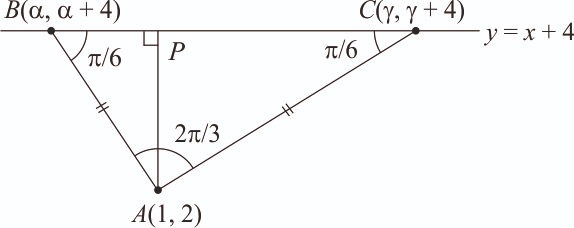
Consider a triangle ABC having the vertices A(1, 2), B(α,β) and C(γ,δ) and angles ABC=π6 and BAC=2π3. If the points B and C lie on the line y = x + 4, then α2+γ2 is equal to __________          [2024]


(14)

P = |1 + 2  4|12 + 12 = 32

sin (π6) = 3/2AB    32AB = 12    AB = 62

   (α  1)2 + (α + 4  2)2 = (62)2

   α2 + 1  2α + α2 + 4 + 4α = 18

   2α2 + 2α  13 = 0  α and γ satisfy same equation

    α and γ are the roots of the equation 2x2 + 2x  13 = 0

Sum of roots = α + γ = 22 = 1 

Product of roots = αγ = 132

Now, α2 + γ2 = (α + γ)2  2αγ

= (1)2  2 (132) = 1 + 13 = 14.


Q 14 :

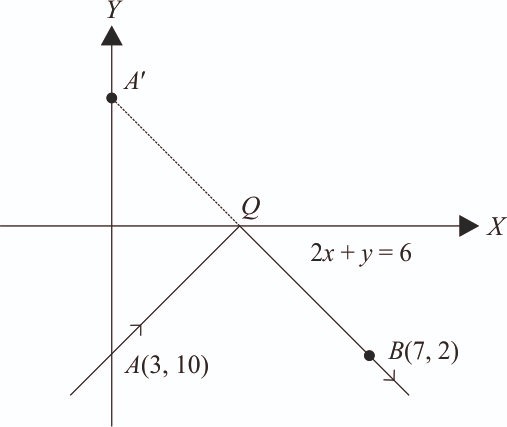
Let a ray of light passing through the point (3, 10) reflects on the line 2x + y = 6 and the reflected ray passes through the point (7, 2). If the equation of the incident ray is ax + by + 1 = 0, then a2+b2+3ab is equal to __________ .           [2024]


(1)

x  32 = y  101 = 2(2 × 3 + 10  6)4 + 1 = 4

    x = 5, y = 6

    A'(–5, 6) and B(7, 2)

    Equation of line A'B is

    y  6 = 2  67 + 5 (x + 5)

    y  6 =  13 (x + 5)

    3y  18 = x  5        x + 3y = 13

and 2x + y = 6 (Given line).

On solving, we get y = 4, x = 1

    Q  (1, 4)

Equation of line AQ is

y  10 = 10  43  1 (x  3)        y  10 = 3(x  3)

    y  10 = 3x  9        3x  y + 1 = 0

On comparing with given equation ax + by + 1 = 0, we get a = 3, b = –1

Hence, a2 + b2 + 3ab = 9 + 1 + 3(3)(1) = 9 + 1  9 = 1.


Q 15 :

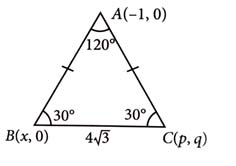
Let ABC be an isosceles triangle in which A is at (–1, 0), A=2π3AB = AC and B is on the positive x-axis. If BC=43 and the line BC intersects the line y = x + 3 at (α,β), then β4α2 is __________.          [2024]


(36)

We have, sin 30°AC = sin 120°BC

    AC = 43 × 12 × 23

    AC = 4 = AB

    AB2 = (x + 1)2      x + 1 = ±4

But B is on positive x-axis

    Coordinates of B = (3, 0)

Now, AC2 = 16

    (p + 1)2 + q2 = 16         ... (i)

Also, BC2 = 48

    (p  3)2 + q2 = 48          ... (ii)

Solving (i) and (ii), we get

p = 3, q = 23

So, coordinates of C = (3, 23)

    Equation of line BC is, y  0 = 23  03  3 (x  3)

    x +3y = 3          ... (iii)

Now, point of intersection of line (iii) and x + 3 = y is

(3(3  2), 3(3  1))

    α = 3(3  2), β = 3(3  1)

β4α2 = 34(3 + 1  23)232(3  2)2 = 9(2(2 3))2(2  3)2 = 9 × 4 = 36.


Q 16 :

If the sum of squares of all real values of α, for which the lines 2xy + 3 = 0, 6x + 3y + 1 = 0 and αx+2y2=0 do not form a triangle is p, then the greatest integer less than or equal to p is __________.          [2024]


(32)

We have, 2xy + 3 = 0         ... (i)

6x + 3y + 1 = 0                     ... (ii)

αx + 2y  2 = 0          ... (iii)

Case I. If the lines are concurrent then they do not form a triangle

    |213631α22|= 0

    α(1  9)  2(2  18)  2(6 + 6) = 0

    10α + 32  24 = 0    10α = 8    α = 45

Case II. If the lines are parallel then they do not form a triangle.

If the lines (i) and (iii) are parallel,

   2α = 12  32      α = 4

If the lines (ii) and (iii)  are parallel,

   6α = 32  12      α = 4

    Sum of squares of all real values of α

= (45)2 + (4)2 + (4)2 = 1625 + 16 + 16 = 1625 + 32

[P] = [32 + 1625] = 32.


Q 17 :

Let for any three distinct consecutive terms a, b, c of an A.P., the lines ax + by + c = 0 be concurrent at the point P and Q(α, β) be a point such that the system of equations x + y + z = 6, 2x + 5y + αz = β and x + 2y + 3z = 4, has infinitely many solutions. Then (PQ)2 is equal to __________.          [2024]


(113)

a, b, c are in A.P. 2b = a + c a – 2b + c = 0 and ax + by + c = 0 are concurrent.

Two lines a1x + b1y + c1 = 0 and a2x + b2y + c2 = 0 are concurrent if

a1a2 = b1b2 = c1c2           1x = 2y = 11 = 0

    x = 1  and  y = 2

So, P(1, –2) is the point of concurrency.

Now, x + y + z = 6                    ... (i)

         2x + 5y + αz = β           ... (ii)

         x + 2y + 3z = 4               ... (iii)

has infinitely many solution.

On solving these equation, we have

          x + y = 6 – zx + 2y = 4 – 3z

On solving these two, we get –y = 2 + 2z

    y = –2(1 + z)      x = 6 – z + 2 + 2z      x = 8 + z

From (ii), we get 2(8 + z) + 5(–2(1 + z)) + αz = β

   6  8z + αz = β

   z(α  8) = β  6

For infinitely many solution, α = 8, β = 6

|PQ|2= ((8  1)2 + (6 + 2)2)2 = 113


Q 18 :

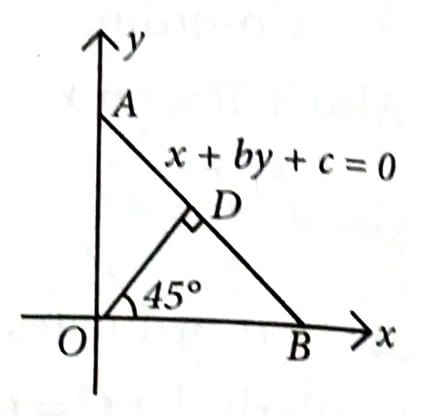
Let the area of the triangle formed by a straight line L : x + by + c = 0 with co-ordinate axes be 48 square units. If the perpendicular drawn from the origin to the line L makes an angle of 45° with the positive x-axis, then the value of b2+c2 is :          [2025]

  • 83


  • 97


  • 93


  • 90


(2)

We have, area of OAB = 48 sq. units

Now, slope of line OD is m = tan 45° = 1

   Slope of line  AB=-1m=-1         ... (i)

Also, equation of line AB is x + by + c = 0

So, Slope  1b          ... (ii)

From (i) and (ii), we get

 1=1b  b=1

Now, x and y intercept of line x + by + c = 0 are given as x = – c and y=cb respectively.

   Area of OAB12×(c)×cb  48=c22b

 c2=48×2          [ b = 1]

 c2=96

So, b2+c2=1+96=97.


Q 19 :

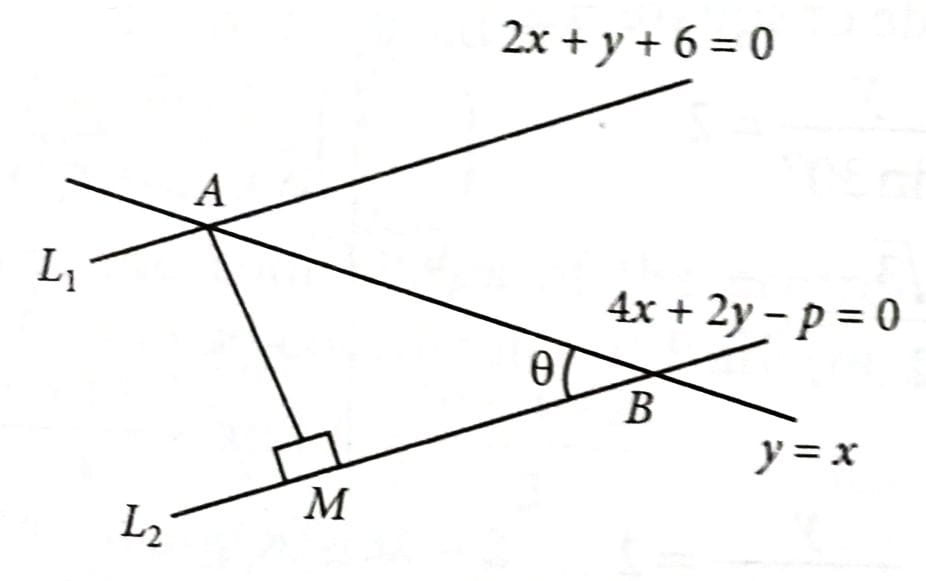
A line passes through the origin and makes equal angles with the positive coordinate axes. It intersects the lines  L1:2x+y+6=0 and L2:4x+2yp=0, p > 0, at the points A and B, respectively. If AB=92 and the foot of the perpendicular from the point A on the line L2 is M, then AMBM is equal to          [2025]

  • 4


  • 3


  • 5


  • 2


(2)

We have, L1:2x+y+6=0 and L2:4x+2yp=0

Line y = x passes through origin and makes equal angles with the positive coordinates axes.

Slope of y = x is m1=1, Slope of L2 is m2=2

So, tan θ=|1+212|=3

Now, in ABM

 tan θ=AMBM=3.


Q 20 :

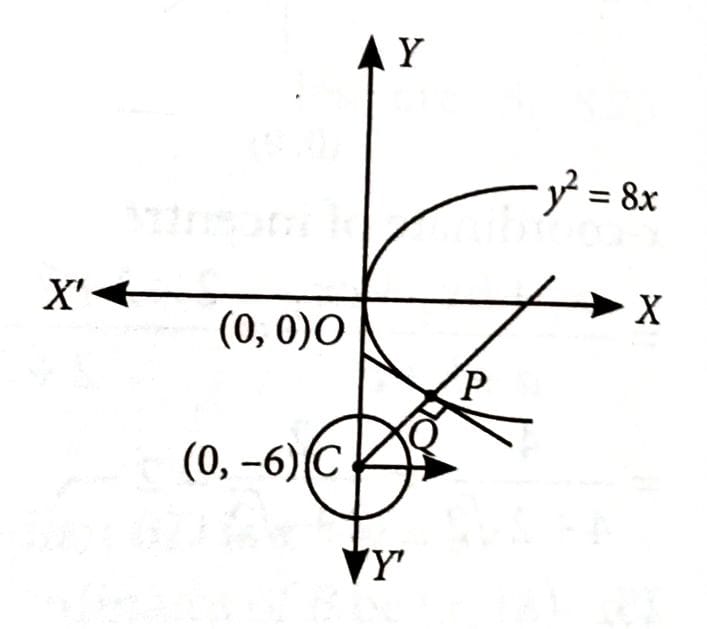
The shortest distance between the curves y2=8x and x2+y2+12y+35=0 is:          [2025]

  • 321


  • 231


  • 2


  • 221


(4)

Given, x2+y2+12y+35=0, which is a circle having centre, C = (0, –6)

Radius, r=3635=1

Since, the shortest distance between both curves will be normal to the curve y2=8x from centre (0, –6), as shown in figure.

   Equation of normal to the parabola

          y2=8x is y=mx4m2m3

where m is slope, passes through (0, –6), then –6 = –4m – 2m3

 m3+2m3=0

 (m1)(m2+m+3)=0

 m=1

          P(am2,2am)=(2,4)

   Shortest distance, PQ = PCr

=(20)2+(4+6)21=81=(221) units.


Q 21 :

Let the equation x(x + 2)(12 – k) = 2 have equal roots. Then the distance of the point (k,k2) from the line 3x + 4y + 5 = 0 is          [2025]

  • 53


  • 155


  • 12


  • 15


(4)

We have, (x2+2x)(12k)=2

 λx2+2λx2=0, k12          [Let 12 – k = λ]

For equal roots, D = 0

 4λ2+8λ=0

 4λ(λ+2)=0

 λ=0     (which is not possible)

or   λ=2  12k=2

 k=14

So, P(k,k2)=(14,7)

  Distance, d=|3×14+4×7+59+16|=15.


Q 22 :

Consider the lines x(3λ+1)+y(7λ+2)=17λ+5λ being a parameter, all passing through a point P. One of these lines (say L) is farthest from the origin. If the distance of L from the point (3, 6) is d, then the value of d2 is         [2025]

  • 15


  • 10


  • 30


  • 20


(4)

We have, x(3λ+1)+y(7λ+2)=17λ+5

 (x+2y5)+λ(3x+7y17)=0

The intersection of family of lines is the point P(1, 2) and let Q(3,6).

Now, d=PQ=22+42=20  d2=20


Q 23 :

For an integer n2, if the arithmetic mean of all coefficient in the binomial expansion of (x+y)2n3 is 16, then the distance of the point P(2n1,n24n) from the line x + y = 8 is          [2025]

  • 2


  • 22


  • 32


  • 52


(3)

Number of terms in (x+y)2n3=2n3+1=2n2

If x = 1, y = 1

Then, sum of all coefficients = 22n3

So, arithmetic mean of all coefficients = 22n3(2n3)+1

 22n32n2=16  22n=256(n1)  n = 5

Now, P(2n1,n24n)=(9,5)

So, distance from P(9, 5) to the line x + y = 8 is

(9+58)1+1=62=32 units.


Q 24 :

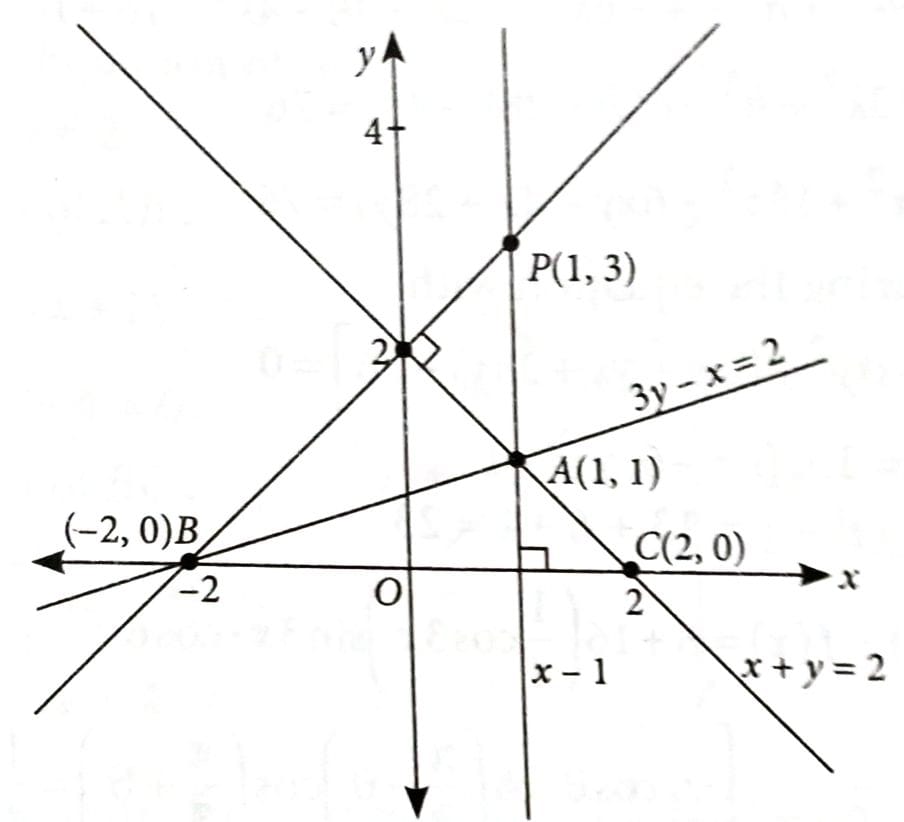
Let ABC be the triangle such that the equation of lines AB and AC be 3yx = 2 and x + y = 2, respectively, and the points B and C lie on x-axis. If P is the orthocentre of the triangle ABC, then the area of the triangle PBC is equal to          [2025]

  • 10


  • 4


  • 8


  • 6


(4)

Equation of Altitude AP, which is perpendicular to BC is given by

x = 1          ... (i)

Equation of Altitude BP, which is perpendicular to AC is given by

y – 0 = 1(x + 2)  xy + 2 = 0          ... (ii)

Hence, P(1, 3)          [From (i) and (ii)]

  Area of PBC=12×4×3=6 sq. units


Q 25 :

If for θ[π3,0], the points (x,y)=(3tan(θ+π3), 2tan(θ+π6)) lie on xy+αx+βy+γ=0, then α2+β2+γ2 is equal to          [2025]

  • 72


  • 75


  • 80


  • 96


(2)

We have, x=3 tan(θ+π3)

 x=3(tan θ+313 tan θ)

 xx3 tan θ=3 tan θ+33

 tan θ=x333+3x          ... (i)

Also, y=2 tan(θ+π6)

 y=2(tan θ+13)(1tan θ3)

 y(3tan θ)=2(3 tan θ+1)          ... (ii)

Solving (i) and (ii), we get

 2(x333+x+1)=y(3(x33)3(3+x))

 23(x33+x+3)=y(3(3+x)x+33)

 43x12=y(2x+63)

 xy23x+33y+6=0

Comparing with xy+αx+βy+γ, we get

α=23, β=33, γ=6

  α2+β2+γ2=12+27+36=75.


Q 26 :

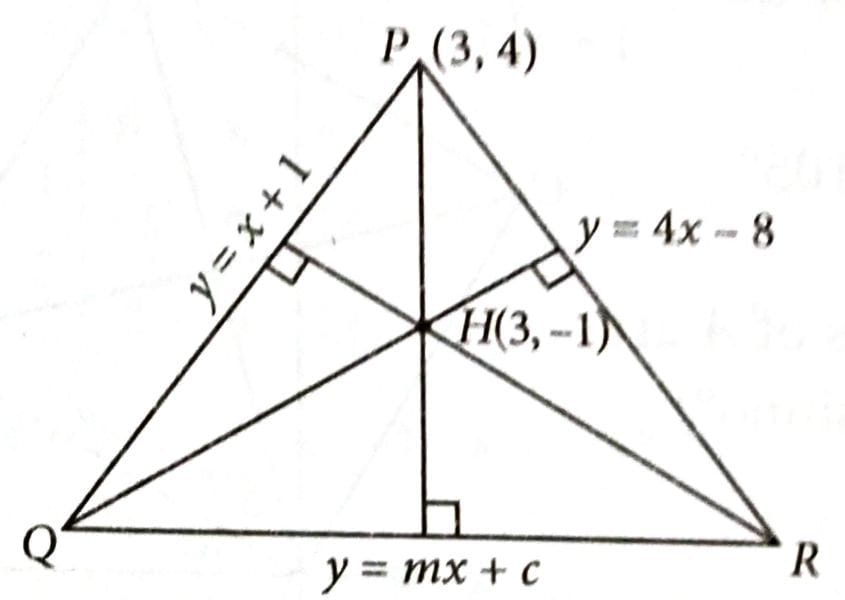
If the orthocenter of the triangle formed by the lines y = x + 1, y = 4x – 8 and y = mx + c is at (3, –1), then mc is:          [2025]

  • –2


  • 0


  • 4


  • 2


(2)

Using lines PQ and QR, we get

Point Q(1cm1,1cm1+1)

mQH=1cm1+21cm13=1c+2m21c3m+3=14    [ QHPR]          ... (i)

  mPH=50  Slope of line QR (m)=0

Put value of m in equation (i), we get

         1c21c+3=14  c=0

 mc=0.


Q 27 :

A line passing through the point P(a, 0) makes an acute angle α with the positive x-axis. Let this line be rotated about the point P through an angle α2 in the clock-wise direction. If in the new position, the slope of the line is 23 and its distance from the origin is 12, then the value of 3a2 tan2 α23 is:          [2025]

  • 8


  • 6


  • 5


  • 4


(4)

Slope of new line =23

The new angle with x-axis is αα2=α2

  tan(α2)=23=tan(π12)  α2=π12  α=π6

The new line passes through (a, 0) and has slope 23.

So equation of new line is

(y0)=(23)(xa)  y(23)x=(23)a

Now, distance of this line from origin is 12

 |0+(23)a(23)2+12|=12  (23)|a|843=12

On squaring both sides, we get (23)2a2843=12

 2(743)a2=843

 (743)a2=423

 a2=423743×7+437+43

           =28+163143244948

       a2=4+23

Now, 3a2 tan2 α23=3(4+23) tan2π623

                                                 =(12+63)·1323

                                                 =4+2323=4.


Q 28 :

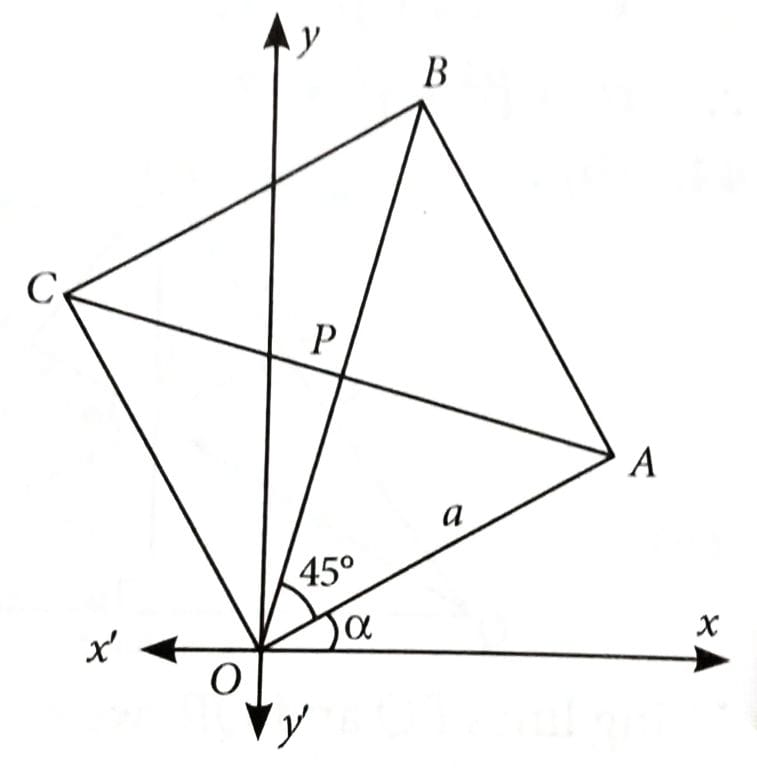
Let a be the length of a side of a square OABC with O being the origin. Its side OA makes an acute angle α with the positive x-axis and the equations of its diagonals are (3+1)x+(31)y=0 and (31)x(3+1)y+83=0. Then a2 is equal to:          [2025]

  • 48


  • 32


  • 24


  • 16


(1)

Slope of OB = 3+113=tan 105°

Now, α+45°=105°  α=60°

   Coordinates of A are (a cos 60°, a sin 60°)

i.e.(a2,3a2)

Now, A lies on diagonal AC.

 (31)a2(3+1)3a2+83=0

 a2[3133]+83=0

 a2[4]+83=0

 a=43

 a2=48.


Q 29 :

Let the triangle PQR be the image of the triangle with vertices (1, 3), (3, 1) and (2, 4) in the line x + 2y = 2. If the centroid of PQR is the point (α, β), then 15(αβ) is equal to:          [2025]

  • 19


  • 24


  • 21


  • 22


(4)

Let P, Q and R be the mirror images of points (1, 3), (3, 1) and (2, 4) in the line x + 2y – 2 = 0.

Coordinates of P is given by

x11=y32=2(1+625) i.e., P(1,1)

Similarly, Q(95,75) and R(65,125)

Centroid of PQR=(215,85)

  α=215 and β=85

Thus, 15(αβ)=15(215+85)=22.


Q 30 :

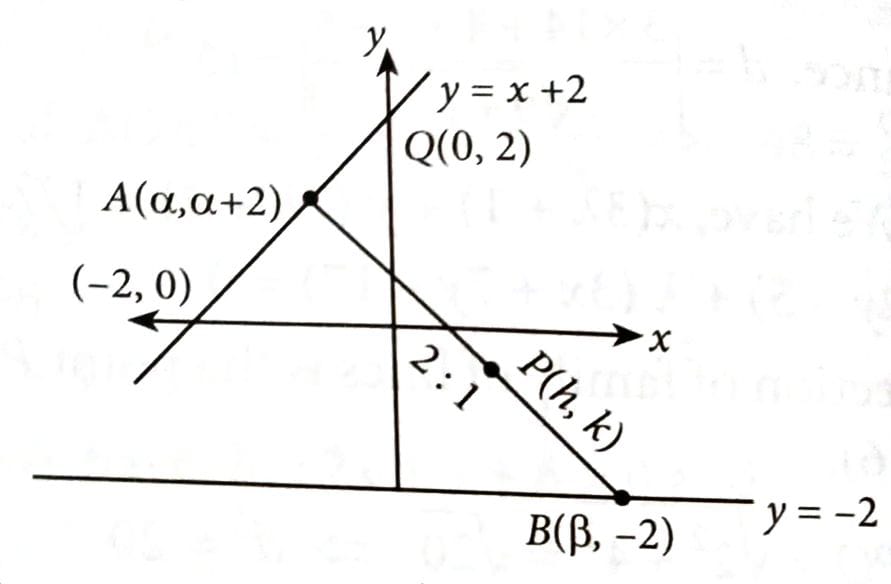
A rod of length eight units moves such that its ends A and B always lie on the lines xy + 2 = 0 and y + 2 = 0, respectively. If the locus of the point P, that divides the rod AB internally in the ratio 2 : 1 is 9(x2+αy2+βxy+γx+28y)76=0, then αβγ is equal to:          [2025]

  • 22


  • 21


  • 24


  • 23


(4)

Let P(h, k) be the point which divides AB internally in the ratio 2 : 1.

  h=2β+α3 and k=4+α+23

 α=3k+2

  2β=3hα=3h3k2

So, AB = 8

 (αβ)2+(α+4)2=64

 (3k+2(3h3k22))2+(3k+2+4)2=64

 (9k3h+6)24+(3k+6)2=64

 9[(3kh+2)2+4(k+2)2]=64×4

 9(9k2+h2+46kh+12k4h+4k2+16+16k)=256

 9(13k2+h26kh+28k4h)=76

 9(x2+13y26xy4x+28y)=76

Comparing the equation with

[9(x2+αy2+βxy+γx+28y)76]=0

 α=13, β=6, γ=4

  αβγ=13+6+4=23