

Q 1 :

Let PQ be a chord of the parabola y2=12x and the midpoint of PQ be at (4, 1). Then, which of the following point lies on the line passing through the points P and Q?          [2024]

  • (2, –9)


  • (32,–16)


  • (12,–20)


  • (3, –3)


(3)

y2=12x

Chord PQ having mid-point (x1,y1)≡(4,1)

Equation of chord PQ

T=S1

yy1–12(x+x1)2=y12–12x1

⇒ y–6(x+4)=1–12×4

⇒ y–6x–24=–47 ⇒ y–6x+23=0

From the options, point (12,–20) lies on the chord.


Q 2 :

Let C be the circle of minimum area touching the parabola y=6–x2 and the lines y=3|x|. Then, which one of the following points lies on the circle C?          [2024]

  • (1, 1)


  • (2, 4)


  • (2, 2)


  • (1, 2)


(*)

The given data is inadequate.


Q 3 :

If the shortest distance of the parabola y2=4x from the centre of the circle x2+y2–4x–16y+64=0 is d, then d2 is equal to :          [2024]

  • 16


  • 24


  • 20


  • 36


(3)

Circle x2+y2–4x–16y+64=0

Centre ≡ (2, 8), Radius = 2 units

Parabola : y2=4x

a = 1

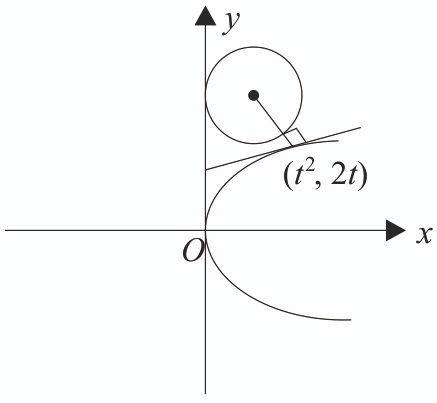
Equation of normal at (t2,2t) of parabola:

xt+y=at3+2at

 xt+y=t3+2t         ... (i)

Since, normal passes through centre, then

2t+8=t3+2t          ... (ii)

⇒t3=8

⇒ t3–8=0

⇒ (t–2)(t2+4+2t)=0

⇒ t=2     (∵ t≥0)

d = distance between (2, 8) and (4, 4) = 4+16=20

⇒ d2=20.


Q 4 :

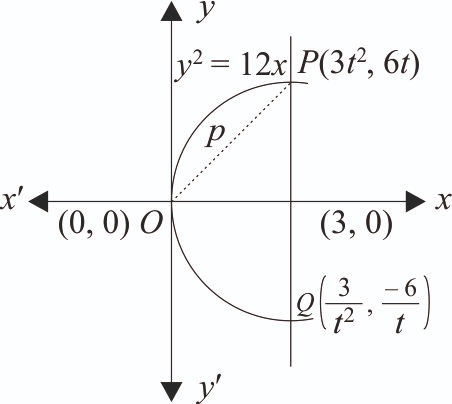
Let the length of the focal chord PQ of the parabola y2=12x be 15 units. If the distance of PQ from the origin is p, then 10p2 is equal to __________.          [2024]


(72)

PQ=15 ⇒ (3(t2–1t2))2+(6(t+1t))2=225

⇒ 9(t2–1t2)2+36(t+1t)2=225

⇒ (t+1t)2[(t–1t)2+4]=25

⇒ (t+1t)2(t+1t)2=25 ⇒ (t+1t)4=25

⇒ t+1t=±5 ⇒ (t-1t)=±1

⇒ Equation of PQ : (y–6t)=(2tt2–1)(x–3t2)

⇒ Distance from y – 6t = mx – 3mt2, where m=2tt2–1

⇒ p=|3mt2–6t|1+m2=|(6tt2–1)|5=65

⇒ 10p2=10×365=72.


Q 5 :

Suppose AB is a focal chord of the parabola y2=12x of length l and slope m<3. If the distance of the chord AB from the origin is d, then ld2 is equal to __________.          [2024]


(108)

Equation of focal chord

y–0=tanθ·(x–3)

⇒ tanθ·x–y–3 tanθ=0

∴  Distance from origin,

d=|–3 tanθ1+tan2θ|

l =4×3 cosec2θ

l·d2=9 tan2θ1+tan2θ×12 cosec2θ

=108 cosec2θ1+cot2θ=108


Q 6 :

Let a line perpendicular to the line 2x – y = 10 touch the parabola y2=4(x–9) at the point P. The distance of the point P from the centre of the circle x2+y2–14x–8y+56=0 is __________.          [2024]


(10)

Let L : 2x – y = 10 and C : y2=4(x–9)

Equation of line perpendicular to L is given by

2y + x = k

Now, let us find the point of intersection of 2y + x = k and y2=4(x–9)

i.e., (k–x2)2=4(x–9)

⇒ x2–2(k+8)x+(k2+144)=0

As parabola touches the line so this quadratic equation must have at most one real root

⇒ D=0

⇒ 4(k+8)2–4(k2+144)=0

⇒ 16k+64–144=0

⇒ k=5

So, equation becomes x2–26x+169=0

⇒ (x–13)2=0

⇒ x=13

⇒ y=±4

Now, parabola and line 2y + x = 5 meets at P(13, –4)

Now, centre of given circle is (7, 4)

∴  Required distance =(13–7)2+(–4–4)2=10.


Q 7 :

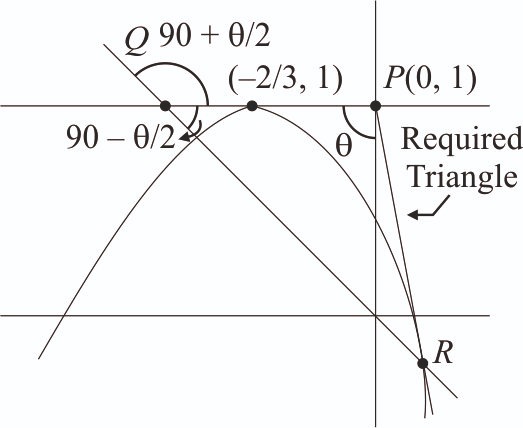
Let L1, L2 be the lines passing through the point P(0, 1) and touching the parabola 9x2+12x+18y–14=0 . Let Q and R be the points on the lines L1 and L2 such that the △PQR is an isosceles triangle with base QR. If the slopes of the lines QR are m1 and m2, then 16(m12+m22) is equal to __________.          [2024]


(68)

We have 9x2+12x+18y–14=0

⇒ 9x2+12x+4+18y–18=0

⇒ (3x+2)2=–18y+18

⇒ (x+23)2=–2(y–1)

Vertex of parabola is (–23,1)

Now, equation of line passing through (0, 1) is given by y = mx + 1.

Since the line is touching the parabola, so we have

(x+23)2=–2mx

⇒ (3x+2)2=–18mx

⇒ 9x2+(12+18m)x+4=0

Discriminant of this quadratic equation must be zero.

⇒ 4(6+9m)2=4(36)

⇒ 6+9m=6  or  –6

⇒m=0, –43

∴  tan θ=–43

⇒ 2 tan θ/21–tan2 θ/2=–43

⇒ –4+4 tan2 θ/2–6 tan θ/2=0

⇒ 2 tan2 θ/2–3 tan θ/2–2=0

⇒(tanθ2–2)(2tanθ2+1)=0

⇒ tanθ2=2, –12          ... (i)

Now, in △PQR, ∠P=θ so ∠Q=∠R=90–θ2

∴ mQR=tan(90+θ2)=–cotθ2=-12,2          [Using (i)]

⇒ m1=–12, m2=2

∴ 16(m12+m22)=16(14+4)=68.


Q 8 :

Let a conic C pass through the point (4, –2) and P(x, y), x≥3, be any point on C. Let the slope of the line touching the conic C only at a single point P be half the slope of the line joining the points P and (3, –5). If the focal distance of the point (7, 1) on C is d, then 12d equals __________.          [2024]


(75)

Slope of C at P=12(y+5x–3) 

⇒ dydx=12(y+5x–3) ⇒ 2dyy+5=1x–3dx

On intergrating, we get

2 ln (y + 5) = ln (x – 3) + C

Since, C passes through (4, –2)

⇒ 2ln3=C

⇒2ln(y+5)=ln(x–3)+2ln3

⇒ 2ln(y+53)=ln(x–3) ⇒ (y+53)2=x–3

⇒ (y+5)2=9(x–3), which represent a parabola so, 4a = 9

⇒ a=94

Focus =(3+94,–5)=(214,–5) 

∴  d=(214–7)2+(–5–1)2

         =(–74)2+(–6)2=254

⇒ 12d=254×12=75.


Q 9 :

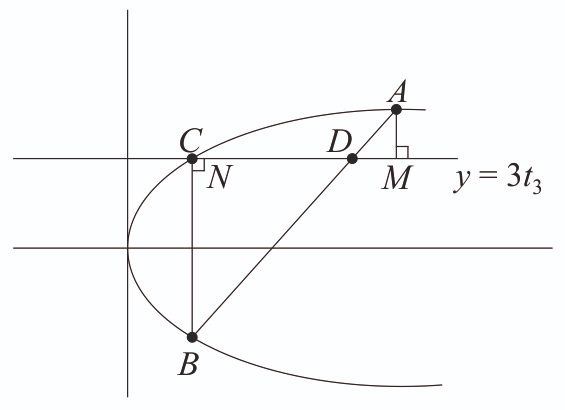
Let A, B and C be three points on the parabola y2=6x and let the line segment AB meet the line L through C parallel to the x-axis at the point D. Let M and N respectively be the feet of the perpendiculars from A and B on L. then (AM·BNCD)2 is equal to __________.          [2024]


(36)

Equation of parabola, y2=6x

i.e.,  y2=4×32x

Let  A(32t12, 3t1), B(32t22, 3t2) and C(32t32, 3t3)

be points on parabola y2=6x.

Equation of AB is given by

⇒ (y–3t1)=3t2–3t132(t22–t12)(x–32t12)

⇒ y–3t1=2t1+t2(2x–3t12)2

⇒ (y–3t1)(t1+t2)=2x–3t12

⇒ y(t1+t2)–3t12–3t1t2=2x–3t12

⇒ y(t1+t2)=2x+3t1t2

For point D, y=3t3

⇒ 2x=3t1t3+3t2t3–3t1t2

⇒ x=32(t1t3+t2t3–t1t2)

|CD|=32(t1t3+t2t3–t1t2)–32t32

|AM|=|3t1–3t3|, |BN|=|3t2–3t3|

So, (AM·BNCD)2=(9(t1–t3)(t2–t3)32(t1–t3)(t3–t2))2=(–6)2=36.


Q 10 :

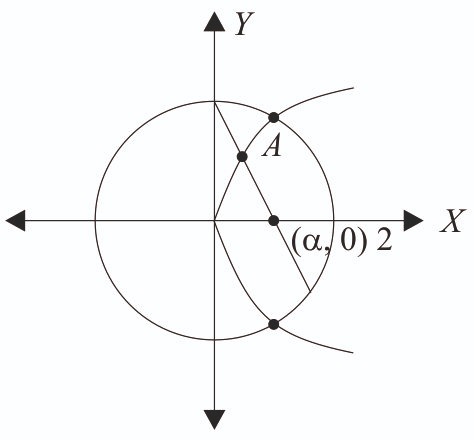
Consider the circle C:x2+y2=4 and the parabola P:y2=8x. If the set of all values of α, for which three chords of the circle C on three distinct lines passing through the point (α,0) are bisected by the parabola P is the interval (p, q), then (2q–p)2 is equal to __________.          [2024]


(80)

Equation of chord of parabola whose mid-point is (α, 0) is given by T=S1

⇒ yy1–4(x+x1)=y12–8x1

i.e.,  –4(x+α)=0–8α

⇒ x=α

Equation of chord of circle with A(2t2, 4t) as mid-point is

xx1+yy1–4=x12+y12–4

⇒ 2t2x+4ty=4t4+16t2

Also, it passes through (α, 0)

⇒ 2t2α=4t4+16t2

⇒ 2α=4t2+16

⇒ α=2t2+8=x0+8

Also, we have x2+y2=4 and y2=8x

⇒ x2+8x–4=0

⇒ x0=–8+802

⇒ p=8  and  q=4+25

∴  (2q–p)2=80.


Q 11 :

Let the line L:2x+y=α pass through the point of the intersection P (in the first quadrant) of the circle x2+y2=3 and the parabola x2=2y. Let the line L touch two circles C1 and C2 of equal radius 23. If the centres Q1 and Q2 of the circle C1 and C2 lie on the y-axis, then the square of the areas of the triangle PQ1Q2 is equal to __________.          [2024]


(72)

We have, L : 2x+y=α

 x2+y2=3         ... (i)

  x2=2y             ... (ii)

Equation (i) and (ii) intersect at (2, 1) in first quadrant.

∴  P=(2,1)  and  α=2×2+1=3

⇒ α=3

Radius of Circle C1 and C2=23

We centre C1 & C2 of two circle are (0, y1) and (0, y2) respectively.

We know that length of perpendicular from centre to the tangent = Radius of circle

∴ |2×0+y–33|=23

⇒ |y–3|=6 ⇒ y=9, –3

∴  y1=–3, y2=9

∴  Centre of C1 and C2 are Q1(0, –3) and Q2(0, 9) respectively.

Q1Q2=12 units, Height of triangle =2 units

A = Area of triangle PQ1Q2=12×12×2

                                   [∵  Area of △PQ1Q2=12×Q1Q2×height]

=62 sq. units

⇒ A2=72.


Q 12 :

Let P(α, β) be a point on the parabola y2=4x. If P also lies on the chord of the parabola x2=8y whose mid point is (1, 54), then (α–28)(β–8) is equal to __________.          [2024]


(192)

We α = t2, β = 2t

Now, equation of chord of the parabola x2=8y, bisected at (1, 54) is x·1–2×2(y+54)=1–10

⇒ x–4y–5=–9 ⇒ x–4y+4=0

Now, (α, β) satisfies the above equation

∴  t2–8t+4=0            ... (i)

Now, (α–28)(β–8)=(t2–28)(2t–8)

=(8t–4–28)(2t–8)           (Using (i))

=16t2–64t–64t+256=16(t2–8t+16)

=16(t2–8t+4+12)=192.


Q 13 :

Let the focal chord PQ of the parabola y2=4x make an angle of 60° with the positive x-axis, where P lies in the first quadrant. If the circle, whose one diameter is PS, S being the focus of the parabola, touches the y-axis at the point (0, α), then 5α2 is equal to :          [2025]

  • 15


  • 25


  • 20


  • 30


(1)

Let the coordinate of a point P be (t2,2t)

Coordinate of focus S of the parabola is (1, 0).

Now, tan 60°=2t–0t2–1=3 ⇒3t2–2t–3=0

⇒ (3t+1)(t–3)=0 ⇒ t=3          {∵ P lies in first quadreant}

∴ P(3,23)

Equation of circle is (x–1)(x–3)+(y–0)(y–23)=0

At x = 0,  3+y2–23y=0

⇒ (y–3)2=0 ⇒y=3

⇒ y=3=α

∴  5α2=15.


Q 14 :

Let the point P of the focal chord PQ of the parabola y2=16x be (1, –4). If the focus of the parabola divides the chord PQ in the ratio m : n, gcd (m, n) = 1, then m2+n2 is equal to :          [2025]

  • 10


  • 17


  • 26


  • 37


(2)

End point of the focal chord PQ of the parabola y2=4ax is P(at2,2at)

Now, we have parabola y2=16x

∴  P(4t2,8t)=(1,–4)

⇒ t=–12

∴   Point Q is given by (at2,–2at)=(16,16)

Now, focus of parabola y2=16x is (4, 0)

Focus (4, 0) divides P(1, –4) and Q(16, 16) in ratio m : n

⇒ (4,0)=(16m+nm+n,16m–4nm+n)

⇒ 16m–4n=0 ⇒ 4m=n ⇒ mn=14

⇒ m=1, n=4          [∵ gcd(m, n) = 1]

∴  m2+n2=1+16=17.


Q 15 :

The radius of the smallest circle which touches the parabolas y=x2+2 and x=y2+2 is          [2025]

  • 722


  • 7216


  • 724


  • 728


(4)

The given parabolas are symmetric about the line y = x.

Tangents at A and B must be parallel to line y = x, so slope of the tangents = 1, which is minimum.

(dydx)min A=1=(dydx)min B

For point B, y=x2+2

⇒ dydx=2x=1

When x=12 ⇒ y=94

∴  Point B=(12,94)

Similarly, point A=(94,12)

AB=(12–94)2+(94–12)2=9816=724

Radius = 7242=728.


Q 16 :

The axis of a parabola is the line y = x and its vertex and focus are in the first quadrant at distances 2 and 22 units from the origin, respectively. If the point (1, k) lies on the parabola, then a possible value of k is :          [2025]

  • 8


  • 4


  • 3


  • 9


(4)

For the parabola, axis is y = x

⇒ Directrix is x + y = 0

Also, vertex and focus are of 2 and 22 from origin

⇒ Vertex is (1, 1) and focus = (2, 2)

The point P(1, k) lies on parabola.

Using definition of parabola

         PS = PM

⇒ (1–2)2+(k–2)2=1+k2

⇒ k2–10k+9=0

 ⇒(k–9)(k–1)=0

∴   k = 9 and k = 1.


Q 17 :

Let P be the parabola, whose focus is (–2, 1) and directrix is 2x + y + 2 = 0. Then the sum of the ordinates of the points on P, whose abscissa is –2, is          [2025]

  • 52


  • 32


  • 34


  • 14


(2)

Equation of parabola.

         (x+2)2+(y–1)2=(2x+y+25)2

⇒ 5[(x+2)2+(y–1)2]=(2x+y+2)2          ... (i)

Put x = –2, in equation (i),

         5(y–1)2=(y–2)2

⇒ 5(y2–2y+1)=y2–4y+4

⇒ 4y2–6y+1=0

∴   The sum of ordinates, y1+y2=32.


Q 18 :

Let the parabola y=x2+px–3, meet the coordinate axes at the points P, Q and R. If the circle C with centre at (–1, –1) passes through the points P, Q and R, then the area of △PQR is :          [2025]

  • 7


  • 4


  • 6


  • 5


(3)

Given, equation of parabola is y=x2+px–3 and equation of circle with centre at (–1, –1) is

         (x+1)2+(y+1)2=r2          ... (i)

Let P(α, 0), Q(β, 0) and R(0, –3) are the three points.

Now, circle passes through point R(0, –3)

⇒ 1+(–2)2=r2 ⇒ 5=r2

Put y = 0 in equation (i), we get

         (x+1)2+1=5

⇒ (x+1)2=4 ⇒ x=1 or x=–3

⇒ Point are P(1, 0) and (–3, 0)

∴  Area of △PQR=12|101–3010–31|=6 sq. units


Q 19 :

Let P(4,43) be a point on the parabola y2=4ax and PQ be a focal chord of the parabola. If M and N are the foot of perpendiculars drawn from P and Q respectively on the directrix of the parabola, then the area of the quadrilateral PQMN is equal to :          [2025]

  • 3433


  • 34338


  • 26338


  • 173


(2)

Since, P(4,43) lies on y2=4ax

⇒ 48=4a(4) ⇒ 4a=12

⇒ y2=12x is equation of parabola

Let (4,43) be (at2,2at) ⇒ t=23

As PQ is focal chord

∴  Q(at2,–2at)=(94,–33)

Area of trapezium PQNM

=12MN(PM+QN)

=12MN(PS+QS)          [by definition of parabola]

=12×MN×PQ

=12×73(494)=(343)38.


Q 20 :

If the line 3x – 2y + 12 = 0 intersects the parabola 4y=3x2 at the points A and B, then at the vertex of the parabola, the line segment AB subtends an angle equal to          [2025]

  • tan–1(119)


  • tan–1(97)


  • tan–1(45)


  • π2–tan–1(32)


(2)

Given, 3x – 2y + 12 = 0

⇒ y=3x+122

Put value of 'y' in 4y=3x2, we get

⇒ 2(3x+12)=3x2

⇒ x2–2x–8=0 ⇒ x=–2,4

∴   y = 3, 12

Let A(–2, 3) and B(4, 12)

Since, vertex of parabola is O(0, 0).

∴  mOA=–32, mOB=–12–4=3

∴  tan θ=|mOA–mOB1+mOA×mOB|=|–32–31+(–32)×3|

⇒ tan θ=97 ⇒ θ=tan–1(97).


Q 21 :

Let the shortest distance from (a, 0), a > 0, to the parabola y2=4x be 4. Then the equation of the circle passing through the point (a, 0) and the focus of the parabola, and having its centre on the axis of the parabola is:          [2025]

  • x2+y2–4x+3=0


  • x2+y2–8x+7=0


  • x2+y2–10x+9=0


  • x2+y2–6x+5=0


(4)

Equation of normal at P(t2,2t) is given by

y+tx=2t+t3          ... (i)

Put x = a, y = 0 in equation (i), we get

at=2t+t3

⇒ a=2+t2

∴   The point Q is (2+t2,0)

⇒ PQ=4 ⇒ 4+4t2=16

⇒ 4t2=12 ⇒ t2=3

∴  a=5 and Q≡(5,0)

∵   Focus of parabola is (1, 0) and centre of circle lie on axis of parabola.
⇒ (1, 0) and (5, 0) will be the end points of diameter of the circle.

∴   Equation of circle is (x–1)(x–5)+y2=0

⇒ x2+y2–6x+5=0.


Q 22 :

If the equation of the parabola with vertex V(32,3) and the directrix x + 2y = 0 is αx2+βy2–γxy–30x–60y+225=0, then α+β+γ is equal to :          [2025]

  • 9


  • 6


  • 8


  • 7


(1)

Given : Vertex of parabola (32,3) and directrix is x + 2y = 0

Since, axis is ⊥ to directrix and passes through vertex, then equation of axis

y–3=2(x–32) ⇒ y=2x–3+3 ⇒ y=2x

∴   Foot of directrix is intersecting point of

            y = 2x & 2y + x = 0 i.e., (0, 0)

∴   Focus ≡ (3, 6)

Using definition of parabola,

PS2=PM2

⇒ (x–3)2+(y–6)2=(x+2y5)2

⇒ x2+9–6x+y2+36–12y=x2+4y2+4xy5

⇒ 4x2+y2–4xy–30x–60y+225=0

On comparing we get α=4, β=1 and γ=4

Hence, α+β+γ = 4 + 1 + 4 = 9.


Q 23 :

Let ABCD be a trapezium whose vertices lie on the parabola y2=4x. Let the sides AD and BC of the trapezium be parallel to y-axis. If the diagonal AC is of length 254 and it passes through the point (1, 0), then the area of ABCD is          [2025]

  • 252


  • 1258


  • 754


  • 758


(3)

Let A(at12,2at1) and C(at12,–2at1) be the points lies on parabola y2=4x.

∴   Length of AC=a(t1+1t1)2=254 (Given)

⇒ t1+1t1=±52

So, A(14,1), B(4, 4), C(4,–4) and D(14,–1)

∴   The area of trapezium ABCD = 12(8+2)(4–14)=754.


Q 24 :

Two parabolas have the same focus (4, 3) and their directrices are the x-axis and the y-axis, respectively. If these parabolas intersects at the points A and B, then (AB)2 is equal to :          [2025]

  • 392


  • 96


  • 384


  • 192


(4)

Let the two parabolas intersect at A(x1,y1) and B(x2,y2).

∴   Equation of parabolas are

(x–4)2+(y–3)2=x2          ... (i)

and (x–4)2+(y–3)2=y2          ... (ii)

From (i) and (ii), we get x = y

⇒ x2–14x+25=0 and

⇒ x1+x2=14 and x1x2=25

∴  AB2=(x1–x2)2+(y1–y2)2=2(x1–x2)2

=2[(x1+x2)2–4x1x2]=2[142–100]=192.


Q 25 :

The focus of the parabola y2=4x+16 is the centre of the circle C of radius 5. If the values of λ, for which C passes through the point of intersection of the lines 3x – y = 0 and x + λy = 4, are λ1 and λ2,λ1<λ2, then 12λ1+29λ2 is equal to __________.          [2025]


(15)

We have, y2=4(x+4)

Focus of parabola = (–3, 0) ⇒ Center ≡ (–3, 0)

∴   Equation of circle is given by (x+3)2+y2=25

Intersection point of 3x – y = 0 and x + λy = 4 is

               (43λ+1,123λ+1)

Circle passes through the point of intersection of two lines 3x – y = 0 and x + λy = 4.

⇒ 144λ2+24λ–168=0 ⇒ 18λ2+3λ–21=0

⇒ λ=–76,1

Now, 12λ1+29λ2 = –14 + 29 = 15.


Q 26 :

Let A and B be the two points of intersection of the line y + 5 = 0 and the mirror image of the parabola y2=4x with respect to the line x + y + 4 = 0. If d denotes the distance between A and B, and a denotes the area of △SAB, where S is the focus of the parabola y2=4x, then the value of (a + d) is __________.          [2025]


(14)

Image of point (0, 0) w.r.t. to line x + y + 4 = 0

x–x1a=y–y1b=–2(ax1+by1+c)a2+b2

x–01=y–01=–2(4)2 ⇒ x=y=–4

Image of focus (1, 0) w.r.t. to line x + y + 4 = 0

x–11=y–01=–2(1+4)2   x=–4; y=–5

Equation of mirror image of parabola

(x–h)2=–4a(y–k)(x+4)2=–4(1)(y+4)

Put y = –5; we get x = –6 and –2

∴   A = (–6, –5); B = (–2, –5)

Distance between the points, d = AB = 4

Area of △SAB, a=12×4×5=10

So, a + d = 14.


Q 27 :

Let y2=12x be the parabola and S be its focus. Let PQ be a focal chord of the parabola such that (SP)(SQ) = 1474. Let C be the circle described taking PQ as a diameter. If the equation of a circle C is 64x2+64y2–αx–643y=β, then β–α is equal to __________.          [2025]


(1328)

Given, equation of parabola is y2=12x

Focus = S = (3, 0)

Let P(3t12,6t1) and Q(3t22,6t2) are points on parabola

Also, t1t2=–1

∴  P≡(3t2,6t) and Q≡(3t2,–6t)

Now, (SP)(SQ)=1474 ⇒ (3+3t2)(3+3t2)=1474

(∵ (SP) = PM and (SQ) = QN, where PM and QN are perpendicular distance from directrix)

⇒ (1+t2)2t2=4912 ⇒ 12t4–25t2+12=0

⇒ t2=34,43 ⇒ t=±32 or t=±23

Case I : When t=32 or t=–23

Points are P(94,33) and Q(4,–43)

∴   Equation of circle is

          (x–4)(x–94)+(y–33)(y+43)=0

⇒ x2+y2–25x4+3y–27=0

On comparing with given equation of circle 64x2+64y2–αx

–643y=β, we get α = 400, β = 1728

Case II : When t=–32 or t=23

Point are P(94,–33) and Q(4,43)

Similarly, we get α = 400, β = 1728

∴  β–α = 1728 – 400 = 1328.


Q 28 :

Let R be the focus of the parabola y2=20x and the line y=mx+c intersect the parabola at two points P and Q. Let the point G(10,10) be the centroid of the triangle PQR. If c-m = 6, then (PQ)2 is                    [2023]

  • 296 


  • 325 


  • 346


  • 317


(2)

We have y2=20x                        ⋯(i) 

∴   Focus, R≡(5,0)

Now, put x=y-cm in y2=20x 

⇒  y2=20(y-cm) 

⇒  my2-20y+20c=0 

⇒  my2-20y+20(6+m)=0                       (∵ c-m=6 given) 

Let y1 and y2 be the roots, then   

y1+y2=20m                           ⋯(ii)

Now centroid of ∆PQR is at (10,10)

∴   y1+y2+03=10

⇒  y1+y2=30            ⋯(iii)

From (ii) and (iii), we get

         20m=30 ⇒ m=2030=23

Now, c=6+m=6+23=203

∴  Equation of line PQ is    y=23x+203

⇒ 2x-3y+20=0                  ⋯(iv)

Now, solving equation (i) and (iv), we get

       P≡(5,10), Q≡(20,20)

∴   (PQ)2=152+102=325


Q 29 :

Let A(0, 1), B(1, 1) and C(1, 0) be the mid-points of the sides of a triangle with incentre at the point D. If the focus of the parabola y2=4ax passing through D is (α+β2,0), where α and β are rational numbers, then αβ2 is equal to             [2023]

  • 12


  • 6


  • 92


  • 8


(4)

a=OP=2, b=OQ=2, c=PQ=22

Incentre is given by

D≡(ax1+bx2+cx3a+b+c,ay1+by2+cy3a+b+c)

D≡(42+2+22, 42+2+22)≡(2-2, 2-2)

Now, y2=4ax passes through D.

So, (2-2)2=4×a(2-2)⇒a=2-24

The focus of parabola y2=4ax is (a,0)

So, (2-24,0)≡(α+β2, 0)

⇒  α=24=12, β=-14

∴   αβ2=8


Q 30 :

Let PQ be a focal chord of the parabola y2=36x of length 100, making an acute angle with the positive x-axis. Let the ordinate of P be positive and M be the point on the line segment PQ such that PM : MQ = 3 : 1. Then which of the following points does NOT lie on the line passing through M and perpendicular to the line PQ?          [2023]

  • (3, 33)


  • (- 6, 45)


  • (6, 29) 


  • (- 3, 43)


(4)

We have y2=36x    ⋯(i)

Length of PQ=100 units

PM:MQ=3:1

y2=4ax    ⋯(ii)

On comparing (i) and (ii), we get a=9

∴   Now, the coordinates of  P≡(9t2, 18t) and coordinate of Q≡(9t2, 18t)

PQ=a(t+1t)2 ⇒ 100=(t+1t)2

⇒t+1t=±103

⇒ 3t2+3=10t ⇒ 3t2-10t+3=0 ⇒ (3t-1)(t-3)=0

⇒ t=13,3

or    t+1t=-103 ⇒ 3t2+3=-10t ⇒ 3t2+10t+3=0

⇒ (3t+1)(t+3)=0 ⇒ t=-13,-3

∴  Coordinates of  P are (81, 54) and coordinates of  Q are (1,-6)

Now, the coordinates of M are (3(1)+814,3(-6)+544)≡(21, 9)

Slope of PQ =-6-541-81=34

∴  Slope of the line perpendicular to PQ=-43

Therefore, the equation of line passing through M  and perpendicular to PQ is given by

y-9=-43(x-21) ⇒ 4x+3y=111

Only point (-3, 43) does not satisfy the equation 4x+3y=111.