
Q 11 :

Let Cr1n=28Crn=56 and Cr+1n=70. Let A(4 cos t, 4 sin t), B(2 sin t, – 2 cos t) and C(3rn, r2n – 1) be the vertices of a triangle ABC, where t is a parameter. If (3x1)2+(3y)2=α, is the locus of the centroid of triangle ABC, then α equals         [2025]

  • 18


  • 8


  • 20


  • 6


(3)

We have, Cr1n=28Crn=56 and Cr+1n=70

Cr1nCrn=2856  n!(r1)!(nr+1)!×r!(nr)!n!=12

 r(nr+1)=12  3r=n+1          ... (i)

Also, CrnCr+1n=5670  r+1nr=45  9r=4n5         ... (ii)

From equations (i) and (ii), we get r = 3 and n = 8.

Now, A = (4 cos t, 4 sin t), B(2 sin t, – 2 cos t) and C(1, 0)

   Centroid of triangle is

               (4cost+2sint+13,4sint2cost3)

Then, (3x1)2+(3y)2=(4cost+2sint)2+(4sint 2cost)2(3x1)2+(3y)2=20

So, value of α=20.


Q 12 :

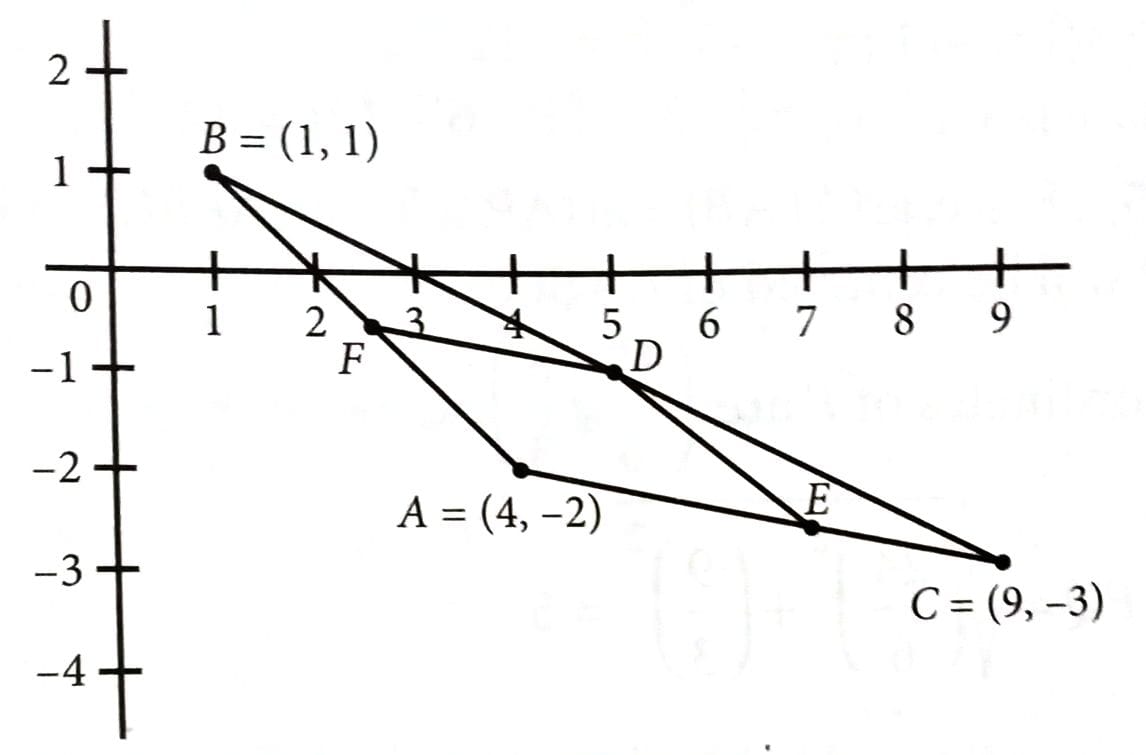
Let A(4, –2), B(1, 1) and C(9, –3) be the vertices of a triangle ABC. Then the maximum area of the parallelogram AFDE, formed with vertices D, E and F on the sides BC, CA and AB of the triangle ABC respectively, is __________..         [2025]


(3)

The maximum area of a parallelogram inscribed in a triangle is half the area of the triangle.

Now, Area of ABC=12|4(1(3))+1(3(2))+9(21)|

                                             =12|16127|=6 sq. units

   Area of parallelogram AFDE = 3 sq. units.


Q 13 :

Let A(6, 8), B(10 cos α, – 10 sin α) and C(–10 sin α, 10 cos α), be the vertices of a triangle. If L(a, 9) and G(h, k) be its orthocenter and centroid respectively, then (5a – 3h + 6k + 100 sin 2α) is equal to __________.          [2025]


(145)

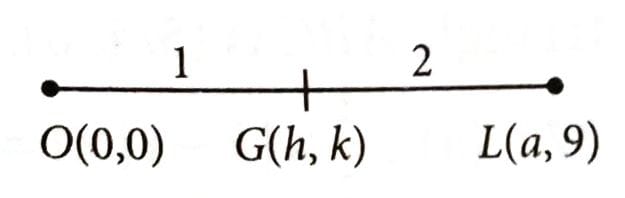
We can observe that all the three points A, B, C lie on the circle x2+y2=100, so circumcentre is (0, 0). Since, centroid divides the line joining orthocentre and circumcentre in the ratio 2 : 1, then

a+03=h  a=3h

and 9+03=k  k=3

Also, 6+10cosα10sinα3=h

 10(cosαsinα)=3h6          ... (i)

and 8+10cosα10sinα3=k          

 10(cosαsinα)=3k8=98=1             ... (ii)

On squaring, 100 (1 – sin 2α) = 1  100 sin 2α = 99

From (i) and (ii), we get h=73

Now, 5a – 3h + 6k +100 sin 2α

= 15h – 3h + 6k + 100 sin 2α12×73+18+99 = 145.


Q 14 :

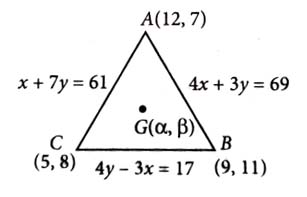
Let G(α,β) be the circumcentre of the triangle formed by the lines 4x+3y=69,4y-3x=17 and x+7y=61. Then (α-β)2+α+β is equal to      [2023]

  • 16


  • 17


  • 18


  • 15


(2)

Let ABC be a triangle with

AB:4x+3y=69  (i)

BC:4y-3x=17  (ii)

AC:x+7y=61  (iii)

Solving (i) and (ii), we get   B(9,11)

Solving (ii) and (iii), we get  C(5,8)

Solving (i) and (iii), we get  A(12,7)

Now,  AG2=GB2

(12-α)2+(7-β)2=(9-α)2+(11-β)2

 8β-6α=9    ...(iv)

Similarly, GC2=GB2

 (5-α)2+(8-β)2=(9-α)2+(11-β)2

8α+6β=113  (v)

Now solving (iv) and (v), we get  

        α=172, β=152

   (α-β)2+α+β=17


Q 15 :

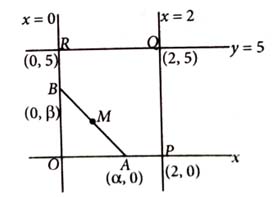
Let R be the rectangle given by the lines x=0,x=2,y=0 and y=5. Let A(α,0) and B(0,β),α[0,2] and β[0,5], be such that the line segment AB divides the area of the rectangle R in the ratio 4 : 1. Then, the midpoint of AB lies on a         [2023]

  • parabola


  • hyperbola


  • straight line


  • circle


(2)

ar(APQRB)ar(OAB)=41

Let M be the mid-point of AB.

M(h,k)(α2,β2)

10-12αβ12αβ=4   52αβ=10

  αβ=4

  (2h)(2k)=4

  Locus of M is xy=1, which is a hyperbola.


Q 16 :

If the point (α,733) lies on the curve traced by the mid-points of the line segments of the lines xcosθ+ysinθ=7,θ(0,π2) between the coordinate axes, then α is equal to            [2023]

  • - 7


  • -73


  • 73


  • 7


(4)

Given line is xcosθ+ysinθ=7

x-intercept=7cosθ, y-intercept=7sinθ

Let locus of intercept be (h,k).

(h,k)=(72cosθ, 72sinθ)

h=72cosθ, k=72sinθ

α=72cosθ, 733=72sinθ

cosθ=72α, sinθ=32

cos2θ+sin2θ=1

494α2+34=1 494α2=14

     α2=49

   α=7      (As θ(0,π2))