

Q 1 :

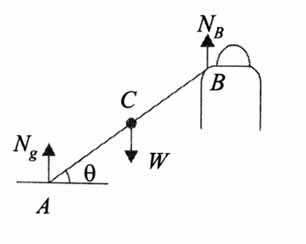
A heavy iron bar, of weight W is having its one end on the ground and the other on the shoulder of a person. The bar makes an angle θ with the horizontal. The weight experienced by the person is _____.      [2024]

  • W2


  • W


  • W cos θ


  • W sin θ


(1)

NB=net reaction force by shoulder.

Balancing torque about point of contact (A) on ground:

W(L2cosθ)=NB(Lcosθ)

⇒NB=W2


Q 2 :

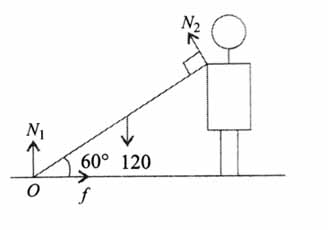
A heavy iron bar of weight 12 kg is having its one end on the ground and the other on the shoulder of a man. The rod makes an angle 60° with the horizontal, the weight experienced by the man is _____.    [2024]

  • 6 kg


  • 12 kg


  • 3 kg


  • 63 kg


(3)

Torque about O=0

120(L2cos60°)-N2L=0

N2=30N


Q 3 :

The torque due to the force (2i^+j^+2k^) about the origin, acting on a particle whose position vector is (i^+j^+k^), would be          [2025]

  • (i^–j^+k^)


  • (i^+k^)


  • (i^–k^)


  • (j^–k^)


(3)

τ→=r→×F→

τ→=|i^j^k^111212|

τ→=i^(2–1)–j^[0]+k^(1–2)=i^–k^


Q 4 :

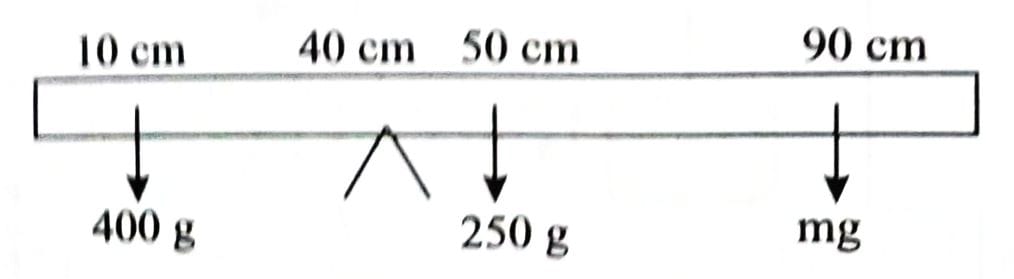
A uniform rod of mass 250 g having length 100 cm is balanced on a sharp edge at 40 cm mark. A mass of 400 g is suspended at 10 cm mark. To maintain the balance of the rod, the mass to be suspended at 90 cm mark, is          [2025]

  • 300 g


  • 190 g


  • 200 g


  • 290 g


(2)

τNet=0 ⇒ (400 g×30)=(250 g×10)+(m g×50)

m=12000–250050=950050

m=190 g


Q 5 :

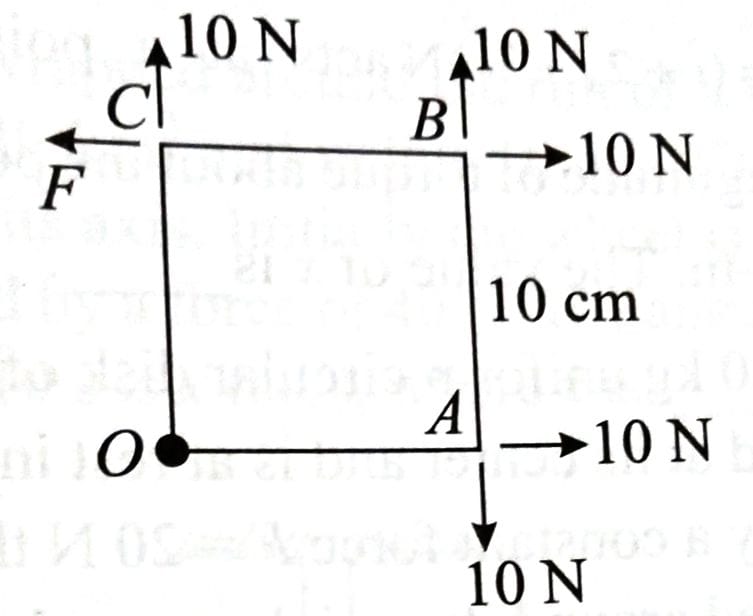
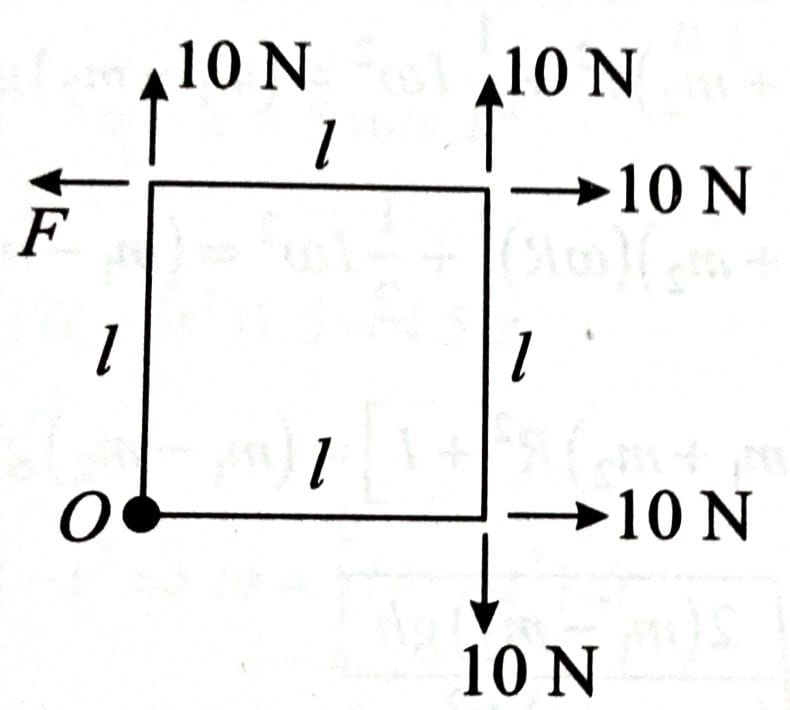
A square Lamina OABC of length 10 cm is pivoted at 'O'. Forces act at Lamina as shown in figure. If Lamina remains stationary, then the magnitude of F is:          [2025]

  • 20 N


  • 0 (zero)


  • 10 N


  • 102 N


(3)

Since the Lamina is equilibrium.

The net torque about O = 0

–Fl+10l–10l+10l=0 ⇒ F=10 N


Q 6 :

Which of the following are correct expressions for torque acting on a body?

A. τ→=r→×L→                               B. τ→=ddt(r→×p→)

C. τ→=r→×dp→dt                            D. τ→=Iα→

E. τ→=r→×F→

(r→ = position vector; p→ = linear momentum; L→ = angular momentum;

α→ = angular acceleration; I = moment of inertia; F→ = force; t = time)

Choose the correct answer from the options given below:          [2025]

  • B, D and E Only


  • C and D Only


  • B, C, D and E Only


  • A, B, D and E Only


(3)

τ→=r→×L→                          wrong

τ→=ddt(r→×p→)               correct

τ→=r→×dp→dt=r→×F→       correct

τ→=Iα→                                  correct

τ→=r→×F→                            correct


Q 7 :

The coordinates of a particle with respect to origin in a given reference frame is (1, 1, 1) meters. If a force of F→=i^–j^+k^ acts on the particle, then the magnitude of torque (with respect to origin) in z-direction is __________.          [2025]


(2)

τ→=r→×F→=|i^j^k^1111–11|

τ→=k^(–1–1)=–2k^ ⇒ |τ→|=2 Nm


Q 8 :

An object of mass 8 kg is hanging from one end of a uniform rod CD of mass 2 kg and length 1 m pivoted at its end C on a vertical wall as shown in fig. It is supported by a cable AB such that the system is in equilibrium. The tension in the cable is (Take g = 10 m/s2)               [2023]

  • 240 N


  • 30 N


  • 300 N


  • 90 N


(3)

System is in rotary equilibrium, ∑τ=0. Taking torques about 'C'

Tsin30°×60=20×50+80×100

T×30=1000+8000=9000⇒T=300 N


Q 9 :

A force of -Pk^ acts on the origin of the coordinate system. The torque about the point (2, - 3) is P(ai^+bj^), the ratio of ab is x2. The value of x is _____ .        [2023]


(3)

τ=r→×F→

Where r→=-2i^+3j^

τ=(-2i^+3j^)×(-Pk^)=P(-2j^-3i^)=P(-3i^-2j^)

⇒So a=-3, b=-2

ab=32