

Q 1 :

If the radius of earth is reduced to three-fourth of its present value without change in its mass then value of duration of the day of earth will be _______ hours 30 minutes.         [2024]


(13)     By angular momentum conservation, I1ω1=I2ω2

            25mr2·ω=25m34r2·ω'ω'=169ω

            2πT'=169×2πTT'=9T16=916×24hours=9×32hours

            T'=272hr=13 hr 30 mins


Q 2 :

A body of mass 5 kg moving with a uniform speed 32ms-1 in X - Y plane along the line y=x+4. The angular momentum of the particle about the origin will be _____ kgm2 s-1.                      [2024]


(60)      y-x-4=0

             d1 is perpendicular distance of given line from origin.

            d1=|-412+12|22m

            So, |L|=mvd1

                  =5×32×22kg m2/s=60kg m2/s


Q 3 :

Two discs of moment of inertia I1=4 kgm2 and I2=2 kgm2 about their central axes and normal to their planes, rotating with angular speeds 10 rad/s and 4 rad/s respectively are brought into contact face to face with their axes of rotation coincident. The loss in kinetic energy of the system in the process is ________ J.                  [2024]


(24)        Here angular momentum will remain conserve

               L=Iω

              Li=Lf

             4×10+2×4=(6)ω

              48=6ω

              ω=8rad/sec

              ΔKE=KEf-KEi

             ΔK=12(6)(8)2-[(124×102)+(12(2)×(4)2)]

            ΔK=192-216

            ΔK=-24J


Q 4 :

A uniform rod AB of mass 2 kg and length 30 cm at rest on a smooth horizontal surface. An impulse of force 0.2 Ns is applied to end B. The time taken by the rod to turn through at right angles will be πxs, where x= _____________ .                   [2024]


(8)


Q 5 :

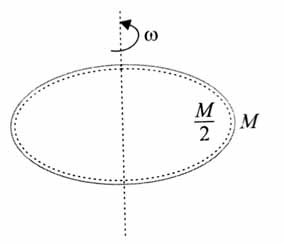
A thin circular disc of mass M and radius R is rotating in a horizontal plane about an axis passing through its centre and perpendicular to its plane with angular velocity ω. If another disc of the same dimensions but of mass M/2 is placed gently on the first disc co-axially, then the new angular velocity of the system is _____.           [2024]

  • 45ω


  • 23ω


  • 54ω


  • 32ω


(2)


Q 6 :

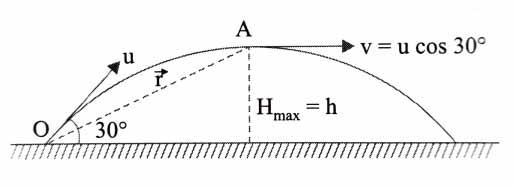
A particle of mass m projected with a velocity 'u' making an angle of 30° with the horizontal. The magnitude of angular momentum of the projectile about the point of projection when the particle is at its maximum height h is _____.          [2024]

  • 316mu3g


  • 32mu2g


  • mu32g


  • zero


(1)

Velocity of particle at maximum height

v=ucos30°=u32

Maximum height, h=u2sin230°2g=u28g

Magnitude of angular momentum

|L|=hmv

       =(u28g)m(u32)=3mu316g


Q 7 :

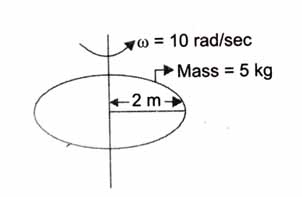
Consider a disc of mass 5 kg, radius 2 m, rotating with angular velocity of 10 rad/s about an axis perpendicular to the plane of rotation. An identical disc is kept gently over the rotating disc along the same axis. The energy dissipated so that both the discs continue to rotate together without slipping is _____ J.             [2024]


(250)

Net torque about axis of rotation is zero

Li=LfIiωi=Ifωf

(5×222)×10=(10×222)ωf

5=ωf

ΔE=Ei-Ef=12Iiωi2-12Ifωf2

            =12(5×222)×102-12(10×222)×52

             =500-250=250 J


Q 8 :

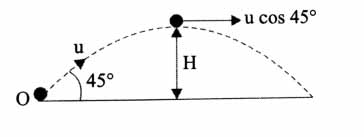
A body of mass 'm' is projected with a speed 'u' making an angle of 45° with the ground. The angular momentum of the body about the point of projection, at the highest point, is expressed as 2mu3Xg. The value of ‘X’ is _____.         [2024]


(8)

L=mucosθu2sin2θ2g=mu3142gx=8


Q 9 :

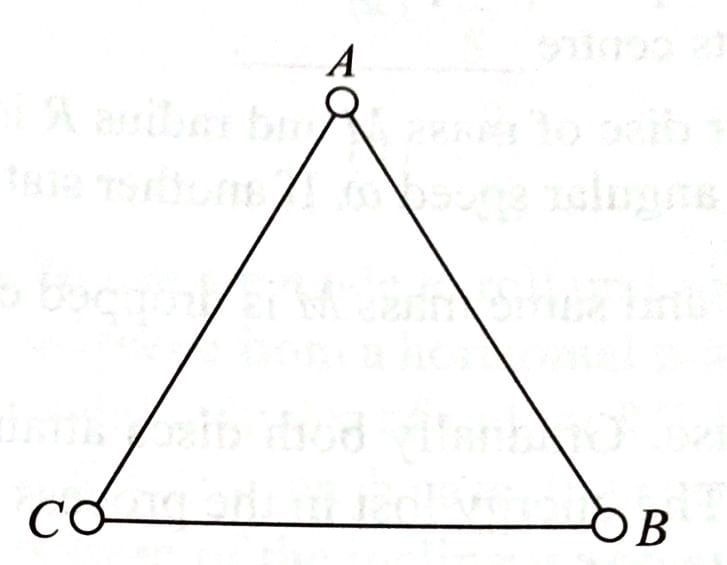
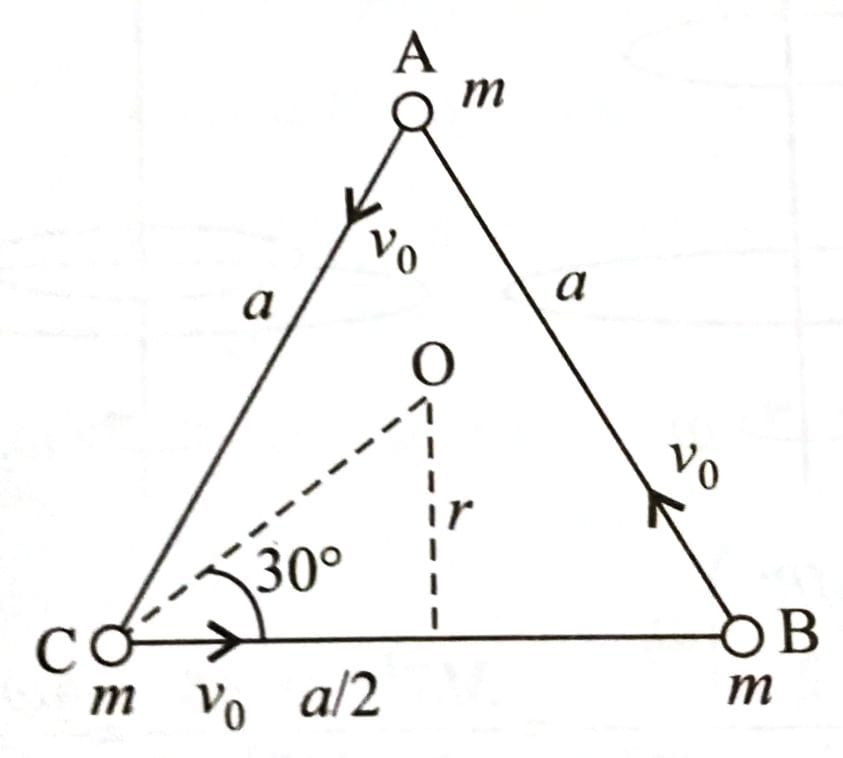
Three equal masses m are kept at vertices (A, B, C) of an equilateral triangle of side a in free space. At t = 0, they are given an initial velocity VA=V0AC,VB=V0BA and VC=V0CB. Here AC,CB and BA ware unit vectors along the edges of the triangle. If the three mases interact gravitationally, then the magnitude of the net angular momentum of the system at the point of collision is :         [2025]

  • 12amV0


  • 3amV0


  • 32amV0


  • 32amV0


(3)

tan 30°=2ra=13  r=a23

Net angular momentum about point O

L=(mvr)×3=mv0a23×3=32mv0a


Q 10 :

An object of mass 'm' is projected from origin in a vertical xy-plane at an angle 45° with the x-axis with an initial velocity v0. The magnitude and direction of the angular momentum of the object with respect to origin, when it reaches at the maximum height, will be [g is acceleration due to gravity]         [2025]

  • mv0322g along negative z-axis


  • mv0322g along positive z-axis


  • mv0342g along positive z-axis


  • mv0342g along negative z-axis


(4)

At highest point

The speed is vx=v0cos 45°  vx=v02

H=(v02)22g=v024g

So, angular momentum about origin is

L=mvx·H

 L=m×v02×v024g

 L=mv0342g     (along negative z-axis)


Q 11 :

Let L and P represent the angular momentum and linear momentum respectively of a particle of mass 'm' having position vector r=a(i^ cos ωt+j^ sin ωt). The direction of force is         [2025]

  • Opposite to the direction of r


  • Opposite to the direction of L


  • Opposite to the direction of P


  • Opposite to the direction of L×P


(1)

r=a cos ωti^+a sin ωtj^

v=drdt=aω sin ωti^+aω cos ωtj^

a=dvdt=aω2cos ωti^aω2sin ωtj^

a=ω2(a cos ωti^+a sin ωtj^)=ω2r

a is antiparallel to r

Hence, F is opposite to the direction of r


Q 12 :

The position vectors of two 1 kg particles, (A) and (B), are given by rA=(α1t2i^+α2j^+α3tk^)m and rB=(β1ti^+β2t2j^+β3t^k^)m, respectively; (α1=1 m/s2, α2=3n m/s, α3=2 m/s, β1=2 m/s), (β2=1 m/s2, β3=4p m/s), where t is time, n and p are constants, At t = 1 s, |VA|=|VB| and velocities VA and VB of the particles are orthogonal to each other. At t = 1 s, the magnitude of angular momentum of particle (A) with respect to the position of particle (B) is Lkgm2s1. The value of L is _________.          [2025]


(90)

rA=(α1t2i^+α2j^+α3tk^)m

 drAdt=VA=(2ti^+3nj^+2k^)

rB=(β1ti^+β2t2j^+β3t^k^)

 drBdt=VB=(2i^2j^+4pk^)

At t = 1 s, VA·VB=0

4 – 6n + 8p = 0

 3n=2+4p          ... (i)

At t = 1 s, |VA|=|VB|

4+9n2+4=4+4+16p2

From (i) and (ii), p=14  n=13

The angular momentum of particle (A) with respect to the position of particle (B)

|L|=mA(rA/B×VA)

rA/B=(α1β1)i^+(α2β2)j^+(α3β3)k^

               =(12)i^+(1+1)j^+3k^

L=|i^j^k^123212|=i^+8j^5k^

|L|=1+64+25=90


Q 13 :

A solid sphere with uniform density and radius R is rotating initially with constant angular velocity (ω1) about its diameter. After sometime during the rotation its starts loosing mass at a uniform rate, with no change in its shape. The angular velocity of the sphere when its radius become R/2 is xω1. The value of x is _________.           [2025]


(32)

When the sphere is of radius R, its mass is M, when radius is reduced to R2, mass will reduced to M8

Angular momentum will remain conserve.

L1=L2  I1ω1=I2ω2

(25MR2)ω1=(25(M8)(R2)2)ω2

ω2=32ω1 value of x is 32.


Q 14 :

A particle of mass 100 g is projected at time t=0 with a speed 20 ms-1 at an angle 45° to the horizontal as given in the figure. The magnitude of the angular momentum of the particle about the starting point at time t=2 s is found to be Kkgm2/s. The value of K is _________ . (Take g=10 ms-2)             [2023]


(800)

Use ΔL=0tτdt

       L0=02mg(vxt)dt

           =mgvxt22=(0.1)(10)(102)222=202

            =800 kg m2/s


Q 15 :

A solid sphere of mass 500 g and radius 5 cm is rotated about one of its diameter with angular speed of 10 rad s-1. If the moment of inertia of the sphere about its tangent is x×10-2 times its angular momentum about the diameter, then the value of x will be ________.          [2023]


(35)

m=500 g=0.5 kg

R=5 cm

ω=10 rad/s

Moment of inertia about tangent=IT

IT=x×10-2L

75mR2=x×10-225mR2ω

72ω=x×10-2=72×10


Q 16 :

A circular plate is rotating in a horizontal plane about an axis passing through its center and perpendicular to the plate, with an angular velocity ω. A person sits at the center having two dumbbells in his hands. When he stretches out his hands, the moment of inertia of the system becomes triple. If E be the initial kinetic energy of the system, then the final kinetic energy will be Ex. The value of x is _______.                 [2023]


(3)

KE=L22IKEfinalKEinitial=IinitialIfinal  KEfinalE=13

  KEfinal=E3


Q 17 :

Two small balls with masses m and 2m are attached to both ends of a rigid rod of length d and negligible mass. If angular momentum of this system is L about an axis (A) passing through its centre of mass and perpendicular to the rod then angular velocity of the system about A is:            [2026]

  • 2Lmd2


  • 32Lmd2


  • 43Lmd2


  • 2L5md2


(2)

L=Iω  and  ω=LI

ω=Lm(2d3)2+2m(d3)2=L49md2+29md2=L6md29

ω=3L2md2


Q 18 :

Two cars A and B each of mass 103kg are moving on parallel tracks separated by a distance of 10 m, in same direction with speeds 72 km/h and 36 km/h. The magnitude of angular momentum of car A with respect to car B is ______ J·s.   [2026]

  • 3.6×10⁵


  • 105


  • 2×10⁵


  • 3×10⁵


(2)

L=m.Vrelr

   =1000×(36×518)×10

   =105 kg m2/s