

Q 1 :

Match List I with List II.                                        [2024]

  List I   List II
A. Down’s syndrome I. 11?? chromosome
B. α-Thalassemia II. ‘X’ chromosome
C. β-Thalassemia III. 21?? chromosome
D. Klinefelter’s syndrome IV. 16?? chromosome


Choose the correct answer from the options given below.

  • A-I, B-II, C-III, D-IV


  • A-II, B-III, C-IV, D-I


  • A-III, B-IV, C-I, D-II


  • A-IV, B-I, C-II, D-III


(3)


Q 2 :

In which disorder change of single base pair in the gene for beta globin chain results in change of glutamic acid to valine?              [2023]

  • Thalassemia


  • Sickle cell anemia


  • Haemophilia


  • Phenylketonuria


(2)

Sickle cell anemia is caused by the substitution of Glutamic acid (Glu) by Valine (Val) at the sixth position of the beta globin chain of the haemoglobin molecule. The substitution of amino acid in the globin protein results due to the single base substitution at the sixth codon of the beta globin gene from GAG to GUG.


Q 3 :

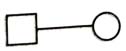
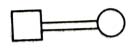
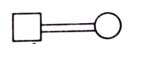
Which one of the following symbols represents mating between relatives in human pedigree analysis?             [2023]

  •  

  •  

  •  

  •  

(4)

In pedigree analysis,  symbol shows consanguineous mating, i.e., mating between relatives.


Q 4 :

Which of the following statements are correct about Klinefelter’s Syndrome?                                    [2023]
A. This disorder was first described by Langdon Down (1866).
B. Such an individual has overall masculine development. However, the feminine development is also expressed.
C. The affected individual is short statured.
D. Physical, psychomotor and mental development is retarded.
E. Such individuals are sterile.

Choose the correct answer from the options given below:

  • B and E only


  • A and E only


  • A and B only


  • C and D only


(1)

Klinefelter’s syndrome is a genetic disorder caused due to the presence of an additional copy of X-chromosome resulting into a karyotype of 47, XXY. Such an individual has overall masculine development, however the feminine development (development of breast i.e., gynaecomastia) is also expressed. Such individuals are sterile.


Q 5 :

Broad palm with single palm crease is visible in a person suffering from             [2023]

  • Klinefelter’s syndrome


  • Thalassemia


  • Down’s syndrome


  • Turner’s syndrome


(3)

Broad palm with characteristic palm crease, small round head, furrowed tongue and retarded mental development are characteristics of Down’s syndrome. It is a genetic disorder due to the presence of an additional copy of chromosome number 21 (trisomy of 21).


Q 6 :

Select the correct match.                [2020]

  • Haemophilia – Y linked


  • Phenylketonuria – Autosomal dominant trait


  • Sickle cell anaemia – Autosomal recessive trait, chromosome -11


  • Thalassemia – X linked


(3)


Q 7 :

What is the genetic disorder in which an individual has an overall masculine development, gynaecomastia and is sterile?       [2019]

  • Down’s syndrome


  • Turner’s syndrome


  • Klinefelter’s syndrome


  • Edward syndrome


(3)

Klinefelter’s syndrome occurs by the union of an abnormal XX egg and a normal Y sperm or a normal X egg and abnormal XY sperm. The individual has 47 chromosomes (44 + XXY). Such persons are sterile males with undeveloped testes, mental retardation, sparse body hair, long limbs and with some female characteristics such as enlarged breast, i.e., gynaecomastia.


Q 8 :

A woman has an X-linked condition on one of her X chromosomes. This chromosome can be inherited by             [2018]

  • only daughters


  • only sons


  • only grandchildren


  • both sons and daughters


(4)

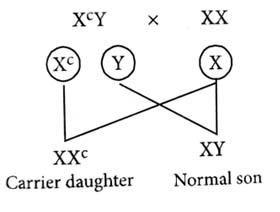
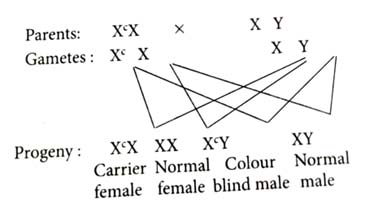
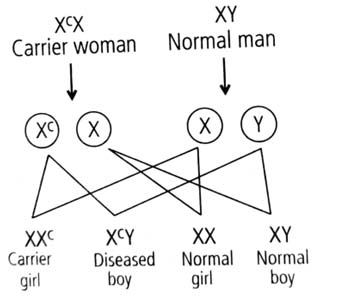
Woman acts as a carrier when she has the X-linked condition on one of her X-chromosomes. Both son and daughter inherit X-chromosome from mother. Hence, one of the two daughters will be carrier and one of the two sons will be diseased. It can be explained by the given cross:

where XC is the X-chromosome carrying the gene for the condition.


Q 9 :

Thalassemia and sickle cell anaemia are caused due to a problem in globin molecule synthesis. Select the correct statement.      [2017]

  • Both are due to a quantitative defect in globin chain synthesis.


  • Thalassemia is due to less synthesis of globin molecules.


  • Sickle cell anaemia is due to a quantitative problem of globin molecules.


  • Both are due to a qualitative defect in globin chain synthesis.


(2)

Sickle cell anaemia is caused due to point mutation in which at the 6th position of beta globin chain, glutamic acid is replaced by valine. Thus, it is a qualitative defect in functioning of globin molecules.
Thalassemia is caused due to either mutation or deletion which ultimately results in reduced rate of synthesis of one of the globin chains that make up haemoglobin. Hence, it is a quantitative defect in functioning of globin molecules.


Q 10 :

A disease caused by an autosomal primary non-disjunction is            [2017]

  • Klinefelter’s syndrome


  • Turner’s syndrome


  • Sickle cell anaemia


  • Down’s syndrome


(4)

Down’s syndrome is an autosomal aneuploidy, caused by the presence of an extra-chromosome number 21. Both the chromosomes of the pair 21 pass into a single egg due to non disjunction during oogenesis.


Q 11 :

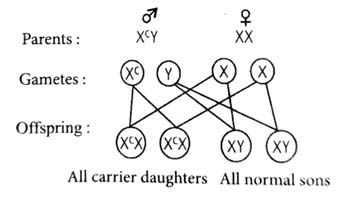
If a colour-blind man marries a woman who is homozygous for normal colour vision, the probability of their son being colour-blind is           [2016]

  • 0


  • 0.5


  • 0.75


  • 1


(1)

Genotype of colour blind man – XcY
Genotype of woman homozygous – XX
for normal woman

Hence, there is zero (0) probability of their son to be colour-blind.


Q 12 :

Pick out the correct statements.                                           [2016]
(1) Haemophilia is a sex-linked recessive disease.
(2) Down’s syndrome is due to aneuploidy.
(3) Phenylketonuria is an autosomal recessive gene disorder.
(4) Sickle cell anaemia is an X-linked recessive gene disorder.

  • (1), (3) and (4) are correct


  • (1), (2) and (3) are correct


  • (1) and (4) are correct


  • (2) and (4) are correct


(2)

Sickle-cell anaemia is an autosomal recessive genetic disorder. It can be transmitted from parents to the offspring when both the partners are carriers of the gene (or heterozygous).


Q 13 :

Which of the following most appropriately describes haemophilia?                [2016]

  • Chromosomal disorder


  • Dominant gene disorder


  • Recessive gene disorder


  • X-linked recessive gene disorder


(4)

Haemophilia is a sex-linked disease. It occurs due to the presence of a recessive sex linked gene h, which is carried by X-chromosome.


Q 14 :

A colour blind man marries a woman with normal sight who has no history of colour blindness in her family. What is the probability of their grandson being colour blind?   [2015]

  • Nil


  • 0.25


  • 0.5


  • 1


(2)

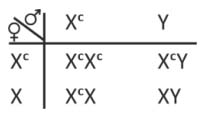
When a colour blind man (XcY) marries a normal woman (XX), all of their daughters are carriers and all of their sons are normal, as shown in following figure:

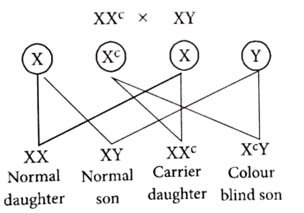
When the carrier daughter (XXc) is married to a normal man, the probability of their son being colour blind is 0.25, as shown in following figure:

From above crosses, it is clear that the probability of occurrence of colour blindness in the grandson of a colour blind man and a normal woman is 0.25.


Q 15 :

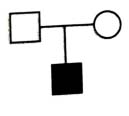
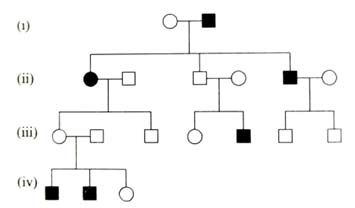
In the following human pedigree, the filled symbols represent the affected individuals. Identify the type of given pedigree.           [2015]

  • Autosomal recessive


  • X-linked dominant


  • Autosomal dominant


  • X-linked recessive


(1)

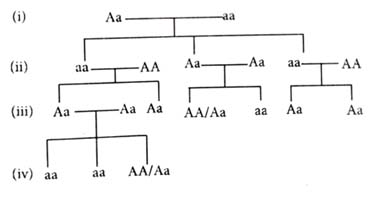
Autosomal recessive traits are the traits which are caused by recessive autosomal genes when present in homozygous condition. The given pedigree can be explained as:

As the trait appears only in homozygous recessive individuals (aa), therefore it is an autosomal recessive trait.


Q 16 :

An abnormal human baby with ‘XXX’ sex chromosomes was born due to             [2015]

  • fusion of two ova and one sperm


  • fusion of two sperms and one ovum


  • formation of abnormal sperms in the father


  • formation of abnormal ova in the mother


(4)

The abnormal baby has an extra X chromosome, thus it must have been produced by fusion of abnormal XX ovum with a normal X sperm. Abnormal XX sperm is not possible because, males have XY genotype, and if produce abnormal sperms, then XY sperms and O sperms will be produced. If fusion of multiple gametes have occurred (either two ova with one sperm or two sperms with one ovum), then the human baby will have triploid genotype not the trisomy of sex chromosomes.


Q 17 :

A man whose father was colour blind marries a woman who had a colour blind mother and normal father. What percentage of male children of this couple will be colour blind?    [2014]

  • 25%


  • 0%


  • 50%


  • 75%


(3)

It is given that the man had colour blind father, i.e., man's genotype would be XY.
Now, the woman had a colourblind mother and normal father, thus her genotype would be XcX. A cross between them can be represented as below.

Therefore, 50% of male children of this couple will be colour blind.


Q 18 :

A human female with Turner’s syndrome                  [2014]

  • has 45 chromosomes with XO


  • has one additional X chromosome


  • exhibits male characters


  • is able to produce children with normal husband.


(1)

A human female with Turner’s syndrome has single sex chromosome i.e., 44 + X0 (45). Such females are called sterile females with rudimentary ovaries. Other associated phenotypes of this condition are short stature, webbed-neck, broad chest, lack of secondary sexual characteristics and sterility. Thus, any imbalance in the copies of the sex chromosomes may disrupt the genetic information necessary for normal sexual development.


Q 19 :

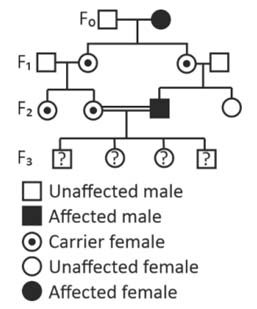
With the help of given pedigree, find out the probability for the birth of a child having no disease and being a carrier (has the disease mutation in one allele of the gene) in F3 generation.              [2025]

  • 1/4


  • 1/2


  • 1/8


  • Zero


(1)

As in the F1 generation the carrier female and non-affected (normal, not carrier) had affected male child that means the genetic disorder is sex-linked recessive.

The consanguineous mating between female (XcX) and male (XcY)

Out of 4 child only one is carrier i.e. 14.