

Q 1 :

Mercury is filled in a tube of radius 2 cm up to a height of 30 cm. The force exerted by mercury on the bottom of the tube is ________ N.

(Given, atmospheric pressure=105 Nm-2,density of mercury 1.36×10⁴kg m-3,g=10 ms-2,π=227)                       [2024]


(177)       P=P0+ρgh

               F=P0A+ρghA=227×4×10-4(105+1.36×104×10×30100)

              F=887×10-4(105+0.408×10⁵)

               =887×10×1.408=177


Q 2 :

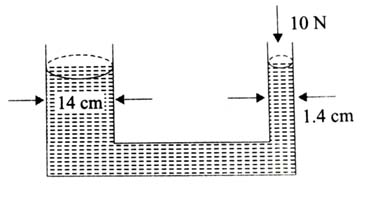
A hydraulic press containing water has two arms with diameters as mentioned in the figure. A force of 10 N is applied on the surface of water in the thinner arm. The force required to be applied on the surface of water in the thicker arm to maintain equilibrium of water is _________ N.          [2024]


(1000)

F1A1=F2A2

F1π(7)2=10π(0.7)2F1=1000 N


Q 3 :

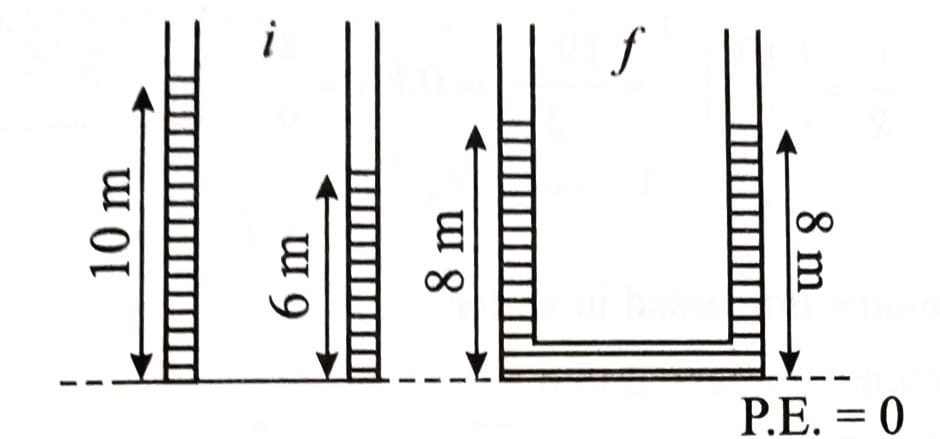
Two cylindrical vessels of equal cross-sectional area of 2 m2 contain water upto height 10 m and 6 m, respectively. If the vessels are connected at their bottom, then the work done by the force of gravity is: (Density of water is 103 kg/m3 and g=10 m/s2)          [2025]

  • 1×10⁵ J


  • 4×10⁴ J


  • 6×10⁴ J


  • 8×10⁴ J


(4)

Uinitial=(ρA×10)g×5+(ρA6)g×3

Uinitial=ρAg(50+18)=68ρAg

Ufinal=(ρA×16)g×4=(ρAg)×64

W=U=68ρAg64ρAg=4ρAg

W=4×1000×2×10=8×10⁴ J


Q 4 :

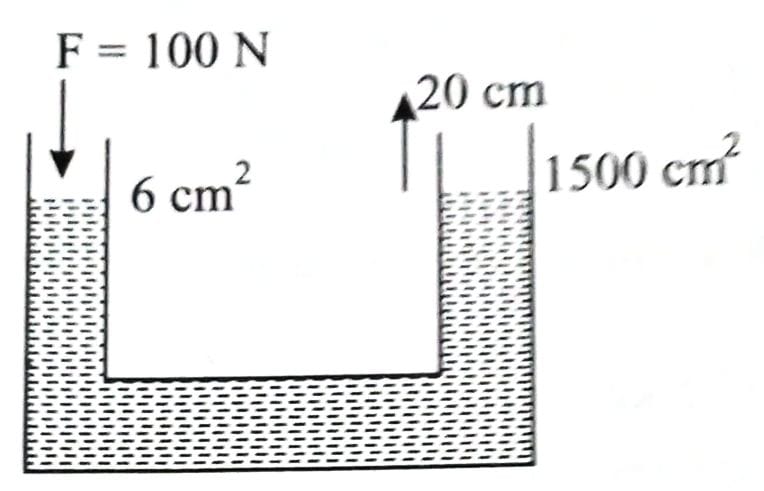
In a hydraulic lift, the surface area of the input piston is 6 cm2 and that of the output piston is 1500 cm2. If 100 N force is applied to the input piston to raise the output piston by 20 cm, then the work done is ______ kJ.          [2025]


(5)

F1A1=F2A2, 1006=F1500, F=503×1500

F=50×500=25×103 N

W=F.S=25×103×20100=5×103=5 kJ


Q 5 :

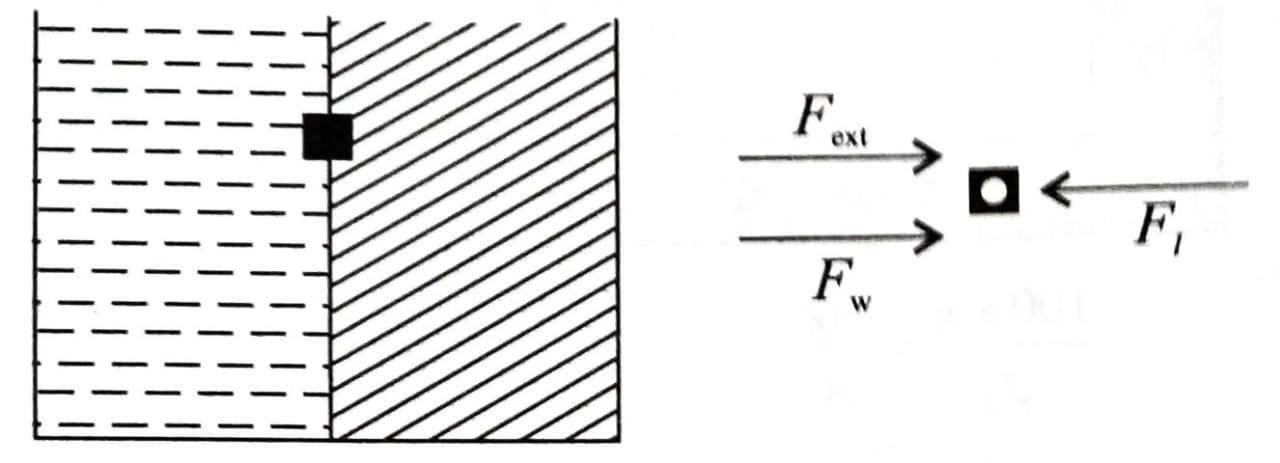
A vessel wih square cross-section and height of 6 m is vertically partitioned. A small window of 100 cm2 with hinged door is fitted at a depth of 3 m in the partition wall. One part of the vessel is filled completely with water and the other side is filled with the liquid having density 1.5×10³ kg/m3. What force one needs to apply on the hinged door so that it does not get opened? (Acceleration due to gravity = 10 m/s2)          [2025]


(150)

in equilibrium

Fext+Fw=Fl

 Fext=FlFw

                     =(P0+ρlgh)A(P0+ρwgh)A

                      =(ρlρw)ghA

                      =(15001000)×10×3×(100×104)

                      = 150 N.


Q 6 :

Given below are two statements; one is labelled as Assertion A and the other is labelled as Reason R.

Assertion A: When you squeeze one end of a tube to get toothpaste out from the other end, Pascal’s principle is observed.

Reason R: A change in the pressure applied to an enclosed incompressible fluid is transmitted undiminished to every portion of the fluid and to the walls of its container.

In the light of the above statements, choose the most appropriate answer from the options given below                  [2023]

  • A is not correct but R is correct


  • A is correct but R is not correct


  • Both A and R are correct and R is the correct explanation of A


  • Both A and R are correct but R is NOT the correct explanation of A


(3)

(R) is the statement of Pascal’s principle and which explains the assertion (S).


Q 7 :

A hydraulic automobile lift is designed to lift vehicles of mass 5000 kg. The area of cross section of the cylinder carrying the load is 250 cm2. The maximum pressure the smaller piston would have to bear is [Assume g=10 m/s2]             [2023]

  • 2×10+5 Pa


  • 200×10+6 Pa


  • 20×10+6 Pa


  • 2×10+6 Pa


(4)

Force=mg=5000g

Area of cross section=250 cm2=250×10-4 m2

Maximum pressure=ForceArea of cross section

                                       =5000g250×10-4=20×g10-4=2×10⁶Pa


Q 8 :

Given below are two statements:                                 [2023]

Statement I: Pressure in a reservoir of water is same at all points at the same level of water.

Statement II: The pressure applied to enclosed water is transmitted in all directions equally.

In the light of the above statements, choose the correct answer from the options given below:

  • Statement I is false but Statement II is true


  • Both Statement I and Statement II are true


  • Statement I is true but Statement II is false


  • Both Statement I and Statement II are false


(2)

Pressure in a static liquid will be same at each point on the same horizontal level.

 P=Patm+ρgh

As per Pascal's law, the same pressure applied to enclosed water is transmitted equally in all directions.